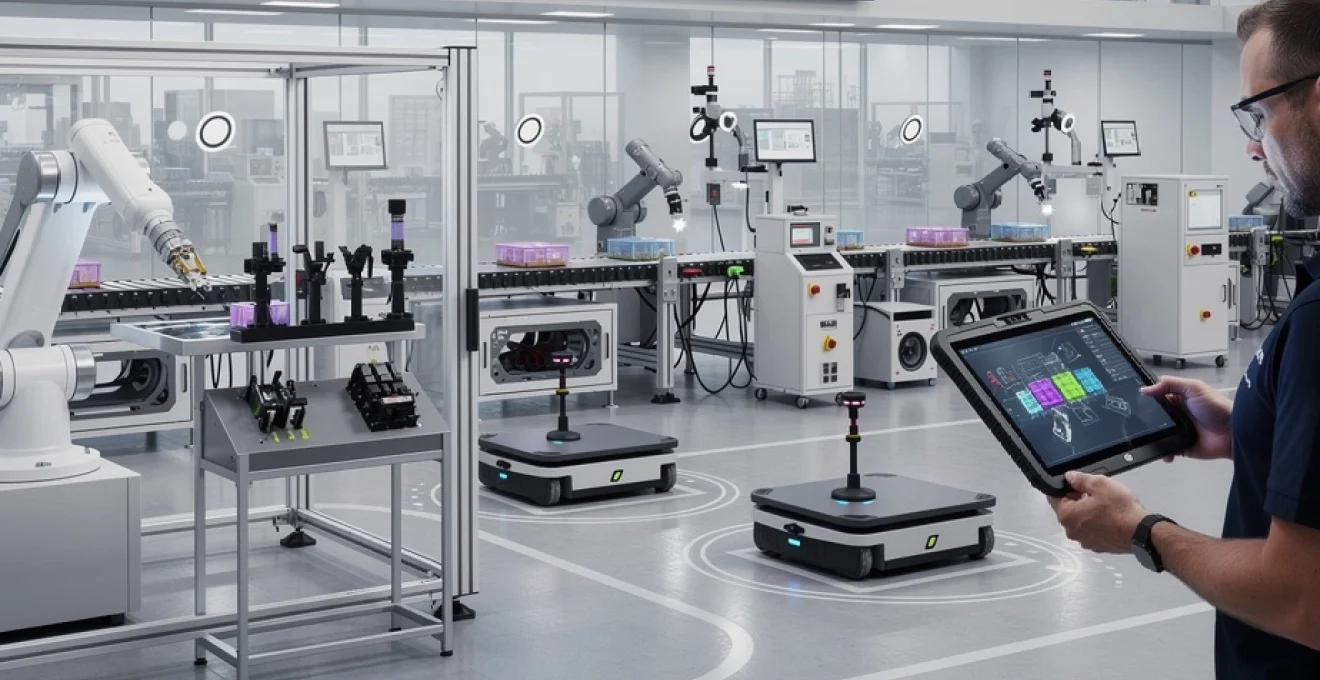
# Why modular automation is key to flexible manufacturing strategies
Manufacturing has entered an era where adaptability determines competitive advantage. Consumer demands shift rapidly, product lifecycles shorten, and market volatility requires production systems that can pivot without catastrophic downtime or capital-intensive overhauls. Traditional fixed automation—once the bedrock of mass production efficiency—now struggles to accommodate the dynamic requirements of modern manufacturing environments. Enter modular automation: a paradigm that transforms production lines from inflexible monoliths into reconfigurable ecosystems of standardised, intelligent components. This approach isn’t merely an incremental improvement; it represents a fundamental reimagining of how manufacturing systems should be designed, deployed, and evolved throughout their operational lifespan.
The business case for modular automation extends beyond technical elegance. Companies implementing modular strategies report remarkable improvements in time-to-market for new products, with some automotive manufacturers achieving production line reconfiguration in hours rather than weeks. The financial implications are equally compelling: staged capital investments replace massive upfront expenditures, whilst obsolescence risk diminishes as individual modules can be upgraded independently. For manufacturers navigating Industry 4.0 transformation, modular automation provides the architectural foundation necessary to integrate digital technologies meaningfully rather than superficially. As global supply chains face unprecedented disruption and customisation becomes the new norm, understanding modular automation principles has shifted from strategic advantage to operational necessity.
Modular automation architecture: core components and system integration principles
At the architectural level, modular automation systems fundamentally differ from traditional automation through their commitment to standardisation, encapsulation, and loose coupling. Each module functions as a self-contained unit with clearly defined interfaces, much like LEGO bricks that connect predictably regardless of the overall structure being built. This architecture enables manufacturers to assemble production capabilities from discrete functional blocks—process modules, material handling units, quality inspection stations—without requiring bespoke integration engineering for every configuration change. The economic implications are substantial: engineering hours decrease by 60-80% when proven modules are reused rather than redesigned from scratch.
The foundation of modular automation architecture rests on three pillars: mechanical modularity (standardised mounting interfaces and dimensional coordination), electrical modularity (plug-and-play power and signal connectivity), and software modularity (standardised communication protocols and control logic templates). Leading automation vendors now design equipment with these principles embedded, offering modules that can be physically relocated and digitally reconfigured with minimal specialist intervention. This contrasts sharply with legacy systems where moving a single station might require weeks of mechanical modifications, extensive rewiring, and complete control system reprogramming.
Plug-and-produce interfaces: ISA-88 and PackML communication standards
The ISA-88 standard, originally developed for batch process industries, has evolved into the de facto framework for defining modular automation architectures across manufacturing sectors. ISA-88 establishes a hierarchical model that decomposes production systems into process cells, units, equipment modules, and control modules—each level possessing standardised states and transitions. This common vocabulary enables equipment from different manufacturers to communicate meaningfully, transforming integration from an art into an engineering discipline. When you specify an ISA-88-compliant module, you’re guaranteed it will expose standardised interfaces for commands, status reporting, and operational modes.
PackML (Packaging Machine Language) extends ISA-88 principles specifically for packaging and discrete manufacturing applications. The PackML state model defines seventeen standard operational states—from Idle and Execute to Stopping and Aborting—that any compliant machine must implement. This standardisation dramatically simplifies line integration: when every module speaks the same language regarding operational states, coordinating complex production sequences becomes exponentially simpler. Companies implementing PackML report 70% reductions in commissioning time for multi-vendor production lines, with troubleshooting simplified by consistent state reporting across all equipment.
Decentralised control systems: autonomous module coordination vs centralised PLCs
Traditional manufacturing automation relied heavily on centralised programmable logic controllers (PLCs) that orchestrated every action across entire production lines. This approach created bottlenecks: any change required modifying monolithic control programs, and scalability was limited by the central controller’s processing capacity. Modular automation increasingly favours decentralised control architectures where each module contains its own intelligence
capable of local decision-making. Instead of a single PLC dictating behaviour, each station or skid executes its own control logic and exposes standard functions to the line. Think of it as moving from a single conductor controlling every note to a jazz ensemble where each musician follows a shared score but can react autonomously. This decentralised control dramatically improves flexibility: adding a new module becomes a matter of connecting it to the network and mapping its standard interfaces, rather than rewriting a global program. It also enhances resilience, as a failure in one module does not necessarily compromise the entire production line.
The most effective modular automation strategies typically adopt a hybrid model, combining decentralised intelligence with light-touch supervisory control. High-level production schedules, recipe management, and performance monitoring still reside in MES or line controllers, while motion control, safety, and sequencing stay close to the physical process. Technologies such as distributed I/O, embedded controllers, and safety PLCs integrated at the module level support this architecture. For manufacturers, the key design principle is clear: push as much logic as possible into reusable modules and keep line-level coordination focused on orchestration, not micromanagement.
Mechatronic module design: self-contained actuation and sensing units
Underpinning modular automation is the discipline of mechatronic design, where mechanical, electrical, and software functions are engineered as a single integrated unit. A well-designed mechatronic module is self-contained: it includes actuators, sensors, local control hardware, safety devices, and standardised interfaces for power, communications, and mounting. Instead of treating a conveyor, robot, or dosing skid as a loose collection of parts, you treat it as a productised building block with defined performance characteristics and configuration parameters. This shift enables repeatable engineering, consistent documentation, and faster deployment across multiple sites.
In practice, mechatronic modularity means specifying modules with clear capability envelopes—payload, speed, accuracy, environmental rating—so you can assemble production lines like configuring options on a car. Need to increase throughput? Swap a standard conveyor module for a higher-speed variant without redesigning the entire line. Leading OEMs now ship modules with embedded diagnostics, condition monitoring sensors, and preloaded function blocks so they can be “plugged” into an existing ISA-88 or PackML framework. For you as a manufacturer, the payoff is tangible: engineering reuse, simpler spare parts strategies, and reduced commissioning risk.
OPC UA and asset administration shell (AAS) for interoperability
Interoperability is the glue that makes modular automation workable in real factories, and OPC UA has become the dominant protocol for this layer. OPC UA provides a vendor-neutral, secure, and object-oriented way for modules to expose their data, methods, and events. Instead of writing bespoke drivers for every new piece of equipment, you can browse a module’s OPC UA address space to discover available variables and functions. This is particularly powerful when combined with the PackML or ISA-88 models, as modules can present standardised objects—states, alarms, recipes—over a common protocol. The result is faster integration, easier troubleshooting, and a more future-proof automation layer.
Building on OPC UA, the Asset Administration Shell (AAS) concept from the Industry 4.0 community adds a digital “passport” for each module. An AAS describes not just real-time data, but also nameplate information, documentation, configuration options, and lifecycle status in a machine-readable form. Imagine every mechatronic module arriving with a digital file that tells your engineering tools exactly how to configure, simulate, and maintain it—that is the promise of AAS. As more equipment vendors adopt OPC UA and AAS, you gain the ability to mix and match modules from different suppliers in a single modular production system without locking yourself into proprietary ecosystems.
Reconfigurable production line design using modular robotic cells
Robotic automation is where modular manufacturing becomes most visible on the shop floor. Instead of monolithic robotic cells engineered for a single product variant, modular robotic cells are built from standard robot platforms, grippers, vision systems, and safety components that can be reconfigured as needs change. Cells can be redeployed from assembly to packaging, or from one product family to another, by changing end-effectors, updating recipes, and re-teaching waypoints. For manufacturers pursuing flexible manufacturing strategies, this reconfigurability is what turns capital-intensive robots into long-term, adaptable assets.
Designing these modular robotic cells requires thinking in “functions” rather than fixed layouts. You define modules for tasks such as part feeding, screwdriving, palletising, or inspection, each with clear interfaces and performance data. Cells can then be assembled like process recipes: choose a pick module, a place module, a verification module, and a packaging module. When market conditions shift or a new product is introduced, you recompose functions rather than rebuild hardware. This approach reduces changeover times from weeks to days—or even hours in highly standardised environments.
Collaborative robot integration: universal robots UR series and KUKA LBR iiwa deployment
Collaborative robots (cobots) such as the Universal Robots UR series and the KUKA LBR iiwa are natural fits for modular automation. Their small footprint, integrated safety features, and intuitive programming make them ideal as mobile, reconfigurable modules. A UR10e, for example, can be mounted on a standardised base with quick-connect utilities and rolled between workstations, where it performs tasks ranging from machine tending to light assembly. Similarly, the LBR iiwa’s force-sensing capabilities allow it to handle delicate assembly work in close proximity to human operators, without extensive guarding.
To unlock true flexibility, cobots must be integrated within a broader modular architecture rather than treated as standalone gadgets. This means using standard I/O mapping, PackML state models, and OPC UA interfaces so cobot cells can be orchestrated alongside conveyors, vision systems, and test stands. Successful manufacturers document their cobot cells as reusable templates, with parameterised programs tied to product recipes. When a new variant appears, you adjust parameters and end-effectors instead of rewriting code from scratch. In effect, cobots become “automation apps” that you can redeploy across your factory portfolio.
Quick-change end-effector systems: schunk and zimmer automatic tool changers
End-effectors are the hands of robotic and gantry systems, and quick-change technologies from suppliers like Schunk and Zimmer are critical to modular production. Automatic tool changers allow robots to switch between grippers, suction cups, welding torches, or screwdrivers autonomously, often in seconds. Combined with standardised pneumatic, electrical, and data couplings, these systems turn a single robot into a multi-purpose module capable of executing entire process families. This is especially valuable for mass customisation, where batch sizes shrink and product variants proliferate.
From a design perspective, you achieve maximum benefit when you define a catalogue of standard tools and map them to product features. Instead of designing bespoke grippers for every new product, you configure combinations of existing jaws, fingers, and suction pads. Quick-change interfaces then become the mechanical equivalent of software plug-ins: the robot “calls” a different tool to execute a different function. Not only does this reduce engineering time and spare parts inventory, but it also allows you to schedule automatic tool swaps within a cycle, enabling mixed-model production on the same robotic cell.
AGV and AMR fleet management: mobile platform coordination for material flow
Modular automation is not just about processing; material flow must be modular as well. Automated guided vehicles (AGVs) and autonomous mobile robots (AMRs) have become the backbone of reconfigurable intralogistics, replacing fixed conveyors and hardwired pallet lines. By deploying a fleet of mobile platforms, you decouple production cells from rigid layouts: machines can be relocated, added, or removed without re-engineering the entire internal logistics system. Fleet management software coordinates navigation, task allocation, and traffic control, ensuring that every module receives materials and removes finished goods just in time.
The key to integrating AGVs and AMRs into modular production lines lies in standardising interfaces between the fleet management layer, MES, and station controllers. Stations advertise their material requests and availability through standard APIs or OPC UA services, while the fleet manager optimises routes and assignments. Because mobile robots are software-defined, you can adapt routes and priorities in response to demand fluctuations, maintenance events, or bottlenecks. For a flexible manufacturing strategy, this dynamic material flow is as important as reconfigurable processing capacity—after all, what good is a flexible cell if parts cannot reach it efficiently?
Vision-guided assembly stations: cognex and keyence adaptive inspection modules
Vision systems from providers like Cognex and Keyence have evolved from isolated inspection tools into modular, multi-function stations that support both guidance and quality control. In a modular automation context, vision-guided assembly cells use cameras to locate parts, compensate for tolerances, and adapt to product variants without mechanical retooling. Instead of fixed nests and hard fixtures, you rely on software-defined coordinates and feature recognition. This is analogous to moving from a stencil to a camera-based measurement system: the hardware remains the same while software adapts to new shapes and colours.
To make vision systems truly modular, manufacturers encapsulate them as mechatronic modules with standard mounting, lighting, communication, and configuration interfaces. Parameter sets for different products are managed as part of the recipe in MES or the line controller, rather than buried in standalone vision programs. When a new product is introduced, engineers train new patterns and link them to existing recipes—no need for wiring changes or new hardware. This approach not only improves flexibility but also elevates traceability, as every inspected feature can be logged and correlated with product serial numbers for downstream analytics.
Digital twin technology enabling real-time module configuration
Digital twins take modular automation to the next level by providing a virtual counterpart for every module and production line configuration. A digital twin is more than a 3D model; it is a dynamic representation that mirrors behaviour, states, and performance metrics in real time. When your production environment is built from standardised modules, you can create a library of digital twins that can be composed just like their physical counterparts. This allows you to explore “what-if” scenarios, optimise layouts, and validate control logic before committing to physical changes—a crucial capability when downtime is costly.
In a flexible manufacturing strategy, digital twins become the sandbox where you prototype new product introductions, process changes, or capacity expansions. You can evaluate how adding a robot, changing a conveyor speed, or rerouting AGVs impacts throughput and bottlenecks without disrupting live operations. As sensor data streams into the twin, you can also compare expected versus actual behaviour, identify deviations, and trigger predictive maintenance. In effect, the combination of modular hardware and digital twin software offers you a highly tunable production system that can evolve with your business.
Siemens NX MCD and dassault systèmes DELMIA virtual commissioning platforms
Tools such as Siemens NX Mechatronics Concept Designer (MCD) and Dassault Systèmes DELMIA are at the forefront of virtual commissioning for modular automation. They enable engineers to design mechanical structures, define kinematics, integrate control logic, and simulate process flows in a unified environment. When modules are modelled as reusable mechatronic components, you can drag-and-drop them into new line layouts, connect their interfaces, and run virtual production cycles long before the first piece of steel is cut. This significantly reduces commissioning risk and compresses project timelines.
Virtual commissioning platforms also bridge the gap between mechanical and automation engineering teams. Instead of discovering collisions, reach limitations, or timing conflicts during physical startup, you uncover them in the virtual model where changes are cheaper. For modular systems, where reconfiguration is frequent, having a validated digital representation of each module and its control logic is invaluable. You can test new product variants or process sequences overnight and push proven configurations to the shop floor the next day, with confidence that the physical modules will behave as simulated.
Physics-based simulation: validating module performance before physical deployment
Physics-based simulation enhances digital twins by modelling forces, inertia, friction, and other real-world effects that impact module performance. In high-speed packaging, for example, slight variations in product stiffness or conveyor dynamics can cause jams or misplacements. By including physics in your simulations, you can validate that a new module or configuration will meet required cycle times, accuracy, and quality levels. It is like test-driving a car on a virtual track that faithfully mimics wet roads, steep hills, and tight curves before letting a customer behind the wheel.
This level of fidelity is particularly important when adopting new technologies—such as collaborative robots or high-speed delta pickers—into existing lines. You can experiment with acceleration profiles, payload distributions, and interaction forces without risking damage to equipment or products. As modular automation encourages rapid reconfiguration, physics-based simulation becomes your safety net, ensuring that flexibility does not come at the cost of reliability. When combined with historical production data, these simulations also help you build more accurate ROI models for proposed module upgrades or additions.
Model-based systems engineering (MBSE) for modular automation architecture
Model-based systems engineering (MBSE) provides a structured methodology to manage the complexity of modular automation. Instead of relying on scattered spreadsheets, drawings, and tribal knowledge, MBSE uses formal models to capture requirements, functions, interfaces, and behaviours. For modular systems, MBSE is particularly powerful because it allows you to define standard module types, interface contracts, and interaction patterns that can be reused across projects and sites. In other words, you codify your company’s modular automation architecture in a way that is consistent and scalable.
Adopting MBSE helps align mechanical, electrical, controls, and IT stakeholders around a single source of truth. You can trace how a high-level requirement—such as “support batch size one production”—flows down to specific module capabilities, communication standards, and MES integration points. When a change request arrives, you assess its impact across the entire system model rather than guessing. For organisations dealing with frequent product launches or regulatory constraints, this rigor reduces rework, prevents integration surprises, and ensures that modular flexibility is maintained over the system’s lifecycle.
Mass customisation strategies powered by modular manufacturing systems
Mass customisation has moved from buzzword to business necessity in many sectors, from automotive to consumer electronics and even food and beverage. Customers expect products tailored to their preferences, yet they are not willing to pay bespoke prices or accept long lead times. Modular manufacturing systems offer a pragmatic way to deliver “batch size one” capabilities while preserving economies of scale. By structuring production around configurable modules and standardised product platforms, you can create an almost Lego-like menu of options that can be assembled late in the process.
To make mass customisation sustainable, the trick is to decouple variety from complexity. You seek to maximise diversity in the customer’s experience while minimising diversity in your internal processes and modules. Modular automation plays a central role here: it allows you to run mixed-model lines, switch recipes on the fly, and adapt workstation functions dynamically. When combined with robust planning and MES orchestration, these capabilities allow you to promise shorter lead times and more configuration options without spiralling costs.
Batch size one production: tesla gigafactory and BMW regensburg flexible assembly lines
Examples from the automotive sector illustrate how far batch size one production has progressed. Tesla’s Gigafactories and BMW’s Regensburg plant have both invested heavily in flexible, software-defined assembly lines that can handle high product mix with minimal changeover. In Regensburg, BMW has implemented modular stations that can assemble different vehicle models on the same line, with work content flexibly distributed according to model complexity. Robots, AGVs, and manual operators collaborate in cells whose tasks are determined by digital work instructions and real-time scheduling.
Tesla, meanwhile, relies on a high degree of software control and over-the-air configurability, both in its vehicles and its factories. Although the hardware structures are still large and capital intensive, underlying principles mirror modular automation: standard stations, reprogrammable robots, and decoupled material flow. For manufacturers in other industries, the lesson is not to copy the exact setup, but to emulate the mindset: design lines so that switching from one variant to the next is a matter of changing data—recipes, routing rules, and parameters—rather than hardware.
Product family management: platform-based design for module reusability
Effective mass customisation begins upstream with product family and platform-based design. By defining common product platforms—shared chassis, electronics, sub-assemblies—you dramatically reduce the number of unique manufacturing steps required. Modular automation then amplifies this benefit by allowing the same modules to process multiple products within a family. A single screwing station, for example, can handle different torque settings and screw types, while a vision system checks multiple feature sets based on the selected recipe.
For engineering teams, this means close collaboration between product design and manufacturing engineering from the earliest stages. You ask: how can we design this new product so that it can pass through our existing module library with minimal changes? When new modules are required, you design them as generically as possible, anticipating future product families. Over time, your factory becomes a physical manifestation of your product platforms: a toolkit of standard modules that can be recombined as your portfolio evolves.
Late-stage differentiation points: postponement strategies in modular production
Late-stage differentiation—also known as postponement—is a powerful strategy for balancing efficiency with customisation. The idea is to keep products in a generic or semi-finished state for as long as possible, introducing customer-specific features only at the final stages. Modular automation makes this operationally feasible by providing flexible final assembly, packaging, and labelling modules that can adapt to last-minute changes. For example, a generic bottled beverage might be filled and capped in high-volume, standardised modules, while labelling, bundling, and palletising modules apply market-specific or customer-specific variants on demand.
From a supply chain perspective, postponement reduces inventory risk and shortens response times to regional or seasonal preferences. On the shop floor, it translates into modular lines where early stages are optimised for throughput and later stages are optimised for flexibility. Recipe-controlled stations, quick-change tooling, and configurable vision checks allow you to switch from one customer configuration to another with minimal downtime. When combined with accurate demand forecasting and real-time order data from ERP, you can run highly tailored production sequences without sacrificing overall equipment effectiveness.
Scalability and ROI calculation for modular automation investment
Despite its clear strategic benefits, modular automation still faces scrutiny when it comes to capital investment decisions. Traditional ROI models often favour large, highly optimised fixed lines tuned to a narrow product range, because they can deliver excellent unit costs at stable, high volumes. However, this logic breaks down when product lifecycles shorten, demand becomes volatile, or product variety explodes. To build a robust business case for modular automation, you need to expand your financial analysis beyond initial cost per unit and incorporate flexibility, scalability, and obsolescence risk.
Scalability is one of modular automation’s strongest financial arguments. You can start with a minimal viable line—perhaps a few robot cells and inspection stations—and add modules as demand grows, spreading CAPEX over time. Equally, if demand contracts, you can redeploy modules to other lines or plants instead of ending up with stranded assets. When you quantify these options using scenario-based ROI or real-options analysis, the apparent cost premium of modular systems often turns into a net advantage over their lifecycle.
Capital expenditure analysis: modular vs traditional fixed automation systems
Comparing CAPEX between modular and fixed automation is not always straightforward because the cost structures differ. A fixed line may appear cheaper per unit of capacity at design time, but it locks you into certain throughput, product mix, and layout assumptions. Modular systems may carry higher unit costs for modules and integration, yet they provide the ability to defer, stage, or repurpose investments. To capture this, you should evaluate not only the base case, but also at least two or three alternative demand and product mix scenarios over a five-to-ten-year horizon.
In many cases, modular automation yields lower risk-adjusted CAPEX because it avoids large sunk costs tied to a single product or process. Engineering reuse also reduces lifecycle project costs: once developed, module designs and software templates can be deployed across multiple sites at marginal cost. When you include savings from shorter commissioning times, lower changeover costs, and reduced downtime during reconfiguration, the total cost of ownership often favours modular solutions—especially in industries where product portfolios change every few years.
Production volume flexibility: break-even analysis for multi-product manufacturing
Break-even analysis for modular automation should explicitly factor in volume flexibility and product diversity. A fixed line may reach its economic sweet spot only within a narrow volume band; above that, it becomes a bottleneck, and below that, it runs underutilised. Modular lines, by contrast, can often be scaled incrementally by adding or removing parallel modules. For multi-product manufacturing, this means you can redistribute capacity across products as demand shifts, instead of being stuck with dedicated, underloaded equipment.
One practical approach is to build a matrix of product families versus required modules and then model different demand scenarios. How many modules do you need active for each scenario, and what is the utilisation rate? At what point does it become profitable to add another module rather than push existing ones harder? By answering these questions quantitatively, you can identify the volume ranges where modular automation provides superior economics. In dynamic markets, the value of avoiding lost sales, expedited shipping, or emergency outsourcing often outweighs any small increase in baseline unit cost.
Technology obsolescence mitigation through incremental module upgrades
Technology obsolescence is an often-overlooked cost driver in automation projects. Drives, PLCs, safety components, and software platforms all have finite support windows; replacing them on a monolithic line can be disruptive and expensive. Modular automation mitigates this risk by isolating technologies within modules that can be upgraded independently. When a particular controller family reaches end-of-life, you can phase in new modules that use the latest platform while older modules continue running until they are naturally replaced.
This incremental upgrade path not only spreads costs over time but also allows you to test new technologies on a limited scale before full rollout. For example, you might introduce a few modules with advanced analytics or AI-based quality control and evaluate their impact before retrofitting additional stations. Standard communication protocols such as OPC UA and consistent interface models like ISA-88 act as stabilising layers, ensuring that new modules can coexist with older ones. In a world where technology cycles shorten, this architectural resilience becomes a decisive factor in long-term ROI.
Industry 4.0 integration: MES and ERP connectivity for modular production networks
Modular automation reaches its full potential only when it is tightly integrated with Industry 4.0 technologies, particularly MES and ERP systems. MES orchestrates production execution—scheduling orders, managing recipes, tracking genealogy—while ERP handles order intake, planning, and financial control. In a modular production network, these systems must be able to view and command capacity not as a single fixed line, but as a set of configurable resources. Each module becomes a node in a cyber-physical network, exposing its capabilities, status, and performance metrics to higher-level systems.
Standards such as ISA-95, B2MML, and OPC UA information models are central to this integration. They provide a common language for describing equipment, processes, and production orders so that MES can dynamically allocate work to available modules. For instance, if one assembly module is down for maintenance, MES can reroute orders to a parallel module without manual intervention. This level of agility is essential for flexible manufacturing strategies where product priorities and order mixes can change daily.
On the ERP side, modular automation supports more granular and responsive planning. Because modules report real-time OEE, queue lengths, and energy consumption, planners gain a more accurate picture of actual capacity and constraints. This enables more reliable promise dates, dynamic pricing for rush orders, and better alignment between sales commitments and factory reality. As data from modular systems feeds into analytics platforms, you can identify which module combinations deliver the best performance for given product mixes, guiding future investment decisions.
Ultimately, integrating modular automation with MES and ERP transforms your factory into a responsive, software-driven production system. You move from static, once-per-year rebalancing to continuous optimisation of flows, configurations, and resource allocations. In this environment, modular automation is not just a hardware concept; it becomes a strategic enabler of digital manufacturing, allowing you to align operational flexibility with business objectives in real time.