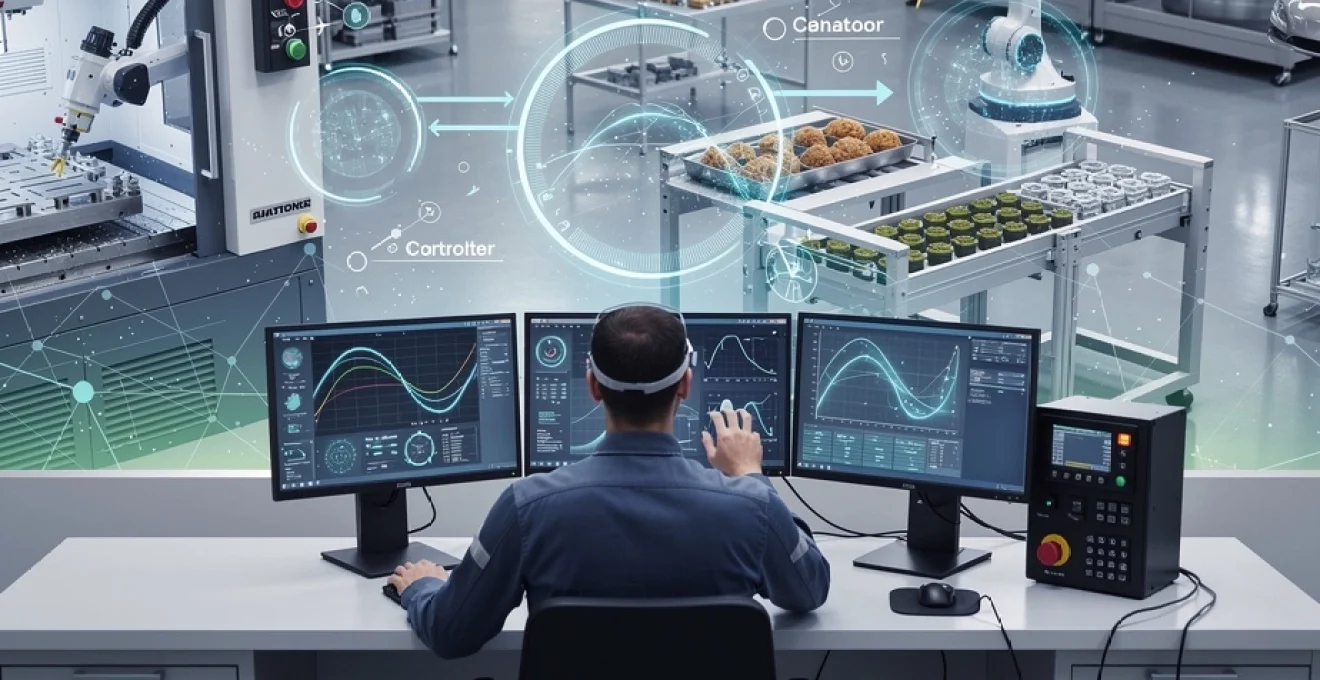
Manufacturing industries worldwide face mounting pressure to deliver products with unprecedented precision while minimising resource consumption. Closed-loop automation systems have emerged as a transformative solution, fundamentally changing how production facilities approach quality control and operational efficiency. These intelligent systems continuously monitor process parameters, compare them against desired outcomes, and make real-time adjustments without human intervention. The impact extends far beyond simple automation—these feedback-driven mechanisms represent a paradigm shift in industrial operations, where machines actively learn from their environment and self-correct to maintain optimal performance. As global competition intensifies and sustainability becomes non-negotiable, understanding how closed-loop systems achieve microscopic precision whilst slashing waste has become essential for manufacturers seeking competitive advantage.
Fundamentals of Closed-Loop control systems in industrial automation
At the heart of modern manufacturing precision lies the closed-loop control system—a sophisticated arrangement where output measurements directly influence input commands. Unlike open-loop systems that execute predetermined instructions regardless of outcomes, closed-loop configurations create a continuous feedback circuit. This circuit compares actual performance against target specifications, calculates deviations, and implements corrective actions automatically. The elegance of this approach stems from its self-regulating nature, much like how a thermostat maintains room temperature by continuously sensing current conditions and adjusting heating or cooling accordingly.
The closed-loop architecture consists of four fundamental components working in orchestrated harmony: sensors that measure process variables, controllers that process this information, actuators that implement adjustments, and the process itself being controlled. This symbiotic relationship creates what engineers call a feedback loop, where information flows cyclically rather than linearly. The system’s effectiveness depends entirely on how quickly and accurately each component responds to changing conditions, making component selection and integration critical to overall performance.
PID controller architecture and feedback mechanism principles
Proportional-Integral-Derivative (PID) controllers represent the workhorse of industrial closed-loop systems, deployed in approximately 95% of manufacturing control applications worldwide. These controllers implement three distinct mathematical operations simultaneously: proportional action responds to current error magnitude, integral action addresses accumulated historical errors, and derivative action anticipates future trends based on error rate of change. This tri-faceted approach enables remarkably nuanced control responses that neither over-correct nor under-compensate.
The proportional component provides immediate response proportional to error size—larger deviations trigger stronger corrections. However, proportional control alone typically leaves a small persistent error called steady-state error. The integral component eliminates this residual by accumulating error over time, applying increasing correction until the error reaches zero. Meanwhile, the derivative component acts as a predictive damper, preventing overshooting by considering how rapidly the error changes. When properly tuned, these three elements work together to achieve setpoint tracking with minimal oscillation and rapid stabilisation.
Sensor integration and Real-Time data acquisition protocols
Modern closed-loop systems rely on diverse sensor technologies to capture process variables with extraordinary fidelity. Temperature sensors, pressure transducers, position encoders, flow metres, and vision systems generate continuous data streams that feed controller algorithms. The quality of control directly correlates with sensor accuracy, response time, and resolution. Industrial environments demand sensors capable of withstanding extreme temperatures, vibrations, electromagnetic interference, and corrosive atmospheres whilst maintaining measurement integrity.
Data acquisition protocols have evolved to support increasingly demanding real-time requirements. Industrial Ethernet protocols like PROFINET and EtherCAT enable deterministic communication with cycle times below one millisecond, ensuring that sensor data reaches controllers without delay. These protocols implement time-synchronisation mechanisms across distributed sensor networks, critical for applications where multiple measurements must align temporally. The transition from traditional analogue signals to digital fieldbus communication has dramatically improved noise immunity whilst enabling advanced diagnostics that detect sensor degradation before it compromises control performance.
Actuator response times and system latency minimisation
Even the most sophisticated controller becomes ineffective if actuators cannot implement commanded changes rapidly enough. Actuator response time—the delay between receiving a command and completing the corresponding physical action—directly limits control system bandwidth. Pneumatic actuators typically respond within 100-500 milliseconds, whilst hydraulic systems achieve 50-100 milliseconds, and electric servo motors reach 10-50 milliseconds. Application requirements dictate which
technology provides the optimal balance between speed, force, precision, and cost. For high-precision closed-loop automation, electric servo drives increasingly dominate due to their superior positioning accuracy and repeatability. However, regardless of technology, engineers must consider not only the inherent response time of the actuator but also the end-to-end system latency, including communication delays, controller scan times, and mechanical backlash.
Minimising system latency requires a holistic approach to closed-loop system design. High-speed fieldbuses, fast-scan PLCs, and optimised control algorithms all contribute to shorter feedback cycles, enabling tighter control and better disturbance rejection. Mechanical elements such as couplings, gearboxes, and linkages must be selected and installed to reduce play and compliance that can introduce additional delays and overshoot. In many advanced applications, you will see feed-forward terms and pre-compensation techniques used alongside feedback control to counteract known delays proactively. When these elements are engineered in concert, the closed-loop system can respond almost as quickly as disturbances arise, which is crucial for maintaining product quality at high production speeds.
Setpoint tracking and error correction algorithms
Setpoint tracking lies at the core of every closed-loop automation strategy. The objective is simple in theory but complex in practice: ensure the process variable follows the desired target as closely and quickly as possible, under all foreseeable operating conditions. Error correction algorithms transform the raw deviation between setpoint and measurement into actionable control signals that drive actuators. Beyond classic PID control, modern systems often employ advanced techniques such as gain scheduling, adaptive control, and feed-forward compensation to maintain accurate tracking across changing regimes.
In applications with frequent setpoint changes—such as variable-speed drives, recipe-based production, or multi-product lines—ramp-and-soak profiles and trajectory planning help avoid sudden jumps that can destabilise the process. Algorithms may impose rate limits or acceleration constraints on setpoint changes so that actuators and mechanical structures are not overstressed. For non-linear processes, model-based controllers adjust their internal parameters as operating conditions shift, ensuring that error correction remains effective from low load to full capacity. When correctly implemented, these setpoint tracking strategies allow you to ramp production up or down quickly without sacrificing precision or generating excessive scrap.
Precision enhancement through adaptive feedback control
As industrial processes grow more complex and quality tolerances tighten, fixed-parameter control strategies can struggle to deliver consistent results. This is where adaptive feedback control begins to unlock additional precision. By continuously updating control actions based on real-time data and predictive models, these systems can accommodate drift, wear, and variability that would otherwise degrade performance. Instead of treating the production line as a static system, adaptive closed-loop automation recognises that every process evolves over time and needs dynamic compensation.
You can think of adaptive feedback control as teaching the production system to “learn” from its own historical behaviour. When the system detects that standard controller settings no longer yield the desired response—perhaps due to seasonal temperature shifts or tooling wear—it automatically refines control parameters. This capability is particularly valuable in high-mix, low-volume manufacturing, where each batch or product run might exhibit different dynamics. By embedding intelligence within the feedback loop, manufacturers can push precision to levels that would be impossible with manual tuning alone.
Model predictive control (MPC) for dynamic process optimisation
Model Predictive Control (MPC) takes closed-loop automation to the next level by using a mathematical model of the process to forecast future behaviour. Unlike PID controllers, which react only to current and past errors, MPC evaluates how control moves made now will influence system performance several steps ahead. At each control interval, an optimisation algorithm calculates the control trajectory that best satisfies multiple objectives—such as minimising tracking error, respecting actuator limits, and reducing energy use—over a defined prediction horizon.
This predictive capability is especially powerful in multivariable processes where several inputs and outputs interact, such as chemical reactors, distillation columns, or integrated packaging lines. For example, in a high-speed filling line, MPC can coordinate pump speed, valve position, and conveyor movement to maintain constant fill levels while avoiding spillage and foaming. Studies across process industries indicate that MPC can cut variability by 30–50% compared to traditional controllers, directly translating into tighter quality distributions and less rework. For manufacturers aiming to optimise complex operations in real time, deploying MPC within their closed-loop architecture offers a compelling route to dynamic process optimisation.
Kalman filtering techniques for measurement noise reduction
Accurate decisions depend on accurate measurements, yet industrial sensors inevitably face noise from electrical interference, mechanical vibration, and environmental disturbances. Kalman filtering provides a mathematically rigorous method for extracting reliable estimates from noisy data. Rather than accepting each sensor reading at face value, a Kalman filter combines the measurement with a predictive model of how the process should evolve, weighting each according to its estimated uncertainty. The result is a continually updated “best guess” of the true state of the system.
In practical closed-loop automation, Kalman filters are widely used in motion control, robotics, and process instrumentation. For instance, in a servo-driven CNC machine, encoder readings may be corrupted by vibration or quantisation effects. A Kalman filter can smooth these signals, providing a cleaner estimate of position and velocity that allows the controller to maintain tighter tolerances. Similarly, in flow and level control, filtering helps prevent spurious spikes from triggering unnecessary control actions. By reducing the effective noise in feedback signals, Kalman filtering supports more aggressive control tuning, which enhances precision without inducing oscillation or instability.
Servo motor positioning accuracy in CNC machining applications
CNC machining is one of the most demanding domains for closed-loop precision. Here, servo motors and high-resolution encoders work in tandem to position cutting tools with sub-micron accuracy. The controller maintains a continuous feedback loop between commanded toolpath and actual position, making thousands of corrections per second. Any lag, overshoot, or mechanical backlash can translate directly into dimensional inaccuracies or poor surface finish, so the fidelity of the servo loop is paramount.
Modern CNC systems often use dual-loop feedback, combining motor shaft encoders with linear scales mounted directly on the machine axes. This configuration compensates for mechanical compliance and thermal expansion, ensuring that the workpiece rather than just the motor follows the programmed trajectory. Advanced jerk-limited motion profiles prevent sudden accelerations that could excite structural resonances, further boosting positioning accuracy. As a result, manufacturers can run higher feed rates while still holding tight tolerances, improving both throughput and yield. For anyone aiming to exploit closed-loop automation in precision machining, careful servo tuning and feedback sensor selection are among the most impactful design decisions.
Temperature stabilisation in semiconductor manufacturing processes
Semiconductor fabrication provides a textbook example of how closed-loop automation underpins extreme precision. Many steps—such as deposition, etching, and lithography—require temperature stability within fractions of a degree Celsius. Even minor fluctuations can alter chemical reaction rates or material properties, resulting in defects that may only become apparent during final testing. Consequently, fabs invest heavily in sophisticated temperature control systems that integrate fast-reacting heaters, chillers, and high-resolution sensors.
Closed-loop temperature control in these environments often combines PID regulation with model-based compensation for thermal inertia and external disturbances. Multi-zone control strategies maintain uniform temperature profiles across large wafers, while predictive algorithms anticipate the thermal load of upcoming process steps. The integration of real-time analytics allows engineers to detect subtle drifts long before they breach specification limits. By tightly controlling thermal conditions, semiconductor manufacturers reduce variability, increase die yield, and support the ongoing drive toward smaller geometries and higher device complexity.
Waste reduction mechanisms in Closed-Loop manufacturing
Beyond improving precision, closed-loop automation plays a decisive role in reducing waste across materials, energy, and labour. Every time a system corrects a deviation before it produces an out-of-spec part, it prevents potential scrap, rework, and downstream disruption. As sustainability metrics and ESG reporting gain prominence, the ability to quantify and reduce waste through closed-loop feedback becomes a strategic advantage. You are not just automating for speed—you are automating for resource efficiency and environmental responsibility.
Waste reduction mechanisms typically emerge from three complementary capabilities: early detection of anomalies, rapid compensation for disturbances, and data-driven optimisation of setpoints and operating windows. By constantly measuring process performance and linking it to quality outcomes, closed-loop systems can identify inefficient regimes and automatically steer the process toward optimal conditions. In many factories, these improvements have cut raw material usage and scrap rates by double-digit percentages, simultaneously lowering costs and improving carbon footprints.
Material consumption optimisation in injection moulding systems
Injection moulding is highly sensitive to parameters such as injection pressure, melt temperature, and cooling time. Small deviations can lead to short shots, flash, warpage, or sink marks, all of which create scrap and wasted resin. Closed-loop control of injection pressure and screw position ensures that the precise amount of material is delivered into the mould cavity every cycle. By monitoring cavity pressure and using feedback to adjust packing and holding phases, the system can compensate for variations in material viscosity or ambient conditions.
Advanced injection moulding machines also employ adaptive process control, learning from historical cycles to refine profile settings and reduce over-packing. This not only lowers material consumption per part but also shortens cycle times by preventing unnecessary cooling intervals. Energy-efficient servo-driven hydraulic systems further cut electricity use, aligning material savings with lower operational costs. For manufacturers processing expensive engineering polymers, even a 2–3% reduction in average shot weight across thousands of cycles can translate into substantial annual savings and a measurable reduction in waste sent to landfill.
Scrap rate minimisation through Real-Time quality monitoring
Traditional quality control relies on periodic inspections and offline measurements, which often detect defects only after a full batch has been produced. Closed-loop automation enables a radically different approach: real-time quality monitoring directly integrated into the production line. Vision systems, laser gauges, and in-line sensors continuously assess critical dimensions, surface finish, or assembly integrity. When the system identifies a trend toward non-conformance, it can adjust process parameters before defects accumulate.
In some plants, this approach has reduced scrap rates by more than 50%, particularly in industries such as electronics assembly and packaging. Instead of discarding entire lots, only a handful of borderline products may be rejected while the process is automatically brought back into control. Statistical process control (SPC) algorithms embedded within the control system analyse data distributions and trigger alarms when variation exceeds acceptable thresholds. By closing the loop between quality measurements and actuator commands, manufacturers move from reactive firefighting to proactive defect prevention.
Energy recovery and regenerative braking in automated systems
Closed-loop automation is also a powerful tool for cutting energy waste, especially in motion-intensive applications like conveyor systems, automated storage and retrieval systems, and robotics. One key technique is regenerative braking, where electric drives recover kinetic energy during deceleration and feed it back into the power bus instead of dissipating it as heat. This energy can then be used by other drives on the same DC link or returned to the grid, depending on the system architecture.
When combined with intelligent motion profiles and load-sharing strategies, regenerative systems can reduce energy consumption by 10–30% in many material handling applications. Closed-loop control monitors torque, speed, and load conditions in real time, continually optimising acceleration and deceleration ramps to minimise peak currents and avoid unnecessary stops and starts. In an environment where energy prices and carbon regulations are both rising, such savings are far from trivial. They contribute directly to lower operating costs while supporting corporate sustainability and net-zero commitments.
Chemical dosing accuracy in water treatment facilities
Water and wastewater treatment plants depend on accurate chemical dosing to meet regulatory standards without overusing reagents. Overdosing leads to unnecessary chemical consumption and higher sludge disposal volumes, while underdosing risks non-compliance and public health concerns. Closed-loop dosing systems constantly measure key water quality indicators—such as pH, turbidity, chlorine residual, or nutrient levels—and adjust pump speeds and valve positions accordingly.
Instead of using fixed dosing rates based on historical averages, modern systems implement flow-paced and feedback-paced control strategies. For example, a chlorination system might use real-time flow data combined with residual chlorine measurements downstream to fine-tune chlorine injection. This ensures disinfection targets are met with minimal excess. With rising costs for treatment chemicals and tighter environmental regulations, the move toward fully closed-loop dosing can yield both economic and ecological benefits, making water treatment operations more sustainable and resilient.
Industrial applications across manufacturing sectors
While the principles of closed-loop control are universal, their implementation varies significantly across industries. Each sector brings its own constraints, regulatory frameworks, and performance metrics. By examining how closed-loop automation is applied in pharmaceuticals, automotive manufacturing, and food processing, we gain a clearer view of its versatility and impact. These real-world scenarios also highlight practical considerations you should keep in mind when deploying feedback systems in your own operations.
From ensuring sterile conditions in batch reactors to achieving uniform paint thickness on car bodies, the underlying objective remains the same: increase precision while reducing waste. However, the relative emphasis on parameters such as traceability, hygiene, cycle time, or aesthetics shapes how the control architecture is designed. Understanding these sector-specific nuances can help engineers and managers benchmark their own closed-loop strategies and identify opportunities for cross-industry learning.
Pharmaceutical batch processing with SCADA integration
Pharmaceutical manufacturing operates under some of the most stringent regulatory regimes, including GMP, FDA 21 CFR Part 11, and EU Annex 11. In this context, closed-loop automation must not only maintain precise control but also provide complete traceability and secure data integrity. Batch processing systems integrate distributed control systems (DCS) or PLCs with SCADA platforms that supervise temperature, pressure, agitation speed, and dosing across reactors, filters, and dryers. Feedback loops ensure that critical process parameters remain within narrow validated ranges throughout each batch.
SCADA integration allows operators and quality teams to visualise trends in real time, set alarms, and generate electronic batch records that document every control action and deviation. Advanced strategies such as PAT (Process Analytical Technology) add in-line spectroscopic monitoring of product attributes, enabling closed-loop adjustments to maintain potency, purity, and particle size distribution. By moving toward real-time release testing and adaptive control, pharmaceutical plants can reduce batch failures, shorten cycle times, and respond more flexibly to market demand without compromising patient safety.
Automotive paint application using robotic spray systems
Automotive paint shops are a classic showcase for closed-loop robotic automation. Paint thickness, coverage, and surface appearance must meet strict aesthetic and corrosion protection standards, all while minimising solvent emissions and material usage. Robotic spray systems use multi-axis robots equipped with flow meters, electrostatic atomisers, and sometimes in-line thickness gauges. Closed-loop control coordinates robot trajectory, spray pattern, paint flow, and electrostatic charge to achieve uniform coatings on complex body geometries.
Feedback from pressure sensors and flow controllers allows the system to adjust atomisation and fan width on the fly, compensating for nozzle wear, viscosity changes, or temperature variations in the paint booth. Some advanced installations employ machine vision or non-contact film thickness measurement to verify coverage immediately after application, enabling rapid correction of any anomalies. These strategies can reduce paint consumption per vehicle and lower volatile organic compound (VOC) emissions, helping manufacturers meet environmental regulations while delivering flawless finishes that customers expect.
Food processing line synchronisation and portion control
In food and beverage manufacturing, closed-loop automation addresses both quality and regulatory concerns. Portion control is vital for meeting label claims, controlling calories, and managing ingredient costs. Weighing systems, flow meters, and vision-based counting devices provide continuous feedback on product mass, volume, or unit count. Fillers, cutters, and depositors use this feedback to fine-tune valve timings, conveyor speeds, or cutting positions, keeping each portion within tight tolerances.
Line synchronisation is equally important, particularly in high-speed packaging and bottling operations. Encoders and sensors synchronise the motion of conveyors, wrappers, and sealing units so products arrive at each station at the right moment and orientation. Closed-loop control helps avoid jams, misalignments, and packaging defects that can lead to rework or waste. Hygiene constraints mean that equipment must be easy to clean, so designers often favour non-contact sensing and sealed actuators. By orchestrating every stage of the line through integrated feedback loops, food processors can increase throughput while maintaining consistent quality and minimising giveaway.
Digital twin technology and Simulation-Based optimisation
Digital twin technology is reshaping how engineers design, commission, and refine closed-loop automation systems. A digital twin is a virtual replica of a physical asset or process that runs in parallel with the real system. It incorporates physics-based models, control logic, and real-time data feeds to simulate behaviour under different conditions. Before a new control strategy is rolled out on the factory floor, engineers can test it on the digital twin, exploring “what-if” scenarios without risking actual equipment or production.
This simulation-based optimisation allows you to identify bottlenecks, tune controller parameters, and evaluate energy-saving strategies with remarkable speed. For example, a digital twin of a packaging line can reveal how changes in conveyor speed, buffer sizes, or motion profiles affect throughput and accumulation. The insights gained can then be translated into control code updates with high confidence in their real-world impact. As more factories connect their assets via Industrial IoT platforms, digital twins increasingly use live operational data to remain accurate over time, enabling continuous improvement rather than one-off optimisation exercises.
Machine learning integration for predictive maintenance and process refinement
The latest evolution of closed-loop automation involves integrating machine learning to enhance predictive maintenance and process refinement. Traditional control loops focus on maintaining current performance; machine learning extends this by forecasting future states and recommending or executing proactive interventions. By analysing historical sensor data, event logs, and quality outcomes, algorithms can detect subtle patterns that indicate emerging faults, such as bearing wear, valve sticking, or sensor drift. Maintenance teams can then schedule interventions before failures occur, avoiding unplanned downtime and secondary damage.
On the process side, machine learning models can uncover complex relationships between input parameters and product quality that are difficult to capture with first-principles models alone. These insights can feed into advanced supervisory controllers that adjust setpoints or controller tuning to keep the process in its most efficient operating window. In some implementations, reinforcement learning agents experiment within controlled boundaries—often first in a digital twin—to discover control policies that minimise energy use or cycle time while preserving quality. As we combine the deterministic strengths of classical control with the pattern-recognition power of AI, closed-loop systems become not just self-correcting, but increasingly self-optimising.