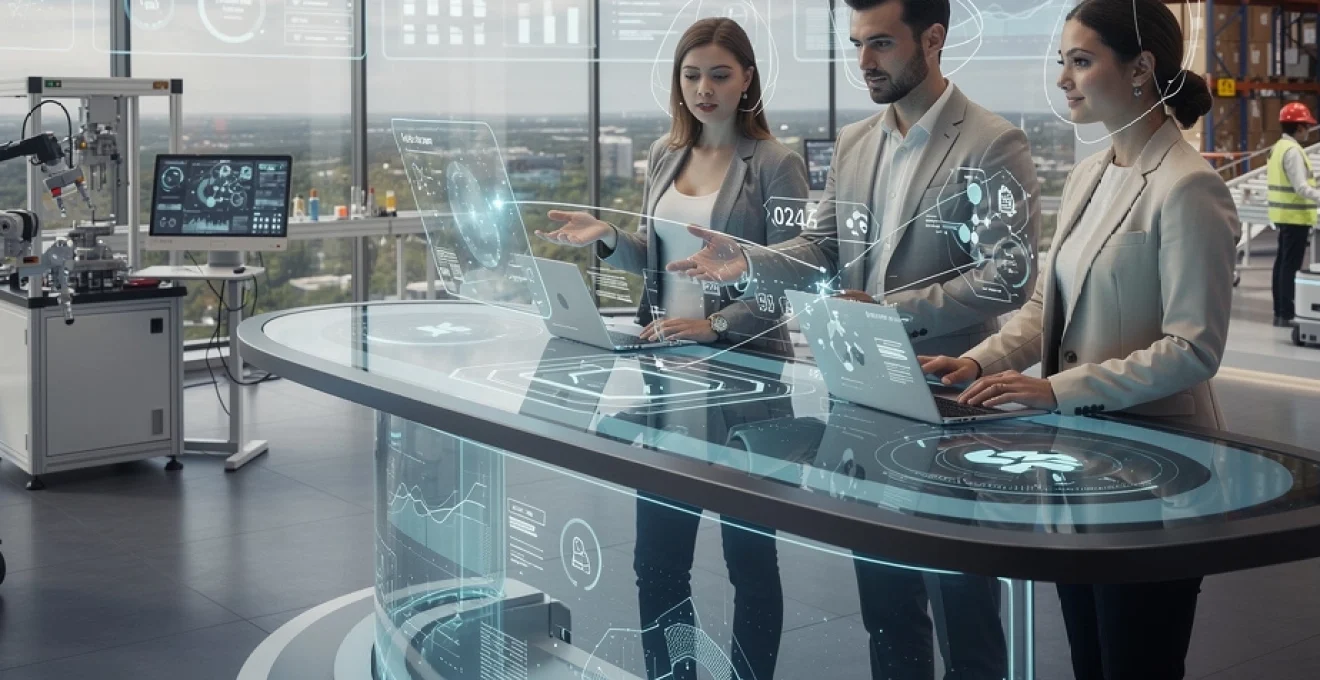
The evolution of workplace automation has reached a pivotal moment where the binary choice between human workers and machines no longer defines operational excellence. Modern enterprises are discovering that the most powerful solutions emerge when human intelligence seamlessly integrates with automated systems, creating hybrid automation models that leverage the unique strengths of both. This symbiotic relationship transforms how organisations approach complex challenges, combining the precision and speed of machines with the creativity, emotional intelligence, and contextual understanding that only humans possess.
Research from MIT’s Center for Collective Intelligence reveals that human-AI combinations achieve 73% higher productivity in specific tasks, particularly in content creation and complex decision-making scenarios. However, the study also highlighted that these partnerships require careful orchestration to avoid the common pitfall where hybrid systems underperform compared to optimised human-only or machine-only approaches. The key lies in understanding when and how to blend capabilities rather than simply adding automation to existing human processes.
Manufacturing leaders at companies like Tesla and Amazon have pioneered hybrid automation frameworks that demonstrate remarkable results. Tesla’s Gigafactories employ collaborative robots working alongside human technicians, achieving both the precision required for battery cell assembly and the adaptability needed for rapid product iterations. Meanwhile, Amazon’s fulfilment centres showcase how human decision-making can enhance algorithmic efficiency, particularly in handling edge cases and maintaining customer satisfaction during peak demand periods.
Defining hybrid automation architecture and core integration principles
Hybrid automation architecture represents a fundamental shift from traditional automation paradigms, establishing a framework where human operators and automated systems function as integrated components within a unified operational ecosystem. This architecture requires sophisticated orchestration mechanisms that enable seamless transitions between human control and machine autonomy, ensuring optimal performance across varying operational conditions and complexity levels.
The core integration principles of hybrid automation centre on cognitive complementarity, where each system component operates within its domain of expertise while maintaining constant communication channels for collaboration. Unlike conventional automation that aims to replace human involvement, hybrid models amplify human capabilities through intelligent machine augmentation, creating workflows that adapt dynamically to changing requirements and unexpected scenarios.
Human-in-the-loop (HITL) framework implementation strategies
Effective Human-in-the-Loop frameworks require carefully designed intervention points where human expertise can enhance automated processes without creating operational bottlenecks. These intervention points typically occur at decision nodes involving ambiguous data interpretation, ethical considerations, or scenarios requiring creative problem-solving approaches that exceed current algorithmic capabilities.
Implementation strategies focus on creating intuitive interfaces that allow human operators to monitor, adjust, and override automated systems when necessary. The framework incorporates progressive automation, where routine tasks operate autonomously while complex decisions escalate to human oversight. This approach maintains operational efficiency while ensuring human expertise remains accessible for critical decision-making processes.
Machine learning model orchestration with human oversight protocols
Machine learning model orchestration in hybrid environments requires sophisticated governance protocols that balance autonomous operation with human supervision. These protocols establish clear boundaries for model decision-making authority while providing mechanisms for human experts to review, validate, and refine algorithmic outputs in real-time operational contexts.
The orchestration framework incorporates feedback loops that enable continuous model improvement through human expertise integration. When human operators make corrections or adjustments to automated decisions, these interventions become training data for model refinement, creating a self-improving system that enhances performance over time while maintaining human oversight capabilities.
Cognitive load distribution between automated systems and human operators
Optimal cognitive load distribution ensures that automated systems handle routine, data-intensive tasks while humans focus on activities requiring creativity, empathy, and complex reasoning. This distribution strategy prevents cognitive overload for human operators while maximising the utilisation of machine computational capabilities for appropriate task categories.
The distribution framework considers factors such as task complexity, decision urgency, and required expertise levels when allocating responsibilities between human and machine components. By analysing these factors, organisations can create dynamic task allocation algorithms that adjust workload distribution based on current operational demands and available human resources.
Real-time decision handoff mechanisms in hybrid workflows
Real-time decision handoff mechanisms enable seamless transitions between automated and human decision-making processes without disrupting operational continuity. These mechanisms incorporate intelligent routing algorithms that assess decision complexity, time constraints, and available
expertise before determining whether to keep a decision automated or escalate it to a human. In mature hybrid automation models, this routing happens in milliseconds, with predefined thresholds and confidence levels determining when a case should be auto-processed, flagged for review, or immediately handed off to a specialist. Crucially, every handoff is logged to create a clear audit trail, enabling teams to analyse when machines succeed, when humans add the most value, and how to continuously refine the balance between human and automated control.
Advanced hybrid workflows also support bi-directional handoffs, where a task can move from automation to human review and back into automated execution once a decision is made. For example, an AI system may pre-screen quality inspection images, escalate uncertain cases to a technician, and then automatically apply the human decision across similar future cases. This creates a virtuous cycle in which human judgment not only resolves edge cases but also trains the automation layer to handle more complexity over time.
Cognitive complementarity: leveraging human intuition with machine precision
At the heart of hybrid automation models lies the principle of cognitive complementarity: machines excel at scale, speed, and statistical consistency, while humans bring intuition, ethics, and context. Rather than viewing these capabilities as competing, leading organisations design workflows that deliberately pair human strengths with machine strengths. The result is a form of augmented intelligence in which both sides of the partnership perform at their highest level.
This perspective moves the conversation away from a narrow focus on task replacement and toward a richer view of joint performance. When you design hybrid automation with cognitive complementarity in mind, you do not just automate faster—you make better decisions, reduce risk, and unlock forms of value creation that neither humans nor machines could achieve alone. This becomes particularly powerful in domains that involve complex data interpretation, nuanced customer interaction, and creative problem-solving.
Pattern recognition superiority in complex data interpretation
Machine learning and advanced analytics systems are unmatched in their ability to process vast quantities of structured and unstructured data, detecting subtle correlations and anomalies that would be invisible to human analysts. In high-frequency environments—such as sensor-heavy manufacturing lines or real-time fraud detection—algorithms can monitor thousands of signals simultaneously, flagging deviations in milliseconds. This pattern recognition capability is the backbone of many hybrid automation models, especially in data-intensive operations.
However, raw pattern detection is only part of the story. Humans excel at interpreting what those patterns mean in a broader business or operational context: is a detected anomaly a genuine issue, a known quirk, or the sign of an emerging trend that demands strategic action? By pairing automated anomaly detection with expert review, organisations can rapidly triage alerts, reduce false positives, and convert data signals into informed decisions. Think of the machine as a radar system scanning the horizon and humans as the pilots deciding how to respond to what appears on the screen.
Emotional intelligence integration in customer service automation
Customer service has become a key proving ground for hybrid automation. Chatbots and virtual agents handle routine queries—checking order status, resetting passwords, or updating account details—at any time of day, providing fast responses at scale. Yet even the most advanced conversational AI struggles with emotionally charged situations, subtle tone shifts, or culturally nuanced expectations that shape how a customer experiences a brand.
In a well-designed hybrid automation environment, AI acts as the first line of engagement, while agents equipped with high emotional intelligence take over when empathy, negotiation, or reassurance are required. Intelligent routing systems monitor sentiment, keyword patterns, and interaction history to determine when to escalate from bot to human, ensuring that frustrated or vulnerable customers are not left in automated loops. This human-AI blend not only improves resolution rates but also strengthens brand trust, because customers feel both supported by efficient automation and heard by real people when it matters most.
Creative problem-solving capabilities in algorithmic limitations
Algorithms shine when the problem space is well-defined and the objective function is clear. But what happens when an issue falls outside historical data or involves conflicting goals, such as balancing cost minimisation with brand reputation or regulatory expectations? These are the moments when human creativity and strategic thinking become indispensable. Humans can reframe problems, propose unconventional solutions, and integrate qualitative factors that are difficult to encode into models.
Hybrid automation frameworks recognise these algorithmic limitations and deliberately route ill-structured problems to human teams. For example, when an AI-driven supply chain system encounters a disruption that has no close historical precedent, it may suggest several optimised options. Human planners then evaluate these scenarios, consider supplier relationships, geopolitical risks, and long-term strategy, and sometimes propose a third path that blends or overrides algorithmic recommendations. You can think of the AI as a powerful calculator generating options, and the human as the architect deciding which design best fits the landscape.
Contextual understanding enhancement through human domain knowledge
Context is one of the hardest variables for machines to capture, yet it is central to effective decision-making. Domain experts understand tacit rules, legacy constraints, and unwritten practices that shape how work actually gets done. Hybrid automation models harness this domain knowledge by embedding experts directly in the design, supervision, and refinement of automated workflows. Their insights ensure that machine decisions align with real-world constraints and organisational culture.
For instance, a predictive maintenance model might flag a machine as likely to fail within a week, but a seasoned engineer knows that the same warning appears after every software update and rarely leads to issues. Without that contextual layer, operations might schedule unnecessary downtime. By capturing and codifying such expertise through human-in-the-loop feedback, knowledge graphs, or rule overlays, organisations make their hybrid automation systems more accurate and trustworthy. Over time, this continuous exchange turns individual know-how into institutional intelligence that scales across the enterprise.
Enterprise implementation case studies: tesla manufacturing and amazon fulfilment
Tesla and Amazon offer two of the most visible examples of hybrid automation at industrial scale, each illustrating how human and machine capabilities can be orchestrated for performance and resilience. Tesla’s experience is particularly instructive: early attempts at extreme automation in its factories led to bottlenecks and unexpected downtime, prompting Elon Musk to publicly acknowledge that “excessive automation” had been a mistake. The company rebalanced its approach, reintroducing human workers in areas where flexibility, dexterity, and rapid problem-solving were critical.
Today, Tesla’s plants combine high-speed robotic cells for welding, painting, and battery assembly with human technicians responsible for fine adjustments, complex assemblies, and quality validation. AI-driven vision systems continuously inspect components, flagging potential defects for human review. This hybrid automation model allows Tesla to iterate designs quickly without complete retooling, because human teams can adapt to new processes faster than fully automated lines can be reprogrammed.
Amazon’s fulfilment centres demonstrate a different flavour of hybrid automation focused on logistics, inventory management, and last-mile delivery. Autonomous mobile robots move shelves to human pickers, who leverage their spatial awareness and dexterity to select items rapidly and accurately. Machine learning models predict demand, optimise bin locations, and schedule labour, but floor associates make real-time adjustments when orders spike unexpectedly or when physical constraints differ from digital assumptions.
Crucially, both companies treat human workers as strategic assets rather than legacy constraints. Training programmes teach employees how to collaborate with robots and AI tools, turning operators into system orchestrators rather than manual labourers. The result is a continuous feedback loop: data from human interactions refines algorithms, and algorithmic insights empower workers to make smarter decisions on the fly. For organisations seeking to modernise their operations, these case studies illustrate that hybrid automation is not a compromise—it is a competitive strategy.
Technical infrastructure requirements for seamless human-machine collaboration
Delivering hybrid automation at scale requires more than deploying robots or training a few models. It demands a robust technical infrastructure that connects people, processes, and intelligent systems through secure, low-latency communication channels. Without this backbone, even the best-designed workflows will suffer from delays, data silos, and inconsistent decision-making.
From an architectural perspective, successful hybrid environments share several traits: modular services that can be updated independently, standardised interfaces that allow systems to talk to each other, and observability layers that give humans a clear window into automated operations. As you design or modernise your automation stack, focusing on these technical foundations will determine whether your hybrid model feels seamless and responsive—or fragmented and fragile.
API gateway configuration for bidirectional communication channels
Application Programming Interfaces (APIs) are the connective tissue of hybrid automation models, enabling humans, applications, and devices to exchange data and commands in real time. An API gateway sits at the centre of this ecosystem, acting as the single entry point for external requests and internal services. Properly configured, it manages authentication, rate limiting, routing, and protocol translation, ensuring that both human interfaces and machine components can communicate securely and efficiently.
Bidirectional communication is essential: not only must automated systems send information and recommendations to human operators, but operators must also be able to send feedback, overrides, and new instructions back into the system. For example, when a quality engineer flags a false positive from an inspection algorithm via a web interface, that feedback travels through the same API gateway as sensor data. Designing these channels with clear contracts, versioning, and monitoring allows you to evolve automation services without breaking the tools humans rely on every day.
Microservices architecture design for modular automation components
Hybrid automation benefits greatly from a microservices architecture, where complex capabilities are decomposed into small, independently deployable services. Instead of a monolithic automation platform that is difficult to change, you have a collection of focused services—such as image analysis, scheduling, anomaly detection, or conversational interfaces—that can be scaled, updated, or replaced without disrupting the entire system. This modularity supports experimentation and continuous improvement, which are vital for keeping pace with new AI techniques and evolving business needs.
From a practical standpoint, microservices make it easier to embed human-in-the-loop checkpoints into specific workflows. For instance, a service handling invoice classification can be configured to route low-confidence predictions to a human review microservice before updating the ERP system. As your hybrid automation model matures, you can gradually increase autonomy in services that demonstrate strong performance while maintaining human guardrails around more sensitive or variable processes. In this way, architecture and governance reinforce each other.
Real-time monitoring dashboard development for hybrid system performance
Visibility is non-negotiable in hybrid automation. Real-time monitoring dashboards give operations teams, engineers, and managers a shared, up-to-date view of how human and machine components are performing. These dashboards typically track key metrics such as throughput, error rates, model confidence levels, human intervention frequency, and system latency. By surfacing these indicators in a clear and approachable format, you enable faster incident response and more informed optimisation decisions.
The most effective dashboards go beyond raw numbers and incorporate contextual cues and drill-down capabilities. For example, a spike in manual overrides on a particular production line can be highlighted with links to recent configuration changes or environmental data. Over time, patterns in dashboard metrics can reveal where additional automation would be beneficial and where further human oversight is required. In essence, the dashboard becomes a “flight deck” for your hybrid automation model, allowing teams to steer complex systems with confidence.
Error handling and escalation protocols in mixed-mode operations
No hybrid automation environment is immune to errors, edge cases, or unexpected interactions between systems. What differentiates resilient organisations is the quality of their error handling and escalation protocols. These protocols define what should happen when a model fails, a robot misaligns, or an integration times out—who gets notified, what is rolled back, and how the incident is logged for later analysis.
Well-designed protocols incorporate automated safeguards and human judgment. For instance, if a machine learning model starts producing outputs outside defined thresholds, the system can automatically revert to a safer baseline rule set and notify an expert for investigation. Similarly, if a cobot detects unusual resistance, it can stop, alert a supervisor, and enter a safe mode. By treating error handling as a first-class design concern rather than an afterthought, you protect both your workforce and your customers while learning from each incident to harden your hybrid automation over time.
Performance metrics and ROI optimisation in hybrid automation deployments
Measuring the success of hybrid automation models requires a broader lens than traditional automation projects. While cost reduction and throughput remain important, they are no longer the only indicators of value. Hybrid systems aim to enhance quality, resilience, employee experience, and customer satisfaction—all of which contribute to long-term return on investment. To capture this richer picture, leading organisations define a balanced portfolio of metrics spanning operational, financial, and human dimensions.
On the operational side, metrics such as cycle time reduction, first-pass yield, error rates, and unplanned downtime provide clear evidence of performance gains. Financially, you can track improvements in revenue per employee, reduced rework costs, and lower returns or warranty claims. From a human perspective, indicators like employee engagement, turnover rates in automated areas, and training completion help you assess whether your hybrid automation model is truly empowering people or creating hidden friction. By reviewing these metrics together, you avoid optimising one dimension at the expense of another.
To maximise ROI, organisations often adopt an iterative deployment approach: start with high-impact, bounded use cases; define baseline metrics; then pilot, measure, and refine. This allows you to validate assumptions about where human oversight is most valuable and where automation can safely take on more responsibility. Over time, comparing performance across different hybrid configurations—such as varying thresholds for human review or different task allocation rules—helps you converge on the optimal blend of human and machine capabilities for your specific context. In many cases, the greatest gains come not from more automation, but from better collaboration.
Future evolution: augmented intelligence and symbiotic automation paradigms
Looking ahead, hybrid automation is evolving toward even more integrated models of augmented intelligence and symbiotic automation. In these paradigms, humans and machines do not just hand tasks back and forth; they co-create strategies, learn from each other continuously, and adapt in real time to changing environments. Advances in generative AI, adaptive robotics, and contextual computing are making it possible for systems to understand intent, anticipate needs, and present options in ways that feel more like collaboration than command-and-control.
For example, design engineers already use generative AI tools to explore thousands of design variants, then apply their judgment to choose and refine the most promising concepts. In operations, digital twins of factories allow teams to simulate new workflows where AI agents and human operators work side by side, testing different configurations before deploying them on the shop floor. As these tools become more accessible, you will see a shift from static automation scripts to living systems that evolve with your business.
This future does, however, demand thoughtful governance. As machines become more capable, questions of responsibility, transparency, and skill development grow more urgent. Organisations that succeed will invest not only in technology but also in cultivating what some researchers call “double literacy”: fluency in both human cognition and algorithmic logic. When leaders, engineers, and frontline workers understand how hybrid automation makes decisions—and when they feel empowered to question and improve those decisions—symbiotic automation becomes a source of competitive advantage rather than a black box.
Ultimately, the most effective hybrid automation models will be those that keep humanness at the centre. By designing systems that respect human judgment, enhance well-being, and create room for creativity, organisations unlock the full potential of both people and machines. In an era defined by rapid technological change, this human-centric, symbiotic approach is what will differentiate enterprises that merely deploy automation from those that truly transform.