# The Future of Human-Machine Collaboration in Digitised Factories
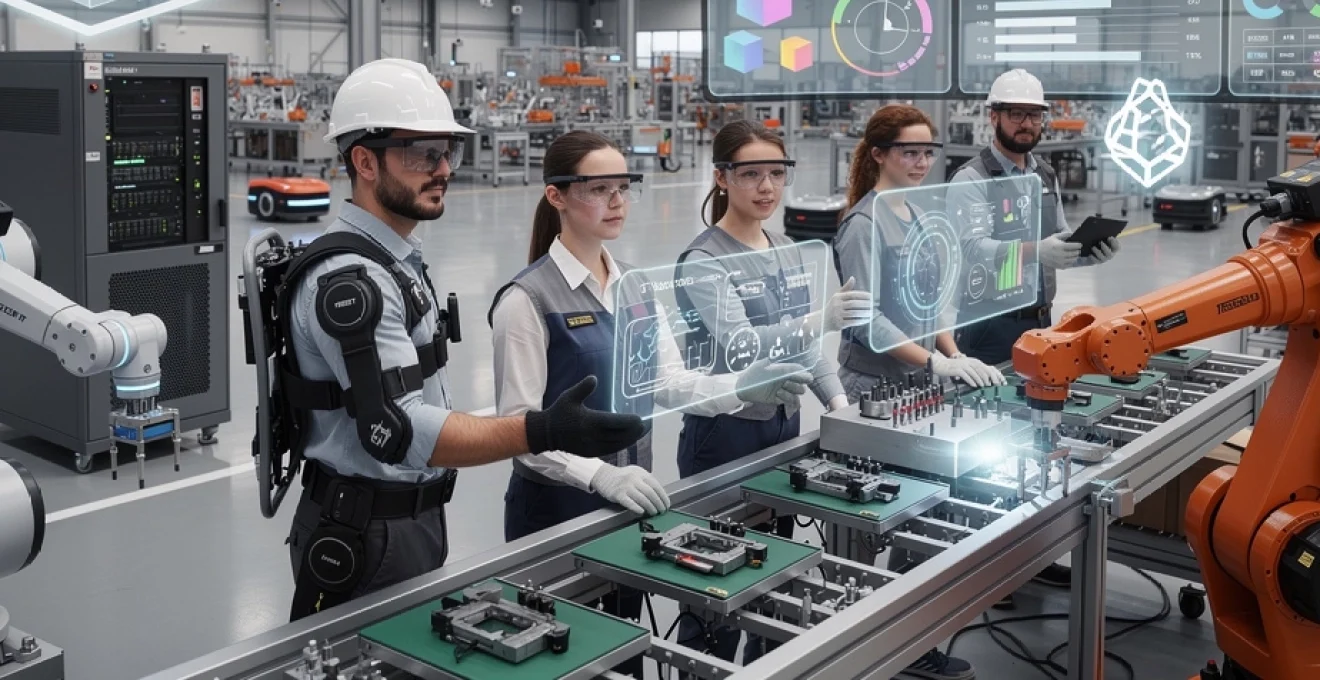
Manufacturing stands at a transformative crossroads where artificial intelligence, robotics, and human ingenuity converge to reshape production environments. The digital revolution sweeping through factory floors worldwide is fundamentally altering how operators interact with machinery, how decisions are made in real-time, and how organisations structure their workforce capabilities. This transformation extends far beyond simple automation—it represents a paradigm shift towards intelligent ecosystems where human workers and advanced systems function as complementary partners rather than competitors. As Industry 4.0 technologies mature and Industry 5.0 concepts emerge, manufacturers face unprecedented opportunities to enhance productivity whilst elevating the human role to strategic orchestration rather than repetitive task execution. The convergence of digital twins, collaborative robotics, and artificial intelligence is creating production environments that are simultaneously more efficient and more human-centric than ever before.
Industry 4.0 technologies reshaping factory floor dynamics
The fourth industrial revolution has introduced a comprehensive suite of technologies that fundamentally alter the relationship between human workers and manufacturing systems. These innovations create interconnected environments where data flows seamlessly between physical assets and digital platforms, enabling unprecedented levels of visibility and control. The integration of these technologies is not merely additive—it creates synergistic effects that multiply operational capabilities whilst simultaneously reducing cognitive load on human operators. Recent industry reports indicate that manufacturers implementing comprehensive Industry 4.0 strategies have achieved productivity improvements ranging from 15% to 30% whilst simultaneously reducing defect rates by up to 50%. These remarkable gains stem from the intelligent distribution of tasks between human and machine collaborators, with each contributing their unique strengths to the production process.
Digital twin integration with siemens MindSphere and GE predix platforms
Digital twin technology represents one of the most powerful tools for enhancing human-machine collaboration by creating virtual replicas of physical assets, processes, and entire production lines. Platforms such as Siemens MindSphere and GE Predix provide the infrastructure necessary to construct these digital representations, enabling operators to visualise complex system behaviours, test modifications virtually, and predict outcomes before implementing physical changes. The value proposition extends beyond simple monitoring—digital twins empower human workers to become strategic decision-makers rather than reactive troubleshooters. When an operator can simulate the impact of a parameter adjustment before touching actual equipment, the risk profile of optimisation efforts fundamentally changes. Manufacturing organisations leveraging digital twin capabilities report reductions in unplanned downtime exceeding 40%, primarily because potential issues are identified and addressed in the virtual environment before manifesting physically.
The practical implementation of digital twin technology requires careful consideration of data architecture and system integration. Siemens MindSphere excels in creating comprehensive ecosystem connectivity, allowing manufacturers to aggregate data from diverse sensor networks, enterprise resource planning systems, and manufacturing execution platforms into a unified analytical environment. This holistic data integration enables predictive models that account for complex interdependencies across production systems. Meanwhile, GE Predix offers particular strength in asset performance management, providing machine learning algorithms specifically designed to identify degradation patterns and optimise maintenance interventions. For human operators, these platforms transform their role from reactive maintenance responders to proactive performance optimisers who leverage predictive insights to schedule interventions during planned production windows rather than responding to emergency failures.
Collaborative robots (cobots) from universal robots and KUKA in assembly lines
Collaborative robots have emerged as perhaps the most visible manifestation of human-machine partnership on modern factory floors. Unlike traditional industrial robots that operate within safety cages isolated from human workers, cobots from manufacturers like Universal Robots and KUKA are specifically engineered to work alongside humans in shared workspaces. These systems incorporate sophisticated force-sensing capabilities, speed limitations, and collision detection mechanisms that enable safe proximity operation. The deployment of cobots fundamentally redistributes assembly line tasks—machines handle repetitive motions, heavy lifting, and precision placements whilst human workers focus on quality inspection, complex assembly steps requiring dexterity, and adaptive problem-solving when variations occur. This division of labour plays to the strengths of both collaborators, with cobots providing tireless consistency and humans contributing judgment, adaptability, and fine motor skills.
The economic and operational impact of cobot integration extends beyond productivity metrics to encompass workforce sustainability and job satisfaction. Manufacturing facilities implementing collaborative robotics report significant reductions in workplace injuries related to
musculoskeletal strain, as cobots take over ergonomically demanding tasks such as overhead fastening or palletising. At the same time, operators often report higher engagement, because they move from monotonous, low-value activities to roles centred on supervision, fine adjustments, and problem-solving. From a strategic perspective, the most successful deployments start small—one cell, one line, or one repetitive operation—and evolve through continuous worker feedback and incremental optimisation. In this way, cobots become catalysts for a broader shift from “operators” to “orchestrators”, where people configure, coordinate, and continuously improve human-machine collaboration on the factory floor.
Industrial IoT sensor networks and edge computing architecture
Whilst cobots and digital twins often capture the spotlight, industrial IoT sensor networks form the invisible nervous system of digitised factories. Thousands of sensors capture temperature, vibration, torque, energy consumption, and environmental conditions, streaming this data into edge gateways positioned close to machines. Edge computing architectures process and filter this information locally, reducing latency and bandwidth requirements whilst ensuring that only high-value insights flow to central platforms. This architecture is crucial where milliseconds matter—such as real-time safety interlocks or closed-loop motion control—because decisions can be executed near the production asset rather than in a remote data centre.
For human workers, industrial IoT combined with edge intelligence translates into clearer situational awareness and fewer information blind spots. Maintenance technicians receive alerts about early-stage anomalies detected by edge analytics, allowing them to plan interventions before failures cascade into costly downtime. Production supervisors access consolidated metrics across multiple lines in near real time, enabling faster response to quality drifts, bottlenecks, or energy spikes. Importantly, edge-based anomaly detection can also support safer human-machine collaboration by identifying patterns of unsafe behaviour—such as frequent emergency stops or unexpected zone entries—and feeding this information into targeted training or workflow redesign.
Augmented reality maintenance systems using microsoft HoloLens 2
Augmented reality (AR) is rapidly moving from experimental pilots to mainstream tools in smart factories, with Microsoft HoloLens 2 emerging as a key enabler. By overlaying digital instructions, 3D models, and live sensor data onto physical equipment, AR maintenance systems turn complex service procedures into intuitive, step-by-step experiences. A technician wearing a HoloLens 2 can view animated guidance directly on the machine, see torque specifications floating next to bolts, or access exploded views that reveal hidden components. This “see-what-to-do-while-you-do-it” approach significantly reduces cognitive load compared with switching between paper manuals or static screens.
AR-assisted maintenance fundamentally changes how expertise is distributed in the factory. Less experienced technicians can execute complex repairs under remote guidance from experts who see exactly what they see, reducing the need for costly travel and enabling faster response times. Manufacturers adopting AR maintenance at scale report reductions in mean time to repair of up to 30–40%, along with shorter onboarding periods for new hires. From a collaboration standpoint, AR acts as a bridge between people and machines: it translates raw IoT data, diagnostic codes, and digital twin simulations into human-friendly visual cues that help you make confident decisions at the point of work.
Adaptive human-machine interface design in smart manufacturing
As factories become more digitised, the quality of human-machine interfaces (HMIs) increasingly determines whether operators feel empowered or overwhelmed. Traditional HMIs often present dense, static screens with fixed layouts and technical jargon, forcing workers to mentally translate data into actionable insights. Adaptive HMI design in smart manufacturing takes the opposite approach: interfaces adjust dynamically to user roles, tasks, and contexts. Instead of asking people to adapt to machines, these systems adapt to people—surfacing the right information, in the right format, at the right moment. This shift is central to the future of human-machine collaboration, because it allows frontline teams to interact with advanced systems in more natural, intuitive ways.
Gesture recognition and voice command systems for hands-free operation
Gesture recognition and voice command interfaces are becoming vital in environments where operators need hands-free control. Computer vision systems and depth cameras track pre-defined hand movements, enabling workers to advance instructions, zoom into digital twins, or acknowledge alarms with simple gestures. Voice interfaces, integrated with industrial assistants, allow operators to query machine status, call up work instructions, or log incidents without leaving their workstation. In high-mix assembly or maintenance tasks where both hands are busy, this type of interaction can be as transformative as moving from paper to digital.
From a design perspective, gesture and voice systems must be tuned carefully to industrial realities—background noise, protective gloves, safety glasses, and varying lighting conditions. Successful implementations begin with a narrow set of high-frequency commands, then expand based on operator feedback and usage data. When done well, hands-free HMIs reduce physical strain, shorten task-switching time, and make complex systems feel as responsive as a conversation. They also support inclusive workplaces by giving operators with limited mobility or dexterity more flexible ways to interact with factory systems.
Predictive analytics dashboards with SAP leonardo and rockwell FactoryTalk
Predictive analytics dashboards have become the cockpit from which supervisors and engineers steer digitised factories. Platforms such as SAP Leonardo and Rockwell FactoryTalk aggregate data from ERP, MES, and industrial IoT systems into role-based views that highlight emerging risks and opportunities. Rather than scanning dozens of charts, users see prioritised alerts—impending quality drifts, rising scrap rates, or machines trending toward failure—colour-coded and contextualised within production schedules. This evolution mirrors shifting roles on the shop floor: supervisors are no longer only reacting to yesterday’s reports; they are managing tomorrow’s outcomes in real time.
In practice, the value of predictive dashboards hinges on thoughtful visual design and clear thresholds. For example, a heatmap might show which lines are at highest risk of bottlenecks given current orders and OEE trends, while drill-down views give engineers quick access to root-cause signals such as tool wear or operator changeovers. Both SAP Leonardo and FactoryTalk increasingly embed machine learning models that continuously update risk scores and recommendations. For human-machine collaboration, the key is interpretability: dashboards must not only tell you what is likely to happen, but also give enough context so that your team understands why and can intervene with confidence.
Contextual AI assistants for real-time decision support
Contextual AI assistants take dashboards one step further by providing conversational, situation-aware support at the moment of decision. Integrated into HMIs, mobile devices, or AR headsets, these assistants can answer questions such as “What is causing the temperature spike on Line 3?” or “Which maintenance task should I prioritise in the next hour?”. By combining historical patterns, current sensor readings, and production plans, contextual AI moves from generic suggestions to tailored recommendations aligned with the specific machine, shift, and operator in front of it.
Think of these assistants as digital colleagues rather than black-box controllers. They do not replace your judgment; they augment it by pre-filtering vast data sets and explaining likely consequences of different actions. The most effective systems offer transparency—highlighting which signals influenced their recommendations—and allow operators to provide feedback when suggestions are not followed. Over time, this feedback loop improves model accuracy and fosters trust, turning AI into a partner that learns the organisation’s unique processes, constraints, and risk appetite.
Ergonomic wearable technology and exoskeleton integration
Ergonomic wearables and industrial exoskeletons are redefining how human bodies interact with heavy machinery and repetitive tasks. Lightweight exoskeletons provide back or shoulder support during lifting, overhead assembly, or extended bending, redistributing loads through mechanical structures rather than muscles alone. Meanwhile, smart wearables—such as posture sensors, fatigue-monitoring wristbands, or connected safety vests—track biomechanical strain and environmental exposure in real time. Together, these technologies help reduce injuries and extend the productive working life of skilled operators.
However, introducing exoskeletons and wearables is not just a technical exercise; it is also a cultural one. Workers must feel that these tools enhance their autonomy and comfort, rather than acting as surveillance mechanisms or productivity levers. The most progressive manufacturers involve employees in device selection, pilot evaluations, and ergonomic assessments, iterating based on user feedback. When integrated with safety analytics platforms, wearables can highlight hotspots where workflows need redesign—much like a car’s dashboard reveals driving patterns—allowing organisations to remove risk at the source rather than relying solely on personal protective equipment.
Machine learning algorithms optimising production workflows
Machine learning has moved from experimental labs into the core of day-to-day factory operations, quietly optimising flows that were once managed by intuition and static rules. Instead of relying solely on human planners to juggle shifting demand, machine constraints, and workforce availability, algorithms continuously search for better ways to allocate tasks and resources. When combined with human insight, this creates a powerful optimisation loop: algorithms propose, humans validate and refine, and the system learns from each outcome. As a result, production workflows become more adaptive, resilient, and aligned with real-world variability.
Reinforcement learning for autonomous task allocation
Reinforcement learning (RL) is particularly well suited to the dynamic nature of factory scheduling and task allocation. In RL, an algorithm—often called an “agent”—learns by trial and error which decisions lead to better outcomes, such as higher throughput, lower changeover times, or reduced energy consumption. In a digitised factory, RL agents can explore millions of possible sequencing and routing strategies in simulation, using digital twins of lines and machines, before recommending policies for the real shop floor. Over time, they adapt to changing product mixes, machine performance, and even workforce skill profiles.
Crucially, RL-based allocation does not have to operate as an opaque black box. Many organisations deploy it in a “human-in-the-loop” configuration, where planners review suggested schedules, override them when necessary, and provide feedback that becomes part of the learning process. This approach mirrors how a new team member learns from more experienced colleagues—except the RL agent can analyse far more historical scenarios and constraints simultaneously. The result is a collaborative planning environment where you focus on strategic trade-offs and exception management, while the algorithm handles routine optimisation at machine speed.
Computer vision quality control with NVIDIA metropolis framework
Computer vision has transformed quality control from a largely manual, sample-based activity into a continuous, automated inspection process. Powered by frameworks like NVIDIA Metropolis, high-resolution cameras and GPU-accelerated inference models can detect defects far smaller and more subtle than the human eye can reliably perceive over long shifts. These systems learn from labelled images of both good and defective parts, progressively refining their understanding of acceptable variation. Once deployed, they inspect every unit at full line speed, flagging anomalies in real time and triggering immediate corrective actions.
Yet human inspectors remain essential in this new paradigm. Operators review borderline classifications, provide new training examples, and make final judgments when the system’s confidence is low or when entirely new defect types appear. In effect, computer vision becomes a tireless first line of defence, while human experts handle nuanced cases and continuous improvement. When integrated with production analytics, vision systems can link defect patterns to upstream process parameters—such as tool wear, material batches, or operator changes—helping teams address root causes rather than treating symptoms.
Neural network-based predictive maintenance scheduling
Predictive maintenance is one of the most mature and widely adopted applications of neural networks in manufacturing. By analysing time-series data from vibration sensors, current measurements, acoustic signatures, and temperature readings, neural models learn to distinguish normal operating patterns from early signs of degradation. Instead of servicing equipment based on fixed intervals or waiting for catastrophic failure, maintenance teams receive advance warnings of component wear, bearing faults, or misalignments—often days or weeks before traditional methods would detect them.
The real power of neural-based predictive maintenance emerges when it is tightly integrated with production planning and workforce scheduling. Rather than generating generic alerts, advanced systems propose optimal intervention windows that minimise disruption to delivery commitments, coordinate parts availability, and consider technician workloads. Maintenance planners then decide whether to accept, adjust, or defer these suggestions based on local knowledge. This collaborative model helps you shift from firefighting to orchestrated asset care, reducing unplanned downtime while avoiding unnecessary preventive work that consumes time and budget without adding value.
Workforce upskilling strategies for digital manufacturing environments
The most advanced technologies in the world will underdeliver if the workforce is not equipped to use them confidently and creatively. In digital manufacturing environments, upskilling is not a one-off initiative; it is a continuous process that evolves alongside tools, processes, and business models. Organisations leading in smart manufacturing treat learning as a strategic capability, not a compliance requirement. They recognise that experienced operators bring irreplaceable process understanding, while digitally native recruits contribute fresh perspectives on data, software, and automation. The future of human-machine collaboration hinges on turning this diversity of experience into a strength.
Effective upskilling strategies blend formal training with hands-on, on-the-job learning. Many manufacturers are adopting modular learning paths that combine micro-courses on topics such as basic data analytics, interpreting dashboards, or working safely with cobots, alongside project-based assignments on the shop floor. Mentoring programmes pair senior technicians with younger, tech-savvy colleagues, encouraging two-way knowledge transfer: deep process insights flow one way, digital fluency the other. Some organisations also partner with universities and technical institutes to co-create curricula that reflect real factory challenges, ensuring that new graduates arrive with skills relevant to AI-enabled and IoT-connected environments.
Change management plays an equally important role in workforce transformation. Transparent communication about the goals of automation—emphasising exposure reduction rather than headcount reduction—helps build trust and reduce resistance. Involving frontline teams in technology selection, pilot design, and KPI definition turns them from passive recipients into active co-creators of the new work environment. As roles evolve from operators to orchestrators, job descriptions, career paths, and performance metrics must evolve too, recognising skills such as data interpretation, cross-functional collaboration, and continuous improvement as core to success in digitised factories.
Cybersecurity protocols for connected industrial control systems
As factories grow more connected, cybersecurity moves from an IT concern to a core pillar of operational excellence and safety. Every new sensor, cobot, or cloud connection expands the potential attack surface, and breaches can have consequences far beyond data loss—ranging from production stoppages to compromised safety systems. To safeguard human-machine collaboration, manufacturers are increasingly adopting defence-in-depth strategies that span devices, networks, applications, and human behaviour. This means combining technical controls with rigorous governance and ongoing training for everyone on the shop floor.
Modern cybersecurity protocols for industrial control systems (ICS) often begin with network segmentation, separating critical control networks from corporate IT environments and external connections. Zero-trust principles—assuming no device or user is inherently trusted—drive the use of strong authentication, role-based access control, and continuous monitoring of unusual behaviour. Secure-by-design procurement policies ensure that new equipment supports encryption, secure boot, and patch management, while legacy systems are wrapped with compensating controls such as jump servers and monitored gateways. Regular vulnerability assessments and penetration tests help identify weak points before malicious actors do, turning cybersecurity into a proactive discipline rather than a reactive response.
Human factors are just as important as technical measures. Phishing simulations, targeted awareness campaigns, and clear incident response playbooks help employees recognise and respond to suspicious activity. Operators must understand why, for example, plugging an unknown USB stick into a control panel is not just a local risk but a potential plant-wide threat. By framing cybersecurity as a shared responsibility—and connecting it explicitly to safety and business continuity—you foster a culture where protecting connected systems is seen as integral to everyone’s role, not an IT checkbox.
Ethical frameworks and regulatory compliance in automated factories
As automation, AI, and advanced analytics become deeply embedded in manufacturing, ethical considerations and regulatory compliance move to the forefront. Factories are no longer just physical spaces; they are data-rich environments where human behaviour, performance metrics, and health indicators may all be captured and analysed. Without clear frameworks, there is a risk that productivity gains come at the expense of privacy, fairness, or worker dignity. The future of human-machine collaboration therefore requires robust governance structures that balance innovation with responsibility, ensuring that digitisation strengthens—not undermines—trust between workers and organisations.
ISO 45001 occupational health standards in collaborative workspaces
ISO 45001 provides a global benchmark for occupational health and safety management systems, and its relevance is only increasing in collaborative human-robot environments. The standard emphasises proactive risk identification, worker participation, and continuous improvement—principles that align closely with the introduction of cobots, exoskeletons, and AI-driven safety monitoring. When machines share physical space with humans, traditional hazard assessments must be expanded to consider dynamic interactions, unforeseen behaviours, and software-driven changes in system states.
Applying ISO 45001 in digitised factories involves integrating safety considerations into every stage of technology deployment, from design and risk assessment to commissioning and ongoing operation. For example, safety-rated monitored stops, speed and separation monitoring, and power-and-force limiting functions in cobots must be validated not only technically, but also in the context of real workflows and human behaviour. Regular consultations with frontline employees help uncover practical risks—such as the temptation to bypass safeguards for speed—that may not appear in documentation. In this way, ISO 45001 serves as both a compliance framework and a practical guide for designing human-machine collaboration that truly prioritises well-being.
Data privacy regulations under GDPR for employee monitoring systems
In regions governed by the General Data Protection Regulation (GDPR), the use of connected wearables, computer vision, and location tracking for safety and productivity monitoring raises complex privacy questions. Even when the primary intent is to prevent accidents or optimise workflows, these systems may capture identifiable information about employees’ movements, behaviours, or health indicators. Under GDPR, such data is considered personal and must be handled with clear legal bases, explicit purposes, and strong safeguards. Transparency becomes essential: workers need to know what is being collected, why, and for how long.
Manufacturers can navigate this landscape by adopting privacy-by-design principles. This may include anonymising or pseudonymising data wherever possible, limiting access to aggregated views for performance analysis, and separating safety analytics from individual performance evaluations to avoid chilling effects. Data retention periods should be proportionate to the intended use, and workers should have clear channels to exercise their rights to access, correction, or objection. Crucially, involving worker representatives and legal experts early in system design helps avoid costly retrofits and builds trust that advanced monitoring aims to protect, not police, the workforce.
Algorithmic transparency and explainable AI requirements
As AI systems play a larger role in scheduling, quality inspection, safety monitoring, and even workforce planning, questions of algorithmic transparency and explainability come to the fore. If a model flags an operator’s behaviour as unsafe, recommends reallocating tasks, or rejects a batch as defective, affected stakeholders need to understand the rationale. Otherwise, you risk eroding trust and encountering resistance, especially when decisions have high stakes for safety, quality, or employment. Emerging regulations and guidelines—such as the EU’s AI Act proposals—are increasingly codifying expectations for explainable, auditable AI in critical domains.
In practical terms, explainable AI in manufacturing may involve using interpretable models where possible, or complementing complex neural networks with tools that highlight which features drove a particular prediction. For example, a predictive maintenance system might show that increasing vibration in a specific frequency band and rising motor current were key factors in its failure risk assessment. Documented model governance—covering training data sources, validation procedures, and change management—provides additional assurance that systems behave consistently and fairly over time. By treating transparency as a design requirement rather than an afterthought, manufacturers can harness the power of AI while maintaining accountability, regulatory compliance, and, most importantly, the trust of the people who work alongside intelligent systems every day.