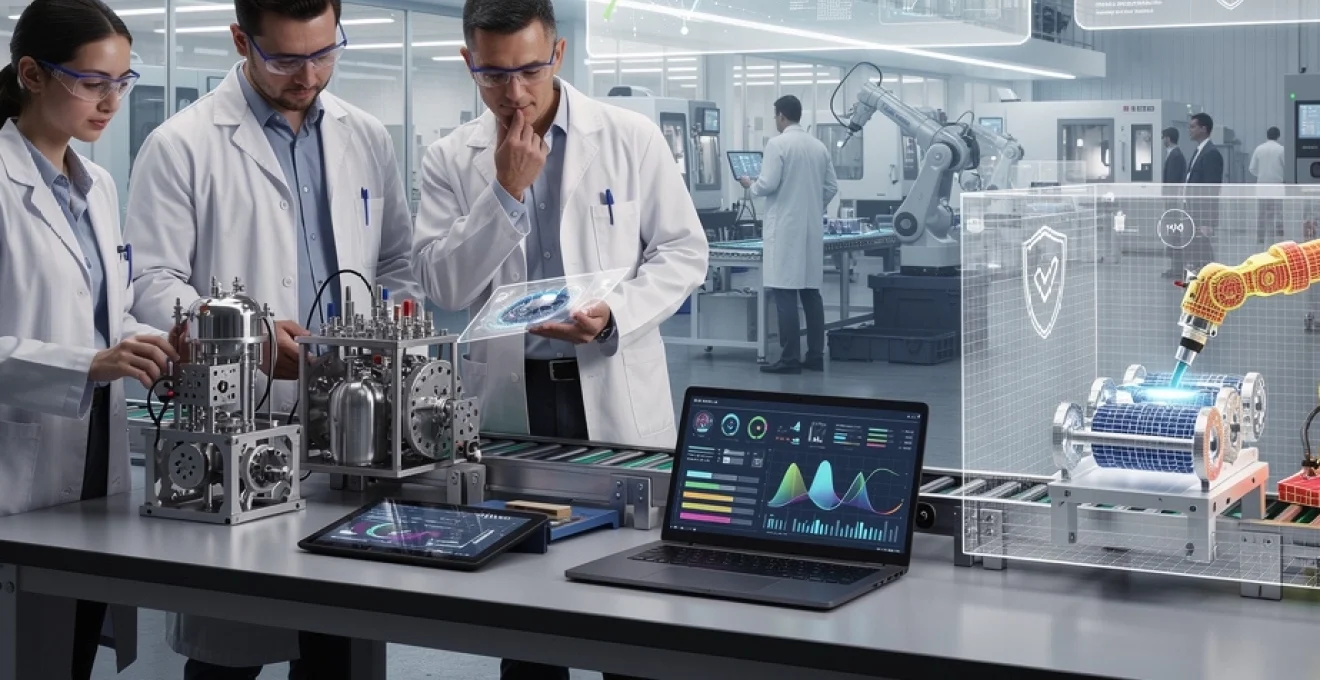
Industrial innovation stands at the crossroads of scientific rigour and commercial viability, where experimentation serves as the critical bridge between theoretical possibilities and market-ready solutions. Modern manufacturing environments face unprecedented challenges in balancing efficiency, sustainability, and competitiveness, making systematic experimentation not merely advantageous but absolutely essential for survival. The traditional approach of incremental improvements has given way to a more dynamic methodology where controlled testing, rapid iteration, and evidence-based decision-making drive breakthrough innovations across industries from aerospace to pharmaceuticals.
The fundamental shift from intuition-based development to data-driven experimentation has revolutionised how industrial organisations approach problem-solving and opportunity identification. This transformation requires sophisticated frameworks, cutting-edge technologies, and methodical approaches that can validate hypotheses while minimising operational risks. Understanding these mechanisms becomes crucial for any organisation seeking to maintain competitive advantage in today’s rapidly evolving industrial landscape.
Theoretical frameworks of industrial experimentation and innovation diffusion
The foundation of successful industrial experimentation rests upon well-established theoretical frameworks that guide organisations through the complex process of innovation development and deployment. These frameworks provide structured approaches to understanding how innovations emerge, evolve, and eventually become integrated into industrial practices.
Schumpeterian creative destruction theory in manufacturing contexts
Joseph Schumpeter’s concept of creative destruction finds particularly relevant application in modern manufacturing environments, where experimental processes continuously challenge existing paradigms. This theory suggests that innovation inherently involves the destruction of old methods, technologies, and business models to make way for superior alternatives. In manufacturing contexts, this manifests through experimental programmes that deliberately question established processes, seeking opportunities to replace outdated systems with more efficient alternatives.
Contemporary examples of Schumpeterian creative destruction through experimentation include the automotive industry’s shift towards electric vehicle production, where traditional combustion engine manufacturing lines undergo complete transformation. Experimental facilities serve as testing grounds for new assembly techniques, battery integration methods, and quality control processes that eventually replace decades-old manufacturing practices. The success of these transformations depends heavily on systematic experimentation that validates new approaches before full-scale implementation.
Rogers’ innovation adoption lifecycle within industrial R&D departments
Everett Rogers’ innovation diffusion theory provides valuable insights into how experimental findings spread through industrial organisations and broader industry networks. The adoption lifecycle—comprising innovators, early adopters, early majority, late majority, and laggards—directly influences how experimental programmes should be structured and communicated within industrial settings.
Industrial R&D departments typically contain representatives from each adoption category, creating both opportunities and challenges for experimental innovation implementation. Early adopters within engineering teams often champion experimental projects, while more conservative elements may resist unproven methodologies. Understanding these dynamics allows organisations to design experimental programmes that account for varying levels of risk tolerance and change readiness across different departmental functions.
The key to successful experimental innovation diffusion lies in creating compelling evidence that addresses concerns across all adoption categories. This requires robust data collection, comprehensive risk assessment, and clear communication of experimental results that demonstrate tangible benefits for different stakeholder groups within the industrial organisation.
Clayton christensen’s disruptive innovation model for process optimisation
Clayton Christensen’s disruptive innovation framework offers profound insights into how experimental programmes can identify and develop breakthrough technologies that initially appear inferior to existing solutions but eventually transform entire industries. In industrial contexts, this model helps organisations recognise when experimental approaches might lead to fundamental shifts in manufacturing paradigms.
Process optimisation through disruptive innovation often begins with experimental programmes targeting underserved market segments or applications where existing solutions prove inadequate. These experiments frequently involve simpler, more cost-effective approaches that may initially offer lower performance but provide other advantages such as accessibility, ease of use, or significantly reduced costs.
The most successful industrial innovations often emerge from experimental programmes that initially appear to offer inferior performance compared to established solutions, but provide unique advantages that eventually prove transformative.
Manufacturing organisations implementing Christensen’s model focus their experimental efforts on identifying performance metrics that differ from traditional industry standards. This approach has proven particularly effective in sectors such as 3D printing, where initial experimental programmes produced components with lower strength characteristics than traditional manufacturing but offered unprecedented design flexibility and customisation capabilities.
Open innovation paradigms and henry chesbrough’s knowledge transfer mechanisms</h3
Chesbrough’s open innovation paradigm reframes experimentation as a boundary-spanning activity, where ideas, technologies, and even partially developed prototypes flow between firms, universities, suppliers, and startups. Instead of relying solely on internal R&D, industrial organisations use external partnerships, licensing agreements, and joint ventures to broaden their experimental portfolio. This approach accelerates industrial innovation by allowing companies to test more hypotheses at lower cost and with reduced time-to-market, especially in complex manufacturing ecosystems.
Knowledge transfer mechanisms such as technology scouting, co-development agreements, and IP marketplaces enable industrial firms to tap into external experimentation results rather than duplicating efforts internally. For example, a chemical manufacturer might license a catalysis technology developed in academia and integrate it into its own pilot plants for process validation. By combining internal experimentation capabilities with external knowledge inflows, organisations can build more robust innovation pipelines and de-risk large-scale industrial experiments.
Laboratory-to-factory scaling methodologies and pilot programme implementation
Translating laboratory discoveries into robust, factory-ready processes is one of the most challenging aspects of industrial experimentation. Scale-up introduces new physical constraints, safety considerations, and economic realities that are often invisible in controlled lab environments. To navigate this transition, industrial organisations rely on structured methodologies, pilot programmes, and standardised maturity models that guide innovations from early-stage concepts to fully qualified manufacturing systems.
Stage-gate process development from TRL 4 to TRL 9 manufacturing readiness
The combination of Technology Readiness Levels (TRLs) and stage-gate processes provides a clear roadmap for industrial experimentation as it moves toward commercial deployment. Between TRL 4 (validation in a lab environment) and TRL 9 (proven in operational use), innovations must pass through multiple gates where technical, financial, and regulatory criteria are rigorously evaluated. Each gate acts as a decision point, determining whether an experiment should be scaled, redirected, or terminated.
In practice, industrial firms design experiments that are explicitly aligned with the requirements of each TRL step. For instance, at TRL 5 and TRL 6, pilot-scale facilities are often built to emulate real production environments while maintaining flexibility for parameter variation. By the time a technology reaches TRL 7 and beyond, experimentation focuses on reliability, repeatability, and integration with existing production assets, ensuring that the transition to TRL 9 manufacturing readiness is both safe and economically justified.
Design of experiments (DOE) applications in industrial process validation
Design of Experiments (DOE) provides a statistically robust framework for understanding how multiple process variables interact to impact product quality and production efficiency. Rather than changing one factor at a time, industrial engineers use DOE to systematically vary several parameters—such as temperature, pressure, and feed rate—according to carefully planned experimental matrices. This approach reveals interaction effects and nonlinear behaviours that are critical for reliable process scale-up.
During industrial process validation, DOE helps organisations identify optimal operating windows and critical control points with minimal experimental runs. For example, in pharmaceutical manufacturing, factorial and response surface designs are commonly used to define the design space required by regulatory authorities. By embedding DOE into validation protocols, companies can create data-driven justifications for process settings, reducing variability and strengthening the overall quality management system.
Minimum viable product (MVP) strategies for industrial equipment prototyping
While MVP concepts originated in software development, they have become increasingly relevant for industrial equipment prototyping and manufacturing innovation. An industrial MVP might be a simplified machine, a partial production cell, or a retrofitted line that demonstrates core functionality without incorporating every desired feature. The goal is to generate rapid, real-world feedback on usability, reliability, and integration before committing to full-scale capital expenditure.
By treating industrial equipment prototypes as MVPs, organisations can run focused experiments that answer specific questions: Does the new robotic cell reduce cycle time by the expected margin? Can operators interact with the new HMI without extensive retraining? These MVP-oriented experiments shorten development cycles and help avoid costly over-engineering. They also foster a culture where learning from small, controlled failures is viewed as a strategic asset rather than a liability.
Statistical process control integration during experimental phase transitions
As industrial experimentation progresses from lab to pilot to full production, Statistical Process Control (SPC) becomes essential for maintaining stability while changes are introduced. SPC tools—such as control charts, capability indices, and trend analyses—enable engineers to distinguish between normal process variation and signals that indicate a genuine shift in performance. Integrating SPC early in the experimental lifecycle strengthens the evidence base for each scale-up decision.
During phase transitions, such as moving from pilot runs to limited commercial production, SPC provides real-time insight into whether new processes behave as expected under industrial conditions. For instance, introducing a new heat treatment profile might initially show wider variation in hardness or microstructure, which SPC can quickly highlight. By combining SPC with structured experimentation, organisations can make more confident go/no-go decisions and fine-tune process parameters without compromising product quality or safety.
Digital twin technologies and virtual experimentation platforms
Digital twin technologies have transformed how industrial organisations plan, execute, and interpret experiments. A digital twin—a high-fidelity virtual replica of a physical asset or process—allows engineers to test scenarios that would be too risky, costly, or time-consuming in the real world. As computing power and simulation tools advance, virtual experimentation platforms are becoming central to industrial innovation strategies, from early design decisions to predictive maintenance programmes.
ANSYS fluent computational fluid dynamics for process simulation
ANSYS Fluent and similar Computational Fluid Dynamics (CFD) tools enable detailed simulation of fluid flow, heat transfer, and chemical reactions within industrial equipment. By creating virtual models of reactors, furnaces, or ventilation systems, engineers can experiment with different geometries, inlet conditions, and operating parameters before any physical hardware is built. This significantly reduces the number of physical prototypes required and accelerates process optimisation.
For example, in process industries such as oil and gas or specialty chemicals, CFD-based experimentation can identify dead zones, hotspot formations, or inefficient mixing patterns that would be difficult to observe directly. By adjusting design parameters in ANSYS Fluent and running multiple simulation iterations, organisations can converge on optimal configurations and then validate them with a smaller set of targeted physical experiments. This hybrid approach of virtual and real-world experimentation saves both time and capital while improving process safety and performance.
Siemens NX and dassault systèmes SIMULIA for product development testing
In discrete manufacturing sectors, Siemens NX and Dassault Systèmes SIMULIA provide integrated environments for designing, simulating, and testing mechanical components and assemblies. These platforms support structural, thermal, and fatigue analyses that mimic real-world operating conditions, enabling engineers to experiment with different materials, geometries, and load cases digitally. As a result, potential failure modes can be detected and mitigated long before physical testing begins.
Using these tools, product development teams can run design-of-experiments campaigns entirely within the virtual environment, changing dimensional parameters or material properties and tracking how each variation affects performance. Imagine testing hundreds of bracket geometries for vibration resistance without machining a single part. By converging on the most promising configurations virtually, organisations can reserve physical experiments for final validation and certification, thereby shortening development cycles and reducing prototyping costs.
Machine learning algorithms in predictive maintenance experimentation
Machine learning has opened new frontiers for experimentation in predictive maintenance, where algorithms learn from historical and real-time data to forecast equipment failures. Industrial organisations now treat predictive models themselves as experimental artefacts, iteratively improving feature sets, model architectures, and alert thresholds. Each model version is tested in controlled conditions—often in shadow mode—before being trusted to trigger maintenance interventions.
What does this look like in practice? A manufacturer may deploy multiple machine learning models on the same compressor fleet, experimenting with different combinations of vibration, temperature, and acoustic signals as inputs. Model performance is then evaluated based on false alarm rates, lead time before failure, and maintenance cost savings. By treating predictive maintenance as a continuous experimentation ecosystem, companies can progressively improve uptime, extend asset life, and refine maintenance strategies based on data-driven evidence rather than fixed schedules.
Iot sensor networks for real-time industrial experimental data collection
Internet of Things (IoT) sensor networks form the backbone of modern industrial experimentation, providing the real-time data streams needed to evaluate hypotheses and adjust processes on the fly. Distributed sensors capture variables such as pressure, torque, humidity, and energy consumption at high resolution, turning production lines into living laboratories. This granular visibility enables experiments that would have been impossible with periodic manual measurements alone.
In an industrial setting, an IoT-enabled pilot line can be configured to run A/B tests on different process recipes, automatically logging data to central analytics platforms. Engineers can then quickly compare performance across variants, using dashboards and automated alerts to identify statistically significant improvements. By combining IoT data collection with advanced analytics and digital twins, organisations create a powerful feedback loop where every production run contributes to ongoing industrial innovation.
Cross-industry innovation transfer mechanisms and knowledge spillovers
Many of the most impactful industrial innovations emerge not from within a given sector, but from ideas and technologies imported from other industries. Cross-industry innovation transfer leverages knowledge spillovers, where experimental practices, materials, or digital tools tested in one context are adapted and refined in another. This process is analogous to biological cross-pollination: when ideas travel, they can produce unexpected and highly valuable outcomes.
Concrete examples abound. Techniques from semiconductor manufacturing, such as cleanroom protocols and precision metrology, have heavily influenced advanced pharmaceutical and battery production. Likewise, automotive just-in-time logistics and modular assembly concepts have been adapted for aerospace and heavy equipment manufacturing. To systematise such transfers, leading organisations establish formal technology scouting functions, participate in cross-sector consortia, and encourage engineers to attend conferences outside their traditional domains, turning external experimentation into internal advantage.
Regulatory compliance and risk management in industrial experimentation
Industrial experimentation operates within strict regulatory and safety frameworks, especially in sectors such as pharmaceuticals, energy, and food processing. Balancing the need for rapid innovation with compliance requirements demands a disciplined approach to risk management. Every experimental change—whether to a process parameter, raw material, or equipment configuration—must be assessed for its potential impact on worker safety, environmental performance, and product conformity.
To manage this, organisations integrate formal risk analysis methods such as HAZOP, FMEA, and Layer of Protection Analysis into their experimental design processes. Experiments are categorised based on risk level, with higher-risk trials requiring more extensive review, contingency planning, and monitoring. Regulatory guidelines, such as Good Manufacturing Practice (GMP) or ISO standards, are treated not as obstacles but as boundary conditions that shape how experiments are conceived and executed. By embedding compliance thinking into the experimentation lifecycle, companies avoid costly rework, recalls, or legal issues while still advancing industrial innovation.
Performance metrics and ROI assessment for industrial innovation experiments
Without clear metrics and robust ROI assessment, even the most sophisticated experimental programmes risk being viewed as cost centres rather than strategic investments. Industrial organisations therefore define quantitative and qualitative indicators that link experimentation outcomes to business value. Common metrics include cycle time reduction, yield improvement, energy savings, defect rate reduction, and maintenance cost avoidance, alongside softer indicators such as learning speed and employee engagement in innovation activities.
ROI assessment for industrial innovation experiments often requires a portfolio perspective rather than evaluating each experiment in isolation. Some trials will fail to deliver immediate benefits yet generate critical insights that inform future successes. To capture this, leading companies track not only direct financial returns but also knowledge creation, IP generation, and capability building. By establishing transparent governance structures, clear success criteria, and regular review cycles, organisations can continually refine their experimental strategies and ensure that industrial experimentation remains aligned with long-term competitive advantage.