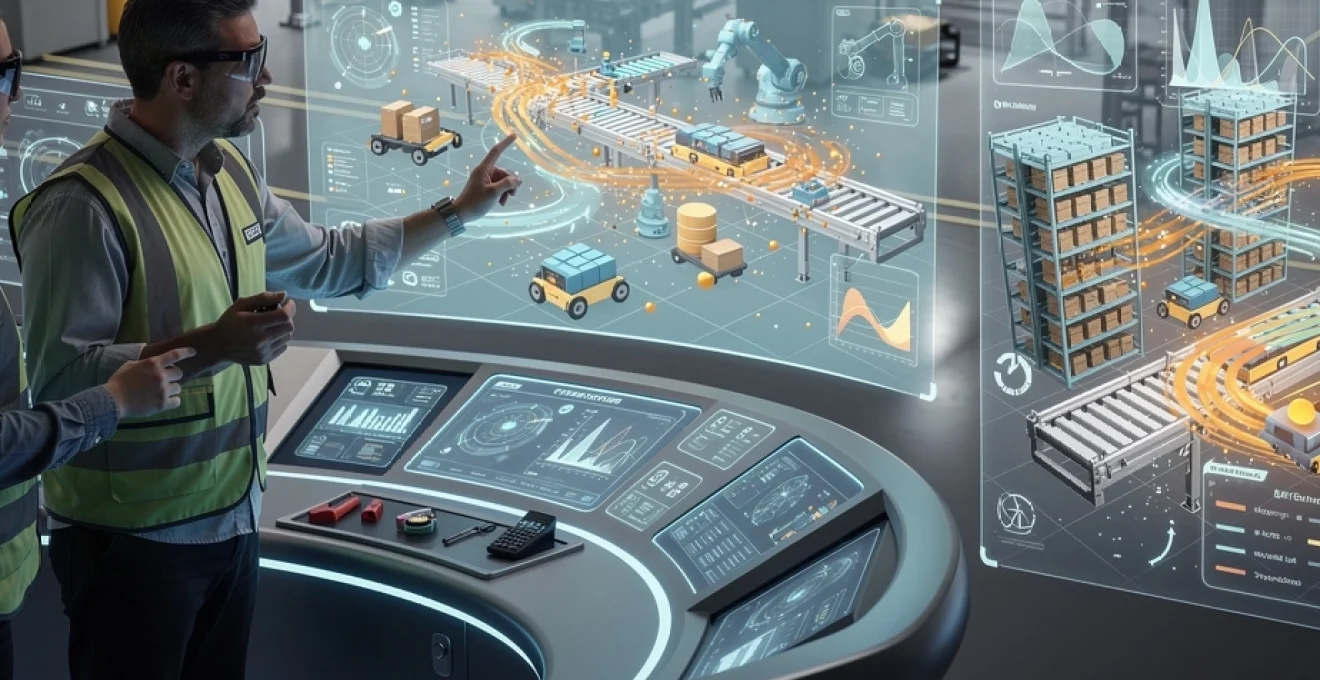
Manufacturing and logistics operations face unprecedented pressure to deliver higher throughput, lower costs, and improved reliability. Traditional trial-and-error approaches to process design have become untenable in an environment where downtime can cost thousands per minute and market windows close rapidly. Simulation technologies have emerged as transformative tools that allow engineers to test, validate, and optimise automated systems before a single component is installed on the production floor. By creating accurate digital representations of complex manufacturing environments, you can identify bottlenecks, test alternative configurations, and predict system behaviour under various operating conditions—all without disrupting existing operations or committing capital to unproven designs.
The financial implications are substantial. Recent industry studies indicate that companies implementing simulation-driven design methodologies reduce their product development cycles by 30-40% whilst simultaneously decreasing costly design errors by up to 60%. These statistics reflect a fundamental shift in how automation projects are conceived, validated, and deployed. Rather than discovering integration issues during commissioning—when modification costs escalate dramatically—simulation enables you to address potential problems during the design phase, where changes require only computational resources rather than physical rework.
Discrete event simulation fundamentals in process automation design
Discrete Event Simulation (DES) represents the cornerstone methodology for modelling automated manufacturing and logistics systems. Unlike continuous simulation approaches, DES focuses on systems where state changes occur at specific moments—when a part arrives at a workstation, when a robot completes an assembly operation, or when an AGV reaches its destination. This event-driven paradigm aligns naturally with the operational characteristics of automated processes, making DES particularly effective for analysing throughput, queue dynamics, and resource utilisation patterns.
When you construct a DES model, you’re essentially creating a virtual laboratory where time can be compressed, expanded, or repeated as needed. A production scenario that would take weeks to observe in reality can be simulated in minutes, allowing you to explore thousands of configurations in the time traditionally required to test a handful. The statistical rigour inherent in DES provides confidence intervals around key performance metrics, enabling data-driven decision-making rather than reliance on intuition or incomplete information. Modern DES platforms incorporate sophisticated animation capabilities that allow stakeholders without technical backgrounds to understand system behaviour, facilitating consensus-building around proposed automation investments.
Monte carlo methods for stochastic process modelling
Real-world manufacturing environments rarely exhibit perfectly predictable behaviour. Machine cycle times vary, material properties fluctuate, and unexpected events disrupt planned operations. Monte Carlo simulation techniques address this inherent uncertainty by incorporating probability distributions into process models. Rather than assuming a single deterministic outcome, Monte Carlo methods generate thousands of scenarios by randomly sampling from defined distributions, producing a comprehensive picture of possible outcomes and their associated likelihoods.
When designing automated systems, you can apply Monte Carlo approaches to model variability in processing times, failure rates, quality outcomes, and demand patterns. For instance, if historical data shows that a robotic welding operation completes in 45-55 seconds following a normal distribution, your simulation can randomly generate cycle times within this range for each operation. After running perhaps 10,000 iterations, you obtain statistically significant insights into system performance under realistic conditions, including worst-case scenarios that deterministic models might overlook.
Agent-based simulation for Multi-Robot coordination systems
As automation systems incorporate increasing numbers of autonomous mobile robots, AGVs, and collaborative robots, the complexity of their interactions grows exponentially. Agent-based simulation (ABS) provides a powerful framework for modelling these decentralised systems where individual entities make decisions based on local information and interaction rules. Each agent in the simulation operates according to defined behavioural parameters, and system-level patterns emerge from these individual actions rather than being explicitly programmed.
This bottom-up approach proves particularly valuable when you’re designing flexible manufacturing systems with multiple robots sharing workspace and resources. Traditional analytical methods struggle with the combinatorial complexity of possible interactions, but ABS handles this naturally by simulating each robot as an independent agent with its own decision logic, path-planning algorithms, and collision-avoidance behaviours. The resulting simulation reveals congestion points, identifies opportunities for improved coordination protocols, and helps you optimise fleet sizing without relying on oversimplified assumptions about robot behaviour.
System dynamics approaches in throughput
optimisation extends this event-focused view by modelling the flow of materials, information, and capacity constraints at a higher, often more continuous level. While DES zooms in on individual events, system dynamics looks at feedback loops, accumulations (stocks), and delays that drive overall throughput behaviour. By combining both approaches, you can understand not only where queues form but also why they persist over time, and which policy levers—such as batch sizes, WIP limits, or staffing rules—will most effectively relieve them.
In practice, system dynamics is particularly useful when you want to evaluate strategic scenarios such as demand surges, product mix changes, or the gradual introduction of new automation. Instead of scripting every individual part movement, you model aggregate flows and their interactions, much like studying traffic density on a motorway rather than the trajectory of each car. This allows you to test capacity expansion strategies, kanban policies, or shift patterns and see how they influence long-term throughput, inventory levels, and lead times. When embedded into your process automation design, system dynamics simulation becomes a powerful tool for aligning day-to-day control logic with long-term operational goals.
Petri net modelling for workflow validation and deadlock prevention
Petri nets provide a mathematically rigorous yet visually intuitive method for modelling concurrent workflows in automated processes. Places, transitions, and tokens represent system states, events, and resource/part availability, respectively, allowing you to capture complex routing logic, synchronisation points, and shared resource usage. Unlike informal flowcharts, Petri nets support formal analysis techniques that can prove properties such as reachability, liveness, and boundedness—critical when you need high confidence that your automated line will not lock up under specific conditions.
Deadlock prevention is one of the major reasons to apply Petri net modelling in automated manufacturing and logistics systems. For example, when multiple robots, conveyors, and buffers interact, subtle circular wait conditions can emerge that are difficult to detect with intuition alone. By analysing the Petri net representation of your workflow, you can identify configurations where tokens (representing parts or jobs) become trapped, signifying a deadlock. You can then refine control logic, buffer capacities, or resource reservation rules in the simulation before deploying PLC logic or robot programs, dramatically reducing commissioning risk.
Digital twin integration with AutoMod and siemens plant simulation software
The concept of the digital twin takes simulation beyond offline planning and into continuous, real-time decision support. In a digital twin architecture, detailed models built in tools such as AutoMod or Siemens Plant Simulation remain synchronised with the live factory, reflecting current states of machines, conveyors, AGVs, and inventories. This allows you to use the same simulation model for process design, what-if analysis, and day-to-day operational optimisation, rather than maintaining separate, static models that quickly become obsolete.
By coupling discrete event simulation with live data streams, you transform your automated process model into a predictive engine. Instead of asking, “What will our throughput be if we add a new robot?” you can ask, “Given today’s order book and machine conditions, where will bottlenecks appear in the next two hours?” This is where digital twins begin to justify their investment: they reduce firefighting by giving planners and control engineers a look-ahead window into how automated systems will behave under near-term conditions, enabling proactive interventions.
Real-time data synchronisation between physical and virtual manufacturing systems
Robust real-time synchronisation between physical operations and their virtual counterparts relies on a carefully designed data architecture. Typically, PLCs, MES, and SCADA systems publish status information—such as machine states, queue lengths, and sensor readings—through OPC UA, MQTT, or similar protocols. Simulation software like Siemens Plant Simulation or AutoMod subscribes to these streams, updating model parameters and object states at defined intervals so that the digital twin remains aligned with the shop floor.
Achieving useful synchronisation is not just about raw data connectivity; it also requires thoughtful mapping between physical signals and simulation abstractions. For example, a simple sensor input may need to be translated into part arrivals at a virtual station, or an aggregated OEE value may feed into stochastic machine uptime distributions in the model. Latency and data quality also matter: if your virtual manufacturing system lags reality by several minutes or ingests noisy signals, predictions will quickly lose value. Establishing clear update cycles, data validation rules, and fallback behaviours helps ensure that real-time simulation remains a trustworthy foundation for automated decision support.
Flexsim 3D visualisation for conveyor network layout optimisation
Complex conveyor networks can be surprisingly difficult to reason about using 2D layouts alone, especially when you incorporate elevation changes, crossovers, accumulation zones, and diverter logic. FlexSim’s 3D visualisation capabilities bring these networks to life, allowing you and your stakeholders to “walk through” proposed configurations and immediately grasp how parts will flow through the system. This immersive perspective is particularly valuable when explaining design trade-offs to non-technical decision-makers or evaluating ergonomic and safety implications.
From a performance standpoint, FlexSim enables rapid experimentation with conveyor speeds, routing rules, sensor placement, and accumulation strategies. You can test different line balancing approaches or buffer allocations and visually observe where congestion forms or where conveyors run underutilised. The result is a more efficient conveyor layout that supports higher throughput and smoother integration with robots or manual workstations, all validated virtually before steel is cut. In many projects, this 3D validation step prevents costly rework caused by overlooked interferences or unrealistic clearance assumptions.
Anylogic multimethod simulation for warehouse automation scenarios
Modern warehouses increasingly combine automated storage and retrieval systems (AS/RS), shuttle systems, AMRs, sorters, and human pickers in a tightly orchestrated environment. AnyLogic’s multimethod simulation—mixing discrete event, agent-based, and system dynamics in one model—offers a natural way to capture this complexity. You can use DES to handle order processing and queueing, ABS to model individual robots, pickers, and pallets, and system dynamics to represent higher-level inventory flows and demand patterns.
This flexibility is especially valuable when you are evaluating different warehouse automation scenarios such as adding a new shuttle aisle, changing slotting strategies, or introducing zone picking with collaborative robots. Rather than building separate models for each aspect, you maintain a single integrated representation that covers resource behaviour, control logic, and long-term dynamics. With this holistic view, you can answer strategic questions like, “How will this AS/RS configuration respond to seasonal peaks?” or “What is the optimal fleet size for AMRs in this building layout?” and back up automation investments with robust performance forecasts.
Arena simulation software in bottleneck identification and cycle time reduction
Arena has long been a staple tool for process analysts looking to improve manufacturing and logistics performance through discrete event simulation. Its strength lies in providing a clear, process-oriented view of how entities flow through automated and semi-automated systems. By instrumenting models with key performance indicators—such as average cycle time, queue lengths, resource utilisation, and on-time completion rates—you can quickly pinpoint where bottlenecks and inefficiencies originate.
In the context of designing more efficient automated processes, Arena is particularly effective for evaluating incremental changes. What happens if you add a parallel workstation, modify batching rules, or adjust maintenance intervals? By running controlled experiments within Arena, you can quantify the impact of each design alternative before making changes in the real system. This evidence-based approach often reveals that relatively minor adjustments—such as re-sequencing tasks or adjusting dispatch rules—can deliver significant cycle time reductions without large capital outlays.
Parametric analysis and design of experiments for robotic process automation
Robotic process automation in manufacturing—whether involving industrial robots, cobots, or AMRs—offers a wide design space of parameters: path trajectories, speeds, acceleration profiles, buffer sizes, task allocation rules, and more. Parametric analysis allows you to systematically vary these inputs within your simulation model to understand their influence on throughput, utilisation, energy consumption, and safety margins. Instead of relying on ad hoc tuning, you explore structured ranges and relationships, revealing sensitive parameters where small changes yield large performance differences.
Design of Experiments (DoE) techniques elevate this approach by defining statistically valid experiment plans that minimise the number of simulation runs needed to draw reliable conclusions. Factorial designs, Latin hypercube sampling, or Taguchi methods help you screen high-impact variables and identify robust settings that perform well under variability. For instance, you might use DoE in a Plant Simulation or FlexSim model to determine the combination of robot cycle time, buffer capacity, and pallet pattern that minimises average cycle time while keeping robot utilisation below a defined threshold. By embedding DoE into your simulation-driven design workflow, you transform automation engineering from a trial-and-error exercise into a disciplined optimisation process.
Predictive maintenance scheduling through Simulation-Driven failure mode analysis
Automation systems may be designed for peak performance, but their real-world efficiency hinges on how well you manage equipment degradation and failures. Predictive maintenance aims to intervene just before performance drops or failures occur, balancing availability with maintenance cost. Simulation adds a powerful dimension to this strategy by allowing you to test different maintenance policies, failure mode scenarios, and spare part strategies before applying them on the shop floor. You can ask, for example, “What is the impact on line availability if we switch from time-based to condition-based servicing of our conveyors?” and obtain quantified answers.
By combining reliability data, stochastic failure models, and realistic production schedules, simulation-driven failure mode analysis reveals the hidden interactions between maintenance windows, buffer capacities, and production targets. This is particularly important in highly automated assembly lines where a single piece of equipment can become a critical single point of failure. Through virtual experimentation, you can adjust maintenance frequencies, crew sizes, and planning rules until you identify a schedule that maximises uptime while respecting resource constraints.
Weibull distribution modelling for equipment lifecycle forecasting
The Weibull distribution is a workhorse in reliability engineering because it can represent a wide range of failure behaviours—from early “infant mortality” to wear-out failures. When you fit Weibull parameters to historical failure data for robots, conveyors, or sensors, you obtain a probabilistic model of equipment life that can be embedded directly into your simulation. Each virtual machine then fails according to realistic distributions rather than arbitrary mean time to failure values, giving you a more accurate picture of availability and downtime patterns.
Within your automated process simulation, you can use these Weibull-based models to forecast how failure risks evolve over time and to evaluate competing replacement or overhaul strategies. For example, should you replace a critical actuator after 15,000 cycles or 20,000 cycles? By running long-horizon simulations with different thresholds, you see how each policy affects overall throughput, maintenance workload, and spare parts consumption. This allows you to align maintenance decisions with business objectives, instead of relying solely on generic OEM recommendations.
Condition-based monitoring integration with SCADA systems
Condition-based monitoring (CBM) leverages real-time sensor data—vibration, temperature, current draw, cycle counts—to infer the health of equipment and trigger maintenance when degradation is detected. Integrating CBM with SCADA and simulation closes the loop between detection and decision-making. SCADA collects and aggregates condition data, while your simulation model uses this information to update failure probabilities, remaining useful life estimates, and maintenance event triggers.
In practice, this means your digital twin does not operate on static failure assumptions; it reflects the actual wear state of your automated assets. You can then run short-term predictive simulations to assess whether upcoming production schedules are feasible given current equipment health, or whether you should bring forward maintenance to avoid unplanned downtime during a critical campaign. This kind of integration turns predictive maintenance from a reactive reporting tool into an active planning instrument.
Mean time between failures optimisation in automated assembly lines
Mean Time Between Failures (MTBF) is a familiar metric, but using it effectively in automated assembly lines requires more than aiming for the highest possible value. There is often a trade-off between MTBF, investment cost, and the complexity of redundancy. Simulation allows you to explore this trade-off quantitatively. By modelling different equipment options, redundancy schemes, and buffer capacities, you can search for configurations where the line-level availability is maximised for a given budget.
For example, you might compare a single high-reliability robot with a very long MTBF against two lower-cost robots in a redundant configuration. While the former looks attractive on paper, simulation may reveal that the redundant option delivers higher effective availability and smoother throughput under realistic failure patterns. Through such experiments, you move from component-level MTBF thinking to system-level reliability optimisation, ensuring that your automated processes achieve their target OEE in practice.
Machine Learning-Enhanced simulation for adaptive process control
As automated processes become more complex and data-rich, machine learning (ML) is increasingly used to augment traditional physics-based and rule-based simulation models. One common approach is to train surrogate models—fast ML approximations of detailed simulations—that can be queried in real time for control decisions. For instance, a neural network trained on thousands of simulated scenarios can predict expected queue lengths or energy consumption for a given set of control parameters in milliseconds, enabling adaptive process control strategies that would be infeasible with full-scale simulation alone.
Another powerful application lies in closed-loop optimisation. Reinforcement learning agents can interact with a simulation of your automated process, iteratively trying different control policies—such as dispatching rules for AGVs or dynamic speed adjustments for conveyors—and receiving performance-based rewards. Over time, they learn policies that outperform handcrafted rules, particularly in environments with high variability. When combined with robust verification and safety constraints, these ML-derived policies can then be transferred to real systems, delivering adaptive behaviour that continuously reacts to changing demand, machine states, and upstream/downstream conditions.
Verification and validation protocols for simulation model accuracy in industrial settings
No matter how visually impressive or sophisticated a simulation model appears, its value ultimately depends on accuracy and credibility. Verification and validation (V&V) protocols ensure that models of automated processes both are built correctly (verification) and represent reality adequately (validation). Verification focuses on eliminating implementation errors: checking that logic, event sequencing, and parameter values are consistent with specifications. Techniques include structured code reviews, step-by-step trace analysis, and simplified test cases where expected outcomes are known analytically.
Validation, in contrast, compares simulation outputs against real-world data or trusted benchmarks. For industrial automation, this might involve collecting time-stamped event logs, throughput figures, and utilisation metrics from existing lines and ensuring that the model reproduces them within an acceptable tolerance. Statistical tests, confidence intervals, and sensitivity analyses all play a role here. It is often useful to validate at multiple levels of detail—for example, first confirming that individual machine cycle time distributions match, then verifying that line-level throughput patterns align with historical performance.
Establishing formal V&V procedures also supports organisational trust and cross-team collaboration. When operations managers, maintenance engineers, and automation specialists can see documented evidence of model accuracy, they are more likely to rely on simulation results when making investment or scheduling decisions. In regulated industries, robust V&V documentation can even become part of compliance submissions. Ultimately, disciplined verification and validation transform simulation from an exploratory toy into a dependable engineering instrument for designing and operating highly efficient automated processes.