Manufacturing enterprises today operate in an environment where the distinction between business planning and shop floor execution has become increasingly blurred. The gap between what your enterprise resource planning system believes is happening and what’s actually occurring on the production line creates friction that manifests as inventory discrepancies, scheduling conflicts, and costly quality failures discovered hours after they begin. This disconnect isn’t merely an operational inconvenience—it represents a fundamental architectural challenge that separates high-performing manufacturers from those struggling with reactive, firefighting approaches to production management.
The integration of ERP and MES systems addresses this challenge by creating a bidirectional information flow that connects business-level planning with real-time production execution. When implemented properly, this integration transforms manufacturing operations from isolated functional silos into a unified, data-driven ecosystem where decisions at every level are informed by accurate, timely information. The benefits are measurable: manufacturers with integrated ERP-MES environments report inventory accuracy improvements exceeding 98%, scrap reduction approaching 47%, and the elimination of manual data re-entry that typically consumes dozens of hours weekly.
Understanding the architectural differences between ERP and MES platforms
The fundamental architectural distinction between ERP and MES systems reflects their differing operational mandates. ERP systems operate at the enterprise planning layer, managing financial transactions, procurement workflows, customer relationships, and inventory planning across the entire organisation. These platforms prioritise data consistency, transactional integrity, and reporting capabilities that support strategic decision-making over extended timeframes. The architecture typically emphasises relational database structures optimised for complex queries and batch processing operations.
MES platforms, conversely, function at the production execution layer where millisecond response times and real-time data capture define system requirements. These systems must track work orders as they progress through manufacturing operations, capture quality measurements at each process stage, monitor equipment performance continuously, and provide operators with immediate feedback. The architectural priorities shift towards low-latency data processing, event-driven workflows, and integration with industrial automation equipment. Understanding these foundational differences is essential when designing integration strategies that respect each system’s strengths whilst bridging their operational gaps.
ERP system architecture: SAP S/4HANA and oracle NetSuite data models
Modern ERP platforms like SAP S/4HANA leverage in-memory computing architectures that fundamentally reimagine how enterprise data is stored and processed. The HANA database eliminates the traditional distinction between transactional and analytical processing, enabling complex calculations and aggregations to occur directly on operational data without the latency traditionally associated with data warehouse extractions. This architecture supports real-time financial close processes and enables manufacturing planners to query current production status without impacting transactional performance.
Oracle NetSuite represents a cloud-native approach to ERP architecture, built from inception as a multi-tenant SaaS platform. The data model emphasises flexibility through customisable record types and extensible field structures, enabling manufacturers to adapt the system to industry-specific requirements without extensive custom development. The platform’s REST-based web services architecture facilitates integration with external systems including MES platforms, though manufacturers must carefully design data synchronisation patterns to account for the inherent latency in cloud-based transactions when production processes require sub-second response times.
MES layer functionality: siemens SIMATIC IT and rockwell FactoryTalk architecture
Siemens SIMATIC IT exemplifies the modular approach to MES architecture, offering distinct functional components for production execution, quality management, warehouse logistics, and energy monitoring. The platform’s service-oriented architecture enables manufacturers to implement specific modules aligned with immediate operational needs whilst maintaining the integration framework necessary for future expansion. The underlying data model employs ISA-95 compliant structures for equipment hierarchies, material definitions, and process segments, facilitating standardised integration with both shop floor automation and enterprise business systems.
Rockwell FactoryTalk takes a different architectural approach by tightly integrating MES functionality with the vendor’s broader industrial automation ecosystem. This integration extends from programmable logic controllers on the shop floor through supervisory control systems to enterprise-level manufacturing intelligence platforms. For manufacturers heavily invested in Rockwell automation infrastructure, this vertical integration simplifies data collection and reduces integration complexity. However, facilities with heterogeneous equipment environments may find the architecture less flexible when connecting diverse automation platforms.
ISA-95 hierarchical framework for manufacturing system integration</h3
Within this model, Level 4 systems such as ERP focus on business planning and logistics, while Level 3 systems such as MES manage manufacturing operations, including dispatching, detailed scheduling, and production tracking. Levels 0–2 encompass physical processes, sensing, and basic control. For ERP-MES integration, ISA-95 provides standardised object models for materials, equipment, personnel, and process segments, defining what data should be mastered where, and how it should move between levels. By aligning SAP S/4HANA, Oracle NetSuite, Siemens SIMATIC IT, and Rockwell FactoryTalk to this framework, you dramatically reduce custom point-to-point mappings and create a common language for all your manufacturing systems.
Adopting ISA-95 also clarifies responsibility boundaries. For example, ERP remains the system of record for customers, contracts, and high-level production orders, whereas MES owns detailed routing steps, machine states, and work-in-progress (WIP) status. When you design interfaces against these standard models instead of each application’s proprietary schema, you shorten implementation timelines and reduce integration maintenance costs. In practice, ISA-95 becomes the reference blueprint against which you can validate every interface you build, avoiding the gradual drift into undocumented, brittle integrations.
Real-time data processing requirements in shop floor vs enterprise systems
One of the biggest architectural tensions in ERP-MES integration lies in differing real-time requirements. Shop floor systems often need sub-second responses to machine events, operator inputs, and safety interlocks. MES applications must process high-frequency signals from PLCs, CNCs, and sensors, evaluate business rules, and present updated instructions to operators with minimal latency. This is why MES platforms typically rely on event-driven architectures, in-memory caches, and lightweight message brokers located close to the production network.
ERP platforms, by contrast, are optimised for transactional integrity and throughput rather than millisecond reaction times. Financial postings, MRP runs, and consolidated reporting usually operate in minutes or hours, not milliseconds. When integrating ERP and MES, you rarely want every machine event to trigger an immediate ERP transaction. Instead, you design aggregation and buffering layers so that MES can operate in real time while ERP receives summarised, validated data at appropriate intervals. Think of MES as the high-speed sensor cluster of the business, with ERP functioning as the central nervous system that processes and acts on consolidated signals.
Successful architectures define clear boundaries between “hard real-time” data needed for immediate control and “near real-time” or “batch” data sufficient for planning and costing. For example, machine status changes and interlock signals stay within MES and automation layers, while completed-operation confirmations, scrap counts, and labour bookings are pushed to ERP every few minutes or at key workflow milestones. By tuning these integration frequencies, you avoid overloading ERP with noisy data while still gaining the benefits of real-time production visibility.
Integration middleware technologies for ERP-MES connectivity
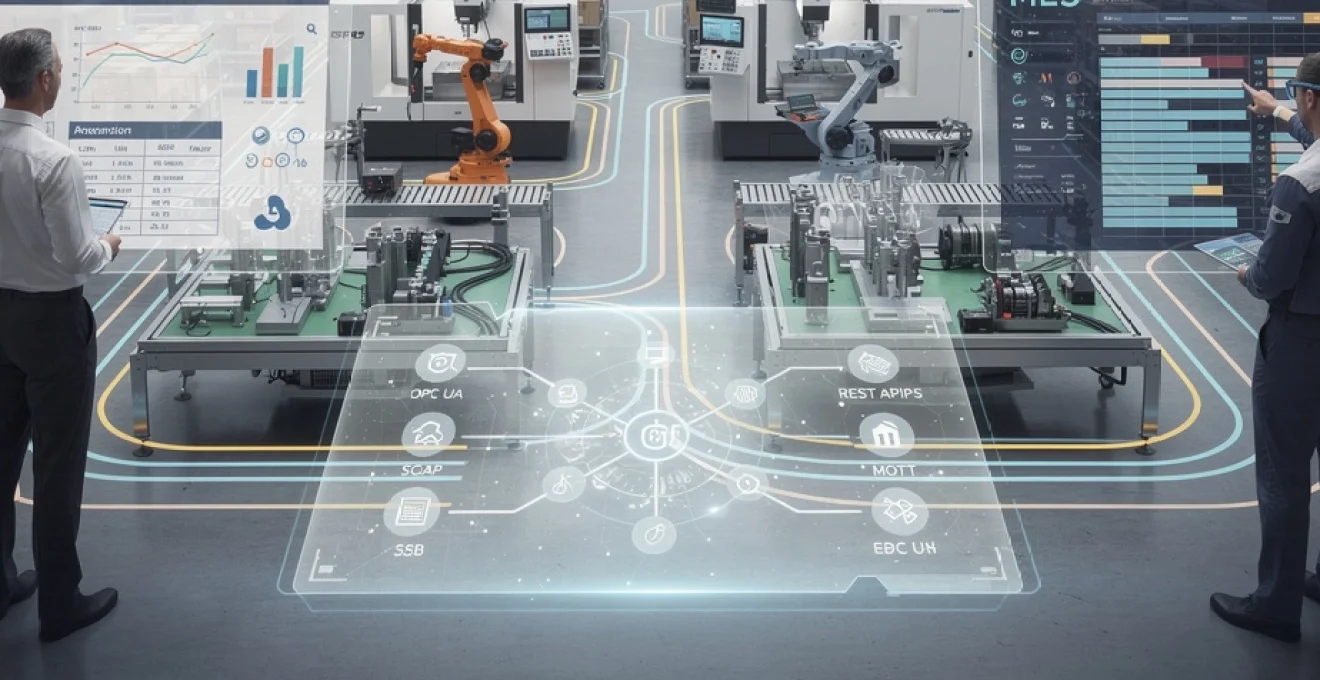
Bridging the gap between ERP and MES requires more than just point-to-point interfaces; it calls for a robust middleware layer that can translate, route, and secure data flows. As plants add more connected equipment and cloud-based applications, integration middleware becomes the backbone of seamless production management. Choosing the right combination of protocols and platforms—OPC UA, REST APIs, MQTT, and enterprise service buses—determines how scalable, resilient, and future-proof your architecture will be.
Rather than relying on tightly coupled custom code, manufacturers increasingly adopt integration platforms that decouple applications and abstract protocol details. This approach allows you to change an MES module, upgrade an ERP version, or add new IoT devices without rewriting the entire integration stack. The result is an environment where business and production systems can evolve independently while continuing to share trustworthy, production-critical data.
OPC UA protocol implementation for industrial data exchange
OPC UA (Open Platform Communications Unified Architecture) has become the de facto standard for secure, interoperable data exchange in industrial environments. Unlike older OPC standards that depended on Microsoft-specific technologies, OPC UA is platform-independent and supports rich information modelling. This makes it ideal for exposing machine states, process variables, and alarms in a structured way that MES and, indirectly, ERP can consume. When you implement OPC UA servers on PLCs, CNCs, or gateways, you create a consistent interface layer between physical equipment and higher-level systems.
From an ERP-MES perspective, OPC UA typically feeds the MES with accurate, time-stamped production data, which is then aggregated and forwarded to ERP. For example, an OPC UA server can expose tags such as CurrentPartID, CycleTime, and AlarmState that Siemens SIMATIC IT or Rockwell FactoryTalk read and transform into production events. These events trigger updates to work order status, OEE metrics, and quality checks. Because OPC UA supports encryption, authentication, and role-based access, it also forms a key part of a secure industrial data exchange strategy.
Practically, many manufacturers deploy OPC UA gateways to bridge legacy equipment into modern MES and ERP integrations without replacing controllers. This is particularly valuable in brownfield environments where machine lifecycles span decades. By standardising on OPC UA at the machine connectivity layer, you reduce the number of proprietary drivers and simplify long-term maintenance of your production data infrastructure.
REST API and SOAP web services for cross-platform communication
While OPC UA dominates at the equipment level, REST APIs and legacy SOAP web services remain the primary methods for exchanging data between business applications such as ERP and MES. Modern ERP systems like SAP S/4HANA and Oracle NetSuite expose rich RESTful endpoints for objects including production orders, materials, and inventory movements. MES platforms in turn provide APIs for recording production results, logging quality events, and retrieving WIP status. By orchestrating these APIs via integration middleware, you can create reliable, auditable workflows across the enterprise.
REST-based integration is particularly suited to stateless operations such as creating work orders, updating order status, or querying inventory balances. SOAP web services, although older, still feature prominently in many SAP and Oracle deployments, especially where advanced transactional guarantees or complex data types are needed. When mixing REST and SOAP, middleware plays the translator role, converting payload formats and handling authentication differences. The goal is to shield MES and ERP from each other’s protocol specifics, allowing each to evolve without breaking the overall integration.
To design resilient cross-platform communication, you should implement idempotent operations, robust error handling, and clear retry policies. For instance, if a MES-generated production confirmation fails to post to ERP due to a network glitch, the middleware must queue and retry without creating duplicate entries. Treating each integration call as part of a well-defined business process, rather than a simple data push, is what ultimately delivers stable, seamless production management.
Message queue telemetry transport (MQTT) in IoT-enabled production environments
As plants adopt Industrial IoT, MQTT has emerged as a lightweight messaging protocol well-suited to high-volume, distributed data collection. Its publish-subscribe model allows devices, gateways, and applications to exchange messages through a central broker, decoupling producers and consumers. On the shop floor, sensors, machine controllers, and edge gateways publish topics like line1/machine3/status or plantA/temperature. MES and analytics platforms then subscribe to the topics they need, without machines knowing anything about the consuming applications.
For ERP-MES integration, MQTT acts as the backbone for real-time telemetry that informs higher-level processes. MES can listen to MQTT topics, transform raw signals into production events, and forward summarised information to ERP. In environments with mobile devices, AGVs, and remote sites, MQTT’s low bandwidth requirements and efficient payloads provide a clear advantage. You can think of MQTT as the “circulatory system” carrying vital signs from your factory floor into the digital core of the business.
However, MQTT is not a replacement for transactional ERP integrations; it complements them. You still need APIs or message-based interfaces for master data changes, work order creation, and financial postings. The key is to design an architecture where MQTT handles streaming telemetry, while ERP and MES coordinate business transactions based on that data. When this balance is right, you gain real-time production visibility without compromising data integrity or overcomplicating your ERP landscape.
Enterprise service bus (ESB) architecture with MuleSoft and apache camel
To manage the growing web of interfaces between ERP, MES, PLM, WMS, and IoT platforms, many manufacturers implement an enterprise service bus (ESB). Tools such as MuleSoft and Apache Camel provide centralised routing, transformation, and orchestration capabilities. Instead of building dozens of direct connections, each system integrates once with the ESB, which then handles message flows using standardised canonical data models—often aligned to ISA-95. This greatly reduces integration complexity and improves visibility into end-to-end processes.
In an ESB-centric architecture, a new production order created in SAP S/4HANA is published as a message on the bus. The ESB transforms it into the appropriate format for Siemens SIMATIC IT and Rockwell FactoryTalk, routes copies as needed to planning or quality systems, and logs all transactions for auditing. When MES completes operations, it sends confirmations back through the ESB, which in turn updates ERP, triggers inventory movements, and notifies downstream applications. This hub-and-spoke model simplifies monitoring and troubleshooting compared to scattered custom scripts.
When using MuleSoft or Apache Camel, best practice is to separate transport concerns (protocols like HTTP, JMS, or MQTT) from business logic. Define reusable integration flows, shared data mappings, and consistent error handling policies. Over time, the ESB becomes a strategic asset: a catalogue of well-defined services that encapsulate your manufacturing processes, making future expansions—from new plants to additional MES modules—faster and less risky.
Synchronising production data flows between manufacturing execution and enterprise resource planning
Once the technical plumbing is in place, the real value of ERP-MES integration comes from well-designed data flows that mirror your actual production processes. Synchronising production data means more than exchanging files; it requires a shared understanding of how work orders, materials, inventory, quality records, and schedules move through your organisation. When these flows are aligned, you eliminate blind spots, reduce manual reconciliations, and give planners a single, trusted view of what is happening in real time.
To achieve this, manufacturers typically start by mapping end-to-end scenarios such as “order to production”, “material receipt to consumption”, and “inspection to release”. Each scenario identifies which system is the master for specific data elements, when ownership transfers, and what events trigger updates. By deliberately designing these handoffs between MES and ERP, you avoid the common pitfalls of duplicate records, asynchronous statuses, and conflicting KPIs across departments.
Bill of materials (BOM) synchronisation and work order cascading
In most architectures, ERP is the master for engineering and manufacturing bills of materials, as well as high-level production orders. These BOMs define which components are required, in what quantities and revisions, to build a finished product. MES, however, needs BOM data in a more granular, operation-centric form, associated with specific routing steps and work centres. BOM synchronisation ensures that when engineering updates a component or changes a revision in ERP, those changes cascade to MES before the next work order hits the shop floor.
Work order cascading follows a similar pattern. ERP creates a production order based on demand signals and MRP calculations, then releases it to MES as one or more detailed shop orders. MES may further decompose these into operation-level tasks, each linked to machines, tools, and inspection plans. When integration is well designed, this cascade is automatic: planners in ERP trigger releases, MES receives the data with correct BOMs and routings, and operators see up-to-date instructions without manual re-entry. This is where many manufacturers first see tangible gains in seamless production management.
To keep BOMs and work orders aligned, you should establish clear rules for revision control and effectivity dates. For example, a new component revision might only apply to orders released after a specific date or batch number. Integration logic must respect these rules to avoid mixing incompatible components or instructions. Regular reconciliation reports between ERP and MES BOMs can highlight discrepancies early, preventing them from turning into costly quality issues.
Inventory transaction management across warehouse and shop floor systems
Inventory accuracy is one of the most visible benefits of ERP-MES integration. Traditionally, ERP tracks inventory at storage-location level, while MES deals with material at work-centre or machine level. Without synchronisation, you end up with “phantom inventory” where ERP shows materials available but MES operators cannot find them, or vice versa. By integrating inventory transactions, you ensure that every material movement—issue to production, return to stock, scrap, or rework—is reflected consistently in both systems.
In a unified environment, MES records material consumption as operators scan barcodes, pull components from bins, or confirm operation completions. These events generate backflushing or real-time goods issues in ERP, decrementing stock and updating WIP balances. Conversely, when ERP posts goods receipts from purchasing or inter-plant transfers, MES receives visibility to newly available materials on the shop floor. The result is an end-to-end audit trail from supplier receipt through production use, enhancing both traceability and working capital control.
Designing this flow requires careful consideration of timing and granularity. Do you want ERP updated for every single component consumed, or only at operation completion? Should MES handle line-side kanban replenishment while ERP manages bulk warehouse stock? By answering these questions up front and encoding the rules in your integration, you avoid double counting, stockouts, and manual adjustment cycles that erode trust in your inventory figures.
Quality management data integration: deviation reports and non-conformance records
Quality management is another area where seamless ERP-MES integration pays dividends. MES typically captures in-process inspection results, SPC readings, and alarms at the point of manufacture. When tolerance limits are exceeded or defects are detected, MES generates deviation reports or non-conformance records. If these remain isolated within MES, your enterprise loses the ability to link quality outcomes back to suppliers, customers, and financial impact. Integrating quality data with ERP closes this loop.
In an integrated scenario, non-conformance events triggered in MES automatically create corresponding quality notifications or defect records in ERP. These records can block shipments, trigger supplier corrective action requests, or initiate internal CAPA processes. At the same time, ERP-originated quality requirements—such as inspection plans tied to specific customers or regulatory mandates—flow down into MES to ensure the correct checks occur at each operation. You gain full genealogy: which batch, which components, which line, and which operator contributed to each finished unit.
This level of integration is particularly important in regulated industries such as pharmaceuticals, aerospace, and medical devices, where traceability and compliance reporting are non-negotiable. By aligning deviation reports and non-conformance records across MES and ERP, you reduce the manual effort of compiling audit evidence and increase responsiveness when issues arise. Instead of scrambling to piece together spreadsheets, you have a single, connected view of your quality landscape.
Production scheduling alignment with material requirements planning (MRP)
ERP’s MRP engine determines what needs to be produced and when, based on demand forecasts, sales orders, and inventory positions. MES, on the other hand, knows the real-time capacity of machines, the current status of WIP, and the impact of unplanned downtime. Aligning production scheduling across these two domains prevents the classic situation where ERP plans an “ideal” schedule that the shop floor cannot realistically execute. Integration ensures that both planning and execution operate on a shared, up-to-date picture of constraints and priorities.
In practice, this means that MRP-generated planned and firmed orders in ERP are sent to MES along with required dates and quantities. MES then sequences these orders based on machine availability, setup optimisation, and operator shifts. As production progresses, MES feeds back actual start and finish times, changeover durations, and delays caused by material shortages or quality issues. ERP uses this feedback to adjust future MRP runs, refine lead times, and improve promise dates to customers.
Over time, this closed-loop scheduling process turns into a powerful continuous-improvement mechanism. Planners can compare planned vs actual performance, identify recurring bottlenecks, and adjust routings or capacity assumptions. You move from firefighting around missed orders to proactive management of constraints, which is one of the defining traits of seamless production management in modern manufacturing.
Master data governance strategies for unified ERP-MES environments
All of these integrations rely on consistent, well-governed master data. Without clear ownership and governance, even the most sophisticated middleware will simply propagate inconsistencies faster. Master data governance in a unified ERP-MES environment focuses on harmonising core objects—materials, work centres, resources, BOMs, routings, equipment hierarchies, and personnel records—so that every system uses the same identifiers and definitions.
Effective strategies start with defining a single system of record for each master data domain. For example, ERP may own material masters and customer records, while MES owns detailed machine states or operation codes. A cross-functional data governance board, including IT, operations, planning, and quality, establishes naming conventions, approval workflows, and change-control processes. Any change to critical data, such as a new material or routing, passes through a standard workflow that ensures downstream impact on MES, WMS, and other systems is assessed and managed.
Data quality monitoring is equally important. Regular audits, exception reports, and automated validation rules catch issues such as duplicate material codes, obsolete routings, or mismatched units of measure before they cause production disruptions. By investing in robust master data governance, you create the stable foundation on which reliable analytics, OEE dashboards, and predictive maintenance models depend. In a sense, clean master data is the “raw material” for digital transformation in manufacturing.
Real-time production monitoring through integrated analytics dashboards
Once ERP and MES are sharing accurate, timely data, the next logical step is to make that information visible through integrated analytics dashboards. These dashboards bring together operational and business metrics—OEE, throughput, scrap, labour utilisation, inventory turns, and on-time delivery—into a single view. Decision-makers at every level, from line supervisors to executives, can monitor performance and act quickly when trends deviate from plan.
Integrated dashboards also help bridge cultural gaps between departments. When finance, operations, and sales all look at the same set of KPIs derived from the same underlying data, conversations shift from debating numbers to solving problems. With modern BI tools and embedded analytics in ERP and MES, you can move from static, end-of-month reports to near real-time performance management, which is essential in volatile markets and complex supply chains.
Overall equipment effectiveness (OEE) calculation from combined data sources
OEE is a cornerstone metric for many manufacturers, measuring how effectively equipment is being used by combining availability, performance, and quality. Calculating OEE accurately requires data from both MES and ERP. MES typically provides machine run times, downtime reasons, cycle counts, and scrap quantities, while ERP adds context such as planned production times, order quantities, and product mix. When these data sources are integrated, you can compute OEE not just for individual machines, but for lines, products, and even customers.
For example, a drop in availability captured by MES may be tied in ERP to a specific product line with frequent changeovers. Integrated OEE analysis can reveal that a small tooling investment or a change in scheduling policy would deliver a disproportionate increase in throughput. Conversely, high performance but low quality might signal issues with a particular supplier’s material lot, visible in ERP’s purchasing and batch records. By fusing shop floor signals with enterprise context, OEE becomes a strategic tool rather than a standalone production metric.
To operationalise OEE, many manufacturers deploy role-based dashboards: operators see simple green/amber/red indicators and top downtime reasons, while managers see trends across plants and shifts with associated cost impacts. Because all views are derived from the same integrated dataset, improvement initiatives can be tracked from idea to financial outcome, reinforcing a culture of data-driven continuous improvement.
Power BI and tableau visualisation of cross-system manufacturing KPIs
Business intelligence tools such as Microsoft Power BI and Tableau have become popular choices for visualising manufacturing KPIs drawn from combined ERP and MES data. They excel at blending data from multiple sources—SQL databases, REST APIs, OPC UA historians, and CSV exports—into interactive dashboards. With properly modelled data, you can provide users with drill-down capabilities from high-level KPIs like on-time delivery or cost per unit, down to specific orders, lines, or batches that drove the result.
Typical cross-system dashboards might include tiles for OEE by line, scrap rate by product family, schedule adherence by plant, and inventory turns by warehouse. Behind each visual, Power BI or Tableau queries both ERP and MES datasets, often through a semantic layer or data warehouse that normalises structures and timestamps. Because these tools support row-level security and role-based access, you can safely expose sensitive financial or operational data to different user groups without losing control.
To get the most from these platforms, it’s important to invest in a consistent data model and KPI definitions. If “on-time delivery” means one thing in ERP and another in MES, your dashboards will confuse rather than clarify. Establishing a central analytics team or centre of excellence to manage these definitions ensures that as you add more plants, products, or systems, the visualisations remain coherent and trustworthy.
Predictive maintenance algorithms using historical ERP and live MES data
Predictive maintenance is a natural extension of integrated ERP-MES analytics. By combining historical maintenance records and spare-parts consumption from ERP with real-time condition data from MES and machine sensors, you can move from reactive or time-based maintenance to condition-based interventions. Machine learning models can identify patterns in vibration, temperature, cycle counts, and quality drift that precede failures, enabling you to schedule work before breakdowns occur.
ERP contributes important context: planned production schedules, maintenance windows, technician availability, and the cost of downtime for specific assets. MES and IIoT platforms provide the live telemetry needed to trigger or refine predictions. Together, they enable algorithms that can answer questions like, “Given the current production load and condition signals, when is the optimal time to service this machine with minimal impact on delivery commitments?”
Implementing predictive maintenance need not be an all-or-nothing project. Many manufacturers start with a pilot on a handful of critical assets, using basic models and existing sensor data. As confidence grows, they extend coverage, refine features, and integrate recommendations into standard maintenance and scheduling workflows in ERP. The payoff often includes reduced unplanned downtime, lower spare-part inventory, and longer asset lifecycles—benefits that directly support seamless, reliable production management.
Cybersecurity frameworks for protecting integrated manufacturing systems
As ERP and MES systems become more tightly integrated and connected to IIoT devices, cybersecurity moves from an IT concern to a core operational risk. A successful attack on integrated manufacturing systems can halt production, corrupt quality records, or expose sensitive customer and supplier data. Protecting these environments requires a layered approach that spans industrial networks, applications, and data in transit between them.
Modern cybersecurity strategies for manufacturing lean heavily on established frameworks and standards, coupled with practical controls such as network segmentation, secure remote access, and continuous monitoring. Because ERP, MES, and automation layers often come from different vendors and eras, one of the key challenges is implementing consistent security policies across heterogeneous landscapes without disrupting operations.
IEC 62443 industrial network security standards implementation
IEC 62443 has emerged as the primary standard for securing industrial automation and control systems. It defines security requirements for everything from individual components to entire systems and organisations. For integrated ERP-MES environments, IEC 62443 provides guidance on segmenting networks into zones (such as enterprise IT, DMZ, MES, and control networks) and controlling conduits between them. This minimises the spread of potential intrusions and limits the attack surface available to adversaries.
Implementing IEC 62443 often involves creating dedicated industrial DMZs where application servers, OPC UA gateways, and integration middleware reside, isolating them from both the open internet and the most critical control systems. Firewalls, intrusion detection systems, and strict access controls regulate traffic between zones. Vendors supplying MES, ERP, and automation solutions are increasingly required to demonstrate compliance with relevant IEC 62443 parts, giving manufacturers more confidence in the security posture of their integrated stacks.
Because cyber threats evolve quickly, IEC 62443 adoption is not a one-time project but an ongoing programme. Regular risk assessments, patch management processes, and incident response plans ensure that as you add new connections or upgrade systems, your defences keep pace. Integrating security monitoring data into your broader operations dashboards helps make cybersecurity a visible, shared responsibility—not just a background IT function.
Role-based access control (RBAC) across heterogeneous system landscapes
With multiple systems sharing sensitive production and business data, controlling who can do what becomes critical. Role-based access control (RBAC) provides a structured way to assign permissions based on job functions rather than individual users. In an integrated ERP-MES landscape, RBAC ensures, for example, that a line operator can record production and view relevant work instructions, but cannot change master data or approve large purchase orders.
Achieving consistent RBAC across heterogeneous systems means aligning roles and privileges between ERP, MES, and supporting applications such as WMS or PLM. Single sign-on and central identity management platforms can help, but you also need a clear matrix of responsibilities that maps business roles (planner, quality engineer, maintenance technician) to system permissions. Regular reviews of access rights, especially after role changes or staff departures, reduce the risk of privilege creep that attackers could exploit.
From a governance perspective, tying RBAC policies to documented procedures and training is essential. Users should understand why certain actions are restricted and how to request additional access when needed. When implemented well, RBAC not only improves security but also clarifies processes and reduces the risk of accidental changes that could disrupt production or compromise data integrity.
Data encryption protocols for production-critical information transfer
Finally, protecting data as it moves between ERP, MES, and shop floor systems is a cornerstone of secure integration. Encryption in transit, typically via TLS, ensures that sensitive information such as production recipes, quality results, or customer-specific requirements cannot be easily intercepted or tampered with. Whether you are using REST APIs, SOAP web services, MQTT, or OPC UA, enabling strong encryption and certificate-based authentication should be considered a baseline requirement.
At the same time, you may need encryption at rest for databases and file stores holding production histories, batch records, or intellectual property. ERP and MES vendors increasingly offer built-in support for database-level encryption and key management, but you must configure and maintain these features correctly to avoid performance bottlenecks or operational issues. Balancing security with system responsiveness is particularly important in real-time MES environments.
By standardising on proven encryption protocols and centralising key management where possible, you reduce complexity and improve auditability. Combined with IEC 62443-aligned network segmentation and robust RBAC, encrypted data transfer completes a defence-in-depth posture that allows you to reap the benefits of integrated ERP-MES systems without exposing your operations to unnecessary cyber risk.