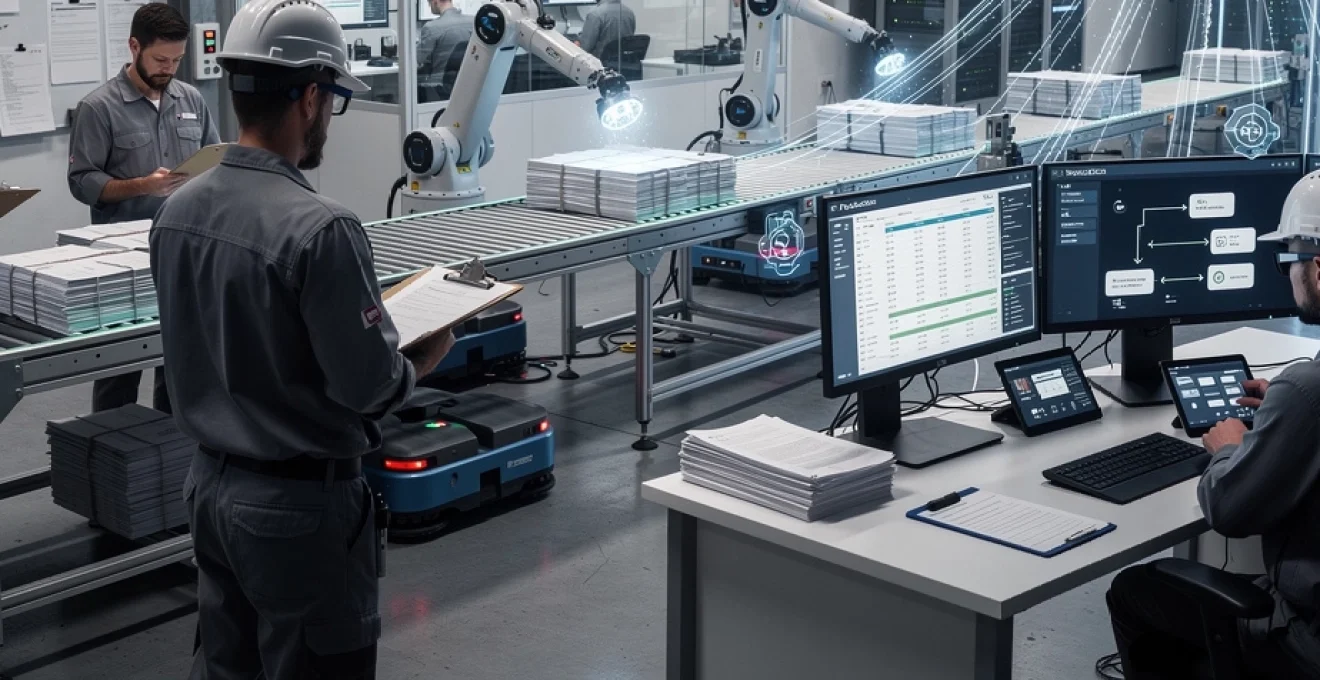
Industrial manufacturing has reached a pivotal moment where traditional manual coordination systems can no longer support the complexity and speed demands of modern production environments. Digital transformation is fundamentally reshaping how manufacturing operations coordinate tasks, manage resources, and maintain quality standards across entire production ecosystems. The integration of advanced digital workflows represents more than just technological upgrades—it signifies a complete paradigm shift from reactive, human-dependent processes to proactive, intelligent automation systems that can anticipate, adapt, and optimise manufacturing operations in real-time.
The manufacturing sector faces unprecedented pressure to deliver higher quality products faster while reducing operational costs and maintaining strict compliance standards. Legacy coordination methods, which relied heavily on paper-based documentation and manual handoffs between departments, have become significant bottlenecks that limit productivity and increase the risk of costly errors. Modern digital workflow solutions leverage advanced technologies such as artificial intelligence, machine learning, and Internet of Things (IoT) connectivity to create seamless coordination between human operators, automated systems, and intelligent machines throughout the entire production lifecycle.
Legacy manual coordination systems and their operational limitations in manufacturing
Traditional manufacturing coordination systems were built around centralised, hierarchical structures where information flowed slowly through multiple layers of management and operational personnel. These legacy systems created numerous inefficiencies that compound as production volumes increase and product complexity grows. The fundamental limitation of manual coordination lies in its dependence on human availability, decision-making speed, and the inherent variability in how different individuals interpret and execute instructions.
Paper-based work order management and documentation bottlenecks
Paper-based work order systems create significant delays in manufacturing processes, with studies showing that manual documentation can add up to 15-20% additional time to production cycles. Physical work orders must be printed, distributed, manually updated, and physically transported between workstations, creating multiple points of potential delay. When changes or updates are required, the entire documentation chain must be manually updated, often resulting in version control issues where different departments work from outdated information.
The storage and retrieval of paper documentation presents another major challenge, particularly in large manufacturing facilities where thousands of work orders may be processed monthly. Document retrieval times can range from minutes to hours, depending on the complexity of the filing system and the availability of personnel to locate specific records. This inefficiency is compounded during shift changes, when incoming personnel must spend valuable time understanding the current status of ongoing work orders.
Human error propagation through Multi-Stage production handoffs
Manual handoffs between production stages represent critical vulnerability points where errors can propagate throughout the entire manufacturing process. Research indicates that human error rates in manual data transfer can reach 1-3%, which may seem minimal but can result in significant quality issues and costly rework when multiplied across thousands of daily transactions. Each handoff requires manual interpretation of instructions, status updates, and quality requirements, creating opportunities for miscommunication and errors.
The complexity of modern manufacturing processes means that a single product may pass through dozens of different workstations, each requiring specific instructions, quality checks, and documentation updates. When these transitions rely on manual coordination, the cumulative effect of small errors can result in substantial quality deviations or production delays that are difficult to trace back to their original source.
Communication delays between shop floor teams and management systems
Traditional communication methods between shop floor operations and management systems rely heavily on periodic reports, shift meetings, and manual data compilation. This approach creates information lag times of hours or even days, preventing management from making timely decisions based on current production conditions. Real-time visibility into production status, quality metrics, and resource utilisation becomes impossible when information must be manually collected, compiled, and reported through multiple organisational layers.
The disconnect between shop floor reality and management information systems often results in decisions being made based on outdated or incomplete data. Production schedules may continue to run even when quality issues have been identified, or resource allocation decisions may be made without awareness of current equipment status or personnel availability.
Inventory tracking inefficiencies using Spreadsheet-Based methods
Spreadsheet-based inventory management systems, while familiar to many operators, create significant challenges in manufacturing environments where material consumption and inventory levels change rapidly throughout production cycles. Manual inventory updates often lag behind actual consumption, leading to stockouts or overstock situations that can disrupt production schedules. The
risk of inaccurate stock visibility is further amplified when multiple operators update separate copies of the same file, resulting in conflicting data and broken version control. In fast-moving production environments, this can trigger urgent expediting costs, unexpected line stoppages, and excess safety stock that ties up working capital. Without automated reconciliation between actual consumption on the shop floor and inventory records, planners are effectively “driving blind,” relying on estimates rather than real-time data to make critical production and replenishment decisions.
These inventory tracking inefficiencies also undermine broader efforts in lean manufacturing and just-in-time (JIT) production. When inventory accuracy cannot be trusted, organisations are forced to build in larger buffers, accept more waste, and tolerate higher variability in lead times. As we move toward increasingly digital workflows in manufacturing, replacing spreadsheet-based inventory systems with integrated, automated solutions becomes a foundational step in eliminating manual coordination and achieving end-to-end visibility.
Digital workflow architecture: MES and ERP integration frameworks
To overcome the limitations of manual coordination in industrial processes, manufacturers are increasingly adopting integrated digital workflow architectures that connect Manufacturing Execution Systems (MES), Enterprise Resource Planning (ERP) platforms, and industrial control systems into a unified data environment. Instead of relying on disconnected tools and human intermediaries, these architectures enable real-time synchronisation of production, quality, and logistics data across the entire value chain. At the core of this transformation is the tight integration between MES and ERP, orchestrated through industrial IoT networks, APIs, and cloud-based automation platforms.
Well-designed MES–ERP integration frameworks act like the central nervous system of a smart factory: MES captures what is happening on the shop floor second by second, while ERP plans and coordinates materials, capacity, and financials at the enterprise level. When these systems communicate seamlessly, digital workflows can automatically trigger work orders, update inventory levels, adjust schedules, and initiate quality checks with minimal human intervention. This is where digital workflows begin to replace manual coordination in a meaningful and scalable way.
Manufacturing execution system (MES) real-time data synchronisation
Modern MES platforms sit directly between the physical production equipment and higher-level business systems, continuously collecting and distributing operational data. Through real-time data synchronisation, MES captures machine states, production counts, downtime events, and quality results, and feeds this information into digital workflows that can respond within seconds. Instead of operators manually logging production quantities or scrap in paper logs, sensors and machine interfaces automatically feed data into the MES, ensuring accuracy and eliminating delays.
Real-time MES synchronisation enables powerful use cases such as automatic work order progression, where operations move from one stage to the next without manual sign-off, and automatic labour reporting, where operator time is captured digitally rather than through timesheets. When combined with digital work instructions and electronic batch records, MES-based workflows significantly reduce human error and improve traceability. For manufacturers working under strict regulatory regimes, such as pharmaceuticals or aerospace, this level of synchronised, timestamped data becomes a key enabler for compliance and audit readiness.
Enterprise resource planning (ERP) module connectivity with SAP and oracle
On the enterprise side, ERP platforms like SAP and Oracle provide the transactional backbone for materials planning, procurement, finance, and order management. Historically, ERP data has been updated in batches—often once per shift or once per day—based on manual inputs from production and warehouse teams. By integrating MES with ERP in a continuous, bidirectional way, manufacturers can establish digital workflows for order-to-production that minimise manual coordination and data entry.
In practice, this means that when a customer order enters SAP or Oracle, it can automatically generate a detailed production order in the MES, complete with routing, material requirements, and quality specifications. As production progresses, confirmations, yield data, and material consumption are pushed back into the ERP in near real time. This tight loop allows planners to see true available-to-promise (ATP) quantities, finance teams to track work-in-progress (WIP) accurately, and purchasing teams to trigger replenishment at precisely the right moment. Instead of chasing spreadsheets and email threads, you get an integrated digital workflow where information flows automatically between systems.
Industrial IoT sensor networks and SCADA system integration
Industrial IoT (IIoT) sensor networks and SCADA (Supervisory Control and Data Acquisition) systems form the data acquisition layer that feeds accurate, high-frequency information into MES and other workflow tools. Sensors on machines, conveyors, storage tanks, and environmental systems measure everything from temperature and pressure to vibration and energy consumption. SCADA systems aggregate this data and provide control interfaces, but when integrated into digital workflows, they become far more than simple monitoring tools.
By connecting IIoT and SCADA data streams into MES, ERP, and analytics platforms, manufacturers can automate responses to production events that previously required manual intervention. For example, when a critical parameter drifts outside specification, a digital workflow can automatically stop the affected line, create a quality nonconformance record, notify the responsible engineer, and initiate a root cause analysis process. Instead of operators calling supervisors or sending emails, the system itself coordinates the required actions based on predefined rules and machine learning models.
Cloud-based workflow orchestration using microsoft power automate
Cloud-based workflow orchestration platforms, such as Microsoft Power Automate, are increasingly used to connect industrial systems with enterprise applications, collaboration tools, and external data sources. These platforms provide low-code interfaces for designing digital workflows that span MES, ERP, maintenance systems, and communication channels like email or Microsoft Teams. For manufacturers, this means you can automate many coordination tasks without building custom code or waiting for major IT projects.
Consider a scenario where an MES system logs an unexpected machine stoppage. A Power Automate flow can instantly create a ticket in the Computerised Maintenance Management System (CMMS), update the production schedule in the ERP, alert the shift supervisor via Teams, and log an incident in a central operations dashboard. All of these actions would have required multiple phone calls and manual data entry in a traditional setting. Cloud-based workflow orchestration thus acts as the “glue” that links legacy industrial systems with modern digital tools, accelerating your journey away from manual coordination.
Api-driven communication protocols between production systems
APIs (Application Programming Interfaces) are the primary mechanism enabling different production systems to exchange data reliably and securely. In a digital workflow architecture, APIs replace ad hoc file transfers, email attachments, and manual data rekeying with standardised, machine-readable interfaces. RESTful APIs, OPC UA, and MQTT are commonly used protocols in industrial environments to support event-driven communication between equipment, MES, ERP, and analytics platforms.
API-driven communication is crucial for achieving flexible, scalable digital workflows in manufacturing. When each system exposes well-documented APIs, you can orchestrate complex cross-system processes—such as automated production scheduling, quality approvals, and logistics coordination—without introducing brittle, point-to-point integrations. This allows you to add new equipment, upgrade software, or integrate with customer and supplier systems more easily. In effect, APIs turn your manufacturing ecosystem into a modular, composable platform where coordination is handled by software rather than by people passing information manually.
Automated production scheduling and resource allocation technologies
Automated production scheduling is one of the most tangible ways digital workflows are replacing manual coordination in industrial processes. Instead of planners juggling spreadsheets, whiteboards, and tribal knowledge to align machines, materials, and labour, advanced planning and scheduling (APS) systems use algorithms to optimise schedules in real time. These systems take into account constraints such as machine capacity, changeover times, material availability, and workforce skills, and then generate schedules that maximise throughput and minimise downtime.
When integrated with MES and ERP, automated scheduling technologies can adjust plans dynamically based on real-time events. If a machine goes down or a rush order arrives, the system recalculates priorities and resource allocations, then pushes updated work instructions directly to operator terminals and connected machines. This dynamic, rules-based coordination is far more responsive than manual methods, helping manufacturers reduce lead times by 20–40% and improve on-time delivery performance. For you as an operations leader, this means less firefighting and more predictable, data-driven decision-making.
Quality control automation through digital inspection workflows
Quality control has traditionally relied on manual inspections, paper checklists, and delayed reporting, which make it difficult to detect issues early and maintain consistent standards across shifts and sites. Digital inspection workflows transform this process by embedding quality checks directly into the flow of production and automating data capture and analysis. Instead of inspection being a separate, manual step, it becomes a continuous, real-time activity driven by integrated systems.
By digitising inspection plans, linking them to specific work orders and equipment, and capturing results electronically, manufacturers can create a closed-loop quality management system. Nonconformances can automatically trigger corrective actions, rework processes, or supplier investigations. Over time, the wealth of digital quality data supports advanced analytics and machine learning models that predict where defects are most likely to occur. This is where quality control automation stops being a compliance exercise and becomes a strategic lever for improving yield and reducing scrap.
Computer vision systems for defect detection and classification
Computer vision systems are rapidly replacing manual visual inspections in many manufacturing environments, from automotive paint shops to electronics assembly lines. Using high-resolution cameras and deep learning algorithms, these systems analyse images of products at high speed, detecting surface defects, dimensional deviations, or missing components that humans might overlook—especially during repetitive, high-volume tasks. Unlike manual inspectors, computer vision solutions maintain consistent performance over long shifts and can operate at line speeds that would be impossible for human workers.
Once integrated into digital workflows, computer vision systems do more than simply flag defects. They can classify defect types, log detailed inspection data into the MES or quality management system, and trigger automated responses such as diverting defective items, adjusting process parameters, or notifying engineers. As models are retrained with new defect examples, their accuracy improves over time, much like an experienced inspector gaining expertise—but at a much greater scale. For complex products, this kind of automated defect detection becomes a cornerstone of Industry 4.0 quality assurance.
Statistical process control (SPC) integration with six sigma methodologies
Statistical Process Control (SPC) has long been a cornerstone of quality management, but in many plants it is still implemented through manual sampling and offline analysis. Digital workflows change this by integrating SPC directly with real-time data streams from machines, sensors, and inspection systems. Control charts can be updated automatically as measurements are taken, and rule violations can trigger immediate alerts and corrective actions without waiting for a quality engineer to review reports at the end of a shift.
When SPC is combined with Six Sigma methodologies in a digital environment, continuous improvement becomes much more data-driven and proactive. Automatically collected process data feeds into DMAIC projects, root cause analyses, and capability studies, reducing the time required to identify and validate improvements. You can think of this as moving from a rear-view mirror approach—where you look at defects after they occur—to a forward-looking, predictive model where the process itself is constantly monitored and adjusted to stay within optimal limits.
Automated Non-Destructive testing (NDT) documentation systems
Non-Destructive Testing (NDT) methods such as ultrasonic, radiographic, and magnetic particle inspection are critical in industries like aerospace, oil and gas, and power generation. Traditionally, NDT results have been recorded manually on paper forms or standalone software, making it difficult to maintain complete, traceable records across complex assets and long lifecycles. Automated NDT documentation systems replace these manual processes with digital workflows that capture inspection data, images, and reports in structured, searchable formats.
By integrating NDT instruments and imaging devices with MES and asset management systems, inspection results can be automatically linked to specific components, serial numbers, and work orders. This not only improves traceability but also enables advanced analytics on defect trends and asset performance. For example, you can quickly identify whether certain weld procedures, materials, or suppliers are associated with higher defect rates. Automated NDT documentation ensures that critical safety and compliance records are complete, accurate, and instantly accessible during audits or incident investigations.
Real-time quality metrics dashboard implementation
Real-time quality dashboards provide a visual, up-to-the-minute view of quality performance across lines, plants, or entire enterprises. Powered by data from MES, inspection systems, and ERP, these dashboards consolidate key metrics such as defect rates, first-pass yield, rework levels, and customer returns into a single, intuitive interface. When deployed on large displays on the shop floor and accessible via web or mobile devices, they create a shared “single source of truth” for quality across teams.
Implementing real-time quality dashboards as part of your digital workflows has two major benefits. First, issues become visible as soon as they arise, enabling frontline teams to take corrective action before defects propagate downstream. Second, leadership gains a transparent view of performance trends, which supports more informed strategic decisions about training, investments, and process changes. Instead of waiting for weekly reports, you can see in minutes whether a process change is improving or degrading quality—and adjust accordingly.
Predictive maintenance workflows using machine learning algorithms
Predictive maintenance is one of the most powerful examples of how digital workflows are replacing manual coordination in industrial processes. Rather than relying on fixed-interval preventive maintenance plans or reactive repairs after failures occur, predictive maintenance uses machine learning algorithms to analyse sensor data and predict when equipment is likely to fail. This shift from time-based to condition-based maintenance reduces unplanned downtime, extends asset life, and optimises maintenance resources.
In a predictive maintenance workflow, data from vibration sensors, temperature probes, motor currents, and other condition indicators is continuously collected and transmitted to analytics platforms. Machine learning models identify patterns that precede failures—such as subtle changes in vibration frequency or temperature rise—and generate health scores or remaining useful life (RUL) estimates for each asset. When a model detects a high probability of failure within a defined time window, it can automatically create a maintenance work order, schedule technicians, reserve spare parts, and update the production schedule to accommodate the planned intervention.
These automated workflows drastically reduce the need for manual coordination between maintenance, production, and planning teams. Instead of maintenance engineers sending emails or making phone calls to negotiate downtime windows, the system proposes optimal times based on demand forecasts, current WIP, and technician availability. For you, this means fewer surprise breakdowns, more predictable maintenance windows, and better alignment between reliability and production goals. According to recent industry studies, manufacturers implementing predictive maintenance at scale have reported up to 30–50% reduction in unplanned outages and 10–40% savings on maintenance costs.
ROI analysis and implementation challenges in digital transformation projects
While the benefits of digital workflows in manufacturing are clear, real-world implementation is rarely straightforward. Digital transformation projects require upfront investment in technology, change management, and process redesign, and the return on investment (ROI) must be carefully assessed and tracked. The most successful manufacturers treat digital transformation not as a one-time IT project but as a multi-year journey, with incremental value delivered at each stage.
From an ROI perspective, digital workflows typically generate value through several levers: reduced downtime, higher throughput, lower scrap and rework, improved labour productivity, better inventory turns, and reduced compliance risk. Quantifying these benefits begins with establishing a baseline of current performance using KPIs such as Overall Equipment Effectiveness (OEE), on-time delivery, defect rates, and maintenance costs. As digital initiatives are rolled out—such as MES deployment, automated scheduling, or predictive maintenance—these KPIs can be monitored to measure impact. Many organisations see payback periods of 12–24 months for well-scoped projects, especially when they target high-value pain points first.
However, there are significant implementation challenges that you should not underestimate. Legacy systems may lack modern interfaces, making integration complex and time-consuming. Data quality issues can hamper analytics and machine learning efforts, requiring substantial work on data cleansing and standardisation. Perhaps most critically, cultural resistance and skills gaps can slow adoption, as employees accustomed to manual coordination may be wary of new digital workflows. Addressing these challenges requires a structured change management approach, clear communication of benefits, and targeted training programs to build digital capabilities on the shop floor.
Another common pitfall is either “cherry-picking” isolated automation projects that never scale, or attempting to automate everything at once, leading to long, overambitious programs that struggle to deliver. A balanced approach focuses on a roadmap of use cases that share common data and integration requirements—starting with high-impact opportunities like automated production scheduling, digital quality workflows, or predictive maintenance. By delivering quick wins while building a reusable digital foundation, manufacturers can steadily replace manual coordination with robust, scalable digital workflows that support long-term competitiveness.