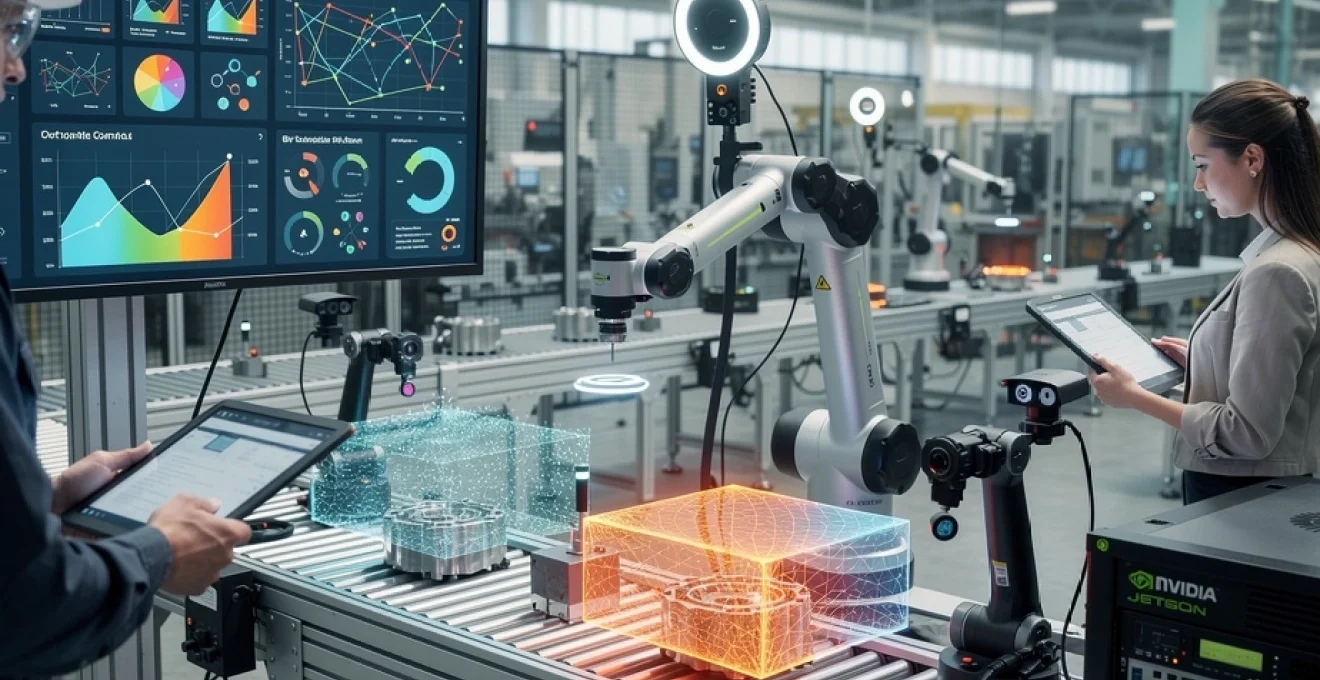
Manufacturing quality assurance is undergoing a fundamental transformation as intelligent inspection systems replace traditional manual processes. Modern factories are implementing sophisticated artificial intelligence technologies that can detect defects with unprecedented accuracy, often exceeding 95% detection rates in complex production environments. These advanced systems combine machine learning algorithms, computer vision technologies, and robotic automation to create comprehensive quality control platforms that adapt and improve over time.
The shift from rule-based inspection to AI-powered quality assurance represents more than a technological upgrade—it’s a complete reimagining of how manufacturers approach product quality. Traditional inspection methods, which relied on predefined parameters and human oversight, are proving inadequate for today’s high-volume, multi-variant production lines. Intelligent inspection systems learn from production data, identify previously unknown defect patterns, and provide real-time insights that enable proactive quality management rather than reactive problem-solving.
Machine learning algorithms transforming quality control inspection processes
Machine learning algorithms have revolutionised quality control by introducing adaptive inspection capabilities that evolve with production demands. Unlike traditional systems that require extensive pre-programming for each defect type, these algorithms learn from historical data and continuously refine their detection capabilities. The transformation is particularly evident in automotive manufacturing, where companies like BMW report processing thousands of distinct customer configurations while maintaining consistent quality standards across all variants.
The fundamental advantage of machine learning in quality inspection lies in its ability to identify anomalies without explicit programming for each potential defect. Statistical pattern recognition enables these systems to establish baselines for acceptable production quality and flag deviations that may indicate emerging problems. This approach proves especially valuable in environments where product complexity makes it impossible to anticipate every potential failure mode during system design.
Convolutional neural networks for visual defect detection in manufacturing
Convolutional Neural Networks (CNNs) represent the backbone of modern visual inspection systems, processing image data with remarkable precision and speed. These networks excel at identifying surface defects, dimensional variations, and assembly errors that might escape human detection. Recent implementations demonstrate CNN accuracy rates approaching 99% for specific defect types, significantly outperforming traditional rule-based vision systems in complex manufacturing environments.
The architecture of CNNs makes them particularly suited for manufacturing inspection tasks because they can process multiple image features simultaneously. Unlike human inspectors who might focus on one aspect at a time, CNNs analyse colour variations, texture patterns, geometric relationships, and dimensional accuracy in parallel. This comprehensive approach reduces inspection time while improving detection reliability across diverse production scenarios.
Deep learning classification models using TensorFlow and OpenCV integration
Integration of TensorFlow and OpenCV frameworks enables manufacturers to deploy sophisticated deep learning models without extensive custom development. TensorFlow provides the machine learning infrastructure while OpenCV handles image preprocessing and feature extraction, creating powerful inspection platforms that can be adapted to various production environments. This combination allows quality engineers to implement advanced AI capabilities without requiring extensive programming expertise.
Practical implementations using these integrated frameworks have demonstrated significant improvements in inspection speed and accuracy. Manufacturing facilities report reduction in false positive rates by up to 60% compared to traditional vision systems, while maintaining detection sensitivity for critical defects. The flexibility of these platforms enables rapid adaptation to new product variants without requiring complete system reconfiguration.
Supervised learning techniques for pattern recognition in assembly line quality checks
Supervised learning approaches in quality inspection rely on carefully curated training datasets that include both acceptable and defective examples. These techniques prove particularly effective for assembly line applications where consistent part orientation and lighting conditions enable reliable model training. Pattern recognition algorithms learn to distinguish subtle variations that indicate quality issues, often identifying problems that would be difficult for human inspectors to detect consistently.
The success of supervised learning in manufacturing quality control depends heavily on data quality and diversity. Leading implementations utilise datasets containing millions of production images, representing various lighting conditions, part orientations, and defect types. This comprehensive training approach enables models to generalise effectively across different production scenarios while maintaining high detection accuracy.
Reinforcement learning applications in adaptive quality threshold optimisation
Reinforcement learning algorithms optimise quality thresholds dynamically based on production outcomes and downstream feedback. These systems learn to balance detection sensitivity with false positive rates, automatically adjusting parameters to minim
ise nuisance alarms while still catching true defects. By continuously learning from operator feedback, scrap reports, and warranty data, reinforcement learning systems evolve towards an optimal operating point for each product family and process step. This dynamic optimisation helps manufacturers avoid the typical trade-off where tightening inspection thresholds causes unnecessary rework, while loosening them increases the risk of quality escapes.
In practical deployments, reinforcement learning agents are often constrained by safety and regulatory limits, ensuring they never reduce quality thresholds below acceptable standards. Instead, they fine-tune parameters such as sensitivity scores, region-of-interest boundaries, or sampling rates based on real-time performance metrics. Over time, the system builds a nuanced understanding of process variability, allowing it to anticipate when a line is drifting out of control and trigger early interventions before defects accumulate.
Computer vision technologies revolutionising industrial inspection systems
Computer vision technologies form the visual foundation of intelligent inspection systems, turning raw pixel data into actionable quality insights. Modern industrial cameras and optics, combined with advanced image processing algorithms, enable detailed analysis of surfaces, geometries, and material properties at production-line speeds. As manufacturers transition towards Industry 4.0 and increasingly towards Industry 5.0, computer vision becomes the primary sensor layer of automated quality assurance, especially in high-volume, multi-variant environments.
The evolution of computer vision in quality control moves far beyond simple presence/absence checks or 2D pattern matching. Today’s systems incorporate multi-spectral imaging, 3D reconstruction, thermal analysis, and even hyperspectral techniques to capture defects that were previously invisible to both human inspectors and legacy cameras. When combined with AI, these rich data streams enable inspection platforms that not only detect defects but also infer their root causes and predict where they are most likely to occur next.
High-resolution imaging sensors and multi-spectral analysis capabilities
High-resolution imaging sensors are the cornerstone of accurate visual defect detection in manufacturing. Modern CMOS and CCD cameras routinely capture images at 12 megapixels or higher, providing enough detail to identify micro-cracks, coating pinholes, and subtle texture inconsistencies. In automotive body shops, for example, these sensors enable detection of paint blemishes smaller than a human hair, even under challenging lighting conditions and reflective surfaces.
Multi-spectral and hyperspectral imaging extend these capabilities by capturing information beyond the visible spectrum, including infrared and ultraviolet bands. This allows quality assurance systems to detect contamination, moisture ingress, or material mix-ups that are invisible in standard RGB images. For sectors such as electronics, pharmaceuticals, and food processing, multi-spectral analysis provides a non-destructive way to verify material composition and integrity. By feeding these richer data channels into AI models, manufacturers can develop inspection workflows that simultaneously assess surface quality, structural integrity, and material properties.
3D point cloud processing for dimensional accuracy verification
For many critical components, especially in aerospace, automotive, and precision machining, dimensional accuracy is as important as surface quality. 3D point cloud processing allows intelligent inspection systems to verify complex geometries by comparing scanned surfaces against CAD models or golden references. Using structured light, laser triangulation, or time-of-flight sensors, these systems generate dense point clouds that capture the full shape of each part in three dimensions.
Advanced algorithms align these point clouds with reference geometry, typically using variants of the Iterative Closest Point (ICP) method. Deviations beyond predefined tolerances are flagged automatically, providing a detailed map of dimensional errors. This is particularly valuable for battery housings, turbine blades, and structural welds where small geometric deviations can have disproportionate effects on performance and safety. When combined with AI-based anomaly detection, 3D inspection systems can highlight not just whether a part is out of tolerance, but also infer likely process issues—such as tool wear, fixture misalignment, or thermal distortion—that caused the deviation.
Real-time image processing using CUDA-accelerated GPU computing
Meeting the speed demands of modern production lines requires massive parallel processing power, which is where CUDA-accelerated GPUs play a critical role. Traditional CPU-based image processing struggles to keep up with multi-camera, high-resolution inspection tasks running at line speed. In contrast, GPU-accelerated pipelines can process hundreds of frames per second, enabling real-time quality assurance even in fast-moving assembly environments like automotive final inspection or high-speed packaging lines.
By offloading compute-intensive tasks—such as convolutional filtering, feature extraction, and deep neural network inference—to GPUs, manufacturers achieve both lower latency and higher throughput. Frameworks like CUDA and cuDNN integrate tightly with TensorFlow and PyTorch, allowing AI models to run directly on the same hardware that handles image acquisition and preprocessing. The result is an inspection architecture that can analyse each part as it passes under the camera, make instant pass/fail decisions, and feed quality data back into MES or SCADA systems without causing production bottlenecks. For many plants, this shift from batch analysis to real-time GPU processing is the key enabler for true inline inspection.
Thermal imaging integration with FLIR systems for non-destructive testing
Thermal imaging adds a powerful non-destructive testing capability to intelligent inspection systems, particularly for applications where internal defects or process anomalies generate heat signatures. Integration with FLIR thermal cameras enables manufacturers to detect issues such as poor weld penetration, delamination in composites, overheating battery cells, or uneven adhesive curing in real time. Because thermal imaging is contactless and fast, it fits naturally into automated inspection stations without disrupting throughput.
By combining thermal data with visible-spectrum images and AI models, quality assurance teams gain a multi-modal view of product integrity. For example, in EV battery pack assembly, a vision system can verify correct placement of components while thermal cameras monitor for hotspots indicating electrical or thermal issues. AI models trained on historical failure data learn to identify subtle temperature patterns that correlate with future field failures, turning thermal imaging into a predictive tool rather than a simple screening method. As safety-critical systems become more common, especially in energy storage and aerospace, this fusion of FLIR-based thermal imaging and AI-driven analysis will become a standard element of advanced quality control.
Robotic process automation integration with smart quality assessment platforms
Intelligent inspection systems reach their full potential when integrated with robotic process automation, creating closed-loop environments where robots not only handle parts but also perform or assist with quality checks. Instead of static cameras watching fixed stations, robots equipped with vision systems can move around products, capture images from optimal angles, and even perform light interventions such as repositioning components or triggering rework workflows. This convergence of robotics and AI-driven quality assurance is reshaping how factories think about inspection coverage and flexibility.
From collaborative robots working side-by-side with humans to fully autonomous inspection cells, robotic integration allows quality tasks to scale with production complexity. You are no longer limited to a single fixed viewpoint; robotic arms can inspect hidden features, interior cavities, or large structures that would otherwise require manual handling. As a result, manufacturers can implement more thorough quality checks without sacrificing takt time, while also reducing ergonomic risks and repetitive tasks for human operators.
Collaborative robot arms with integrated vision systems for precision inspection
Collaborative robot arms, or cobots, have become a popular choice for augmenting quality assurance processes because they combine flexibility, safety, and ease of deployment. Equipped with integrated vision systems—often including 2D cameras, 3D sensors, or laser scanners—cobots can perform precision inspection tasks such as measuring gaps and flushness, checking labels, or verifying correct assembly of small components. Their ability to work safely alongside humans enables hybrid workstations where operators and robots share tasks based on their respective strengths.
For example, in final vehicle assembly, a cobot can move along the body-in-white to measure door alignment or inspect weld seams while a human focuses on complex decision-making or rework. AI models running on the cobot’s controller or connected edge devices interpret the vision data, classify defects, and guide the robot’s movement patterns. Because cobots are relatively easy to reprogram and reconfigure, you can quickly adapt inspection routines to new product variants or model refreshes—an essential capability in markets where customisation and short product life cycles are the norm.
Automated sampling protocols using ABB and KUKA industrial robotics
In high-throughput environments where 100% inspection may not yet be feasible, automated sampling protocols powered by industrial robots from vendors like ABB and KUKA offer a pragmatic step towards intelligent quality assurance. Instead of relying on manual sampling plans that are often inconsistently executed, robotic systems can pick, position, and present parts to inspection equipment with repeatable precision. This not only improves the statistical validity of sampling but also reduces the risk of human error in sample selection.
Robotic arms can be programmed to follow complex sampling rules—such as dynamic adjustment of sample frequency based on recent defect rates or process capability indices. When integrated with AI-driven inspection platforms, these robots can autonomously increase sampling intensity in response to early warning signs of process drift, or reduce sampling when the process demonstrates sustained stability. Over time, this creates a responsive quality ecosystem where inspection effort is automatically aligned with real process risk, helping you optimise both cost and assurance levels.
Edge computing implementation with NVIDIA jetson for real-time decision making
Edge computing has become a critical enabler for real-time quality decisions, particularly when latency, bandwidth, or data privacy constraints make cloud processing impractical. Compact yet powerful platforms like NVIDIA Jetson allow AI inference and image processing to run directly at the machine or robot level. This means that cameras, cobots, and inspection cells can analyse data locally and respond within milliseconds, without waiting for round trips to central servers.
By deploying inspection models on edge devices, manufacturers also reduce the amount of raw image data that needs to traverse the network. Only relevant metadata, defect annotations, or compressed feature representations are forwarded to central systems for long-term storage and analytics. This architecture is especially beneficial in large plants with hundreds of cameras and robots, where network congestion can quickly become a bottleneck. Edge-based quality assurance also enhances resilience: if connectivity to the cloud or data centre is interrupted, local inspection logic continues to operate, ensuring that product quality is not compromised.
Iot sensor networks enabling predictive quality analytics
While vision systems capture rich visual data, IoT sensor networks provide complementary information about process conditions that directly influence product quality. Sensors measuring temperature, vibration, pressure, torque, or humidity feed continuous streams of data into quality assurance platforms. When these sensor readings are correlated with inspection results through AI models, manufacturers can identify subtle patterns—such as a specific vibration profile that precedes welding defects, or a humidity range that increases paint flaws.
This fusion of IoT data and visual inspection underpins predictive quality analytics, where the goal is to prevent defects before they occur rather than merely detect them. For example, if torque sensors on fastening tools indicate a drift in tightening performance, the system can schedule tool maintenance or adjust process parameters before non-conforming joints are produced. Over time, the combined dataset of sensor readings and inspection outcomes becomes a strategic asset, enabling more accurate predictive models and smarter process control across the entire factory.
Statistical process control enhancement through artificial intelligence
Statistical Process Control (SPC) has long been a cornerstone of manufacturing quality management, relying on control charts and capability indices to monitor process stability. However, traditional SPC assumes relatively simple, univariate data streams and often struggles with the complexity and volume of data generated by modern production systems. Artificial intelligence enhances SPC by analysing multivariate datasets, learning non-linear relationships, and detecting subtle patterns that conventional control charts would miss.
AI-augmented SPC platforms can ingest data from vision systems, IoT sensors, and production logs, then apply techniques such as multivariate anomaly detection, clustering, and time-series forecasting. Instead of simply flagging out-of-spec measurements, these systems identify emerging trends—like a gradual shift in gap measurements that correlates with tool wear or fixture drift. They can also differentiate between benign variation and meaningful signals, reducing false alarms and helping quality engineers focus on events that truly matter. In many plants, this AI-driven approach has reduced unplanned downtime and scrap rates by double-digit percentages.
Another advantage of AI-enhanced SPC is its ability to adapt control limits dynamically based on real process capability rather than fixed historical assumptions. For instance, machine learning models can estimate the true distribution of key characteristics under current conditions and adjust control thresholds to maintain desired defect risk levels. This is particularly useful in multi-variant production lines, where each configuration may have slightly different natural variability. By automatically tailoring SPC rules to each context, manufacturers can maintain tight quality control without overreacting to harmless variation.
Industry-specific implementation case studies of intelligent QA systems
While the core principles of intelligent inspection apply across sectors, each industry faces unique challenges that shape how automated quality assurance is implemented. In automotive manufacturing, the push towards electrification and high customisation has made AI-powered visual inspection a necessity rather than a luxury. Plants producing internal combustion, hybrid, and battery-electric vehicles on the same line use intelligent systems to handle thousands of configuration variants while maintaining consistent quality for critical components like battery packs, welds, and safety systems.
In aerospace, non-destructive testing with advanced imaging and AI is transforming inspection of composite structures, turbine components, and high-value assemblies. Here, the cost of a single quality failure can be enormous, both financially and in terms of safety. Intelligent inspection systems combine ultrasonic, X-ray, and thermographic data with machine learning to detect internal defects that were previously difficult to identify reliably. The result is both improved defect detection and more efficient inspection routines, reducing the time required for conformity assessments while maintaining strict regulatory compliance.
Medical device manufacturers are also embracing intelligent QA systems to meet stringent regulatory requirements and rising demand for traceability. AI-driven vision inspection verifies features such as laser markings, packaging seals, and micro-scale geometries, while IoT-enabled process monitoring ensures that environmental and process parameters remain within validated ranges. In semiconductor fabrication, deep learning models running on high-speed cameras identify yield-killing defects at the wafer level, enabling rapid root cause analysis and process correction. Across these industries, a common pattern emerges: intelligent inspection is no longer limited to catching defects at the end of the line—it is integrated throughout the value chain as a strategic quality intelligence layer.
Future technology roadmap for autonomous quality assurance evolution
Looking ahead, the trajectory of automated quality assurance points towards increasingly autonomous systems that integrate inspection, analysis, and corrective action in a closed loop. We can expect inspection platforms to become more self-configuring, using AI to interpret CAD models, process plans, and historical defect data to design their own inspection strategies. Instead of engineers manually defining every measurement or camera angle, systems will automatically propose and optimise inspection plans, updating them as products, materials, and processes evolve.
Another major step on the roadmap is deeper integration between digital twins and real-time inspection data. As factories build high-fidelity digital replicas of their production lines and products, inspection results will continuously update these virtual models, enabling simulation of “what-if” scenarios and predictive quality forecasting. For instance, you might simulate the effect of a new material or process change on defect rates before making physical modifications, dramatically reducing the risk of quality surprises during ramp-up.
At the shop-floor level, we will see more mobile and distributed inspection resources: autonomous robots, drones, and intelligent fixtures equipped with vision and sensors roaming production areas to perform on-demand checks. Combined with 5G connectivity and edge AI, these systems will support dynamic, context-aware inspection strategies that adapt in real time to production conditions. Human roles in quality assurance will evolve as well, shifting from repetitive inspection tasks towards higher-value activities such as model governance, cross-functional problem solving, and strategic oversight of quality data assets.
Ultimately, the evolution of intelligent inspection systems is pushing quality assurance from a cost centre to a source of competitive advantage. Manufacturers that invest early in robust data infrastructure, AI capabilities, and organisational change will build proprietary quality intelligence that compounds over time—much like an asset that appreciates with every part produced. As AI, computer vision, robotics, and IoT technologies continue to mature, autonomous quality assurance will become a defining feature of high-performing, resilient, and customer-centric manufacturing organisations.