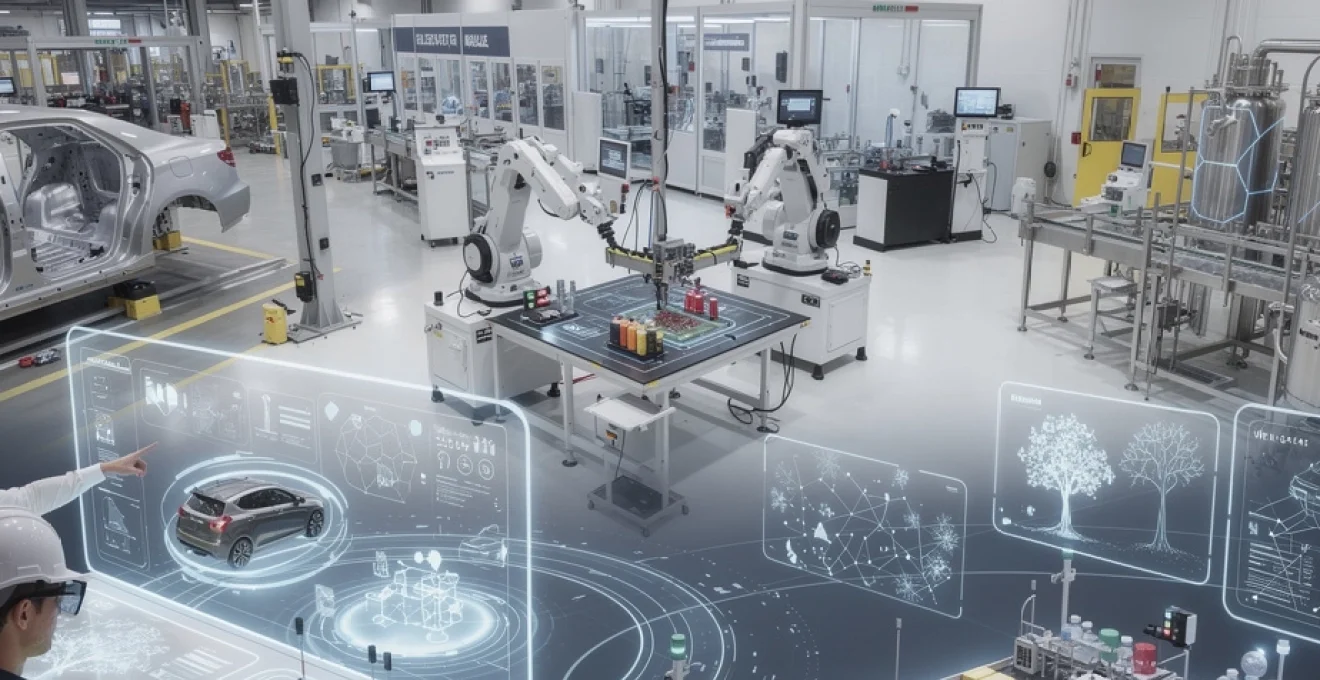
Manufacturing as we know it is undergoing a seismic transformation. Gone are the days when production lines operated on static schedules, fixed parameters, and reactive maintenance strategies. Today’s competitive landscape demands something fundamentally different: systems that learn, adapt, and optimise themselves in real-time without constant human intervention. Self-optimising production systems represent the convergence of artificial intelligence, machine learning, advanced sensor networks, and sophisticated control architectures—creating manufacturing environments that respond dynamically to changing conditions, predict problems before they occur, and continuously improve performance. This evolution isn’t merely about automation; it’s about creating intelligent manufacturing ecosystems that behave more like living organisms than mechanical assemblies.
The urgency behind this transformation stems from escalating pressures across every dimension of modern manufacturing. Product lifecycles have shortened dramatically, with consumer electronics refreshing every few months rather than years. Supply chains have become increasingly complex and interconnected, creating vulnerability to disruptions that can cascade through entire production networks. Customer expectations for quality, customisation, and rapid delivery continue to rise, whilst profit margins face relentless downward pressure from global competition. Traditional manufacturing approaches—where engineers manually analyse reports, planners adjust schedules reactively, and supervisors change machine settings based on experience—simply cannot keep pace with these demands. Self-optimising systems offer a fundamentally different approach: continuous sensing, autonomous decision-making, and immediate action without waiting for human intervention.
Autonomous manufacturing execution systems and Closed-Loop control architecture
At the heart of self-optimising production lies the concept of closed-loop control architecture, where production systems continuously monitor their own performance, compare it against desired outcomes, and automatically adjust parameters to minimise deviation. Unlike traditional open-loop systems that execute predetermined instructions regardless of results, closed-loop architectures create feedback mechanisms that enable autonomous correction and optimisation. These systems integrate Manufacturing Execution Systems (MES) with real-time control layers, creating seamless information flow from shop floor sensors to decision-making algorithms and back to actuators that implement changes. The result is production that self-corrects as conditions change, maintaining optimal performance even as variables fluctuate.
Modern autonomous MES platforms incorporate sophisticated algorithms that coordinate activities across entire production facilities. They manage work orders, route jobs through optimal sequences, allocate resources dynamically, and ensure quality compliance—all whilst adapting to real-time conditions. When a machine experiences performance degradation, the system automatically reroutes jobs to alternative equipment, adjusts upstream processes to prevent bottlenecks, and schedules maintenance during optimal windows. This level of coordination requires processing massive data streams in milliseconds, making decisions that would take human planners hours or days to calculate manually. The competitive advantage isn’t just speed; it’s the ability to consider hundreds of variables simultaneously and identify optimisation opportunities that humans would never detect.
Real-time data acquisition through industrial IoT sensor networks
Self-optimising systems depend fundamentally on comprehensive, high-quality data streams from production environments. Industrial Internet of Things (IIoT) sensor networks provide this foundation, deploying thousands of sensors throughout manufacturing facilities to capture granular information about every aspect of production. Temperature sensors monitor thermal conditions in processing equipment; vibration sensors detect anomalies in rotating machinery; optical sensors measure dimensional accuracy; pressure transducers track fluid dynamics; power meters record energy consumption patterns. These sensors generate continuous data streams, often capturing measurements hundreds or thousands of times per second, creating an unprecedented window into production reality.
The challenge isn’t collecting data—it’s ensuring data quality, managing the sheer volume, and extracting meaningful insights. Modern production lines can generate billions of data points daily, requiring robust infrastructure for transmission, storage, and processing. Data validation algorithms filter sensor malfunctions and measurement errors. Time-synchronisation protocols ensure that data from multiple sources can be correlated accurately. Edge computing devices perform initial processing, reducing the volume of data transmitted to central systems whilst enabling ultra-low-latency responses to critical events. The quality of optimisation decisions depends directly on data quality; as the saying goes in data science, « garbage in, garbage out. » Organisations must invest significantly in sensor calibration, network reliability, and data governance to ensure their self-optimising systems operate on trustworthy information.
Machine learning algorithms for predictive maintenance and downtime prevention
Perhaps no application demonstrates the value of self-optimising systems more compellingly than predictive maintenance. Traditional preventive maintenance follows fixed schedules—
based on averages, not actual equipment condition. This often leads to over-maintenance on some assets and catastrophic failures on others. In contrast, predictive maintenance powered by machine learning continuously analyses real-time sensor data—vibration, temperature, acoustic signals, torque, oil quality—and learns the subtle signatures that precede failures. Instead of asking, « Has this motor run for 5,000 hours? », the system asks, « Does this motor behave like others did shortly before they failed? »
Supervised learning models such as random forests, gradient boosting machines, and deep neural networks are trained on historical failure data to classify equipment states or estimate remaining useful life. Unsupervised techniques like clustering and autoencoders detect anomalies when machines deviate from their learned normal behaviour, even if no labelled failure data exist. In large facilities, these predictive maintenance models run across thousands of critical assets, surfacing only those that show elevated risk and recommending targeted interventions. The impact is tangible: manufacturers routinely report 30–50% reductions in unplanned downtime and 10–40% lower maintenance costs when moving from time-based to condition-based strategies.
For predictive maintenance to support self-optimising production systems, it must be embedded in the closed-loop control architecture rather than remain a standalone analytics dashboard. When the algorithm predicts that a spindle bearing has a high probability of failure within the next 72 hours, the MES can automatically reschedule jobs away from that machine, trigger spare-parts ordering, and slot maintenance into the least disruptive window. Over time, the system learns which interventions are most effective and refines maintenance strategies accordingly. In effect, the production environment becomes a learning organism that not only senses degradation but also adapts its behaviour to minimise impact on throughput and delivery performance.
Digital twin technology in siemens and GE manufacturing environments
Digital twins bring a virtual dimension to self-optimising production systems by creating high-fidelity simulations of machines, lines, and even entire factories. In Siemens and GE manufacturing environments, these digital replicas mirror real-time operating conditions, process parameters, and quality outcomes, enabling engineers and algorithms to test scenarios in the virtual world before applying them on the shop floor. Think of a digital twin as a flight simulator for your factory, where you can experiment with new settings, schedules, or product variants without risking scrap or downtime.
At Siemens’ Amberg Electronics Plant, every product and process step is represented digitally. Data from PLCs, sensors, and MES feed into the digital twin, which continuously compares expected and actual behaviour. When discrepancies arise—such as rising cycle times or drifting quality metrics—the system can simulate potential corrective actions, from parameter changes to layout adjustments, and recommend the option with the highest expected benefit. GE’s Brilliant Manufacturing initiative follows a similar approach, using digital twins of turbine blade machining centres and assembly cells to optimise tool paths, cutting conditions, and maintenance intervals.
The real power of digital twins in a self-optimising production system lies in their role as the decision laboratory for AI. Rather than deploying a new optimisation strategy directly on critical equipment, reinforcement learning agents or optimisation algorithms can be trained in the twin environment using historical and synthetic data. Once a strategy proves robust across thousands of virtual scenarios—including edge cases and disturbances—it can be rolled out gradually to the physical line with defined safety limits. This reduces risk, accelerates innovation cycles, and allows manufacturers to explore “what-if” questions—such as demand spikes or supply shortages—without disrupting live operations.
Edge computing integration for latency-sensitive production decisions
While cloud platforms provide the computational muscle for large-scale analytics, many production decisions cannot tolerate the latency and connectivity risks associated with sending data off-site. This is where edge computing becomes a critical component of autonomous manufacturing execution systems. Edge devices—industrial PCs, embedded controllers, or smart gateways—sit close to machines and production cells, running time-critical analytics and control logic locally. In essence, they act as local brains that can react in milliseconds when conditions change.
For example, a high-speed packaging line running at 1,000 units per minute cannot wait for a cloud-based algorithm to decide whether to reject a defective item or tune a servo axis. Instead, a model deployed on an edge device uses computer vision and sensor data to make that decision in real time, while synchronising summary data and model performance metrics with central systems. This hybrid model—heavy training in the cloud, fast inference at the edge—enables self-optimising behaviour even when network connections are intermittent or bandwidth is constrained.
Edge computing also reduces data transport costs and enhances cybersecurity by processing sensitive information locally and sending only aggregated or anonymised insights upstream. For manufacturers, a practical question becomes: which decisions truly need millisecond-level response times, and which can remain in the cloud? By systematically mapping latency requirements and failure modes, organisations can architect a layered control system where edge, on-premise, and cloud resources each play to their strengths. As 5G and time-sensitive networking mature, we can expect even tighter coupling between edge analytics and closed-loop control, further blurring the line between IT and OT domains.
Adaptive production scheduling and dynamic resource allocation
Beyond machine-level optimisation, self-optimising production systems must orchestrate entire factories: which job runs where, in what sequence, and with which resources. Traditional production scheduling often relies on static rules, heuristics, or manually adjusted Gantt charts that quickly become outdated when disruptions occur. Adaptive production scheduling brings AI and advanced optimisation algorithms into this space, enabling dynamic resource allocation that reacts in real time to capacity changes, rush orders, and supply constraints. Instead of re-planning once per shift, the schedule becomes a living plan that continuously evolves as new information arrives.
In complex job shops and high-mix environments, this adaptivity is critical. Machines with different capabilities, setup times, and constraints must be matched to orders with varying priorities and due dates. Human schedulers, even with decades of experience, simply cannot evaluate all permutations and trade-offs fast enough. By embedding reinforcement learning, genetic algorithms, and constraint-based optimisation into the MES and APS layers, manufacturers can move toward scheduling systems that not only generate feasible plans but also learn which plans deliver the best on-time delivery, utilisation, and changeover performance under real operating conditions.
Reinforcement learning models for job shop scheduling optimisation
Reinforcement learning (RL) treats production scheduling as a sequential decision-making problem: at each point in time, the system selects the next job-machine assignment and receives a reward based on resulting performance. Over thousands or millions of simulated or real episodes, the RL agent learns a policy that maximises long-term rewards such as throughput, on-time delivery, or minimal work-in-progress inventory. Unlike rule-based systems, RL can discover non-intuitive strategies, especially in highly dynamic environments where simple heuristics like “shortest processing time first” or “earliest due date” break down.
In a typical RL-based scheduling setup, the state captures current machine statuses, job queues, due dates, and setup conditions; actions correspond to dispatching decisions; rewards penalise tardiness, idle time, or excessive changeovers. By training these agents inside digital twins, manufacturers can explore a vast decision space safely before deploying policies on the shop floor. Once in operation, the RL scheduler continues to learn from new disruptions—machine breakdowns, urgent orders, supply delays—gradually refining its policy. For you as an operations leader, this means a scheduling system that improves with experience instead of degrading under complexity.
Of course, RL in job shop scheduling is not a magic bullet. It requires high-quality data, careful reward design, and guardrails to prevent unsafe or infeasible decisions. Many companies start with a hybrid approach, where RL-generated suggestions are presented to human planners for review, or constrained by hard rules such as regulatory requirements and minimum batch sizes. Over time, as confidence grows and performance gains become evident, more autonomy can be granted, turning scheduling into a genuinely self-optimising layer of the production system.
Genetic algorithms in multi-objective production planning
While reinforcement learning shines in sequential decision problems, genetic algorithms (GAs) are powerful tools for multi-objective production planning where trade-offs must be balanced across conflicting goals. In practice, planners rarely optimise a single metric; they juggle throughput, inventory levels, changeover costs, energy consumption, and workforce constraints. Genetic algorithms mimic natural selection by evolving a population of candidate plans—encoded as chromosomes—through selection, crossover, and mutation operations. Over successive generations, inferior plans are discarded while promising strategies combine and improve.
In self-optimising production systems, GAs can generate Pareto-optimal schedules that illustrate trade-offs between objectives. For example, one schedule might minimise makespan but require higher overtime, while another reduces overtime at the cost of slightly longer lead times. By presenting this frontier to planners—or to higher-level optimisation agents—the system enables transparent, data-driven choices aligned with business priorities. When priorities shift, such as during an energy price spike or a major rush order, the GA can rapidly search for new schedules better aligned with the changed objective weights.
A key advantage of genetic algorithms is their flexibility: they can incorporate complex, non-linear constraints that are difficult to express in classical mathematical programming models. Setup matrices, sequence-dependent changeovers, preventive maintenance windows, and shared resources can all be encoded into the fitness function and constraint checks. As with RL, many organisations begin by using GAs in decision-support mode, then gradually move toward automatic plan generation and closed-loop execution once robustness has been proven in daily operations.
Toyota production system evolution through AI-driven kanban systems
The Toyota Production System (TPS) popularised Kanban as a visual, pull-based mechanism to control work-in-progress and synchronise flow. In many factories, Kanban has remained a largely manual practice—physical cards, fixed buffer sizes, and static rules about replenishment. Self-optimising production systems take the underlying philosophy of TPS and extend it with AI-driven Kanban systems that adjust dynamically to demand volatility, process variability, and supply chain disruptions. Instead of asking, “How many Kanban cards should this cell have on average?” the system continuously asks, “Given current conditions, what buffer size minimises lead time and stockouts?”
In an AI-driven Kanban environment, digital signals replace or augment physical cards. Demand forecasts, real-time consumption, and machine performance data feed into algorithms that adjust Kanban quantities, reorder points, and replenishment priorities in near real time. When a downstream process slows due to a quality issue, upstream Kanban signals are throttled automatically to prevent overproduction. When demand for a particular variant spikes unexpectedly, Kanban loops for that item expand temporarily while others contract. The result is a pull system that retains TPS simplicity but gains a layer of intelligence and responsiveness.
Several automotive and industrial manufacturers have already reported 15–30% reductions in inventory and 10–20% improvements in delivery adherence by augmenting traditional Kanban with predictive analytics. For organisations steeped in lean principles, this evolution offers an attractive path: you do not abandon TPS; you teach it to learn. The core questions about flow, waste elimination, and respect for people remain, but the tools now include machine learning forecasting, digital twins of value streams, and automated constraint analysis to make Kanban loops continuously self-optimising.
Real-time capacity constraint management in flexible manufacturing systems
Flexible manufacturing systems (FMS) are designed to handle product variety by sharing resources—machines, tools, fixtures—across multiple product families. The challenge is that capacity constraints shift constantly as setups change, tools wear, and demand patterns evolve. Static capacity models, often updated monthly or quarterly, quickly become obsolete. Real-time capacity constraint management brings live data and optimisation together, ensuring that planning and execution decisions reflect the actual, not theoretical, capabilities of the system.
In a self-optimising FMS, machine utilisation, tool life, buffer levels, and labour availability are monitored continuously. Constraint-based schedulers and APS systems use this live information to identify emerging bottlenecks before they manifest as missed deliveries or excessive overtime. For instance, if a critical CNC cell is approaching a tool-change threshold during a high-priority order, the system can pre-emptively re-route specific operations, pull forward preventive maintenance, or adjust lot sizes to smooth the load. Capacity is no longer a static input to the plan; it becomes a dynamic variable that the system manages proactively.
From a practical standpoint, this approach demands tight integration between MES, tool management, warehouse systems, and HR planning. It also requires a shift in mindset: instead of treating capacity as a fixed number in a spreadsheet, operations teams must view it as a living constraint surface that the system constantly measures and reshapes. When done well, manufacturers report 10–25% gains in effective capacity without major capital expenditure, simply by unlocking latent efficiency through smarter, real-time constraint management.
Quality control automation through computer vision and neural networks
Quality has always been a cornerstone of competitive manufacturing, but manual inspection and static sampling plans are increasingly inadequate in high-speed, high-complexity environments. Self-optimising production systems leverage computer vision, neural networks, and advanced analytics to turn quality control into a continuous, automated, and adaptive process. Instead of relying on periodic checks, every unit—or at least a much larger proportion—is inspected in real time, with algorithms learning to spot defects and process drifts faster and more consistently than human inspectors.
By integrating these AI-based quality systems directly into the closed-loop control architecture, manufacturers can move from detecting defects after the fact to preventing them at source. Vision systems on the line not only classify parts as good or bad but also feed defect patterns back into process models, which then adjust parameters upstream. The result is a virtuous cycle: the more the system sees, the better it becomes at both identifying issues and tuning the process to avoid them. In sectors like semiconductor, electronics, and automotive, this can mean defect reductions of 40–60% and substantial savings in scrap and rework.
Convolutional neural networks for defect detection in semiconductor manufacturing
Semiconductor manufacturing is one of the most demanding arenas for automated quality control, with feature sizes measured in nanometres and defect rates that must be driven toward parts per billion. Convolutional neural networks (CNNs) have become the workhorse of defect detection in wafer inspection, photolithography, and packaging processes. Trained on millions of images, CNNs learn to recognise subtle patterns—scratches, contamination, pattern misalignment—that might elude traditional rule-based vision systems or even experienced operators.
In a self-optimising semiconductor fab, CNNs operate at multiple stages: monitoring photoresist coatings, checking mask alignments, and flagging anomalies in die patterns. Detected defects are not just logged; they are correlated with upstream process parameters, equipment IDs, and recipe variations. This correlation enables root-cause analysis and, ultimately, automatic compensation. For example, if a specific etch chamber drift tends to produce micro-scratches under certain temperature gradients, the system can adjust those conditions proactively once the CNN starts seeing early-stage signatures.
The economics are compelling. Given the enormous capital costs and tight margins in semiconductor manufacturing, even a 0.1% yield improvement can translate into tens or hundreds of millions of dollars annually. By embedding CNN-based inspection into the broader self-optimising production system, fabs can shorten feedback loops from days to minutes, accelerating both defect containment and continuous process improvement.
Automated optical inspection systems in electronics assembly lines
Electronics assembly lines, such as SMT (surface-mount technology) processes for printed circuit boards, have long used Automated Optical Inspection (AOI) to verify solder joints, component placement, and polarity. What changes in a self-optimising environment is how AOI systems are powered and integrated. Instead of relying solely on fixed rule sets and golden-board comparisons, modern AOI platforms increasingly employ deep learning models that adapt to new product variants, component suppliers, and process variations with minimal reprogramming.
In high-mix, low-volume electronics production, manually tuning AOI for each new board can be a major bottleneck. By training neural networks on labelled images and synthetic data from CAD models and digital twins, manufacturers can dramatically cut setup times. Once deployed, AOI systems provide rich defect data—bridges, opens, tombstoning, misalignment—that flows back to pick-and-place machines, reflow ovens, and stencil printers. The system can then automatically tweak paste volume, temperature profiles, and placement pressures to reduce systematic defects, creating a closed quality loop.
For you as an industrial decision-maker, this means AOI becomes more than a gatekeeper; it becomes a learning sensor. Lines can sustain OEE improvements while adding more product variants, because the inspection layer helps the rest of the system continuously adapt. In practice, manufacturers implementing AI-enhanced AOI have reported 20–50% reductions in false rejects and significantly faster ramp-up for new products, directly supporting time-to-market objectives.
Statistical process control integration with machine learning anomaly detection
Statistical Process Control (SPC) has been a mainstay of quality management for decades, using control charts and capability indices to monitor process stability. However, SPC alone struggles with the sheer volume, velocity, and multivariate nature of modern production data. Integrating SPC with machine learning-based anomaly detection bridges this gap, enabling self-optimising systems to detect complex, early-warning signals that simple control limits cannot capture.
In this integrated approach, traditional SPC charts still monitor key parameters, but multivariate models—such as principal component analysis (PCA), isolation forests, or deep autoencoders—scan the full sensor space for unusual patterns. When an anomaly is detected, the system can flag it for human review, automatically adjust process settings within safe bounds, or trigger additional inspections. Over time, anomalies and their outcomes (benign vs. defect-causing) are fed back into the models, improving their precision and reducing nuisance alarms.
This combination preserves the interpretability and regulatory familiarity of SPC while adding the sensitivity and scalability of modern machine learning. For regulated industries like pharmaceuticals and aerospace, where you must both improve quality and demonstrate process understanding, this hybrid model offers a pragmatic path toward self-optimising quality control that auditors can accept and operations teams can trust.
Energy consumption optimisation and sustainable manufacturing intelligence
Sustainability has moved from corporate social responsibility slide decks to core operational priorities. Energy costs, carbon pricing, and stakeholder expectations all push manufacturers to reduce their environmental footprint while remaining cost-competitive. Self-optimising production systems provide a powerful lever here by treating energy and resource consumption as first-class optimisation variables rather than afterthoughts. Instead of simply asking, “How do we maximise throughput?”, the system also asks, “How do we minimise kilowatt-hours per unit and CO2 per batch?”
Energy-intelligent factories use sensor data, smart meters, and equipment-level monitoring to build detailed profiles of consumption across machines, lines, and utilities. Machine learning models then identify patterns—such as energy spikes during specific changeovers, idle consumption hotspots, or processes with poor load matching. Based on these insights, closed-loop controls can automatically shift energy-intensive operations to off-peak tariff periods, optimise compressor networks, tune HVAC systems, and adjust machine speeds or batch sizes to balance productivity with energy efficiency. Many manufacturers report 10–30% reductions in energy use per unit after deploying such systems.
Beyond electricity, sustainable manufacturing intelligence extends to water usage, compressed air, process gases, and raw material yield. By correlating resource consumption with process parameters and product variants, the system can uncover waste that would otherwise remain hidden—for example, excessive purge cycles, over-dosing of chemicals, or unnecessary cleaning-in-place runs. When these discoveries feed back into automated recipes and schedules, the factory effectively learns to be greener over time. In a world where customers increasingly compare suppliers on environmental performance, this self-optimising sustainability capability can become a decisive competitive differentiator.
Industry 4.0 implementation case studies across competitive sectors
While the technologies behind self-optimising production systems can seem abstract, their impact becomes concrete in real-world deployments. Leading manufacturers across automotive, machinery, pharmaceuticals, and new energy have demonstrated that Industry 4.0 is not a buzzword but a pathway to measurable performance gains. By examining how companies like BMW, Bosch Rexroth, Novartis, and Tesla implement autonomous control, AI-driven scheduling, and predictive quality, we gain practical insight into what works, what doesn’t, and how you might structure your own transformation roadmap.
These case studies share common themes: a phased approach starting with data visibility, strong integration between IT and OT, and a relentless focus on specific value drivers such as OEE, scrap reduction, and lead time. They also illustrate that self-optimisation is not about removing humans from the loop but about elevating them—shifting engineers and operators from manual firefighting to high-value decision-making and system design. As you read through these examples, consider which elements are transferable to your context and what foundational capabilities you would need to put in place first.
BMW group’s smart factory transformation in regensburg plant
BMW’s Regensburg plant is often cited as a flagship for smart factory transformation within the automotive sector. Producing hundreds of thousands of vehicles annually with high variant diversity, the plant has implemented a tightly integrated network of sensors, MES, and analytics platforms to enable self-optimising behaviour across body, paint, and assembly shops. Each vehicle carries a digital fingerprint that guides it through more than a thousand process steps, while real-time data from robots, conveyors, and quality checkpoints feed into central and edge analytics systems.
In painting and body-in-white operations, AI-based systems analyse weld quality, sealant application, and surface finish in real time, automatically adjusting robot trajectories and process parameters. In logistics and assembly, dynamic scheduling and AI-supported sequencing ensure that the right variant, component set, and workforce resources are available at each station, reducing line stops and rework. BMW reports significant improvements in first-time-through quality and flexibility, with the plant capable of introducing new models and derivatives with shorter ramp-up times and minimal disruption to ongoing production.
Crucially, BMW has emphasised workforce involvement throughout the transformation. Operators use tablets and augmented reality tools to visualise process states and receive recommendations, while continuous improvement teams work with data scientists to refine algorithms and rules. This human-centric implementation underscores a key lesson: self-optimising systems deliver the best results when they are co-designed with the people who know the processes best.
Bosch rexroth’s cyber-physical production systems deployment
Bosch Rexroth, a leader in drive and control technologies, has deployed cyber-physical production systems (CPPS) across several plants to showcase its own Industry 4.0 solutions. In its Homburg and Lohr facilities, for example, assembly lines for hydraulic valves and linear motion components use modular, networked workstations that can be reconfigured quickly for different products. Each station is equipped with sensors, smart tools, and local control units that communicate with higher-level MES and analytics platforms.
Production orders are represented as digital objects that negotiate with machines for processing slots based on capabilities, current load, and due dates. Worker assistance systems provide step-by-step guidance tailored to each variant, while quality and torque data from smart tools are recorded in real time and linked to individual serial numbers. When a deviation occurs—such as a torque outside tolerance—the system can immediately flag the part, adjust tool settings, and, if necessary, modify future process steps to compensate.
The results have included double-digit improvements in productivity and quality, as well as greatly enhanced flexibility. Bosch Rexroth can produce smaller batch sizes economically and respond faster to customer-specific requirements. At the same time, the CPPS approach serves as a living lab for its customers, demonstrating how self-optimising production systems can be implemented using commercially available components and open standards rather than monolithic, proprietary solutions.
Pharmaceutical manufacturing automation at novartis continuous production facilities
Pharmaceutical manufacturing has traditionally relied on batch processes with extensive manual sampling and offline analysis. Novartis has been at the forefront of shifting to continuous production supported by advanced automation and analytics, creating self-optimising systems that improve both efficiency and quality compliance. In its continuous manufacturing facilities, critical quality attributes—such as potency, purity, and particle size—are monitored in-line using process analytical technology (PAT), while control systems adjust process parameters in real time to maintain target ranges.
Digital twins of reactors, dryers, and downstream processing steps simulate how changes in feed composition or process conditions affect product quality. Machine learning models, trained on historical and simulated data, support predictive control strategies, flagging conditions that have historically led to deviations or out-of-spec batches. When such conditions arise, the system can automatically adjust flow rates, temperatures, or mixing intensities to steer the process back into the design space, often before human operators would recognise a problem.
From a regulatory perspective, these self-optimising systems offer richer process understanding and traceability, aligning with concepts of Quality by Design (QbD). For Novartis, the benefits include reduced cycle times, lower material waste, and increased assurance of consistent product quality. For the broader industry, this case demonstrates that even in highly regulated environments, autonomous control and AI-driven optimisation can be not only acceptable but advantageous when implemented with robust validation and documentation.
Tesla’s gigafactory neural network-based production optimisation
Tesla’s Gigafactories, particularly those focused on battery and vehicle production, have become emblematic of data-driven, highly automated manufacturing. While not all details are public, it is well documented that Tesla leverages extensive sensor networks, computer vision, and neural network models to optimise everything from cell formation and module assembly to final vehicle inspection. In some lines, computer vision systems driven by deep learning replace or augment traditional sensors, enabling more flexible and fine-grained inspection and control.
Neural networks analyse images and sensor streams to detect anomalies in welds, sealants, and material handling, feeding back into robot controllers and process parameters in near real time. In battery production, where minor variations in coating thickness or electrolyte filling can influence performance and safety, self-optimising control loops adjust conditions continuously based on predictive models. Combined with aggressive use of digital twins and simulation for line design and ramp-up, this approach allows Tesla to iterate quickly on both product and process designs.
Tesla’s experience also highlights the challenges of pursuing maximal automation: early “over-automation” in some plants led to bottlenecks and downtime, prompting a rebalancing between robots and human workers. The lesson for others is clear: self-optimising production systems must be designed with resilience and maintainability in mind, blending automation with human adaptability rather than chasing autonomy for its own sake.
Integration challenges and cybersecurity considerations in self-optimising systems
Despite the compelling benefits, implementing self-optimising production systems is far from trivial. One of the most significant obstacles is integration complexity: factories often operate a patchwork of legacy machines, proprietary control systems, and isolated IT applications. Bringing these into a coherent, data-driven architecture requires careful planning, robust middleware, and often substantial retrofitting. You cannot simply bolt AI onto a fragmented landscape and expect a seamless, autonomous factory to emerge.
Key technical challenges include establishing common data models, harmonising differing communication protocols, and ensuring time-synchronised data streams across equipment from multiple vendors and generations. Organisations frequently underestimate the effort required for data cleaning, master data management, and semantic mapping between systems such as ERP, MES, SCADA, and PLM. Without this integration foundation, even the most sophisticated machine learning models will struggle with incomplete, inconsistent, or delayed information, undermining trust in autonomous decisions.
Cybersecurity adds another layer of complexity. As production systems become more connected—exposing OT networks to corporate IT, cloud services, and remote access—the attack surface expands dramatically. A successful cyber-attack on a self-optimising production system could do more than steal data; it could manipulate control commands, disrupt quality, or even damage equipment. Manufacturers must therefore adopt a defence-in-depth strategy, combining network segmentation, zero-trust access control, secure device identities, and continuous monitoring for anomalous behaviour.
From a governance perspective, clear roles and responsibilities are essential. Who approves autonomous control changes? How are models validated, updated, and rolled back if needed? What is the fallback mode if connectivity is lost or anomalies suggest a breach? By defining these policies up front and embedding them into both technology and procedures, companies can balance innovation with risk management. Ultimately, the goal is not to eliminate human oversight but to ensure that humans and machines collaborate effectively—machines handling speed and scale, humans providing judgement, ethics, and strategic direction.
For organisations embarking on this journey, a pragmatic approach is to start small: select high-impact use cases, build an integrated data backbone around them, and demonstrate value before scaling. Alongside technology investments, invest equally in skills—data literacy, cybersecurity awareness, and cross-functional collaboration. Self-optimising production systems are as much an organisational transformation as a technical one, and those who recognise this early are far more likely to turn the promise of Industry 4.0 into lasting competitive advantage.