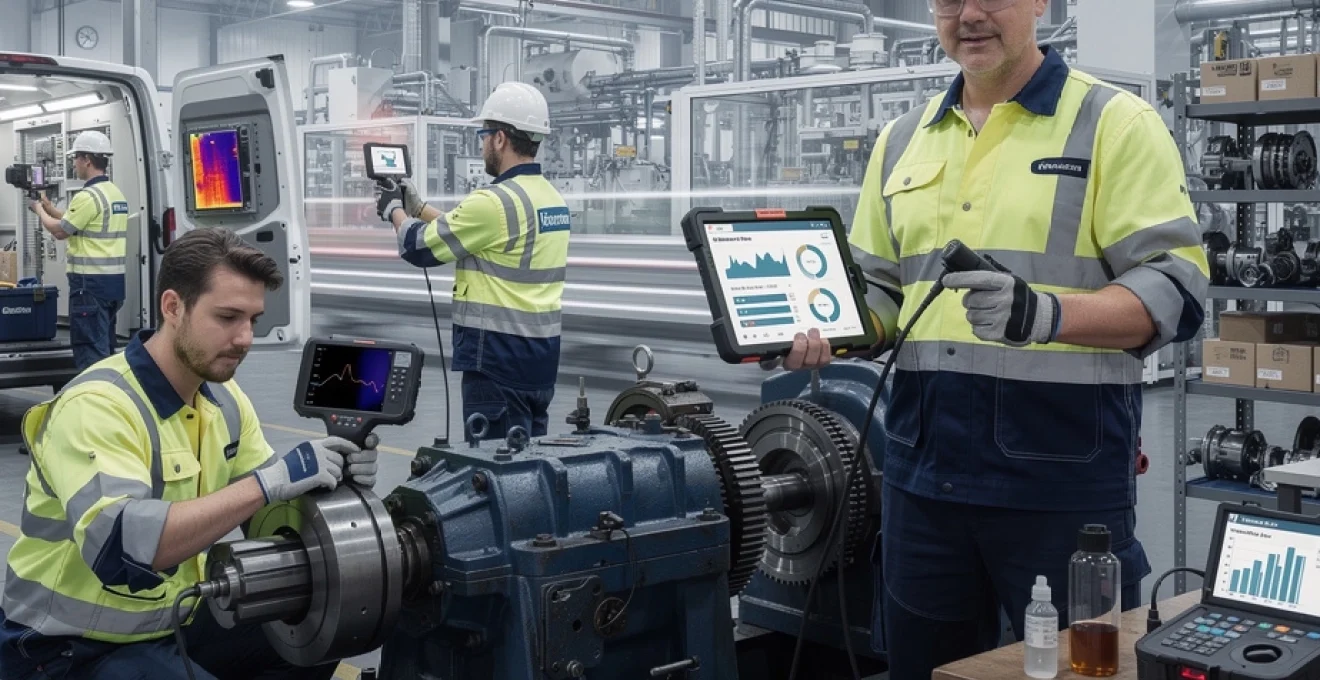
Industrial downtime costs manufacturers millions of pounds annually, with unplanned stoppages averaging £42,000 per hour across critical production facilities. The relentless pressure to maintain operational efficiency whilst managing increasingly complex machinery has transformed maintenance from a reactive necessity into a strategic competitive advantage. Modern industrial environments demand sophisticated approaches that combine predictive technologies, emergency response capabilities, and comprehensive maintenance frameworks to minimise costly interruptions.
The evolution from traditional break-fix methodologies to proactive maintenance strategies represents a fundamental shift in how manufacturing organisations approach equipment reliability. Today’s industrial repair and maintenance services encompass everything from advanced diagnostics and condition monitoring to 24/7 emergency response teams equipped with cutting-edge tools and expertise. This transformation has enabled forward-thinking companies to achieve remarkable reductions in unplanned downtime whilst simultaneously extending equipment lifecycles and optimising operational costs.
Predictive maintenance technologies for industrial equipment optimisation
The integration of predictive maintenance technologies represents one of the most significant advances in industrial equipment management, offering manufacturers the ability to anticipate failures before they occur. These sophisticated systems leverage real-time data collection, advanced analytics, and machine learning algorithms to identify potential equipment issues weeks or even months before traditional maintenance approaches would detect them. The result is a paradigm shift from reactive repairs to proactive interventions that substantially reduce both planned and unplanned downtime.
Modern predictive maintenance programmes typically achieve 25-30% reductions in maintenance costs whilst increasing equipment availability by up to 15%. These impressive figures reflect the technology’s ability to optimise maintenance schedules based on actual equipment condition rather than arbitrary time intervals. By monitoring critical parameters such as vibration patterns, thermal signatures, and lubrication quality, maintenance teams can make data-driven decisions that maximise equipment performance whilst minimising unnecessary interventions.
Vibration analysis systems and accelerometer implementation
Vibration analysis represents the cornerstone of predictive maintenance for rotating machinery, with accelerometer-based monitoring systems providing invaluable insights into equipment health. These sophisticated sensors continuously monitor vibration signatures across multiple frequency ranges, detecting subtle changes that indicate developing mechanical issues such as bearing wear, shaft misalignment, or imbalance conditions. The technology has evolved to include wireless sensors that can transmit real-time data to centralised monitoring platforms, enabling maintenance teams to track equipment health remotely.
Implementation of vibration monitoring systems typically follows a structured approach beginning with baseline establishment for critical equipment. Maintenance professionals install accelerometers at strategic locations on machinery, collecting initial vibration signatures that serve as reference points for future comparisons. Advanced systems utilise spectral analysis algorithms to identify specific fault frequencies associated with different failure modes, allowing technicians to pinpoint exact causes of developing problems rather than simply identifying that an issue exists.
Thermographic infrared inspection protocols for electrical components
Thermal imaging technology has become indispensable for electrical system maintenance, with infrared cameras capable of detecting temperature anomalies that indicate potential failures in switchgear, transformers, and motor control centres. These non-contact inspection methods allow maintenance teams to identify overheating components whilst equipment remains energised and operational, eliminating the need for costly shutdowns during routine inspections. Modern thermal cameras offer temperature measurement accuracies within ±2°C, enabling precise identification of components operating outside normal parameters.
Effective thermographic inspection programmes require standardised protocols that define optimal environmental conditions, measurement techniques, and alarm thresholds for different equipment types. Experienced thermographers develop comprehensive inspection routes that maximise coverage whilst minimising time requirements, often completing facility-wide electrical inspections in a matter of hours. The technology proves particularly valuable for identifying loose connections, overloaded circuits, and failing insulation systems before they result in catastrophic failures or safety incidents.
Ultrasonic testing for bearing condition monitoring
Ultrasonic testing technology provides maintenance teams with powerful capabilities for detecting bearing defects, lubrication issues, and mechanical wear in rotating equipment. These instruments detect high-frequency sound waves generated by friction, impact, and turbulence within machinery, offering early warning signs of developing problems that may not be apparent through traditional vibration analysis. The technology excels at identifying lubrication deficiencies, enabling maintenance teams to optimise lubrication schedules and prevent premature bearing failures.
Advanced ultrasonic instruments incorporate digital signal processing capabilities that filter background noise
to isolate critical ultrasonic signatures, converting complex waveforms into clear, actionable data. Technicians can trend decibel levels over time to distinguish between normal mechanical noise and early-stage bearing defects, allowing maintenance tasks to be scheduled long before catastrophic failure occurs. When combined with vibration monitoring, ultrasonic testing forms a powerful dual-diagnostic approach that significantly improves the accuracy of predictive maintenance for rotating assets.
Practical implementation often starts with establishing baseline readings for healthy equipment and defining alarm thresholds for different bearing types and operating speeds. Handheld ultrasonic devices enable quick, route-based surveys across large plants, while permanently installed sensors can provide continuous monitoring on mission-critical assets. For many facilities, integrating ultrasonic testing into existing inspection routines delivers a rapid return on investment through reduced bearing failures, fewer emergency call-outs, and extended asset life.
Oil analysis and tribology programmes for machinery lubrication
Oil analysis and tribology programmes offer a detailed window into the internal condition of industrial machinery, particularly for gearboxes, hydraulic systems, and high-value rotating equipment. By regularly sampling lubricants and analysing properties such as viscosity, particle contamination, water content, and additive depletion, maintenance teams can detect wear mechanisms long before they cause equipment downtime. In many cases, oil analysis identifies problems weeks in advance, giving you ample time to plan repairs during low-impact windows.
Comprehensive tribology programmes go beyond basic oil testing to include ferrographic analysis, particle count trending, and root cause investigation of abnormal wear patterns. This data helps determine whether issues stem from poor filtration, incorrect lubricant selection, environmental contamination, or mechanical misalignment. When combined with condition-based oil change intervals, these insights can reduce lubricant consumption by 20–30% while simultaneously improving equipment reliability.
Implementing an effective oil analysis regime typically involves partnering with a specialist laboratory, defining sampling points, and standardising procedures for sample collection. Clear alarm limits and colour-coded reports make it easier for non-specialists to interpret results and trigger timely interventions. Over time, the historical database built through oil analysis becomes a powerful tool for lifecycle planning, helping you decide whether refurbishment or replacement offers the best long-term value for critical assets.
Emergency response frameworks for critical manufacturing downtime
Even with robust predictive maintenance in place, no facility can completely eliminate the risk of sudden failures. When a critical asset does go down, the speed and structure of your emergency response framework determine whether you lose minutes or entire shifts of production time. Well-designed industrial repair and maintenance services combine rapid mobilisation, clear escalation paths, and pre-engineered contingency plans to restore operations as quickly as possible.
Leading manufacturers treat emergency response as a disciplined process rather than an ad hoc scramble. Response playbooks define who is called, what tools and spares are deployed, and how decisions are made when every minute of downtime carries significant financial impact. By aligning 24/7 support contracts, mobile service units, and supplier networks in advance, organisations can turn unforeseen breakdowns into tightly controlled events with predictable outcomes.
24/7 mobile field service units and rapid deployment strategies
Round-the-clock mobile field service units form the backbone of any effective rapid repair strategy. These teams are equipped with fully stocked service vehicles, diagnostic equipment, and communication tools, enabling them to respond to calls within predefined response time windows. For high-value production assets, many service providers commit to on-site presence within two to four hours, dramatically reducing mean time to repair (MTTR) compared with traditional call-out arrangements.
Rapid deployment strategies often rely on geofenced service zones and strategic technician placement to minimise travel time. Dispatch systems use live traffic data and technician skill profiles to route the best-qualified engineer to each incident, rather than simply the closest. Think of it as an emergency services model for industrial maintenance: the right team, with the right tools, at the right place, as fast as possible.
To maximise effectiveness, organisations should regularly test their emergency deployment procedures through simulated breakdown drills. These exercises highlight weak points in communication, access control, and on-site coordination, allowing continuous refinement of the framework. When a real failure occurs, the process feels familiar rather than chaotic, and downtime is contained instead of spiralling.
Hot-standby component inventory management systems
One of the fastest ways to turn a manageable failure into an extended outage is to discover that the critical replacement part is not available. Hot-standby component inventory management addresses this risk by identifying the parts most likely to cause catastrophic downtime and ensuring they are held in ready-to-use condition. This typically includes motors, drives, PLC modules, bearings, and specialised sensors for bottleneck equipment.
Rather than attempting to stock every possible spare, successful programmes use criticality analysis and failure history to focus on components with high impact and realistic failure probability. Inventory management systems track stock levels, shelf-life, and last-use dates, preventing both obsolescence and surprise shortages. Some organisations go further by maintaining pre-configured assemblies—such as complete gearmotor units or pre-wired control panels—that can be swapped in as plug-and-play solutions.
For multi-site operations, centralised “hot-standby hubs” can support several plants, with same-day or overnight logistics bridging the distance. The modest carrying cost of these critical spares is usually outweighed many times over by the avoided downtime when a major asset fails. The result is a more resilient production environment where unexpected breakdowns are contained rather than catastrophic.
Cross-trained multi-skilled technician workforce development
When a production line stops, waiting for the one specialist who understands a particular machine or control system can be as damaging as waiting for a spare part. Developing a cross-trained, multi-skilled technician workforce is therefore central to any rapid repair strategy. By equipping engineers with competencies across mechanical, electrical, and control disciplines, organisations reduce bottlenecks in response capability and improve first-time fix rates.
Practical workforce development programmes combine formal training with structured on-the-job mentoring. Junior technicians shadow experienced specialists during complex interventions, building familiarity with critical assets and their failure modes. Over time, skills matrices and competency assessments help identify coverage gaps—ensuring that every shift has sufficient expertise on site to handle the most common emergency scenarios.
This approach does more than just reduce downtime; it also improves job satisfaction and retention among maintenance staff. Technicians who see clear pathways for skills growth are more engaged and more likely to contribute actively to continuous improvement. In an era where skilled maintenance professionals are in short supply, investing in cross-training is both a resilience strategy and a talent strategy.
Emergency procurement networks for obsolete industrial parts
Many plants operate legacy equipment that is mechanically sound but no longer supported by the original manufacturer. When these machines fail, sourcing obsolete parts can take days or weeks—unless you have an established emergency procurement network. Specialist suppliers, refurbishers, and brokers can often locate, remanufacture, or reverse-engineer critical components far faster than traditional channels.
Building such a network starts with mapping your installed base and identifying assets at risk due to obsolescence. From there, maintenance and procurement teams work together to pre-qualify partners who can supply refurbished drives, reconditioned motors, or custom-fabricated mechanical parts at short notice. Some organisations go as far as digitising obsolete components using 3D scanning and CAD models, so that they can be reproduced quickly via CNC machining or additive manufacturing when required.
While emergency procurement is never as fast as installing a part that is already on the shelf, a well-prepared network can compress lead times from months to days. When every hour of downtime represents substantial lost revenue, this difference can be decisive in keeping critical production commitments on track.
Industry-specific maintenance strategies for high-risk sectors
Not all industrial environments face the same risks or regulatory pressures, and a one-size-fits-all maintenance strategy rarely delivers optimal results. High-risk sectors such as pharmaceuticals, food and beverage, oil and gas, and heavy metals processing each demand tailored approaches that reflect their unique safety, quality, and uptime requirements. What might be an acceptable delay in one industry could be intolerable in another where product integrity or environmental risk is at stake.
For example, pharmaceutical manufacturing places a premium on validated equipment performance and contamination control, driving the need for meticulously documented maintenance procedures and highly controlled change management. In contrast, heavy process industries often focus on managing the enormous consequences of major equipment failures, such as kiln outages or refinery unit trips, where downtime costs can exceed six figures per hour. Understanding these sector-specific drivers allows maintenance providers to design targeted service offerings that deliver maximum value.
Effective industry-specific strategies typically combine domain expertise with flexible maintenance frameworks. This might include GMP-compliant documentation for life sciences, hygienic design inspections for food plants, or API/ATEX-certified interventions in explosive atmospheres. By aligning repair and maintenance services with the operational realities of each sector, you can reduce downtime whilst also strengthening compliance and safety performance.
Digital maintenance management systems and CMMS integration
Coordinating predictive technologies, emergency response, and routine maintenance at scale is almost impossible without robust digital support. Computerised Maintenance Management Systems (CMMS) and modern digital maintenance platforms serve as the central nervous system of industrial maintenance operations, capturing asset data, scheduling work, and providing real-time visibility into equipment status and downtime trends. When integrated properly, they transform fragmented activities into a coherent, data-driven maintenance strategy.
A well-implemented CMMS enables you to consolidate work orders, inspection results, sensor alerts, and spare parts transactions in a single source of truth. This not only simplifies day-to-day coordination but also unlocks powerful analytics capabilities. For instance, correlating vibration alarms with historical repair records can reveal chronic design weaknesses or training gaps that would otherwise remain hidden. Over time, these insights guide investments in upgrades, training, or process changes that deliver sustained reductions in downtime.
Integration is where digital maintenance management really comes into its own. Linking your CMMS with condition monitoring systems, SCADA platforms, or ERP solutions allows automatic work order creation when defined thresholds are breached, ensuring that potential failures trigger immediate action. Mobile access ensures technicians can receive, execute, and close jobs in real time on the shop floor, eliminating paperwork delays and improving data accuracy. The result is a more agile maintenance operation where information flows freely and decisions are based on current, credible data rather than end-of-shift recollections.
Cost-benefit analysis of outsourced maintenance versus in-house operations
Deciding whether to rely on external industrial repair and maintenance services or to build in-house capability is a strategic question with far-reaching implications for cost, risk, and flexibility. Neither model is inherently superior; the optimal solution depends on your asset base, production profile, and access to skilled labour. A structured cost-benefit analysis helps you move beyond headline hourly rates to understand the true financial and operational impact of each approach.
Many manufacturers find that a hybrid model delivers the best balance, combining an internal team for routine and corrective tasks with specialist service partners for predictive technologies, major overhauls, and 24/7 emergency cover. This arrangement allows you to retain operational knowledge and day-to-day responsiveness while tapping into advanced expertise and equipment without the capital burden. The key is to quantify all relevant cost elements and risk exposures rather than simply comparing labour rates.
Total cost of ownership models for industrial equipment
Total Cost of Ownership (TCO) models provide a comprehensive framework for evaluating maintenance strategies over the full lifecycle of industrial equipment. Instead of focusing solely on purchase price or annual service costs, TCO calculations include energy consumption, consumables, planned and unplanned downtime, repair expenditure, and eventual replacement or refurbishment. When you consider that downtime alone can account for 20–40% of an asset’s lifecycle cost in some industries, the value of proactive, high-quality maintenance quickly becomes evident.
When comparing in-house versus outsourced approaches, TCO analysis should also factor in training, recruitment, tooling, and software costs required to maintain internal capability. For example, building expertise in vibration analysis or thermography may require significant upfront investment that only pays off if you maintain a large enough asset base. In contrast, a specialist service provider spreads these costs across many clients, often delivering higher technical capability at a lower effective TCO.
By modelling different scenarios—such as increased preventive maintenance frequency, adoption of predictive technologies, or outsourcing complex overhauls—you can identify the mix of services that minimises total cost while maximising uptime. This data-driven approach turns maintenance budgeting into a strategic exercise rather than an annual cost-cutting discussion.
Service level agreement structures and performance metrics
When engaging external maintenance providers, the structure of your Service Level Agreements (SLAs) has a direct impact on downtime performance. Effective SLAs move beyond vague promises of “rapid response” to define clear, measurable commitments such as maximum response times, guaranteed fix times for critical assets, and minimum availability levels for key production lines. These metrics are then linked to financial incentives or penalties that align the provider’s priorities with your operational objectives.
Typical performance indicators within maintenance SLAs include MTTR, first-time fix rate, planned versus unplanned maintenance ratio, and adherence to preventive maintenance schedules. Some advanced contracts also incorporate Overall Equipment Effectiveness (OEE) targets or energy efficiency goals, rewarding providers for delivering broader operational improvements rather than simply completing tasks. The more closely these KPIs reflect your business outcomes—on-time delivery, scrap rates, or throughput—the more value the SLA will generate.
Crucially, SLAs should not be static documents. Regular performance reviews and joint improvement workshops allow both parties to refine targets, address emerging issues, and adapt to changes in production demands. Treating your maintenance partner as an extension of your operations team, rather than a transactional supplier, creates the collaboration needed to drive sustained downtime reduction.
Risk transfer mechanisms through comprehensive maintenance contracts
Comprehensive maintenance contracts can function as powerful risk transfer mechanisms, shifting a portion of the financial and operational risk associated with equipment failures from the manufacturer to the service provider. Under fixed-fee or performance-based arrangements, the provider assumes responsibility for keeping assets available within agreed parameters, absorbing the additional cost if failures exceed expectations. For you, this converts variable, unpredictable breakdown costs into a more stable and forecastable expense.
These contracts often bundle preventive, corrective, and predictive maintenance services into a single package, sometimes including component replacement and remote monitoring. From a risk management perspective, this is similar to taking out an insurance policy backed by technical expertise: you pay a known premium, and the provider carries the burden of managing the unknowns. In sectors where downtime penalties or lost production opportunities are particularly severe, this can be an attractive proposition.
However, effective risk transfer requires careful contract design. Clear definitions of asset scope, operating conditions, and responsibilities are essential to avoid disputes when failures occur. Transparent data sharing via integrated CMMS systems reinforces trust, enabling both parties to see the same performance information. When structured correctly, comprehensive maintenance contracts incentivise providers to invest proactively in reliability improvements, because every avoided failure directly protects their margin.
Regulatory compliance and safety standards in industrial maintenance
Industrial maintenance does not operate in a vacuum; it is tightly bound to regulatory frameworks and safety standards that govern everything from electrical work to pressure systems and lifting equipment. Failure to comply can result not only in fines and legal liability but also in unplanned downtime due to enforcement actions or incident investigations. For this reason, leading maintenance programmes treat compliance as a core design principle rather than an administrative afterthought.
Practical compliance-focused maintenance includes ensuring that all work on hazardous equipment is carried out by suitably qualified personnel, that lockout/tagout procedures are rigorously applied, and that statutory inspections—for example, of pressure vessels or lifting gear—are completed on or ahead of schedule. Digital maintenance management systems can play a vital role here, automatically scheduling legally mandated inspections, storing certification documents, and providing auditable records of all interventions.
From a downtime perspective, robust safety standards act as a protective buffer. Well-maintained safety systems reduce the likelihood of incidents that can shut down entire plants for extended periods, while compliant documentation streamlines interactions with regulators and insurers. Moreover, a strong safety culture encourages operators to report abnormalities early—unusual noises, leaks, or smells—before they escalate into failures. In this way, safety and reliability reinforce each other, supporting both regulatory compliance and continuous operation.