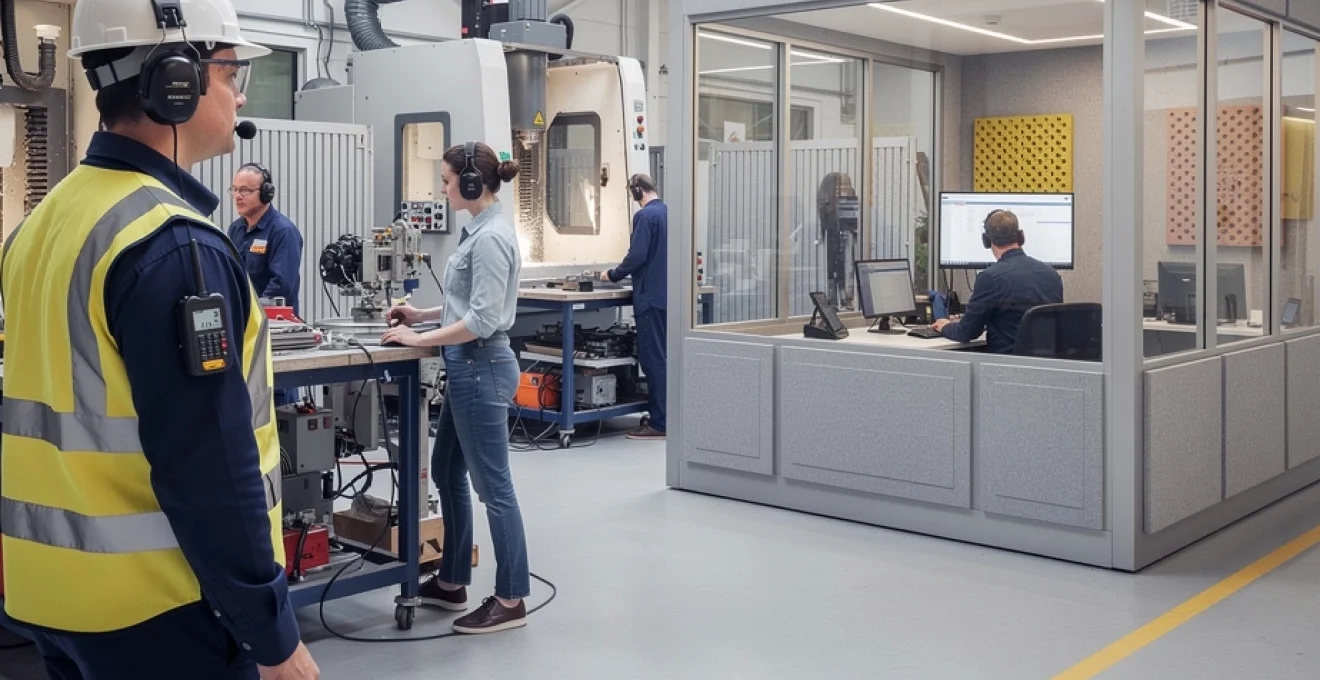
Excessive workplace noise poses significant risks to employee health, productivity, and overall well-being. With approximately 17,000 UK workers suffering hearing damage annually due to occupational noise exposure, implementing comprehensive noise reduction solutions has become a critical priority for employers across all industries. Modern acoustic engineering approaches combine regulatory compliance with innovative technologies to create safer, more comfortable working environments that protect workers whilst maintaining operational efficiency.
The evolution of noise control strategies extends far beyond traditional hearing protection, encompassing sophisticated acoustic design principles, advanced materials science, and cutting-edge monitoring technologies. From manufacturing floors to healthcare facilities, organisations are discovering that strategic noise management not only prevents hearing loss but also enhances concentration, reduces stress-related absenteeism, and improves overall workplace satisfaction. The investment in comprehensive noise reduction programmes demonstrates a commitment to employee welfare whilst delivering measurable returns through increased productivity and reduced liability exposure.
Decibel level regulations and occupational health standards in UK workplaces
The Control of Noise at Work Regulations 2005 establishes mandatory exposure limits that employers must observe to protect workers from noise-induced hearing damage. These regulations specify three critical thresholds: lower exposure action values at 80 dB(A) daily or weekly exposure, upper exposure action values at 85 dB(A), and exposure limit values at 87 dB(A) when accounting for hearing protection. Understanding these limits requires recognising that decibel measurements use a logarithmic scale, meaning a 10 dB increase represents a tenfold increase in sound intensity.
Employers face legal obligations that extend beyond simple noise measurement, requiring comprehensive risk assessments whenever workplace noise levels approach these thresholds. The Health and Safety Executive emphasises that if normal conversation becomes difficult at two metres distance, noise levels likely exceed 80 dB(A), triggering mandatory assessment requirements. These assessments must consider not only average exposure levels but also peak noise events that could cause immediate hearing damage, particularly in industrial environments where impact tools or pneumatic equipment create sudden, intense sound bursts.
Compliance strategies must address both daily and weekly exposure calculations, accounting for varying shift patterns and job rotations that affect individual worker exposure profiles. Modern dosimetry technology enables precise measurement of personal noise exposure, allowing organisations to demonstrate regulatory compliance whilst identifying specific areas requiring intervention. The regulations also mandate that exposure limit values must never be exceeded, even when accounting for hearing protection attenuation, placing emphasis on engineering controls rather than relying solely on personal protective equipment.
Regular noise assessments become essential when workplace changes occur, including new equipment installation, process modifications, or facility expansions that could alter the acoustic environment.
Acoustic engineering solutions for industrial environment noise control
Industrial noise control requires systematic engineering approaches that address sound generation at its source, interrupt transmission pathways, and protect receivers through comprehensive acoustic design strategies. The hierarchy of noise control prioritises elimination and substitution methods, followed by engineering controls, administrative measures, and finally personal protective equipment as the last line of defence. This structured approach ensures maximum effectiveness whilst minimising ongoing operational burdens and costs associated with noise management programmes.
Sound absorption materials and acoustic foam implementation strategies
Acoustic absorption materials function by converting sound energy into minimal heat through friction within porous structures, effectively reducing reverberation and ambient noise levels throughout industrial spaces. High-performance acoustic foams utilise open-cell polyurethane structures that trap sound waves whilst maintaining durability in challenging industrial environments. The selection of appropriate absorption materials must consider factors including fire resistance ratings, chemical compatibility, cleaning requirements, and expected service life under specific operational conditions.
Strategic placement of acoustic treatments maximises noise reduction effectiveness whilst minimising material costs and installation complexity. Ceiling-mounted absorption panels prove particularly effective in large manufacturing spaces where wall access remains limited due to equipment placement and workflow requirements. Modern acoustic materials incorporate antimicrobial treatments and washable surfaces, addressing hygiene concerns in food processing, pharmaceutical, and healthcare manufacturing environments where traditional fibrous materials prove unsuitable.
Noise barrier systems and enclosure design for heavy machinery
Acoustic enclosures provide targeted noise control for specific equipment whilst maintaining operational accessibility and ventilation requirements essential for safe machinery operation. Effective barrier design requires understanding sound transmission principles, ensuring adequate mass and sealing to prevent flanking paths that compromise overall performance. Modular enclosure systems
with removable panels allow maintenance teams to access critical components without dismantling the entire system, reducing downtime while maintaining high acoustic performance. When designing machinery enclosures, engineers must balance sound insulation with ventilation, heat dissipation, and safety interlocks to prevent overheating or restricted emergency access. Integrating sound-absorbing linings on the inside of barriers reduces reverberant build-up around the machine, which in turn lowers overall noise exposure to nearby operators.
Positioning barriers as close as possible to either the noise source or the protected worker maximises attenuation by blocking the direct sound path. Dense materials such as steel, concrete, and multi-layer composite panels provide superior transmission loss compared with lightweight partitions, particularly at low frequencies common in heavy industrial processes. To avoid creating new hazards, barrier layouts must preserve safe movement routes for people and vehicles and maintain clear sightlines where necessary for supervision and signalling. In high-noise environments, combining barriers with overhead acoustic baffles and floor-mounted noise reduction mats can create a holistic noise control strategy that addresses both airborne and structure-borne sound.
Active noise cancellation technology in manufacturing facilities
Active noise cancellation (ANC) systems offer a sophisticated solution for tackling persistent, low-frequency noise that traditional barriers and absorption materials struggle to control. By using microphones to capture incoming sound waves and speakers to generate an equal and opposite “anti-noise” signal, these systems can significantly reduce noise levels in targeted zones, such as operator workstations or control rooms adjacent to noisy plant. ANC is particularly effective for predictable, steady-state noise profiles generated by fans, compressors, turbines, and large electric motors.
In modern manufacturing facilities, ANC technology can be integrated into headsets, machinery enclosures, or dedicated quiet zones where operators spend significant time monitoring equipment. For example, electronic communication headsets with built-in ANC can reduce low-frequency rumble while maintaining critical speech intelligibility for safety instructions and team coordination. While ANC is not a universal solution for every type of industrial noise, it can provide substantial improvements in comfort and communication when deployed alongside traditional acoustic treatments and engineering controls.
Implementing ANC requires careful acoustic analysis to identify dominant frequencies, microphone placement, and the potential for feedback or instability in complex sound fields. Facilities should work with experienced acoustic engineers and equipment manufacturers to design systems that remain robust in the face of changing operating conditions and equipment upgrades. When integrated correctly, active noise control can transform challenging acoustic environments into safer, more comfortable workplaces without the need for extensive structural modifications.
Vibration dampening solutions for pneumatic and hydraulic equipment
Many industrial noise problems originate not only from airborne sound but also from mechanical vibration transmitted through floors, walls, and structural steelwork. Pneumatic and hydraulic equipment, including presses, pumps, and impact tools, often generate high levels of structure-borne noise that radiate from large surfaces into surrounding work areas. Effective vibration dampening solutions interrupt these transmission paths using resilient mounts, isolation pads, and tuned mass dampers designed to match the dynamic properties of the equipment and supporting structure.
Installing anti-vibration mounts beneath heavy machinery can reduce both perceived noise levels and wear on the equipment itself, extending service life and reducing maintenance costs. For pipelines and hydraulic lines, flexible connections and isolation hangers minimise vibration transfer to building elements, preventing secondary noise radiation. In some cases, retrofitting damping materials to machine panels or guards can suppress resonance and “ringing” effects, much like muting a bell to stop it from ringing loudly when struck.
Successful vibration control begins with a thorough assessment of existing noise and vibration patterns, often using accelerometers and spectrum analysis to identify problematic frequencies. You may find that a modest investment in properly specified isolation mounts provides more effective noise reduction than extensive airborne sound treatment alone. By addressing both vibration and airborne noise in parallel, organisations create more stable, predictable acoustic environments that support long-term workplace safety and comfort.
Personal protective equipment and hearing conservation programmes
Even with robust engineering controls in place, many workplaces still present residual noise exposure that must be managed through personal protective equipment (PPE) and structured hearing conservation programmes. PPE should never be treated as the primary solution, but rather as a critical final layer of defence within a broader noise control strategy. A comprehensive programme combines hearing protection device selection, employee training, audiometric testing, and ongoing monitoring to ensure that protection remains effective over time.
Under UK regulations, employers must provide suitable hearing protection when noise exposure exceeds the lower exposure action value of 80 dB(A), and must enforce its use at or above the upper exposure action value of 85 dB(A). However, simply handing out ear defenders is not enough; workers need clear guidance on correct fit, limitations, cleaning, and storage to maintain both attenuation performance and hygiene. A well-designed hearing conservation programme also includes regular reviews of protection choices, particularly when new machinery or process changes alter the acoustic profile of the workplace.
3M peltor and howard leight hearing protection device selection
Selecting the right hearing protection device (HPD) involves balancing comfort, attenuation, compatibility with other PPE, and the communication needs of the workforce. Leading brands such as 3M Peltor and Howard Leight offer extensive product ranges encompassing disposable foam earplugs, reusable plugs, earmuffs, and integrated communication systems. Rather than defaulting to the highest noise reduction rating (SNR) available, employers should aim for protection that reduces effective exposure to safe levels without over-attenuating speech and warning signals.
In practice, this means matching HPD performance to measured or calculated noise levels, typically targeting an effective exposure of 70–80 dB(A) at the ear. Over-protection can be as problematic as under-protection, as workers may feel isolated or remove their protection to communicate, undermining the entire programme. Comfort plays a crucial role in long-term compliance; lightweight earmuffs with soft cushions or low-pressure headbands, for example, are more likely to be worn consistently throughout a shift. You can think of hearing protection like safety footwear: if it hurts to wear, people will find excuses to take it off.
Fit-testing programmes, similar to those used for respiratory protection, are increasingly recognised as best practice for hearing PPE. Objective fit verification helps identify individuals who may not achieve the expected level of attenuation due to ear canal shape, wearing style, or incompatibility with spectacles and other headgear. By combining careful product selection with individual fit assessment and training, organisations significantly increase the real-world effectiveness of their hearing protection policies.
Custom moulded earplugs and communication headset integration
For workers exposed to high noise levels over long periods, custom moulded earplugs provide a tailored solution that combines comfort, durability, and consistent attenuation. These plugs are manufactured from impressions of the individual’s ear canals, creating a secure and repeatable fit that reduces the risk of leakage and variability associated with standard foam plugs. Although the initial cost is higher, custom plugs often deliver long-term value through extended service life, reduced waste, and greater user acceptance.
In environments where clear communication is critical for safety and coordination, integrating hearing protection with communication headsets and radio systems becomes essential. Modern electronic ear defenders incorporate level-dependent microphones that allow low-level ambient sounds and speech to remain audible while automatically attenuating sudden loud noises. Some systems also provide Bluetooth or wired connectivity to radios and intercoms, enabling hands-free communication without compromising hearing protection.
When designing integrated solutions, employers should consider compatibility between custom moulded plugs, earmuff shells, and electronic components to avoid creating pressure points or degraded attenuation. It is also important to provide training on battery management, maintenance, and safe operation of electronic features so that the technology supports, rather than distracts from, safe working practices. By aligning communication needs with effective hearing protection, organisations foster a culture where noise control enhances, rather than hinders, operational performance.
Audiometric testing protocols and noise-induced hearing loss prevention
Audiometric testing forms a cornerstone of any serious hearing conservation programme, providing objective data on workers’ hearing thresholds over time. Baseline tests, conducted when employees first join a noise-exposed role, create a reference point against which future changes can be measured. Subsequent periodic tests, typically annual or biannual depending on risk level, help detect early signs of noise-induced hearing loss (NIHL) before they manifest as noticeable communication difficulties.
Effective protocols follow recognised standards for test environments, equipment calibration, and result interpretation, ensuring that measured changes reflect genuine shifts in hearing rather than test variability. Where threshold shifts are identified, employers should investigate potential causes, including inadequate hearing protection, changes in noise exposure, or non-occupational factors such as recreational noise. Prompt intervention might involve re-training on HPD use, upgrading equipment, or reassigning tasks to limit further exposure.
Communicating audiometric results sensitively and clearly is essential to maintain trust and encourage proactive behaviour. Workers should understand not only their current hearing status but also what practical steps they can take to protect it, both at work and in their personal lives. Viewed in this way, audiometric testing becomes more than a compliance requirement; it evolves into an educational tool that supports long-term hearing health and reinforces the importance of effective noise reduction solutions.
Real-time noise dosimetry monitoring systems
Traditional noise surveys provide valuable snapshots of workplace exposure, but they may miss short-term fluctuations or task-specific peaks that significantly impact an individual’s daily dose. Real-time noise dosimetry systems address this gap by equipping workers with compact, body-worn devices that continuously measure sound levels throughout a shift. Many modern dosimeters transmit data wirelessly to central dashboards, allowing safety managers to monitor exposure patterns in near real-time and respond rapidly to emerging risks.
These systems support proactive noise management by identifying specific tasks, locations, or time periods associated with high exposure, guiding targeted interventions rather than broad, generic controls. For example, data may reveal that a particular maintenance activity or temporary production line generates short but intense noise peaks that require additional controls or revised work practices. Over time, aggregated dosimetry data builds a detailed picture of exposure trends, helping organisations evaluate the effectiveness of engineering controls and justify further investment where needed.
From a worker’s perspective, real-time feedback—via visual indicators or mobile apps—can reinforce safe behaviours by highlighting when exposure is approaching or exceeding safe limits. This transforms noise management from a purely top-down compliance exercise into a shared responsibility, where employees can see the direct impact of their choices around hearing protection and task planning. When combined with clear policies and training, dosimetry technologies become powerful tools for sustaining a robust, data-driven hearing conservation culture.
Workplace productivity enhancement through acoustic comfort design
While regulatory frameworks focus primarily on preventing hearing damage, many organisations are increasingly interested in how noise reduction solutions influence productivity, concentration, and overall employee comfort. Research from bodies such as the World Health Organization and the British Safety Council links excessive noise with reduced cognitive performance, increased error rates, and higher stress-related absenteeism. In office and light industrial settings, even moderate background noise can erode focus and collaboration quality, particularly for tasks demanding sustained attention or complex problem-solving.
Acoustic comfort design recognises that a well-managed sound environment supports different work modes—deep focus, collaboration, communication, and rest—without one dominating the others. This often involves combining sound-absorbing materials, zoning strategies, and behavioural guidelines to reduce intrusive noise while preserving beneficial sounds that aid situational awareness. For example, separating high-traffic circulation routes from focused work areas, or using acoustic screens to shield staff from noisy equipment, can yield noticeable improvements in perceived comfort with relatively modest interventions.
Importantly, acoustic comfort is not solely about making spaces as quiet as possible; it is about achieving the right balance. In some cases, introducing controlled background sound—through sound masking systems or gentle HVAC noise—can help mask sudden disruptions and improve speech privacy in open-plan offices. By treating noise as a design parameter rather than an unavoidable by-product, you can create workplaces where staff feel more in control of their environment, leading to higher satisfaction, fewer distractions, and more consistent performance across the working day.
Industry-specific noise mitigation strategies and case studies
Different industries face distinct acoustic challenges, shaped by their processes, building types, and regulatory expectations. A construction site, for instance, must manage powerful, intermittent noise sources in open-air environments, while a hospital needs to balance patient rest with the constant flow of clinical activity and alarms. Tailored noise mitigation strategies recognise these unique conditions, drawing on both general acoustic principles and sector-specific best practice. Exploring practical examples can help you identify approaches that resonate with your own workplace context.
Across sectors, successful projects share several common threads: early integration of acoustic design into project planning, collaboration between safety teams and operational stakeholders, and a willingness to combine engineering controls with procedural and behavioural measures. The following case-style scenarios illustrate how targeted interventions—ranging from temporary acoustic barriers to advanced speech intelligibility optimisation—can transform noisy environments into safer, more comfortable spaces without compromising productivity or service quality.
Construction site noise control using temporary acoustic barriers
Construction sites present some of the most challenging noise control scenarios, with heavy plant, impact tools, and variable weather conditions all influencing sound propagation. Temporary acoustic barriers offer a flexible solution, shielding nearby residents and on-site workers from the most intense noise sources. These barriers typically consist of modular panels filled with sound-absorbing materials, mounted on frames that can be repositioned as work progresses. When placed close to generators, compressors, or demolition zones, they can deliver reductions of 10–15 dB(A), significantly changing how noisy the site feels.
In a typical urban project, for example, contractors may deploy acoustic curtains or barrier screens around concrete breakers and cutting equipment during peak activity periods. Combined with careful scheduling of the loudest tasks for mid-day hours, when background city noise is already higher, this can help meet local authority noise limits and minimise complaints. Within the site, barriers also protect workers by reducing direct sound paths to welfare areas, walkways, and site offices, making it easier to hold briefings and coordinate activities safely.
Effective deployment of temporary barriers requires attention to detail: gaps at the base, poorly sealed joints, or insufficient height can all undermine performance. Think of a barrier like water-tight dam walls—even small leaks can allow a surprising amount of “flow” through. By training site teams in correct installation and maintenance of acoustic barriers, and combining these with equipment selection, maintenance, and task rotation, construction firms can demonstrate a proactive approach to noise management that supports both compliance and community relations.
Call centre acoustic design and speech intelligibility optimisation
Call centres and customer contact hubs rely heavily on clear, intelligible speech, yet they often operate in open-plan layouts where multiple conversations take place simultaneously. Poor acoustic design leads to a familiar scenario: agents struggling to hear customers over background chatter, raising their own voices, and contributing to a spiral of increasing noise. Addressing this requires a combination of sound-absorbing finishes, workstation design, and electronic sound masking to manage both overall reverberation and direct sound transmission between positions.
Installing acoustic ceiling tiles with high noise reduction coefficients (NRC) can significantly reduce reverberation time, preventing speech from “bouncing” around the space. Desk-mounted screens covered with sound-absorbing fabric act as local barriers, limiting the spread of direct sound between adjacent agents while preserving line-of-sight supervision. In some facilities, carefully tuned sound masking systems introduce a low-level, broadband background sound that masks distant conversations, improving privacy and reducing the cognitive load associated with overhearing irrelevant speech.
Optimising speech intelligibility also involves considering headset technology, microphone placement, and agent training. High-quality headsets with noise-cancelling microphones capture the caller’s voice clearly while rejecting ambient noise, allowing agents to speak at a comfortable level. From a design perspective, you can view the call centre as a finely tuned instrument: each component—finishes, layout, technology, and behaviour—needs to work in harmony to produce a controlled, predictable acoustic “performance” that supports both customer satisfaction and employee well-being.
Manufacturing floor noise reduction in automotive assembly plants
Automotive assembly plants combine extensive conveyor systems, power tools, robotic welding, and material handling equipment, creating complex soundscapes with both continuous and impact noise components. A typical noise reduction project in this environment may start with a detailed noise map, identifying hot spots where levels exceed 85–90 dB(A). Engineers then develop a package of interventions targeting the loudest contributors, such as installing acoustic enclosures around power units, adding damping treatments to metal guards, and isolating vibrating equipment from structural steelwork.
One illustrative case involves retrofitting large, modular acoustic enclosures around body-in-white welding cells, combined with overhead absorptive baffles in the surrounding aisle. This configuration reduced operator exposure by more than 8 dB(A) while maintaining essential access for maintenance robots and quality inspectors. In parallel, introducing quieter, low-noise tooling for manual operations and enforcing strict maintenance regimes on compressed air systems further reduced background noise levels, creating a more comfortable working environment across the line.
Crucially, automotive plants often integrate noise control into lean manufacturing initiatives, recognising that quieter processes are typically more stable, efficient, and easier to monitor. For example, abnormal mechanical noises become easier to detect when overall ambient levels are lower, supporting predictive maintenance and reducing unplanned downtime. By framing noise reduction as both a safety imperative and an operational improvement, manufacturing leaders secure greater buy-in from production teams and sustain improvements over the long term.
Hospital and healthcare facility acoustic environment management
Hospitals and healthcare environments must carefully balance the need for rapid communication and audible alarms with the requirement for restful, low-stress spaces that support healing. Excessive noise—whether from equipment, conversations, or building services—has been linked to increased patient stress, sleep disruption, and even longer recovery times. Staff are not immune either; chronic exposure to high noise levels can contribute to fatigue, miscommunication, and reduced job satisfaction among clinical teams.
Acoustic environment management in healthcare typically involves targeted interventions such as sound-absorbing ceiling systems in wards, vibration-isolated HVAC plant rooms, and door and curtain upgrades to improve speech privacy. For instance, fitting high-performance acoustic ceiling tiles and wall panels in intensive care units can reduce reverberation, allowing staff to speak at lower volumes while still remaining clearly heard. In waiting areas and corridors, soft furnishings, acoustic artwork, and carefully chosen floor finishes help absorb sound from footfall and conversation, creating a calmer atmosphere for patients and visitors.
Alarm management and communication protocols also play a vital role. Rationalising alarm volumes and durations, using visual indicators where appropriate, and introducing “quiet hours” policies in specific clinical areas can all contribute to reduced noise levels without compromising safety. Many trusts now treat acoustics as a core aspect of healthcare design and refurbishment, recognising that noise reduction solutions directly enhance patient comfort, dignity, and outcomes. By embedding acoustic considerations into estates planning and clinical governance, healthcare organisations can create environments that support both high-quality care and the well-being of those who deliver it.