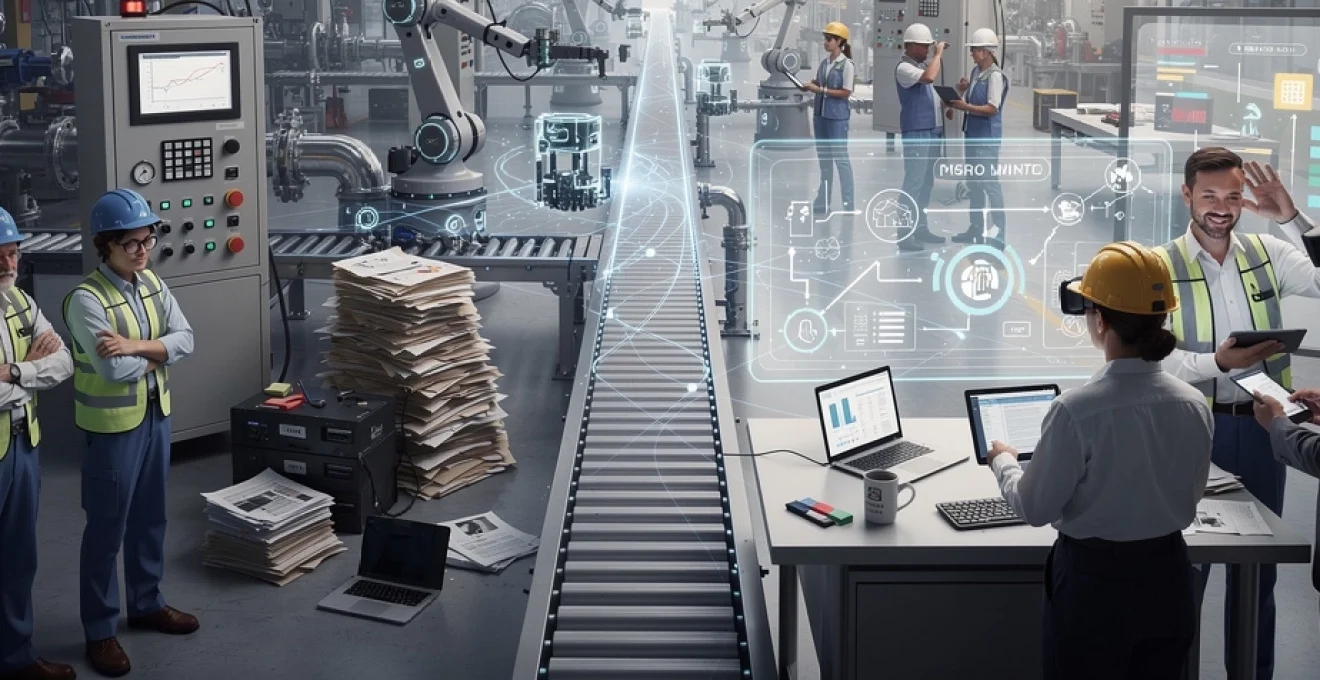
The industrial sector stands at a critical juncture where digital transformation is no longer optional but essential for survival. Manufacturing facilities, processing plants, and industrial operations worldwide are grappling with the challenge of modernising their systems whilst managing workforce resistance to change. This resistance often stems from deeply rooted concerns about job security, skill obsolescence, and the disruption of established workflows that have served organisations for decades. Understanding and addressing these concerns requires a nuanced approach that acknowledges both the technical complexities of industrial environments and the human factors that drive resistance to digital adoption.
Identifying digital transformation barriers in manufacturing and industrial environments
Manufacturing and industrial environments present unique challenges when implementing digital transformation initiatives. Unlike office-based organisations, industrial facilities must contend with complex operational requirements, safety considerations, and infrastructure constraints that significantly impact the pace and scope of digital adoption. The physical nature of manufacturing processes creates additional layers of complexity that require careful consideration during any transformation effort.
Legacy system dependencies and SCADA networks
Industrial facilities often rely heavily on legacy systems that have been operational for decades. These Supervisory Control and Data Acquisition (SCADA) networks form the backbone of industrial operations, controlling everything from production line automation to environmental monitoring systems. The interconnected nature of these systems means that any changes must be carefully planned to avoid disrupting critical operations. Many organisations face the challenge of integrating modern digital solutions with proprietary protocols and aging hardware that may not support contemporary communication standards.
The technical debt associated with these legacy systems creates a significant barrier to digital transformation. Replacing or upgrading critical infrastructure requires substantial planning, testing, and validation to ensure operational continuity. Industrial teams often express concern about the risks associated with modifying systems that have proven reliable over many years, leading to resistance towards adopting newer technologies.
Workforce demographics and digital literacy gaps in operations teams
The demographic composition of industrial workforces presents another significant challenge for digital transformation initiatives. Many manufacturing facilities employ experienced technicians and operators who have developed expertise with traditional systems over decades of service. These team members may lack familiarity with modern digital interfaces, cloud-based platforms, or data analytics tools that form the foundation of Industry 4.0 implementations.
The digital literacy gap becomes particularly pronounced when considering the contrast between older workers’ comfort with mechanical and electrical systems versus their unfamiliarity with software-based solutions. This disparity creates anxiety about the learning curve required to master new technologies, potentially leading to resistance or reluctance to engage with digital transformation efforts. Bridging this gap requires targeted training programmes and support systems designed specifically for industrial environments.
Risk aversion culture in Safety-Critical industrial processes
Industrial environments prioritise safety above all other considerations, creating a culture of risk aversion that can impede digital transformation efforts. Safety-critical processes require rigorous testing, validation, and certification before any changes can be implemented. This regulatory environment naturally creates resistance to new technologies, particularly when they involve modifications to control systems or safety protocols.
The consequences of system failures in industrial settings can be catastrophic, involving potential injury to personnel, environmental damage, or significant financial losses. This reality creates a legitimate basis for caution when considering digital transformation initiatives. Teams may resist changes that they perceive as introducing additional complexity or potential failure points into proven systems. Overcoming this resistance requires demonstrating that new technologies enhance rather than compromise safety and reliability.
Budget constraints and ROI uncertainties for industry 4.0 investments
Industrial organisations often face significant budget constraints when considering digital transformation investments. The capital-intensive nature of manufacturing requires careful allocation of resources, and digital transformation projects compete with other operational priorities such as equipment maintenance, capacity expansion, and regulatory compliance. The long payback periods associated with some digital initiatives can make it difficult to justify investments, particularly when immediate returns are not clearly demonstrable.
Return on investment calculations for Industry 4.0 technologies can be challenging to quantify, especially when benefits include improved efficiency, reduced downtime, or enhanced predictive maintenance capabilities. These soft benefits may not translate immediately into measurable cost savings, creating scepticism among teams responsible for operational budgets. This financial uncertainty contributes to resistance from both management and operational teams who question the value proposition of digital transformation initiatives.
Psychological factors driving employee
Psychological factors driving employee resistance to industrial digitisation
Beyond technical and financial constraints, resistance to digital change in industrial teams is profoundly shaped by psychological factors. Operators, technicians, and supervisors are not just reacting to new systems; they are responding to perceived threats to their identity, competence, and stability at work. When industrial digitisation is introduced without addressing these emotional drivers, even well-designed initiatives can stall. Understanding what sits beneath surface-level objections allows leaders to tailor their approach and build genuine buy-in.
In many plants, past experiences with technology projects inform current attitudes. If employees associate digital transformation with stress, blame, or extra workload, they will naturally be cautious or sceptical. Recognising these underlying narratives helps you move the conversation away from “why are they resisting?” towards “what are they protecting, and how can we support them?”. This shift is critical for building a culture where industrial digital change feels like an opportunity rather than a threat.
Job security concerns related to automation and AI implementation
One of the most powerful psychological barriers to industrial digitisation is fear of job loss. In a sector where automation and robotics already play a major role, the introduction of AI-driven optimisation, predictive maintenance, or autonomous systems can trigger concerns that human roles will be made redundant. Even when leaders emphasise efficiency and quality, many employees hear an unspoken message: “We are trying to do more with fewer people.”
These job security fears are often amplified by media narratives about “robots taking jobs” and by visible examples of workforce reductions in other factories. When staff believe that new technology is a precursor to layoffs, they may consciously or unconsciously slow adoption, refuse to share knowledge, or highlight every potential risk. Addressing this requires clear, repeated communication about workforce strategy, including how roles will evolve, what new opportunities will emerge, and what commitments the organisation is willing to make about redeployment and reskilling.
Practical reassurance goes beyond high-level statements. You can share specific examples of how automation has removed hazardous or repetitive tasks while allowing technicians to focus on higher-value problem-solving. When employees see colleagues transition from manual inspection to data-driven condition monitoring, for instance, it demonstrates that technology can enhance their work rather than eliminate it. Linking automation and AI initiatives to concrete plans for internal mobility and career progression helps transform anxiety into cautious optimism.
Comfort zone disruption in established manufacturing workflows
Many industrial teams have developed finely tuned routines over years of operating and maintaining equipment. These established workflows act as a “comfort zone” where people know what to expect, whom to call, and how to respond under pressure. Digital transformation often demands changes to these routines, from using handheld devices instead of paper checklists to following algorithm-generated work orders rather than supervisor intuition. For some, this feels like being asked to “unlearn” everything that has made them successful.
Disrupting these comfort zones can trigger resistance even when the proposed digital workflow is objectively more efficient. Human beings naturally prefer familiar patterns, especially in high-stakes, safety-critical environments where mistakes can have severe consequences. If operators believe that new digital procedures will slow them down, make them look incompetent, or expose them to criticism, they may cling to traditional methods. This is not irrational; it is a protective response rooted in pride of workmanship and risk awareness.
To ease this disruption, involve frontline workers early in redesigning workflows and pilot new processes in controlled areas before full-scale rollout. When teams help shape digital standard operating procedures, they are more likely to feel a sense of ownership rather than imposition. You can also encourage a phased transition where old and new methods run in parallel for a time, allowing employees to compare outcomes and build trust in the digital approach. Over time, as operators experience fewer manual errors or rework, the new workflow becomes the new comfort zone.
Skill obsolescence anxiety among experienced technicians
Experienced technicians are invaluable in industrial environments because of their deep tacit knowledge—what some call “tribal knowledge”—about how lines behave, how equipment “sounds” when something is wrong, and which unofficial workarounds keep production on track. When digital tools promise to capture, codify, and automate parts of this expertise, seasoned professionals may quietly worry that their unique value is being eroded. This anxiety about skill obsolescence can be a powerful source of resistance.
For someone who has built a 20- or 30-year career on mechanical and electrical mastery, the idea of learning data analytics, digital twins, or cloud dashboards can be intimidating. The fear is not just about mastering a new interface; it is about losing status as the person everyone turns to in a crisis. If industrial digitisation projects are framed solely as a way to “systematise” knowledge, they can unintentionally send the message that individual expertise is being replaced by software.
Leaders can counter this by framing digital skills as an extension—not a replacement—of existing capabilities. Position experienced technicians as mentors and “digital champions” who help define asset hierarchies, validate sensor thresholds, and interpret anomalies identified by analytics. When veteran staff see that their insights are crucial for configuring and tuning digital systems, they begin to view technology as a way to amplify their impact. Offering tailored training paths, rather than one-size-fits-all programmes, further reduces anxiety and shows respect for existing expertise.
Change fatigue from previous failed digital initiatives
In many industrial organisations, resistance to new digital projects is less about the technology itself and more about “change fatigue.” Teams may have lived through multiple waves of transformation—new CMMS platforms, ERP upgrades, mobility projects—that promised big benefits but delivered extra workload, confusing interfaces, and little real improvement. When yet another digital initiative is announced, the natural reaction is scepticism: “Why will this be different?”
Change fatigue is particularly acute when previous programmes were launched with enthusiasm but abandoned halfway due to budget cuts, leadership changes, or shifting priorities. Each incomplete project leaves a residue of frustration and cynicism. Employees remember the time they invested in training and data entry that went nowhere. As a result, they may protect their energy by disengaging early, avoiding training sessions, or giving minimal feedback during pilots.
Addressing change fatigue requires visible evidence that lessons have been learned. Before launching new industrial digitisation efforts, acknowledge past missteps openly and explain what will be done differently—whether that means better governance, more realistic timelines, or closer involvement of line managers. Start with smaller, high-impact use cases that generate quick, measurable wins, such as reducing unplanned downtime on a critical asset. When teams see sustained follow-through and tangible benefits, their willingness to engage in further digital change gradually returns.
Strategic change management frameworks for industrial digital adoption
Because industrial operations are complex and tightly coupled, ad hoc approaches to change rarely succeed. Structured change management frameworks provide a roadmap for guiding teams through digital adoption while minimising disruption to production. In industrial contexts, the challenge is to adapt these frameworks to the realities of shift work, safety protocols, and legacy infrastructure. Rather than treating digital transformation as a one-time project, leading manufacturers use these models to build a repeatable capability for change.
Frameworks such as Kotter’s 8-Step Process, the ADKAR model, Lean change principles, and Agile methodologies can all play a role in supporting industrial digital change. Each offers a different lens: some focus on leadership and culture, others on individual behaviour, and others on iterative delivery. The most effective organisations do not apply them mechanically; they select and combine elements that align with their plant culture, regulatory environment, and digital maturity. How might these proven approaches look when applied on the shop floor rather than in a corporate office?
Kotter’s 8-step process adaptation for manufacturing environments
Kotter’s 8-Step Process is widely used in corporate settings, but it can be highly effective in manufacturing when adapted to the realities of industrial operations. For example, creating a “sense of urgency” about digital transformation may involve sharing hard data on unplanned downtime, scrap rates, or energy consumption compared to industry benchmarks. When operators and maintenance teams see that their plant is falling behind peers, the case for change becomes more concrete than abstract strategy slides.
Building a guiding coalition in an industrial context means involving not only executives but also line supervisors, union representatives where applicable, and respected senior technicians. These individuals carry informal influence and can either accelerate or block digital initiatives. By engaging them in co-design workshops, pilot selection, and decision-making, you anchor the transformation in day-to-day operational reality. This coalition can then help communicate the vision in language that resonates on the shop floor, translating “smart factory” narratives into specific improvements for each area.
Subsequent steps in Kotter’s model—removing obstacles, generating short-term wins, and anchoring new approaches in the culture—also require industrial tailoring. For instance, you may need to adjust performance targets or maintenance KPIs to encourage use of new digital maintenance planning tools rather than manual spreadsheets. Short-term wins might include a documented reduction in mean time to repair (MTTR) after deploying digital work instructions on tablets. Over time, as these successes are celebrated in toolbox talks and shift handovers, digital behaviours become woven into standard operating procedures rather than treated as optional add-ons.
ADKAR model implementation in production floor teams
The ADKAR model focuses on individual change through five stages: Awareness, Desire, Knowledge, Ability, and Reinforcement. In industrial digital adoption, this person-centric view is particularly valuable because each operator or technician must change the way they work. For example, rolling out a new digital quality management system is not just a system deployment; it is a series of individual behaviour changes, such as logging defects in a tablet rather than on paper, or using dashboards instead of whiteboards.
To build Awareness on the production floor, you might use shift briefings, visual management boards, and simple infographics in break rooms explaining why the digital change is necessary and how it links to safety, quality, and customer demand. Desire is cultivated by answering the question, “What’s in it for me?”—showing how digital tools can reduce rework, avoid overtime due to breakdowns, or make audits less painful. Without this personal connection, even well-informed employees may not feel motivated to change.
Knowledge and Ability require structured, hands-on training rather than one-off classroom sessions. That might include on-the-job coaching, shadowing early adopters, and providing quick-reference guides near workstations. Reinforcement is achieved through consistent follow-up: supervisors recognising correct use of the new system, metrics that reflect digital adoption, and feedback loops for continuous improvement. When ADKAR is deliberately applied, you move from “rolling out software” to genuinely enabling each person to work differently and confidently with digital tools.
Lean change management principles for continuous improvement culture
Many industrial organisations already embrace Lean principles for waste reduction and process optimisation. Extending Lean thinking to change management can make digital transformation feel like a natural evolution rather than a foreign intrusion. At its core, Lean change management treats digital initiatives as hypotheses to be tested rather than fixed mandates. Instead of imposing a fully formed system across all lines, you run small experiments, learn quickly, and scale what works.
For example, you might pilot a digital andon system on a single production cell, using Plan-Do-Check-Act (PDCA) cycles to refine alerts, display formats, and response protocols. Operators are invited to share their experience—what helped, what hindered—and their feedback is visibly incorporated into subsequent iterations. This approach reinforces the message that digital tools are being introduced to support their work, not to control it. Over time, continuous improvement events (kaizen) can explicitly focus on digital opportunities, such as reducing manual data entry or improving real-time visibility.
Lean change management also emphasises respect for people, which aligns well with addressing resistance to industrial digitisation. By giving teams a voice in the design and rollout of digital solutions, you tap into their creativity and local knowledge. Visual management can be used to track digital adoption metrics and improvement ideas, making progress transparent and tangible. The result is a culture where change is incremental, evidence-based, and co-created, reducing the fear and disruption often associated with large-scale technology programmes.
Agile transformation methodologies in industrial settings
Agile methodologies, originally developed for software development, are increasingly being adapted for industrial digital transformation. In a factory context, this does not mean turning production scheduling into sprints, but it does involve adopting iterative, customer-focused ways of working for digital initiatives. Rather than spending a year designing a perfect solution that may not fit real-world constraints, cross-functional teams deliver small increments—such as a basic machine data dashboard—and refine them based on operator feedback.
Applying Agile in industrial settings often requires bridging the cultural gap between IT/OT teams and operations. Multi-disciplinary squads might include automation engineers, data scientists, maintenance leaders, and line operators. These teams work in short cycles to prioritise features, test integrations with SCADA or PLCs, and validate usability on the shop floor. Daily stand-ups can be adapted to shift patterns, ensuring that frontline users have regular opportunities to raise issues and suggest improvements.
Agile transformation also encourages transparency and shared ownership of outcomes. When everyone can see the backlog of digital features, the status of ongoing experiments, and the impact on key operational metrics, trust increases. Importantly, Agile does not replace safety and regulatory controls; instead, it operates within those boundaries, ensuring that each incremental change is properly tested and approved. Over time, this iterative approach helps industrial teams get comfortable with continuous digital evolution rather than waiting for infrequent, disruptive “big bang” upgrades.
Communication strategies for technology adoption in industrial teams
Effective communication is the backbone of successful digital change in industrial environments. Because manufacturing and processing plants operate around the clock, messages about industrial digitisation must reach employees across all shifts, roles, and locations. A one-off email or town hall is rarely sufficient. Instead, leaders need a structured communication plan that combines clarity, consistency, and two-way dialogue.
One powerful strategy is to tailor messages to different audiences within the plant. Executives may focus on competitiveness, regulatory compliance, and long-term resilience, while operators care more about workload, safety, and day-to-day usability. By framing digital transformation in terms that matter to each group, you avoid generic slogans and speak directly to real concerns. Communication should also be honest about risks and unknowns; acknowledging challenges builds credibility far more than overpromising flawless implementation.
Industrial teams respond well to visual, practical communication. That might include live demonstrations of new digital tools on actual equipment, short video walk-throughs played in break rooms, or simple before-and-after charts showing reduced downtime or scrap. You can use toolbox talks and shift handovers as regular touchpoints to reinforce key messages, answer questions, and share progress. Introducing “digital ambassadors” or “super users” on each line gives colleagues a familiar face to turn to, reducing the intimidation factor of new technology.
Crucially, communication should be a two-way channel. Creating feedback loops—through surveys, suggestion boxes, or structured debriefs after each rollout phase—signals that leadership is listening. When teams see their feedback result in tangible adjustments, such as interface changes or additional training sessions, trust grows. Over time, this ongoing dialogue turns communication from a top-down broadcast into a collaborative conversation about how best to modernise the plant.
Training and skills development programmes for digital industrial competencies
Even the most advanced industrial digital solutions will fail if teams are not equipped to use them confidently. Training and skills development are therefore essential components of any digital transformation strategy. In industrial settings, however, training must be carefully designed around production schedules, learning preferences, and varying levels of digital literacy. A generic e-learning module is unlikely to meet the needs of a night-shift operator with limited computer experience and a veteran maintenance technician who prefers hands-on learning.
One effective approach is to create tiered training pathways aligned with different roles and responsibilities. For instance, operators may need foundational skills in using digital HMIs, handheld devices, and basic data interpretation, while maintenance teams require deeper capabilities in condition monitoring platforms, root cause analysis tools, and digital work order management. Supervisors and managers might focus on interpreting dashboards, managing digital KPIs, and leading hybrid teams that combine traditional crafts with data-driven decision-making.
Blended learning works particularly well for building digital industrial competencies. Short, focused classroom or workshop sessions can introduce key concepts and systems, followed by on-the-job coaching where employees apply what they have learned in real contexts. Job aids such as laminated quick guides, annotated screenshots near control panels, or short “how-to” videos accessible via QR codes provide ongoing support. By integrating training into daily work rather than treating it as a one-off event, you help new digital behaviours stick.
Another powerful tactic is to formalise mentorship and peer learning. Pairing less digitally confident employees with more experienced “digital natives” or early adopters creates a supportive environment where questions feel safe. For example, a younger engineer familiar with data analytics tools can partner with a senior technician who understands the nuances of machine behaviour, and both benefit from the exchange. Over time, you build an internal community of practice around digital skills, reducing reliance on external consultants and strengthening organisational resilience.
Measuring success and sustaining digital transformation momentum in industrial operations
Sustaining digital transformation in industrial operations requires more than launching projects; it demands ongoing measurement, reflection, and adjustment. Without clear indicators of success, digital initiatives risk losing momentum as attention shifts to the next urgent operational issue. By defining relevant metrics and governance structures from the outset, you can track progress, celebrate achievements, and identify areas needing course correction.
In measuring industrial digital change, it is helpful to combine hard operational KPIs with softer, people-focused indicators. On the operational side, measures might include reductions in unplanned downtime, improved overall equipment effectiveness (OEE), lower scrap rates, energy consumption per unit, or maintenance cost per asset. On the people side, you might track digital tool utilisation rates, training completion and assessment scores, employee sentiment toward new systems, or the number of improvement suggestions related to digital technologies.
Regular review forums are essential for keeping digital transformation on the agenda. Monthly or quarterly “digital performance reviews” can bring together plant leadership, IT/OT teams, and frontline representatives to examine results, share lessons learned, and reprioritise the backlog of enhancements. These sessions should not be blame-focused; instead, they act as learning opportunities where teams discuss what worked, what did not, and why. In this way, measurement becomes a tool for continuous improvement rather than a compliance exercise.
To maintain momentum, it is also important to recognise and reward positive behaviours linked to digital adoption. That does not necessarily mean large bonuses; simple, visible recognition—such as highlighting teams that have successfully implemented a new digital maintenance process or reduced changeover time using data insights—can be highly motivating. As more success stories accumulate, they create a virtuous cycle: industrial teams start to see digital transformation not as a passing trend, but as a proven way to make their work safer, more efficient, and more satisfying. Over time, this mindset shift is what truly overcomes resistance and embeds digital thinking at the heart of industrial operations.