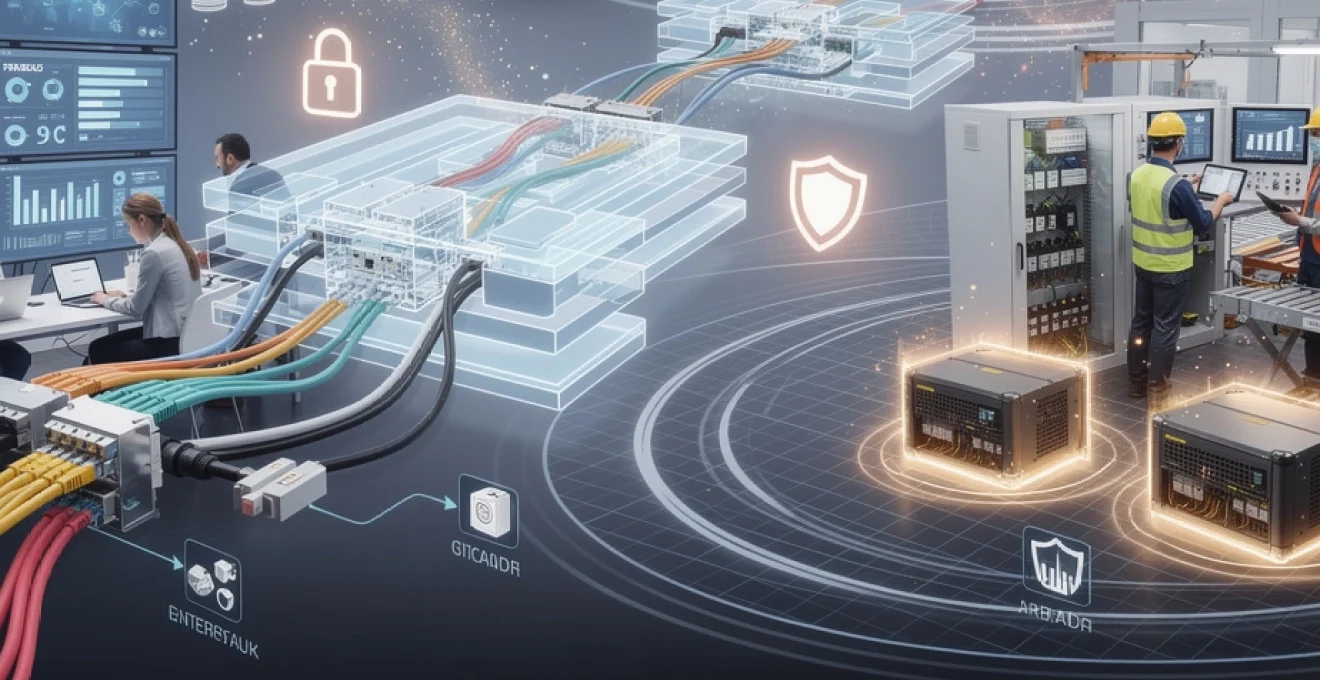
The convergence of Information Technology (IT) and Operational Technology (OT) represents one of the most significant paradigm shifts in modern industrial environments. As manufacturing facilities worldwide embrace digital transformation initiatives, the traditional silos separating corporate IT infrastructure from shop floor operational systems are rapidly dissolving. This convergence isn’t merely about connecting disparate systems—it’s fundamentally reshaping how industrial organisations approach efficiency, security, and innovation.
Industrial transformation projects today demand a sophisticated understanding of both domains, requiring engineers and project managers to navigate complex integration challenges whilst maintaining operational continuity. The stakes are considerable: successful IT-OT convergence can deliver productivity improvements of 30-50%, whilst failed integration attempts can result in costly downtime and security vulnerabilities.
Understanding IT-OT convergence architecture in industrial environments
The foundation of successful IT-OT integration lies in establishing a robust architectural framework that accommodates both domains’ distinct requirements whilst enabling seamless data flow and communication. Modern convergence architectures must balance the IT world’s emphasis on data management and network connectivity with OT’s focus on real-time control, safety, and operational reliability.
Traditional industrial architectures have operated on the principle of air-gapped networks, where OT systems remained isolated from corporate IT infrastructure to ensure operational security and reliability. However, the demands of Industry 4.0 and Industrial Internet of Things (IIoT) implementations require a more integrated approach that maintains security whilst enabling data-driven decision making across all organisational levels.
Purdue enterprise reference architecture (PERA) model implementation
The Purdue Enterprise Reference Architecture serves as the cornerstone for understanding how IT and OT systems should interact within industrial environments. This hierarchical model divides industrial systems into distinct levels, from Level 0 (field devices and sensors) through Level 4 (enterprise and logistics networks), providing a structured approach to integration planning.
Implementing PERA effectively requires careful consideration of data flow patterns between levels, ensuring that information moves efficiently from operational systems to business intelligence platforms whilst maintaining appropriate security boundaries. The model’s strength lies in its ability to provide clear demarcation zones where different security policies, communication protocols, and operational priorities can coexist.
Modern PERA implementations increasingly incorporate edge computing capabilities at Level 1 and Level 2, enabling real-time data processing and analytics closer to operational systems. This approach reduces latency for critical control functions whilst providing preprocessed data to higher-level business systems for strategic decision making.
ISA-95 standard integration for manufacturing operations management
The ISA-95 standard provides essential frameworks for integrating enterprise and control systems, defining clear interfaces between business planning systems and manufacturing execution systems (MES). This standard becomes particularly crucial when organisations seek to align production schedules with business objectives whilst maintaining operational flexibility.
Successful ISA-95 implementation requires mapping existing business processes to the standard’s activity models, ensuring that production schedules, resource allocation, and performance tracking align with enterprise requirements. The standard’s hierarchical approach complements PERA by providing detailed specifications for data exchange between manufacturing operations management and enterprise resource planning systems.
Integration teams must pay particular attention to the standard’s definition of work orders, production schedules, and performance metrics, as these elements form the critical bridge between operational execution and business intelligence. Properly implemented ISA-95 frameworks enable real-time visibility into production performance whilst maintaining the autonomy required for effective shop floor operations.
IEC 62443 cybersecurity framework for industrial control systems
Cybersecurity considerations become exponentially more complex when IT and OT systems converge, requiring a comprehensive framework that addresses both domains’ unique security requirements. The IEC 62443 standard provides this framework, offering a systematic approach to securing industrial automation and control systems throughout their lifecycle.
The standard’s zone and conduit model enables organisations to segment their networks appropriately, creating security boundaries that protect critical operational systems whilst enabling necessary data flow to business systems. This approach recognises that operational technology requires different security priorities compared to traditional IT systems, where availability and safety often take precedence over data confidentiality.
Implementation of IEC 62443 requires careful risk assessment and security level determination for each system component. Industrial organisations
must define security zones, classify assets, and assign target security levels based on risk and criticality. From there, you can select appropriate technical and organisational controls, such as network segmentation, strict access control for remote maintenance, and continuous monitoring of anomalous behaviour. When applied consistently, IEC 62443 becomes the common language that both IT security teams and OT engineers can use to align on cybersecurity priorities in converged IT-OT networks.
Edge computing infrastructure requirements for OT data processing
As industrial data volumes grow, sending every data point directly to the cloud or enterprise data centre is neither economical nor practical. Edge computing provides a distributed layer of compute and storage close to machines and production lines, allowing you to process OT data in near real time. In practice, this means deploying ruggedised edge gateways or industrial PCs at the control or cell level to aggregate, filter, and enrich sensor data before forwarding only high-value information to higher layers.
Designing edge computing for IT-OT convergence requires careful attention to latency, resilience, and cybersecurity. Devices must support industrial protocols, run containerised workloads or lightweight analytics, and be remotely manageable at scale. At the same time, they need hardened operating systems, secure boot, and encrypted communication to withstand harsh environments and cyber threats. Think of the edge as the “customs checkpoint” for OT data: it validates, standardises, and secures information before it crosses into enterprise IT systems or industrial IoT platforms.
Legacy OT system integration challenges and protocol harmonisation
Even the most elegant IT-OT convergence architecture will struggle if it cannot cope with the reality of legacy OT systems. Many plants still rely on decades-old PLCs, fieldbuses, and proprietary protocols that were never designed for Ethernet-based networks or modern cybersecurity practices. The challenge is not simply to “rip and replace” these assets, but to integrate them safely and cost-effectively into a unified industrial data architecture.
Protocol harmonisation is central to this task. By introducing protocol converters, gateways, and software-defined integration layers, you can translate data from legacy fieldbuses into modern industrial Ethernet and IP-based protocols. The aim is to create a consistent, standards-based communication backbone that supports IT-OT convergence without disrupting stable operations. In many cases, this involves a phased strategy where legacy systems are gradually encapsulated, migrated, or modernised while maintaining production continuity.
MODBUS to Ethernet/IP protocol translation strategies
MODBUS remains one of the most widespread legacy protocols in industrial environments, especially in brownfield installations. However, its simple master-slave architecture and lack of inherent security features make direct integration into converged IT-OT networks problematic. To bridge this gap, many organisations deploy gateways that translate MODBUS RTU or MODBUS TCP into Ethernet/IP, allowing legacy devices to participate in modern, Ethernet-based control and data collection architectures.
Effective MODBUS to Ethernet/IP translation strategies start with a thorough inventory of devices, registers, and polling patterns. You then configure gateways to map MODBUS registers to Ethernet/IP tags, normalise data types, and implement rate limiting or buffering to avoid overloading higher-level systems. Where possible, you should also implement access control lists and encryption on the Ethernet/IP side to compensate for MODBUS’s inherent lack of security. This approach lets you treat MODBUS devices as “first-class citizens” in an industrial IoT context without costly controller replacements.
PROFIBUS to PROFINET migration planning for siemens ecosystems
In Siemens-based environments, the transition from PROFIBUS to PROFINET is a common milestone in industrial transformation projects. PROFIBUS fieldbuses have served reliably for decades, but PROFINET’s Ethernet-based architecture offers higher bandwidth, better diagnostics, and easier integration with IT networks. The challenge is to migrate without jeopardising production stability or invalidating existing safety certifications.
Successful PROFIBUS to PROFINET migration relies on a structured plan that includes network segmentation, device compatibility assessment, and staged cutovers. Many plants adopt a hybrid approach, using proxy or coupler devices that allow PROFIBUS nodes to be integrated into a PROFINET backbone while controllers and higher-level systems are upgraded. Over time, critical field devices can be replaced with native PROFINET variants as maintenance windows allow. By viewing the migration as a multi-year roadmap rather than a one-off project, you reduce risk whilst gradually unlocking the benefits of converged IT-OT networks.
Fieldbus foundation H1 integration with industrial ethernet networks
Fieldbus Foundation H1 (FF H1) is still prevalent in process industries, where its deterministic behaviour and intrinsic safety support are highly valued. However, its 31.25 kbit/s data rate and segment-based topology are out of step with modern industrial Ethernet. Rather than dismantling well-functioning FF H1 segments, many organisations opt to integrate them using linking devices or gateways that connect H1 field segments to high-speed Ethernet backbones.
These integration devices act as protocol translators and scheduling coordinators, exposing FF H1 variables as standard objects on Ethernet-based systems such as PROFINET, EtherNet/IP, or OPC UA. When planning such integrations, you must pay close attention to update rates, alarm handling, and time synchronisation so that higher-level applications receive accurate and timely process information. Done well, this approach allows you to keep the deterministic, safety-certified characteristics of FF H1 in the field while enabling advanced analytics, digital twins, and centralised asset management over industrial Ethernet.
Devicenet legacy system modernisation using EtherNet/IP bridges
DeviceNet, widely used in discrete manufacturing for connecting sensors, actuators, and small devices, poses similar challenges. Its CAN-based physical layer and limited bandwidth make it difficult to scale in an era of high-resolution sensing and pervasive data collection. Yet many DeviceNet networks are tightly embedded in production lines that cannot afford extensive downtime for re-cabling or controller replacement.
EtherNet/IP bridges provide a pragmatic path forward. By segmenting existing DeviceNet networks and connecting them via bridges to an EtherNet/IP backbone, you can centralise diagnostics, monitor device health, and expose OT data to industrial IoT platforms. Over time, you can replace DeviceNet nodes with native EtherNet/IP devices during planned maintenance, shrinking the legacy footprint without disrupting operations. This incremental approach allows you to modernise your OT communications layer at the speed of your business, rather than at the speed of a single capital project.
Industrial IoT platform selection for unified data management
Once protocols are harmonised and edge infrastructure is in place, the next strategic decision is choosing an industrial IoT platform to orchestrate unified data management. This platform becomes the “central nervous system” of your converged IT-OT architecture, ingesting data from SCADA, MES, historians, sensors, and business systems into a coherent, governed environment. Selecting the wrong platform can lock you into proprietary stacks or limit your ability to scale use cases across multiple plants.
When evaluating industrial IoT platforms, you should consider several dimensions: protocol support (e.g. MQTT, OPC UA, AMQP), edge-to-cloud orchestration, time-series data handling, and native integration with analytics and AI tools. Just as important are open APIs, security features aligned with IEC 62443, and the ability to implement a Unified Namespace that provides a single, logical view of all industrial data. Think of this platform as your “industrial data operating system”: it should abstract underlying complexity while giving both IT and OT stakeholders reliable, role-based access to trusted data.
Practical selection criteria include total cost of ownership, vendor ecosystem strength, and the availability of pre-built connectors to ERP, EAM, and quality systems. You may also want to favour platforms that are cloud-agnostic or support hybrid deployments, so you can adapt as your infrastructure strategy evolves. Ultimately, the right industrial IoT platform enables you to move from isolated pilots to production-grade, multi-site digital transformation, where KPIs and insights are consistently defined and shared across the organisation.
Change management methodologies for cross-functional teams
Technology alone will not bridge the IT-OT gap; people and processes are equally critical. Cross-functional teams often bring different cultures, vocabularies, and risk perceptions to industrial transformation projects. Without a structured change management approach, even well-designed architectures can face resistance, misunderstanding, or stalled adoption. This is where proven methodologies provide a roadmap for engaging stakeholders and sustaining change.
Industrial organisations increasingly apply models such as ADKAR, Lean Six Sigma, and Agile to manage the human side of IT-OT convergence. These frameworks help you answer practical questions: how do we build awareness of the need for change, equip teams with new skills, and iterate safely in live production environments? By combining structured change management with clear communication and leadership sponsorship, you can turn IT-OT convergence from an abstract strategy into tangible new ways of working on the shop floor and in the office.
ADKAR model application in manufacturing technology adoption
The ADKAR model—Awareness, Desire, Knowledge, Ability, Reinforcement—offers a simple yet powerful lens for managing adoption of new IT-OT solutions. In manufacturing, this might involve explaining why a new industrial IoT dashboard or predictive maintenance system is being introduced (Awareness) and what’s in it for operators, engineers, and managers (Desire). Without these first steps, even the most advanced technology can be perceived as an additional burden rather than an enabler.
Next, you focus on building Knowledge and Ability through targeted training, hands-on workshops, and mentoring. For example, maintenance technicians might learn how to interpret vibration analytics, while process engineers are trained in new digital twin tools. Finally, Reinforcement mechanisms—such as updated KPIs, recognition programs, and feedback loops—help embed the new behaviours into daily routines. When ADKAR is applied deliberately, you create a shared journey where IT and OT teams move through change together, rather than in parallel.
Lean six sigma integration with digital transformation initiatives
Lean Six Sigma has long been used to reduce waste, variation, and defects in manufacturing processes. In the context of IT-OT convergence, it becomes a natural ally for digital transformation. After all, what better way to decide which analytics or automation use cases to prioritise than by tying them directly to quantified process improvements? By integrating Lean Six Sigma with industrial data platforms, you can move from static value stream maps to living, data-driven process models.
Practically, this might look like using IIoT data to measure cycle times, scrap rates, or energy consumption in real time, then applying DMAIC (Define, Measure, Analyse, Improve, Control) to identify and validate improvement opportunities. Digital tools such as automated root-cause analysis or process mining can accelerate the Analyse phase, while closed-loop control based on OT data supports the Improve and Control phases. This synergy ensures that digital investments remain grounded in tangible, measurable business outcomes rather than technology for technology’s sake.
Agile project management frameworks for industrial automation projects
Traditional industrial automation projects have often followed waterfall-style methodologies with long specification and implementation cycles. However, the pace of innovation in IT and industrial IoT demands more flexibility. Agile frameworks, adapted thoughtfully for OT environments, enable cross-functional teams to deliver value in smaller, safer increments. Instead of waiting months to see results, stakeholders can review working prototypes and provide feedback every few weeks.
Implementing Agile in industrial settings requires some adaptation. For instance, “sprints” must respect production schedules and safety constraints, and changes to PLC code or safety systems still require rigorous validation. Yet concepts such as product backlogs, user stories, and iterative releases work remarkably well when applied to dashboards, analytics models, or non-critical automation logic. By adopting Agile ways of working, you encourage collaboration between IT developers, OT engineers, and business users, making IT-OT convergence a continuous improvement journey rather than a one-time project.
Cybersecurity risk assessment in converged IT-OT networks
As IT and OT networks converge, the attack surface for cyber threats expands dramatically. Devices that were once isolated on plant networks are now accessible via remote connections, cloud platforms, and third-party vendors. A rigorous cybersecurity risk assessment is essential to understand where vulnerabilities lie and how to prioritise mitigation efforts. Without this, you risk creating an environment where a simple phishing email in the corporate network can cascade into a plant shutdown.
Effective risk assessment in converged IT-OT networks starts with asset inventory and classification: what systems do you have, where are they located, and how critical are they to safety and production? From there, you map communication pathways, identify trust boundaries, and evaluate existing controls against frameworks such as IEC 62443 and NIST. Threat modelling exercises help you consider realistic attack scenarios, from ransomware affecting historians to compromised remote access connections into control systems.
The outcome should be a prioritised roadmap of technical and procedural controls, including network segmentation, multi-factor authentication for remote access, application whitelisting on critical assets, and robust backup and recovery plans. Regular penetration testing and red-teaming exercises can validate your defences and uncover blind spots. Ultimately, cybersecurity in IT-OT convergence is not a one-off checklist but an ongoing discipline, where continuous monitoring, incident response planning, and staff awareness training play as big a role as firewalls and intrusion detection systems.
Performance monitoring and KPI alignment across IT-OT domains
Bridging the gap between IT and OT is only meaningful if it translates into improved performance that everyone can see and agree on. That is why KPI alignment across IT-OT domains is a cornerstone of successful industrial transformation projects. Rather than each domain tracking its own metrics in isolation, converged environments encourage shared indicators that reflect end-to-end value streams—from equipment uptime and product quality to on-time delivery and energy efficiency.
A unified performance monitoring strategy typically combines OT data (such as OEE, mean time between failures, and process stability indices) with IT-oriented metrics (like application availability, data latency, and cybersecurity incident rates). By visualising these KPIs in common dashboards, you enable cross-functional teams to understand trade-offs and collaborate on improvements. For example, an increase in security patching activity (an IT metric) might correlate with short planned downtimes (an OT metric), prompting a joint optimisation effort.
To make this work in practice, you should define clear data ownership, standardise KPI definitions, and ensure your industrial IoT platform can deliver accurate, timely data to analytics and reporting tools. It can be helpful to start with a small set of “north star” metrics that everyone recognises—such as OEE, safety incident rate, and order fulfilment time—and then expand as maturity grows. Over time, aligned performance monitoring turns IT-OT convergence from a technical exercise into a shared management system, where decisions are based on a single, trusted version of industrial reality.