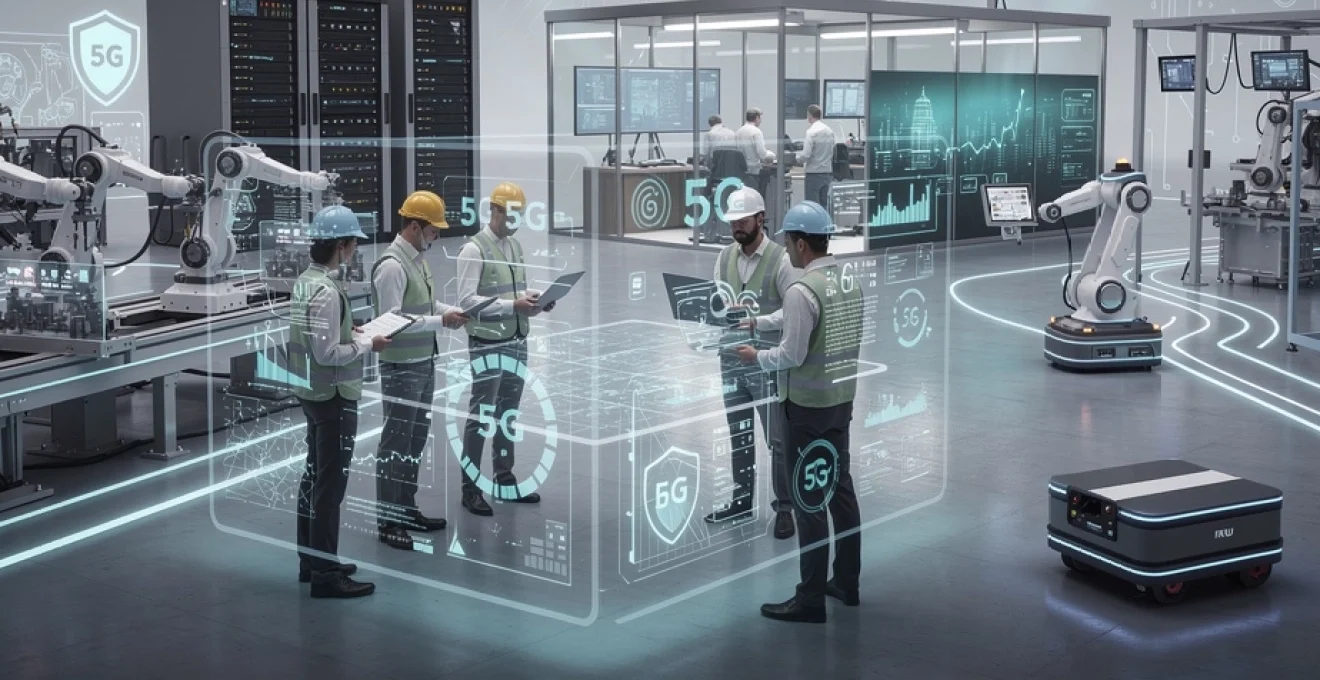
Industrial sectors are experiencing a fundamental shift as 5G technology emerges as the cornerstone of comprehensive digital transformation strategies. This revolutionary wireless communication standard transcends traditional connectivity limitations, delivering unprecedented capabilities that enable manufacturers to reimagine their operational frameworks entirely. With data speeds potentially exceeding 10 Gbps and latency reduced to as low as 1 millisecond, 5G creates an ecosystem where real-time industrial applications become not just possible but practical for widespread deployment.
The convergence of 5G with emerging technologies such as artificial intelligence, machine learning, and edge computing is fundamentally altering how industrial organisations approach digitalisation. Manufacturing facilities, logistics operations, and critical infrastructure systems are increasingly leveraging these enhanced connectivity capabilities to achieve levels of operational efficiency and automation previously considered unattainable. As organisations navigate this technological evolution, understanding the multifaceted impact of 5G on industrial transformation becomes essential for maintaining competitive advantage.
5G network architecture evolution for industrial IoT ecosystems
The architectural foundations of 5G networks represent a paradigm shift specifically designed to support the demanding requirements of industrial Internet of Things ecosystems. Unlike previous generations of wireless technology, 5G employs a service-oriented architecture that can be dynamically configured to meet diverse industrial application requirements. This flexibility enables manufacturers to deploy customised network solutions that align precisely with their operational needs, from real-time process control to comprehensive asset monitoring across expansive industrial facilities.
Industrial organisations are discovering that 5G’s network architecture facilitates unprecedented device density capabilities, supporting up to one million connected devices per square kilometre. This massive connectivity potential transforms how manufacturers approach IoT deployment, enabling comprehensive sensor networks that provide granular visibility into every aspect of production processes. The enhanced network capacity also supports the deployment of advanced industrial applications that require consistent, high-bandwidth connectivity across multiple operational domains simultaneously.
Ultra-reliable low latency communication (URLLC) implementation in manufacturing
Ultra-Reliable Low Latency Communication represents one of the most critical 5G capabilities for industrial applications, delivering sub-millisecond response times with 99.999% reliability. Manufacturing environments implementing URLLC can achieve real-time control of robotic systems, automated guided vehicles, and critical safety systems with unprecedented precision. This capability enables manufacturers to deploy closed-loop control systems that respond to operational changes instantaneously, significantly improving production quality and operational safety.
The implementation of URLLC in manufacturing environments requires careful consideration of network design principles and application architecture. Manufacturers must establish dedicated network slices optimised for ultra-low latency applications whilst maintaining the reliability standards essential for critical industrial processes. The successful deployment of URLLC capabilities often determines the overall effectiveness of industrial 5G implementations.
Massive machine type communications (mMTC) deployment for smart factories
Massive Machine Type Communications functionality enables industrial facilities to deploy extensive networks of connected sensors and devices without compromising network performance or reliability. Smart factories utilising mMTC can implement comprehensive monitoring systems that track equipment performance, environmental conditions, product quality metrics, and operational efficiency indicators across entire production lines. This capability transforms traditional manufacturing environments into intelligent, responsive ecosystems that continuously optimise their operations based on real-time data insights.
The deployment of mMTC in smart factory environments requires strategic planning to ensure optimal device placement and network resource allocation. Manufacturers must consider factors such as device battery life, data transmission requirements, and network coverage patterns when implementing these extensive IoT networks. Successful mMTC deployments often result in operational efficiency improvements of 15-25% within the first year of implementation.
Enhanced mobile broadband (eMBB) integration with industrial control systems
Enhanced Mobile Broadband capabilities provide industrial control systems with the high-speed connectivity required for bandwidth-intensive applications such as augmented reality maintenance procedures, real-time video analytics, and comprehensive data visualisation platforms. Manufacturing facilities implementing eMBB can support mobile workforce applications that provide technicians with immediate access to detailed equipment information, maintenance procedures, and operational data through advanced mobile interfaces.
The integration of eMBB with existing industrial control systems often requires careful coordination between operational technology and information technology teams. Manufacturers must ensure that enhanced bandwidth capabilities complement existing control architectures whilst providing the flexibility needed for future expansion and technology integration. Effective eMBB implementation typically results in significant improvements in maintenance efficiency and operational
efficiency by reducing downtime, shortening troubleshooting cycles, and enhancing overall situational awareness across the plant floor.
To maximise the benefits of eMBB in industrial environments, organisations should prioritise use cases that combine high-bandwidth data streams with clear productivity outcomes, such as remote expert support or immersive training. It is also essential to validate that industrial control systems remain deterministic and stable even as richer media and analytics applications traverse the same 5G infrastructure. When implemented with clear governance and performance baselines, eMBB becomes a strategic enabler for data-driven decision-making in complex manufacturing operations.
Private 5G network infrastructure for critical industrial operations
Private 5G networks are rapidly becoming a cornerstone of industrial digital transformation strategies, particularly in sectors where deterministic performance and data sovereignty are paramount. By deploying dedicated 5G infrastructure on-site, manufacturers can achieve tailored coverage, guaranteed bandwidth, and strict control over how operational data is transmitted and stored. This level of control is especially valuable for highly regulated industries such as pharmaceuticals, automotive, and defence manufacturing, where intellectual property protection and compliance requirements are non-negotiable.
From a practical perspective, private 5G networks enable organisations to segment critical industrial operations from public networks while still leveraging the full spectrum of 5G capabilities, including URLLC, mMTC, and eMBB. You can define network slices for safety systems, robotics, and quality inspection, each with its own performance and security policies. As spectrum regulations evolve in key markets, more enterprises are obtaining local licences or partnering with operators to deploy campus networks that support long-term digitalisation roadmaps.
However, implementing a private 5G infrastructure is not a trivial undertaking. Industrial organisations must carefully consider spectrum acquisition, radio planning, integration with existing operational technology, and long-term lifecycle management. A phased deployment approach—starting with a limited set of high-value use cases—often proves most effective, allowing teams to refine governance models and operational processes before scaling to full-facility coverage. When executed well, private 5G becomes the foundational platform on which future industrial innovation is built.
Edge computing convergence with 5g-enabled industrial applications
The convergence of edge computing and 5G is redefining how industrial organisations architect their digital systems, enabling real-time processing where data is generated rather than in distant data centres. This shift is particularly critical for industrial IoT ecosystems, where milliseconds can make the difference between optimal performance and costly disruption. By bringing compute resources closer to machines, sensors, and production lines, manufacturers can run latency-sensitive workloads, reduce backhaul traffic, and improve resilience against network outages.
In many ways, 5G and edge computing act like the nervous system and brain of the modern factory: 5G provides the ultra-fast signalling pathways, while edge nodes deliver local intelligence and reflexive responses. As industrial enterprises roll out advanced use cases—such as real-time quality inspection, predictive maintenance, and adaptive process optimisation—this tight integration becomes indispensable. The result is a hybrid computing architecture where workloads can dynamically shift between edge and cloud based on performance, cost, and compliance requirements.
Multi-access edge computing (MEC) deployment strategies for real-time processing
Multi-Access Edge Computing (MEC) extends cloud-like capabilities to the edge of the 5G network, enabling industrial applications to process data within microseconds of its creation. For use cases such as robotic motion control, machine vision inspection, or safety interlocks, MEC deployment strategies must prioritise ultra-low latency and deterministic performance. Placing MEC nodes within or adjacent to the factory campus ensures that critical applications are insulated from wide-area network variability.
When planning MEC-enabled industrial IoT deployments, you should start by mapping application latency and bandwidth requirements to physical production zones. This allows you to determine where to host specific workloads: on-device, on local MEC servers, or in regional data centres. It is often beneficial to cluster related applications—such as condition monitoring and anomaly detection—on the same MEC node to minimise data duplication and synchronisation overhead. Additionally, organisations must plan for high availability by implementing redundant MEC instances and automated failover mechanisms.
Cost and scalability are also central considerations in MEC strategy design. Rather than attempting to move all processing to the edge immediately, many manufacturers adopt a tiered approach that prioritises mission-critical use cases first. Over time, less time-sensitive analytics functions can be migrated to the edge to reduce cloud egress fees and improve responsiveness. By treating MEC as a strategic investment aligned with business outcomes, organisations can avoid the trap of over-engineering infrastructure that does not deliver measurable value.
Industrial AI workload distribution across 5G edge nodes
As industrial AI adoption accelerates, orchestrating where and how AI workloads run across 5G edge nodes becomes a crucial design decision. Some algorithms, such as high-frequency anomaly detection on machine vibrations, are best executed directly at the edge to minimise latency and bandwidth consumption. Others, including training deep learning models on historical production data, can be performed in the cloud and then deployed as optimised inference models to edge locations. This distributed industrial AI strategy ensures that each workload runs in the environment where it is most efficient.
To manage this complexity, many organisations are implementing AI lifecycle management platforms that span cloud, core, and edge. These platforms automate model deployment, versioning, and monitoring across heterogeneous hardware, ensuring consistent performance regardless of where models run. With 5G providing predictable connectivity between these layers, manufacturers can continuously refine models based on new data, pushing incremental updates to edge nodes without disrupting operations. Have you considered how often your AI models need to be retrained to keep up with changing production conditions?
Security and governance are equally important when distributing AI workloads in an industrial setting. Sensitive operational data used for AI training may be subject to strict data residency rules, requiring careful attention to where data is stored and processed. Organisations should also implement robust access controls and audit trails for model changes, particularly for AI systems that influence safety or quality-critical decisions. By combining 5G connectivity with disciplined AI governance, industrial enterprises can harness advanced analytics while maintaining trust and compliance.
Edge-to-cloud orchestration for hybrid industrial computing architectures
Hybrid industrial computing architectures that span edge and cloud environments are becoming the default model for digital factories. Edge-to-cloud orchestration ensures that applications, data flows, and security policies remain consistent across this distributed landscape. In practice, this means using orchestration platforms that can deploy containerised workloads to both MEC nodes and cloud clusters, monitor their performance, and dynamically rebalance resources as demand fluctuates. With 5G providing the connective tissue, orchestration becomes the key to turning a collection of disparate systems into a coherent industrial digital platform.
Effective orchestration starts with clear segmentation of workloads based on performance, cost, and regulatory requirements. Time-critical control logic, local buffering, and real-time analytics typically reside at the edge, while long-term storage, enterprise planning, and advanced optimisation run in the cloud. Orchestration tools then automate the movement of data between these tiers, ensuring that only relevant and compressed data streams are sent to central systems. This approach reduces network congestion and enables operators to focus on actionable insights rather than raw data volumes.
For many organisations, the most challenging aspect of edge-to-cloud orchestration is integrating legacy systems with modern, cloud-native applications. Industrial protocols, proprietary systems, and older control platforms may not be designed for dynamic deployment models. Here, gateway devices and protocol translation services play a critical role, acting as bridges between traditional operational technology and 5G-enabled digital platforms. Over time, a well-orchestrated hybrid architecture allows manufacturers to modernise incrementally, avoiding disruptive “rip and replace” projects.
Network slicing optimisation for deterministic industrial edge services
Network slicing allows 5G operators and enterprises to create virtual networks tailored to specific industrial applications, each with its own performance, security, and reliability characteristics. For deterministic industrial edge services—such as motion control, safety signalling, and synchronised robotics—optimised network slices ensure that traffic receives guaranteed quality of service even during peak load conditions. In effect, network slicing lets you carve out dedicated lanes on the 5G highway for your most critical industrial workloads.
Optimising network slicing for industrial digital transformation involves close collaboration between IT, OT, and telecom teams. Together, they must define service level agreements for each slice, including latency targets, jitter thresholds, and acceptable packet loss levels. These parameters then inform how the underlying radio, transport, and core resources are allocated. For example, a slice supporting remote robot control may prioritise ultra-low latency and redundancy, whereas a slice used for non-critical video surveillance might focus on bandwidth efficiency.
Continuous monitoring and analytics are essential to ensure that slices perform as intended over time. As new devices and applications are added, slice configurations may need to be adjusted to prevent resource contention and maintain deterministic behaviour. Advanced analytics and AI-driven traffic management can further enhance slice efficiency, predicting congestion before it occurs and automatically reallocating capacity. When executed thoughtfully, network slicing becomes a strategic lever for aligning 5G infrastructure with evolving industrial business priorities.
Digital twin integration through 5G connectivity frameworks
Digital twins—virtual replicas of physical assets, processes, or entire facilities—are rapidly moving from experimental pilots to core elements of industrial digital transformation strategies. The effectiveness of a digital twin hinges on the timeliness and fidelity of the data that feeds it, which is where 5G connectivity frameworks play a pivotal role. High-bandwidth, low-latency 5G links enable continuous streaming of sensor data, control signals, and contextual information from production environments into digital twin models, keeping them closely aligned with real-world conditions.
When you pair digital twins with 5G-enabled industrial IoT, you gain a powerful environment for scenario testing, what-if analysis, and predictive optimisation. For example, engineers can simulate changes to production line configurations, maintenance schedules, or material inputs in the digital twin before implementing them on the shop floor. This reduces risk and shortens innovation cycles, as potential bottlenecks or failures can be identified virtually. Over time, digital twins enriched by 5G data streams become living systems that learn and adapt alongside the physical factory.
Integrating digital twins into existing industrial architectures requires careful planning around data models, interoperability standards, and governance. Organisations should adopt common semantic models and open interfaces to ensure that data from disparate machines and systems can be harmonised within the twin. It is also critical to define which data remains on-premises and which can be shared with external partners, particularly when collaborating on supply chain or product lifecycle twins. With robust 5G connectivity providing the backbone, digital twins can extend beyond individual sites to represent entire multi-plant networks and value chains.
Industrial automation revolution through 5g-powered robotics and AGVs
The combination of 5G connectivity and advanced robotics is driving a step-change in industrial automation, particularly through collaborative robots (cobots) and autonomous guided vehicles (AGVs). Traditionally, many robotic systems relied on wired connections or isolated networks to achieve deterministic control, limiting their flexibility and scalability. 5G changes this equation by delivering wireless performance that rivals wired connections, allowing robots and AGVs to operate more freely across large facilities while remaining tightly coordinated with central control systems.
In practice, 5G-powered robotics enable dynamic production environments where robot task assignments, paths, and behaviours can be reconfigured in near real time. For instance, AGVs can receive updated routing instructions based on live information about congestion, inventory levels, or equipment status. Cobots working alongside human operators can tap into central AI systems for object recognition, quality inspection, or adaptive motion planning, all supported by reliable 5G links. The result is a more responsive and resilient automation layer that can flex with changing demand and product mixes.
Of course, this new level of wireless automation introduces its own challenges. Safety systems and functional safety certifications must be revisited to account for wireless control paths, and robust fallback mechanisms must be in place to handle connectivity disruptions. Companies should also consider how to manage fleet orchestration for hundreds or even thousands of 5G-connected robots and AGVs, ensuring that spectrum usage, battery life, and maintenance schedules are optimised. When these considerations are addressed, 5G becomes the catalyst for an automation revolution that goes far beyond incremental efficiency gains.
Cybersecurity paradigm shifts in 5g-connected industrial networks
The expansion of 5G-connected industrial networks fundamentally reshapes the cybersecurity landscape for manufacturers and critical infrastructure operators. Instead of a relatively static environment of wired controllers and isolated networks, organisations now manage highly dynamic ecosystems of mobile devices, sensors, edge nodes, and cloud services. This increased connectivity surface demands a new security paradigm that goes beyond traditional perimeter defences, embracing continuous verification, least privilege access, and deep visibility into every layer of the 5G stack.
Interestingly, 5G introduces both new risks and new opportunities for industrial cybersecurity. Features such as network slicing, virtualisation, and advanced encryption provide powerful tools for segmenting and protecting critical workloads. At the same time, the complexity of these technologies can create misconfiguration risks if not properly managed. To navigate this environment, industrial organisations must adopt security-by-design principles, embedding robust controls directly into their 5G industrial transformation strategies rather than treating security as an afterthought.
Zero trust architecture implementation for 5G industrial environments
Zero Trust Architecture (ZTA) is rapidly emerging as a best-practice framework for securing 5G-enabled industrial environments. At its core, Zero Trust operates on the principle of “never trust, always verify,” treating every device, user, and application—whether inside or outside the network—as potentially untrusted. For industrial organisations, this means moving away from the assumption that anything inside the plant network perimeter is safe. Instead, each access request is evaluated in real time based on identity, context, device health, and behavioural patterns.
Implementing Zero Trust in a 5G industrial context typically involves segmenting networks into fine-grained security zones, enforcing strong authentication and authorisation policies, and continuously monitoring traffic for anomalies. 5G capabilities such as network slicing and granular quality of service controls support this approach by allowing security policies to be tailored to specific industrial workloads. For example, a network slice used for safety systems can have stricter access controls and monitoring than one used for non-critical telemetry.
As with any major security transformation, Zero Trust adoption should proceed in phases. You might begin by focusing on high-value assets such as production control networks or remote access pathways for maintenance partners. Over time, Zero Trust principles can be extended across the full spectrum of industrial IoT devices, edge nodes, and cloud services. The ultimate goal is a security posture where compromised credentials or devices are quickly detected and contained, limiting the blast radius of any potential incident.
Software-defined perimeter (SDP) solutions for manufacturing networks
Software-Defined Perimeter (SDP) technology complements Zero Trust principles by creating dynamic, identity-centric perimeters around industrial applications and services. Rather than exposing entire networks to users or devices, SDP solutions allow you to make specific applications “dark” to unauthorised entities, only revealing them after successful authentication and policy evaluation. In a 5G-connected factory, this approach is particularly valuable for securing remote access to production systems and edge devices.
SDP implementations typically leverage a controller that authenticates users and devices, establishes encrypted connections, and brokers access to authorised resources. Because SDP policies can adapt based on context—such as device type, location, or security posture—they are well suited to highly mobile 5G industrial environments. For instance, an engineer connecting from within the plant on a managed device might receive broader access than a contractor connecting from an external network on a personal laptop.
From an operational standpoint, SDP can also simplify security management by centralising access control policies for diverse industrial applications. This reduces reliance on complex firewall rule sets and static network segmentation, which can be difficult to maintain in rapidly evolving digital factories. As more industrial systems become accessible over 5G, implementing SDP helps ensure that connectivity does not come at the expense of control or visibility.
Quantum-safe cryptography integration in 5G industrial communications
The rise of quantum computing poses a long-term challenge to current cryptographic algorithms, many of which underpin secure 5G industrial communications today. While practical, large-scale quantum attacks are not yet a reality, forward-looking industrial organisations are beginning to explore quantum-safe cryptography to protect systems with long lifecycles. Consider assets such as power grid controls, process automation systems, or safety infrastructure that may remain in service for decades; the data they generate and the commands they receive must remain confidential and authentic over extended time horizons.
Quantum-safe, or post-quantum, cryptographic algorithms are designed to resist attacks from quantum computers, typically by relying on mathematical problems believed to be hard even for quantum systems. Integrating these algorithms into 5G-enabled industrial networks requires coordination between equipment vendors, telecom providers, and enterprise security teams. Pilot projects often focus on critical communication channels—such as those between control centres and remote substations or between central SCADA systems and field devices.
As standards bodies such as NIST progress toward formalising post-quantum cryptography standards, industrial organisations should begin assessing where and how to adopt quantum-safe approaches. This may include inventorying cryptographic dependencies, testing hybrid schemes that combine classical and quantum-resistant algorithms, and planning for staged migrations. By proactively addressing quantum risk, manufacturers and infrastructure operators can ensure that their 5G industrial transformation strategies remain secure well into the future.
Network function virtualisation (NFV) security frameworks for industrial 5G
Network Function Virtualisation (NFV) is a foundational technology for 5G, enabling telecom and enterprise operators to run network functions—such as firewalls, gateways, and core services—on virtualised infrastructure rather than dedicated hardware. In industrial 5G deployments, NFV offers significant flexibility and scalability, but it also introduces new security considerations. The attack surface now includes hypervisors, orchestration platforms, and virtual network functions (VNFs) themselves, all of which must be secured to prevent compromise.
Robust NFV security frameworks for industrial environments typically include strong isolation between VNFs, hardened images, secure boot processes, and continuous vulnerability management. Because many VNFs support critical industrial operations—such as connectivity for safety systems or OT networks—any breach could have direct operational consequences. It is therefore essential to integrate NFV security monitoring with broader industrial security operations, ensuring that anomalous behaviour at the virtual network layer triggers appropriate incident response processes.
Another key aspect of NFV security in industrial 5G is supply chain assurance. Organisations must vet VNF providers, validate the integrity of software images, and maintain clear visibility into patch and update cycles. Automation can play a valuable role here, with orchestration platforms enforcing security baselines and rolling out updates in a controlled, low-risk manner. When NFV is secured effectively, it becomes a powerful enabler of agile, software-defined industrial networks that can evolve alongside business needs.
ROI measurement frameworks for 5G industrial transformation initiatives
Measuring the return on investment (ROI) for 5G industrial transformation initiatives is essential to justify ongoing funding and prioritise future projects. Yet the benefits of 5G often span both tangible metrics—such as reduced downtime, higher throughput, and lower maintenance costs—and intangible gains like improved agility, innovation capacity, and workforce satisfaction. A robust ROI measurement framework accounts for both dimensions, providing a balanced view of how 5G-enabled industrial IoT deployments contribute to strategic objectives.
To build such a framework, many organisations begin by defining a clear baseline of current performance across key operational indicators: overall equipment effectiveness (OEE), mean time to repair (MTTR), energy consumption per unit, and defect rates, among others. 5G projects are then tied to specific improvement targets on these metrics, such as reducing unplanned downtime by 20% through predictive maintenance or shortening product changeover times by 30% via flexible automation. By establishing this cause-and-effect linkage up front, you create a clear line of sight from 5G investments to business outcomes.
It is also critical to consider the total cost of ownership for 5G industrial deployments, including infrastructure, spectrum, devices, integration, and ongoing operations. Some benefits, such as reduced cabling costs or faster commissioning of new lines, may offset these expenses in ways that traditional ROI models might overlook. Qualitative factors—such as enhanced safety, regulatory compliance, or the ability to support new revenue-generating services—should be captured through structured stakeholder interviews and risk assessments.
Finally, successful organisations treat ROI measurement as an iterative process rather than a one-time exercise. As 5G capabilities mature and new industrial use cases emerge, ROI models should be recalibrated to reflect evolving realities. Periodic reviews of 5G portfolio performance help you identify which initiatives are delivering outsized value and which may require redesign or decommissioning. By embedding ROI assessment into your broader industrial digital transformation governance, you ensure that 5G remains a strategic asset rather than a mere technology upgrade.