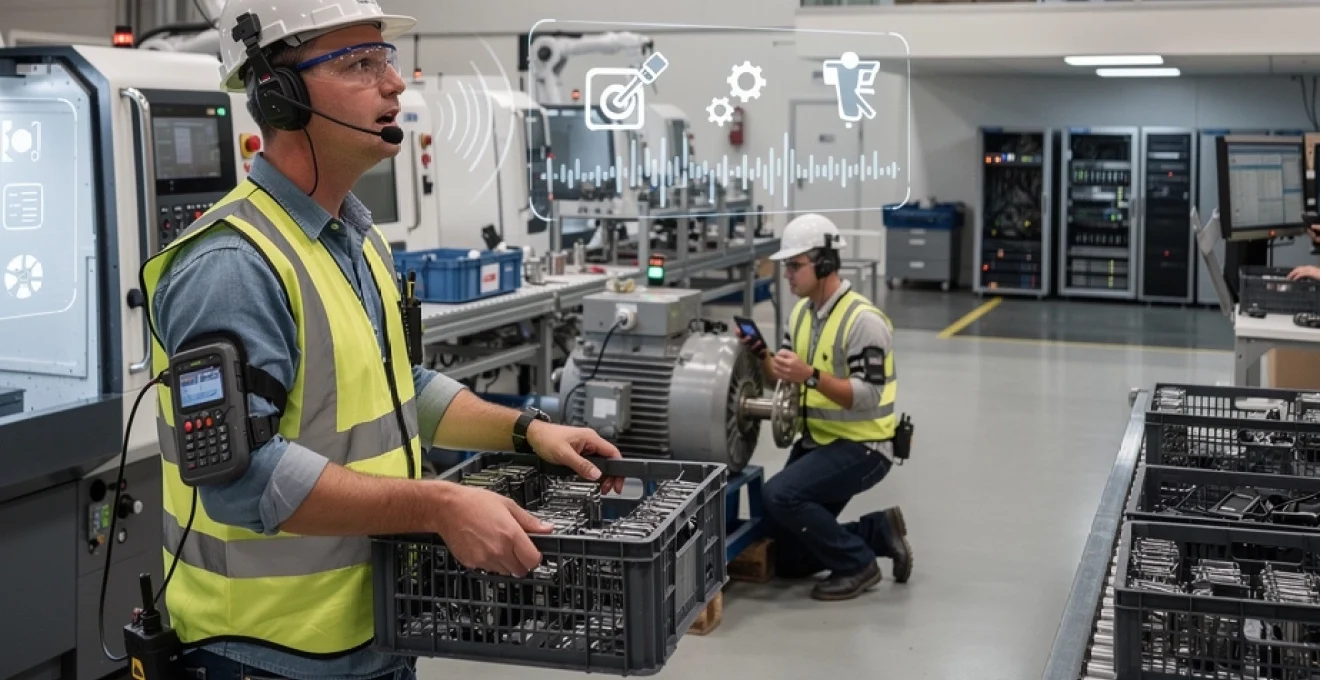
Manufacturing floors and industrial facilities are undergoing a transformative shift as voice-controlled systems transition from consumer novelty to mission-critical infrastructure. The industrial landscape has witnessed remarkable technological evolution over recent decades, but few innovations promise the immediate operational impact of voice activation technology. With global manufacturing productivity demands intensifying and workforce demographics shifting towards younger, digitally-native operators, voice-controlled automation represents more than incremental improvement—it signals a fundamental reimagining of human-machine interaction in industrial settings. Current industry data reveals that voice-enabled systems can reduce task completion times by up to 35% whilst simultaneously improving accuracy rates across warehouse operations, quality control processes, and machine operation protocols.
Voice recognition technology fundamentals for industrial applications
Industrial voice recognition systems operate on substantially different principles compared to consumer-oriented voice assistants. Whilst your smartphone’s voice assistant might struggle with background noise from a television, industrial-grade voice recognition must function flawlessly amidst machinery operating at 85-95 decibels, pneumatic tool noise, conveyor systems, and multiple simultaneous conversations. The fundamental architecture of these systems relies on sophisticated acoustic models trained specifically on industrial vocabulary and environmental conditions. Unlike general-purpose voice platforms that prioritise conversational flexibility, industrial voice systems focus on command accuracy within tightly defined operational parameters. This specialisation allows for remarkable precision—modern industrial voice platforms achieve recognition accuracy rates exceeding 99.7% even in challenging acoustic environments.
The technological foundation begins with advanced digital signal processing that isolates voice commands from ambient industrial noise. Multiple microphone arrays create directional sensitivity, whilst adaptive algorithms continuously learn the acoustic signature of the specific industrial environment. This environmental fingerprinting enables the system to distinguish between operational sounds that should be filtered and voice commands requiring processing. The computational demands of this real-time analysis explain why industrial voice systems represent significant investments compared to consumer alternatives—they’re engineered for reliability in conditions that would render consumer devices completely ineffective.
Natural language processing engines in manufacturing environments
Natural Language Processing (NLP) engines designed for manufacturing contexts differ fundamentally from those powering general-purpose conversational AI. Industrial NLP systems prioritise command precision over conversational flexibility, focusing on domain-specific vocabulary including part numbers, machine designations, operational parameters, and safety protocols. These systems typically recognise between 300-800 specific commands rather than attempting to interpret open-ended conversational input. This constraint actually enhances reliability—by limiting the recognition vocabulary to operationally relevant terms, the system dramatically reduces misinterpretation risk. A warehouse operator saying « pick alpha-seven-three-two » will trigger the precise inventory location every time, whereas a general-purpose system might confuse similar-sounding codes.
The NLP architecture incorporates semantic validation layers that verify command logic before execution. If an operator issues a command sequence that violates established safety protocols or operational logic, the system flags the contradiction rather than blindly executing potentially dangerous instructions. This intelligent verification represents a critical safety enhancement over purely mechanical control systems. Contemporary industrial NLP engines also support multiple languages and accents, recognising that modern manufacturing facilities employ diverse workforces. Leading platforms now offer recognition models for 25+ languages with dialect variations, ensuring inclusive accessibility across multinational operations.
Wake word detection and noise cancellation in factory settings
Wake word detection in industrial environments requires extraordinarily sophisticated signal processing to prevent false activations whilst maintaining responsiveness. Factory floors generate constant verbal communication—operators discussing production issues, supervisors providing instructions, maintenance technicians coordinating repairs. The voice system must distinguish between casual conversation and intentional system commands without requiring unnatural speaking patterns. Modern industrial wake word systems employ neural network architectures that analyse not just phonetic content but also prosodic features including pitch, speaking rate, and emphasis patterns. When you deliberately address the system, you unconsciously modify these speech characteristics in ways the neural network recognises as intentional command delivery.
Noise cancellation technologies deployed in industrial voice systems represent some of the most advanced acoustic engineering available commercially. These systems employ adaptive beamforming techniques that electronically steer microphone sensitivity towards the operator’s mouth position whilst suppressing sounds originating from other directions. Combined with spectral subtraction algorithms that identify and remove consistent background noise signatures, the result is remarkably clean voice signal extraction. Field testing demonstrates that properly configured industrial voice systems maintain full functionality in environments where unaided human conversation becomes difficult—a testament to the engineering sophist
hing deployed in these environments.
To appreciate the challenge, imagine trying to have a precise technical conversation next to a jet engine; industrial voice systems must filter out the acoustic equivalent of that chaos every second. Engineers tune these systems to the specific frequency profiles of each plant, much like a sound engineer equalises a concert hall for different instruments. Over time, machine learning models refine their filtering strategies as they observe recurring noise patterns such as compressor cycles or conveyor motor hum. This continuous adaptation is what allows voice-controlled systems in industrial environments to remain reliable even as equipment ages, production lines change, or new machinery is added to the floor.
Speech-to-text accuracy requirements for safety-critical operations
In safety-critical operations, speech-to-text accuracy is not merely a convenience metric; it becomes a core element of risk management. A misrecognised command in a consumer setting might result in the wrong song playing, but in a refinery or chemical plant it could trigger the wrong valve sequence or delay an emergency shutdown. For this reason, industrial voice-controlled systems typically target minimum word accuracy rates above 99.9% for commands that are mapped to safety instrumented functions. Vendors achieve this by combining constrained vocabularies with confirmation strategies, such as requiring operators to repeat or confirm high-risk instructions.
Many facilities implement multi-factor command validation where the system not only recognises the spoken instruction but also cross-checks it against context data, such as machine state, time of day, or operator clearance level. For example, an operator might say « initiate line-3 emergency stop, » and the system will verify that line 3 is actually running and that the user is authorised to issue such a command. When uncertainty crosses a predefined threshold, the voice assistant will ask for clarification rather than guessing. This is similar to how airline pilots use read-back procedures in cockpits: critical instructions are repeated and confirmed to eliminate ambiguity.
To maintain this high speech recognition accuracy over time, industrial teams must treat their acoustic models as living assets that require periodic tuning. As equipment is upgraded or production recipes change, background noise profiles shift and new technical vocabulary enters everyday use. Progressive manufacturers schedule regular voice system audits, reviewing log files for misrecognitions and near misses, then retraining models to incorporate newly observed patterns. This disciplined approach ensures that voice-controlled industrial automation remains an asset rather than becoming a hidden liability as conditions evolve.
Edge computing versus cloud-based voice processing architectures
The architecture behind voice-controlled systems in industrial environments often hinges on a strategic decision: should speech processing run at the edge or in the cloud? Edge computing solutions execute most voice recognition and natural language processing directly on local gateways, industrial PCs, or even wearable devices, minimising latency and avoiding dependence on external connectivity. This is particularly critical for time-sensitive operations such as emergency shutdowns or real-time machine adjustments, where even a few hundred milliseconds of delay can be unacceptable. Edge-based voice systems also mitigate data sovereignty concerns, since raw audio never leaves the facility.
Cloud-based voice processing architectures, by contrast, offer virtually unlimited compute resources and access to continuously improving AI models. For applications like voice-based analytics, multilingual support, or complex diagnostic conversations, cloud services can provide superior flexibility and accuracy. However, they introduce potential reliability risks if network connectivity is interrupted and can raise additional data security and compliance questions. Many organisations therefore adopt a hybrid model, keeping critical command-and-control processing at the edge while leveraging the cloud for non-urgent tasks such as offline transcription, training updates, and performance benchmarking.
When evaluating edge versus cloud architectures for industrial voice control, you should start by mapping use cases along two axes: latency sensitivity and data sensitivity. Tasks such as voice-operated machine controls, emergency voice commands, and on-the-line quality confirmations usually belong on local or edge infrastructure. Meanwhile, voice dictation for maintenance reports, aggregated warehouse voice analytics, or long-form operator feedback can safely leverage cloud-based processing. The most robust implementations explicitly plan for graceful degradation; if cloud connectivity fails, the core voice-controlled automation at the edge continues operating without disruption.
Industrial voice control platforms and hardware solutions
The hardware and platform ecosystem for industrial voice control has matured rapidly over the past decade, moving from experimental pilots to full-scale deployments. While consumer-grade smart speakers triggered widespread awareness of voice technology, industrial environments demand far more rugged, ergonomic, and integrated solutions. The leading platforms now combine specialised headsets, wearable computers, and back-end software that connects seamlessly to warehouse management systems (WMS), manufacturing execution systems (MES), and PLC-based automation. This convergence enables truly hands-free operations where operators can keep their eyes on the process and their hands on the tools, while voice becomes the primary human-machine interface.
Choosing the right combination of voice platforms and industrial-grade hardware hinges on understanding your operational workflows. Are workers moving continuously through a large facility, or mostly stationary at a single workstation? Do they need both visual cues and audio prompts, or is audio-only guidance sufficient? By analysing task profiles, shift lengths, environmental conditions, and integration requirements, you can determine whether specialised warehousing voice systems, rugged wearable computers, or enterprise voice assistants are the best fit. Let us explore some of the most prominent industrial voice control solutions currently deployed across warehouses and manufacturing floors.
Honeywell voice-directed warehousing systems and wearable devices
Honeywell has been a pioneer in voice-directed warehousing, with its Voice and Vocollect solutions widely used in distribution centres worldwide. These systems provide workers with spoken instructions through robust headsets, guiding them step by step through picking, put-away, replenishment, and cycle counting tasks. Rather than juggling handheld scanners or printed pick lists, operators simply confirm locations, quantities, and exceptions by speaking into the microphone. This pick-by-voice model has been shown to increase productivity by 10–35% while simultaneously reducing error rates, particularly in high-volume e-commerce and retail distribution operations.
Honeywell’s industrial voice-controlled systems rely on purpose-built wearable devices designed for harsh environments, including freezer warehouses and dusty loading docks. The hardware typically meets IP54 or higher ingress protection ratings and can withstand drops, vibration, and temperature extremes. Importantly, the headsets are engineered for all-day comfort and clear speech capture, even when worn under hard hats and with hearing protection. Integration with leading WMS platforms means that voice commands translate directly into inventory updates, shipping confirmations, and performance metrics without manual data entry. As a result, you gain end-to-end visibility while freeing workers from the cognitive load of managing multiple devices.
From an implementation standpoint, Honeywell voice solutions allow operations teams to define highly structured voice dialogs that match existing warehouse workflows. You can specify exactly how workers respond to prompts, which verification steps are required for high-value items, and how exceptions are captured. Because the dialog logic is configurable, organisations can start with a proven template and then iterate as they identify bottlenecks or training gaps. This combination of rugged hardware, high-accuracy voice recognition, and deep WMS integration explains why Honeywell Voice remains a benchmark for industrial voice-controlled warehousing.
Zebra technologies WT6000 and HD4000 headset integration
Zebra Technologies offers another compelling ecosystem for voice-controlled systems in industrial environments, centred around the WT6000 wearable computer and compatible headset solutions such as the HS3100 or third-party ruggedised models. The WT6000 is a compact, arm-mounted Android computer designed to run modern WMS and voice applications, enabling operators to work hands-free while still having access to a small touchscreen when needed. When paired with a robust headset and push-to-talk capability, the WT6000 transforms into a versatile voice interface for picking, kitting, and light assembly tasks.
For workflows that benefit from visual augmentation alongside voice prompts, Zebra’s HD4000 head-mounted display can overlay digital information in the operator’s field of view. Imagine receiving a voice instruction to « pick item 54873 from bin B-07 » while simultaneously seeing an arrow highlighting the correct bin location; this multimodal approach can dramatically reduce training time and further cut error rates. In such configurations, voice commands handle confirmation and navigation, while the display supports complex tasks such as kit verification or visual inspection guidance. The combination of visual and auditory cues turns wearable systems into powerful industrial human-machine interfaces.
Because Zebra platforms are built on standard Android and enterprise mobility foundations, they offer broad compatibility with third-party voice-directed warehousing software and industrial applications. This flexibility allows you to choose best-of-breed voice recognition engines and workflow software while relying on Zebra’s proven rugged hardware. The WT6000 and HD4000 are also designed for easy sanitisation and battery hot-swapping, which are critical features in 24/7 operations and in environments with stringent hygiene requirements. By aligning hardware ergonomics with software configurability, Zebra enables scalable voice-controlled automation across warehouses, production lines, and in-plant logistics.
Amazon alexa for business in manufacturing floor applications
Amazon Alexa for Business extends the familiar Alexa voice assistant into enterprise and industrial contexts, providing centralised management, user access control, and integration with corporate applications. While consumer smart speakers are not suited for harsh factory floors, enterprise deployments often pair Alexa for Business with industrial enclosures, directional microphones, or integration gateways that connect to PLCs and MES systems. In less noisy zones—such as maintenance shops, control rooms, or training areas—Alexa can serve as a convenient hands-free interface for retrieving manuals, logging incidents, or querying real-time production data.
One emerging use case involves creating custom Alexa Skills that map specific voice commands to OT (operational technology) actions. For example, an engineer might say, « Alexa, show me the OEE for line 5, » and receive both a spoken summary and a dashboard on a nearby screen. Similarly, maintenance staff could ask for standard operating procedures or fault codes without leaving the machine they are working on. By connecting Alexa for Business to back-end systems via secure APIs, manufacturers can provide natural language access to KPI dashboards, maintenance histories, and workflow systems without requiring workers to navigate complex interfaces.
That said, deploying Alexa in manufacturing environments demands careful consideration of network segmentation, authentication, and privacy. You would not want a general-purpose consumer device with open microphones directly on your production network. Instead, forward-thinking organisations use industrial gateways that mediate between voice assistants and control systems, ensuring that critical commands are constrained, logged, and subject to approval workflows. In this way, Alexa for Business becomes an efficient layer in a broader voice-controlled industrial automation strategy rather than a standalone control mechanism.
Ruggedised microphone arrays and push-to-talk devices
At the heart of any reliable voice-controlled system in industrial environments lies robust audio capture hardware. Ruggedised microphone arrays, often mounted on ceilings, machinery, or mobile equipment, provide directional listening capability across noisy factory floors. These arrays use beamforming to focus on active speakers and can support multiple operators in defined zones, such as packaging lines or assembly cells. When paired with intelligent noise suppression, they enable « far-field » voice control where workers do not need to wear headsets at all, ideal for short interactions like querying machine status or initiating routine sequences.
Push-to-talk devices complement always-listening systems by giving operators explicit control over when the microphone is active. In environments where privacy, security, or extreme noise is a concern, handheld or wearable push-to-talk units ensure that the system only listens when the operator presses a button. This simple mechanism dramatically reduces accidental activations and reassures workers who may be sceptical about continuous audio capture. Modern industrial push-to-talk devices often integrate with existing radio networks while simultaneously connecting to digital voice assistants, bridging legacy communications with Industry 4.0 technologies.
When designing microphone strategies for industrial voice control, you should consider line-of-sight, mounting flexibility, and maintenance requirements. Dust accumulation, vibration, and temperature changes can degrade microphone performance over time if not accounted for in enclosure design. Regular calibration and health checks—similar to those performed on gas sensors or safety light curtains—help maintain consistent voice recognition accuracy. Ultimately, combining rugged microphone arrays with ergonomic push-to-talk options gives your workforce the freedom to engage with voice-controlled automation in the way that best fits each task and environment.
Hands-free operations and workflow optimisation in manufacturing
Hands-free operations are one of the most tangible benefits of integrating voice-controlled systems in industrial environments. Every time an operator sets down a tool to type on a terminal or scan a barcode, micro delays and ergonomic strain accumulate. By allowing workers to keep both hands on the task while interacting with systems via speech, manufacturers can streamline workflows, reduce fatigue, and minimise cognitive switching costs. This is particularly powerful in repetitive, high-volume operations where even small efficiency gains compound into significant productivity improvements over thousands of cycles.
Optimising workflows with voice control starts with observing existing processes and identifying points where operators are forced to alternate between manual tasks and data entry. Could a quality inspector call out measurements instead of writing them down? Could a line operator request material replenishment without leaving the workstation? By reimagining these touchpoints, you can design voice-first workflows that align with how people naturally work, rather than forcing them to adapt to rigid interfaces. In many cases, voice-controlled automation becomes the connective tissue that links machines, materials, and people into a cohesive, responsive system.
Pick-by-voice systems for distribution centre efficiency
Pick-by-voice systems have become a flagship example of how voice-controlled industrial automation can transform distribution centre performance. Instead of relying on paper lists or handheld scanners, warehouse associates receive spoken instructions through headsets, guiding them from location to location in an optimised route. They confirm each pick with simple verbal responses, often using check digits printed at locations to ensure accuracy. This interaction pattern eliminates the constant need to look down at screens or search for the correct line item, which significantly speeds up order fulfilment while reducing the likelihood of mispicks.
Beyond raw speed, pick-by-voice systems provide a more intuitive training experience for new employees. Because instructions are delivered step by step in natural language, new hires can become productive after just a few hours instead of several days. In labour markets with high turnover, this reduced ramp-up time offers a competitive advantage. Additionally, voice-directed picking inherently captures detailed operational data—time per pick, travel distance, error rates—enabling continuous improvement initiatives. Operations managers can analyse this data to rebalance zones, adjust slotting strategies, or redesign workflows for even greater efficiency.
For distribution centres considering pick-by-voice adoption, a phased rollout often works best. You might start with a specific picking zone or product category, refine the voice dialogs and exception handling, and then gradually expand coverage. Close collaboration with front-line workers is critical; their feedback on prompt wording, confirmation steps, and ergonomic considerations will determine whether the system feels like a helpful assistant or an intrusive supervisor. When implemented thoughtfully, pick-by-voice becomes a core enabler of high-performance logistics, particularly in omnichannel and same-day delivery operations.
Quality control documentation through voice-activated data entry
Quality control processes traditionally involve meticulous manual documentation—measurements, visual inspection results, batch numbers, and non-conformance details. While necessary, this paperwork can slow down inspections and create opportunities for transcription errors or missing data. Voice-activated data entry offers a compelling alternative: inspectors can speak their findings directly into a voice-controlled device while maintaining eye contact with the product. The system transcribes and structures this information in real time, linking it to the correct batch, order, or machine.
Imagine a quality inspector at a filling line saying, « Batch 2451, sample three, fill level 202 millilitres, cap torque within limits, label misalignment detected. » The voice system parses this statement, extracts the relevant fields, and populates the quality database automatically. If the inspector mentions a defect, the system can prompt for additional details or trigger workflows such as hold orders or rework requests. This approach feels less like filling out a form and more like narrating observations to a digital assistant—a shift that often improves both data richness and compliance.
Implementing voice-activated quality documentation does require carefully designed vocabularies and templates. You need to define standard phrases for common conditions, measurements, and dispositions so that the system can reliably map speech to structured data. However, once these patterns are in place, the benefits extend beyond speed. Detailed, time-stamped, and operator-specific records support more precise root cause analysis, regulatory traceability, and continuous improvement initiatives. In highly regulated industries such as pharmaceuticals or food processing, this level of documentation can be a decisive factor during audits.
Machine operation commands and CNC programming via voice interface
Machine operation and CNC programming represent some of the most advanced frontiers for voice-controlled systems in industrial environments. Historically, operators have interacted with CNC machines and other automated equipment through complex keypads and programming screens, which can be intimidating and error-prone. Voice interfaces offer a more natural way to issue routine commands—such as starting cycles, changing tools, or loading programs—while keeping operators focused on setup accuracy and part quality. For example, an operator might say, « Load program 17A for part 865, set work offset G54, verify tool 3, » and the system will execute or stage the sequence after validation.
More sophisticated implementations extend voice control into conversational programming assistance. Instead of manually entering every line of G-code, a machinist could describe the operation and let the system generate or modify the code in the background. The voice assistant might respond with clarifying questions— »Should I use climb milling or conventional? »—and then present the resulting toolpath for confirmation. While full automation of CNC programming by voice is still emerging, early pilots demonstrate meaningful time savings and reduced programming errors, especially for repetitive or parametric parts.
Of course, safety and verification are paramount when controlling high-speed machinery through voice. Best practice is to combine voice commands with visual confirmation on the machine HMI and require explicit verbal confirmation for any operation that could damage equipment or compromise safety. You can think of the voice interface as an intelligent co-pilot rather than a fully autonomous pilot: it handles routine interactions and reduces cognitive load but always keeps the human operator in the decision loop. Over time, as operators grow comfortable with this collaboration, voice-controlled machine operation can unlock higher utilisation and easier knowledge transfer between expert and novice machinists.
Maintenance technician field service reports using voice dictation
Maintenance technicians are often pressed for time, juggling reactive repairs, preventive tasks, and documentation requirements. Yet detailed field service reports are essential for understanding failure modes, planning spare parts, and optimising maintenance strategies. Voice dictation integrated into mobile maintenance systems offers a pragmatic solution. Instead of typing long notes on small screens after finishing a repair, technicians can dictate their observations on the spot: « Replaced motor on conveyor 4, bearing failure due to lack of lubrication, recommend adding monthly inspection to PM checklist. »
The system transcribes these notes, associates them with the correct asset in the CMMS (Computerised Maintenance Management System), and can even apply natural language processing to extract structured fields such as root cause, corrective action, and recommended follow-up. Over time, this creates a rich dataset of maintenance history that would be impractical to capture through manual typing alone. Furthermore, senior technicians can use voice dictation to record troubleshooting tips and best practices in a conversational style, building a knowledge base that newer team members can query by voice later.
To maximise adoption, you should ensure that voice dictation tools are tightly integrated with existing maintenance workflows and available on the same rugged devices technicians already carry. Offline capability is important in remote or plant-room environments where connectivity may be unreliable; audio can be cached and transcribed once the device reconnects. As with other voice-controlled industrial applications, engaging technicians early and incorporating their feedback on vocabulary, prompts, and device ergonomics will determine whether voice dictation becomes a valued timesaver or another underused feature.
Occupational safety enhancement through voice-controlled systems
Occupational safety is one of the most compelling reasons to deploy voice-controlled systems in industrial environments. At its core, voice control reduces the need for workers to interact physically with potentially hazardous equipment, panels, or confined spaces. Operators can initiate equipment states, request status, or trigger emergency responses from a safer distance, sometimes without entering restricted zones at all. In high-risk industries such as oil and gas, mining, or chemical processing, this shift from proximity-based control to remote voice interaction can significantly reduce exposure to danger.
Another safety benefit stems from reducing visual distraction. When workers no longer need to look down at handheld devices or paper instructions, they can maintain situational awareness of moving equipment, vehicles, and co-workers. For example, a forklift driver can receive voice instructions for next pick locations while keeping eyes on pedestrian traffic and other vehicles, rather than glancing repeatedly at a screen. Similarly, technicians performing tasks at height can keep three points of contact while receiving step-by-step guidance via voice, dramatically lowering the risk of slips and falls.
Voice-controlled systems also enhance emergency response protocols. Imagine an operator detecting a leak or fire source and being able to say, « Initiate zone 3 emergency shutdown, » without needing to reach a wall-mounted E-stop or control room phone. Combined with confirmation logic and role-based access, such voice-triggered safety functions can cut response times in critical incidents. Additionally, voice assistants can walk workers through emergency procedures—evacuation routes, muster points, initial containment actions—freeing supervisors to focus on situational decision-making rather than rote instructions.
From a safety culture perspective, voice systems can reinforce behavioural expectations through timely prompts and checklists. Before starting a maintenance task, a technician might be required to complete a spoken lockout-tagout (LOTO) verification, confirming that energy sources are isolated and tags are applied. The system records these confirmations and can block subsequent commands that would violate safety conditions. In this way, voice-controlled automation becomes an active participant in enforcing safety standards, turning procedures from static documents into living, interactive safeguards.
Integration challenges with legacy SCADA and MES platforms
Despite the clear benefits, integrating modern voice-controlled systems with legacy SCADA (Supervisory Control and Data Acquisition) and MES platforms presents significant challenges. Many industrial facilities operate equipment and control systems that were installed decades ago, long before voice activation or Industry 4.0 connectivity were envisioned. These systems may use proprietary protocols, limited computing resources, or outdated operating systems, making direct integration with contemporary voice platforms technically complex and sometimes risky. As a result, attempts to bolt on voice interfaces without a coherent architecture can lead to brittle solutions that are difficult to maintain.
One of the primary hurdles is establishing secure, reliable communication between voice processing engines and OT (operational technology) networks. SCADA systems are often isolated or segmented for cybersecurity reasons, following strict defence-in-depth principles. Introducing a voice gateway means creating a controlled bridge between IT and OT domains, which must be carefully designed to avoid introducing new attack surfaces. Industrial middleware, protocol converters, and API gateways are often required to translate voice-derived commands into formats that legacy SCADA or MES systems can accept, such as OPC UA, Modbus, or proprietary interfaces.
Another integration challenge lies in mapping high-level natural language commands to the granular tags, objects, and workflows inside existing systems. For example, a user might say, « Increase line 2 speed by five percent, » but the SCADA system controls speed via multiple interdependent tags and constraints. Building a robust semantic layer that understands the plant model and translates voice intentions into safe, valid control actions requires close collaboration between OT engineers, control system vendors, and voice application developers. Without this semantic mapping, voice interfaces risk becoming either overly limited or dangerously ambiguous.
To navigate these complexities, many organisations adopt a stepwise integration strategy. They begin by using voice systems for non-intrusive read-only tasks, such as querying production metrics, alarm statuses, or recipe details from MES and SCADA databases. Once confidence is established and appropriate safeguards are in place, they gradually introduce limited write capabilities under strict conditions—often starting with simulation environments or test lines. This incremental approach allows teams to validate security, reliability, and usability before extending voice control to broader, more critical operations.
Regulatory compliance and data security for voice systems in industry 4.0
As voice-controlled systems become embedded in Industry 4.0 architectures, regulatory compliance and data security move to the forefront of design considerations. Audio recordings, transcriptions, and derived metadata can contain sensitive information about production processes, trade secrets, and even personal data. Depending on your sector and geography, regulations such as GDPR, HIPAA, or industry-specific standards may dictate how this information is collected, stored, and processed. Ignoring these requirements can expose your organisation to legal, financial, and reputational risks.
Securing voice data starts with clear decisions about what is recorded and for how long. Not all applications require storing raw audio; in many cases, it is sufficient to retain only anonymised transcripts or structured command logs. When audio must be recorded—for example, for incident investigations or training AI models—strong encryption at rest and in transit is non-negotiable. Access controls should ensure that only authorised personnel can review recordings, and all access should be logged for auditability. On edge devices and gateways, secure boot, firmware integrity checks, and regular patching practices help prevent malicious tampering with voice processing components.
Regulators and auditors increasingly expect transparent governance structures around novel technologies, and voice-controlled industrial automation is no exception. You should document data flows, retention policies, and consent mechanisms where applicable, particularly if voice systems capture identifiable worker speech. Worker councils or unions may also require assurances that audio is not being used for covert surveillance or performance micromanagement. Clear communication about the purpose of voice deployment—safety, efficiency, ergonomics—and appropriate anonymisation or aggregation of analytics can help build trust.
Finally, integrating voice systems into broader cybersecurity frameworks is essential. This includes applying network segmentation so that voice devices sit in controlled zones, using strong authentication for administrative interfaces, and monitoring for anomalous behaviour such as unusual command patterns. Security-by-design principles should guide every stage, from selecting hardware with enterprise-grade security features to choosing cloud or edge platforms that comply with relevant industry standards (such as ISO 27001 or SOC 2). By proactively addressing regulatory and security aspects, you can harness the full potential of voice-controlled systems in industrial environments without compromising compliance or resilience.