# Optimizing warehouse layouts with tailored industrial solutions
Warehouse efficiency stands as the cornerstone of modern logistics success, directly influencing operational costs, customer satisfaction, and competitive advantage. As supply chain demands intensify and e-commerce continues its exponential growth, the strategic optimization of warehouse layouts has evolved from a nice-to-have consideration into an absolute operational imperative. The difference between a well-optimized facility and a poorly configured one can translate into millions of pounds in annual savings, dramatically reduced order fulfillment times, and significantly improved worker safety. Organizations across industrial sectors are discovering that tailored solutions rather than generic approaches deliver the most substantial returns on investment, addressing the unique challenges inherent to specific inventory profiles, throughput requirements, and spatial constraints.
Conducting spatial analysis and material flow mapping for warehouse efficiency
Understanding precisely how materials, personnel, and equipment move through your facility represents the foundational step in warehouse optimization. Spatial analysis involves comprehensive evaluation of your existing layout, identifying inefficiencies that may have developed organically over time as operations evolved. This analytical process reveals hidden productivity drains—unnecessary travel distances, bottlenecks during peak periods, underutilized vertical space, and congestion zones that impede smooth operations. By quantifying these inefficiencies through data-driven methodologies, warehouse managers gain the insights necessary to make informed redesign decisions that deliver measurable improvements.
Modern spatial analysis extends far beyond simple observation. It incorporates advanced tracking technologies, real-time monitoring systems, and sophisticated analytical software that transforms raw operational data into actionable intelligence. The investment in this analytical phase typically represents a fraction of overall optimization costs, yet it fundamentally determines the success of subsequent implementation efforts. Organizations that skip or minimize this crucial step frequently encounter suboptimal results, discovering too late that their redesign efforts failed to address the actual constraints limiting performance.
Implementing spaghetti diagrams to track movement patterns
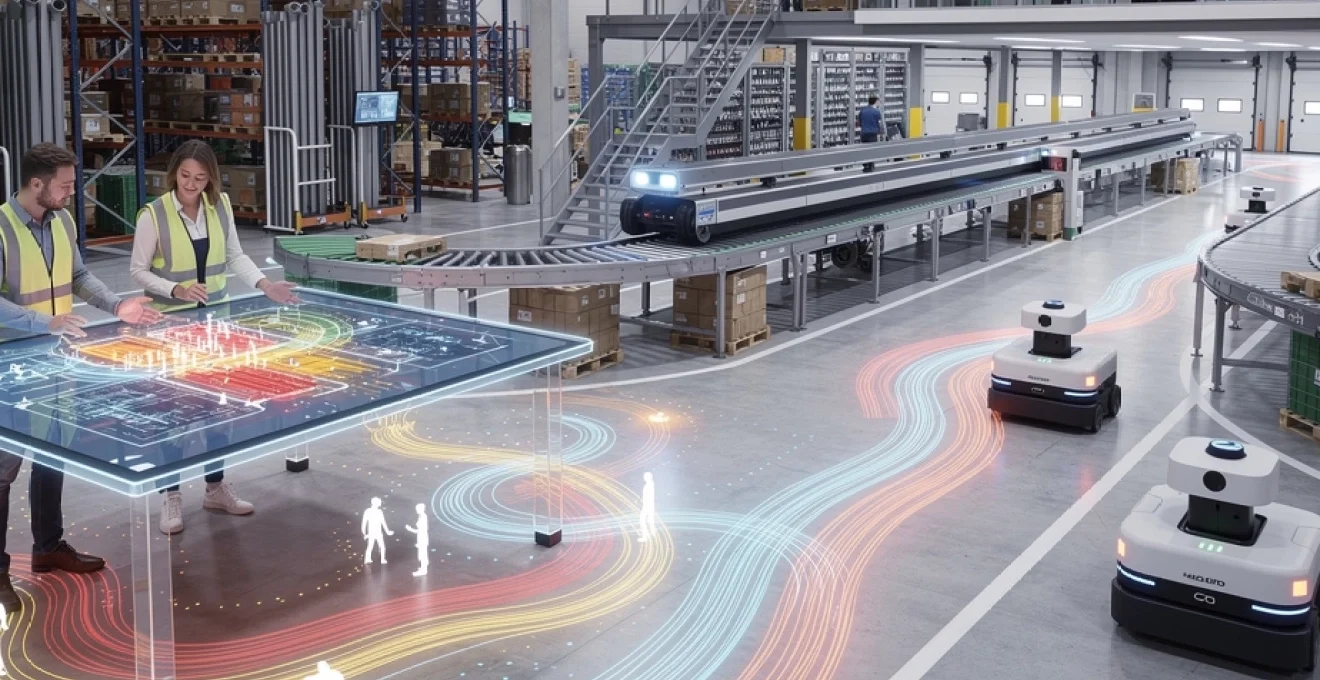
Spaghetti diagrams provide remarkably effective visualization of movement patterns within warehouse environments. These diagrams track the paths taken by workers, equipment, and materials throughout typical operational cycles, creating visual representations that often resemble tangled spaghetti—hence the name. When you overlay multiple journey paths on a single floor plan, patterns emerge that would otherwise remain invisible. High-traffic corridors become immediately apparent, as do unnecessarily circuitous routes that waste time and energy. This technique proves particularly valuable when analyzing picker movements during order fulfillment, revealing opportunities to relocate frequently accessed items closer to packing stations or consolidation areas.
Creating accurate spaghetti diagrams requires systematic observation over representative time periods. You’ll want to capture data during peak operational hours, seasonal fluctuations, and various order profiles to ensure comprehensive understanding. Modern warehouse management systems can automate much of this data collection, using RFID tracking, GPS positioning, or scanner data to construct detailed movement maps without manual observation. The insights gained typically identify quick-win opportunities—simple relocation decisions or minor layout adjustments that deliver immediate productivity improvements before major infrastructure investments commence.
Calculating throughput velocity and cycle time metrics
Throughput velocity measures the speed at which goods move through your facility, from receiving to shipping. This metric provides essential perspective on operational capacity and helps identify constraints limiting overall performance. By calculating cycle times for specific processes—receiving inspection, put-away operations, order picking, packing, and shipping preparation—you develop granular understanding of where delays occur and which processes require optimization priority. Industry benchmarks suggest that well-optimized facilities achieve throughput velocities 30-40% higher than poorly configured warehouses handling similar product profiles.
Accurate cycle time measurement requires consistent methodology and representative sampling. You’ll need to account for variability introduced by product characteristics, order complexity, staffing levels, and equipment availability. Statistical analysis techniques help distinguish between normal variation and systemic inefficiencies requiring intervention. Many organizations discover that their assumed bottlenecks differ significantly from actual constraints revealed through rigorous measurement. This discovery frequently redirects optimization investments toward higher-impact interventions than initially anticipated.
Applying ABC analysis for strategic stock positioning
ABC analysis categorizes inventory based on value contribution and turnover frequency, typically revealing that roughly 20% of stock keeping units (SKUs) account for 80% of picking activity. This Pareto principle application enables strategic positioning decisions
for stock placement, ensuring that your highest-velocity SKUs occupy the most accessible locations. In practice, A-class items should be positioned closest to picking and packing stations, at waist-to-shoulder height, and along the shortest pick paths. B-class products can be located slightly further away or higher on racking, while C-class and slow movers are positioned in more remote or higher-density storage areas. By aligning physical stock positioning with demand patterns, you can reduce travel time, compress pick paths, and lift overall warehouse productivity without increasing headcount.
ABC analysis should not be a one-off exercise. Because product ranges, order profiles, and customer behaviour shift over time, the most efficient warehouses review and refresh their ABC classifications at least quarterly. This rolling analysis is especially valuable in omnichannel environments, where seasonal promotions or new product launches can rapidly change demand. Combining ABC analysis with real-time data from your warehouse management software allows you to continuously refine stock positioning, supporting agile warehouse layout optimisation even as your business evolves.
Utilising heat mapping technology to identify congestion zones
Heat mapping technology builds on spaghetti diagram insights by quantifying where congestion and delays actually occur. Using data from handheld scanners, RFID tags, AGVs, or wearable devices, you can generate visual heat maps that highlight high-traffic zones, dwell times, and queue build-ups across your warehouse layout. These visualisations quickly show which intersections, aisles, or workstations consistently experience crowding, slow movement, or bottlenecks during peak operating windows. Instead of relying on anecdotal feedback, you get hard evidence of where layout changes will yield the greatest impact.
Once congestion zones are identified, you can experiment with targeted interventions: widening critical aisles, changing pick face locations, re-routing material handling equipment, or rescheduling certain tasks to off-peak periods. In many facilities, simple line-side changes—such as relocating fast-moving SKUs away from cross-traffic junctions—can dramatically reduce wait times and improve safety. Think of heat mapping as the equivalent of a traffic management system for your warehouse: by smoothing flow and reducing crossing points, you boost throughput while simultaneously lowering collision risk and operator fatigue.
Designing modular racking systems and vertical storage solutions
With material flow mapped and high-impact optimisation zones identified, the next step is to engineer storage solutions that make the best use of your available cube. Modern warehouse layout design prioritises modular racking systems and vertical storage solutions that can flex as your inventory profile changes. Rather than locking yourself into rigid infrastructure, you design a storage ecosystem that can be reconfigured, extended, or densified with minimal disruption. This approach not only maximises storage capacity but also supports scalable growth and rapid adaptation to new product lines or service models.
When evaluating industrial storage options, it is essential to consider load profiles, SKU variety, access frequency, and the type of material handling equipment you operate. A warehouse dominated by full pallet movements has very different racking requirements from an operation focused on intensive piece-picking. By aligning racking design with your operational model and future growth plans, you avoid the costly trap of installing systems that become constraints within a few years.
Comparing selective pallet racking versus drive-in configurations
Selective pallet racking remains the most common storage option thanks to its flexibility and direct access to every pallet location. It is ideal for operations with a broad SKU range, variable demand patterns, and a need for rapid pallet retrieval. Aisles between selective racks are sized for standard forklifts, allowing operators to access any pallet position without moving neighbouring loads. The trade-off, however, is lower storage density compared to high-density systems, as aisle space consumes a significant proportion of the warehouse footprint.
Drive-in racking, by contrast, offers higher storage density by allowing forklifts to enter the racking structure and store pallets in deep lanes. This configuration is well suited to high-volume, low-SKU environments where pallets of the same item are stored in large batches—think raw materials, seasonal stock, or production buffers. The compromise is reduced selectivity and a last-in, first-out (LIFO) inventory flow, which may not support all product types. When comparing selective pallet racking and drive-in racking, a hybrid approach often proves most effective: reserve drive-in lanes for homogenous, slow-rotation, or buffer stock, while using selective racking near pick and ship zones for fast-moving or high-value SKUs.
Integrating mezzanine flooring for multi-level operations
Mezzanine flooring presents one of the most cost-effective ways to expand capacity without moving premises or extending the building footprint. By adding one or more intermediate floors above your existing operations, you effectively unlock unused vertical space for storage, light manufacturing, or value-added services. Many businesses use mezzanines to create dedicated areas for e-commerce picking, returns processing, packing stations, or office and control rooms, freeing up ground-level space for high-velocity pallet movements and inbound/outbound operations.
Designing mezzanine solutions requires careful assessment of structural loading capacities, fire regulations, access routes, and integration with existing material handling systems. Will you use staircases, lifts, vertical conveyors, or spiral chutes to move goods between levels? How will mezzanine columns interact with racking aisles or forklift travel paths below? Treat your mezzanine not as an isolated platform but as a fully integrated part of your warehouse layout. When done well, multi-level operations can increase usable floor area by 30–100%, often delivering a faster return on investment than relocating to a larger facility.
Specifying cantilever racking for long-goods storage
Standard pallet racking is not well suited to long, bulky items such as timber, pipes, steel sections, or furniture components. For these product categories, cantilever racking provides a tailored industrial solution that significantly improves safety and accessibility. By using vertical columns with projecting arms, cantilever systems eliminate front columns that would otherwise obstruct long loads, enabling side-loading by forklifts or sideloaders. This reduces the risk of product damage and speeds up handling times, particularly for awkward or heavy stock.
When specifying cantilever racking, you must consider maximum load lengths, weights, and deflection limits, as well as the turning circles and mast heights of your material handling equipment. Adjustable arm heights provide flexibility as your product mix changes, while optional accessories—such as arm end-stops, decking, or steel mesh—can be added for additional safety and support. Positioning long-goods racking along outer walls or in dedicated bays also helps minimise interference with standard pallet flows, supporting a more efficient, segment-specific warehouse layout.
Implementing mobile shelving units and compact storage systems
For operations with high SKU counts but relatively low pick frequency—such as spare parts, documentation archives, or MRO supplies—mobile shelving units and compact storage systems can dramatically increase storage density. Mounted on guided carriages that slide along floor rails, mobile shelves eliminate fixed aisles; access aisles are created only where and when needed. This can effectively double storage capacity in the same footprint compared to conventional static shelving, a powerful advantage in space-constrained warehouses or urban fulfilment centres.
Compact storage systems do require careful planning around safety interlocks, floor loading, and access control to prevent collisions or trapping hazards. Integration with your warehouse management software ensures that the correct aisle opens automatically based on pick instructions, reducing search time and improving picking accuracy. Think of mobile shelving as the warehouse equivalent of a sliding puzzle: by intelligently moving blocks of storage rather than people, you minimise walking distances and maximise the use of every square metre of space.
Integrating automated guided vehicles and conveyor networks
As labour markets tighten and order volumes rise, many organisations are turning to automation to support warehouse layout optimisation. Automated guided vehicles (AGVs), autonomous mobile robots (AMRs), and conveyor networks can take over repetitive transport tasks, freeing your team to focus on higher-value activities. The key is to integrate these automated systems into your overall material flow design, rather than treating them as bolt-on add-ons. Well-planned automation redesigns travel routes, buffer locations, and workstation placement to create a synchronised, end-to-end flow of goods.
Before investing in automation, you should model current and projected throughput, peak load scenarios, and product handling requirements. Not every movement needs to be automated; in many successful layouts, automation is targeted at “long-haul” or high-repetition routes, while humans continue to handle complex or exception-prone tasks. By viewing AGVs and conveyor systems as flexible tools within your layout optimisation toolkit, rather than all-or-nothing solutions, you create a balanced, resilient operation.
Deploying AMR technology from providers like locus robotics and fetch robotics
Autonomous mobile robots (AMRs) from providers such as Locus Robotics and Fetch Robotics have transformed how warehouses approach picking and internal transport. Unlike traditional AGVs that follow fixed paths, AMRs dynamically navigate around obstacles and adapt to changing layouts, making them ideal for fast-evolving operations. In a typical configuration, AMRs travel between pick locations and consolidation zones, while human pickers focus on picking items rather than pushing trolleys. This “cobotic” model combines human dexterity with robotic endurance, significantly reducing walking distances and increasing lines picked per hour.
When incorporating AMRs into your warehouse layout, you need to define robot travel lanes, charging points, and interaction zones with manual traffic. Clear visual markings, one-way systems in narrow aisles, and designated crossing points reduce congestion and improve safety. Because AMR fleets can be scaled up or down based on demand, you gain a powerful lever for managing peak seasons without major structural changes. In many facilities, AMR deployment becomes the catalyst for rethinking pick path strategies, slotting logic, and workstation design, delivering compound gains in warehouse efficiency.
Configuring sortation systems with cross-belt and tilt-tray mechanisms
For high-volume operations where thousands of parcels or totes must be routed to different destinations every hour, automated sortation systems become the backbone of the warehouse layout. Cross-belt and tilt-tray sorters can rapidly divert items to hundreds of chutes or dispatch lanes, enabling fast, accurate order consolidation for store replenishment, e-commerce orders, or carrier-specific despatch. By centralising sortation in a dedicated zone, you reduce manual handling, standardise flows, and gain precise control over outbound sequencing.
Effective sorter configuration depends on a detailed analysis of order profiles, destination patterns, and carrier cut-off times. Where will induction points be located? How will upstream conveyors feed the sorter, and where will downstream chutes discharge into pallets, cages, or gaylords? Designing the surrounding layout—staging areas, packing lines, and rework zones—to complement the sorter is crucial. Think of the sorter as a heart pumping product through arterial conveyor networks: if the “veins” and “arteries” are poorly designed, the whole system underperforms.
Establishing automated storage and retrieval systems with shuttle technology
Automated storage and retrieval systems (AS/RS) using shuttle technology offer ultra-high-density storage combined with rapid access times. In these systems, shuttles move horizontally along storage levels, while lifts transfer totes, trays, or pallets vertically to input and output stations. This architecture dramatically reduces the footprint required for high-throughput storage, making it especially attractive for operations where land costs are high or expansion space is limited. AS/RS solutions are increasingly used for e-commerce fulfilment, pharmaceuticals, and spare parts operations where accuracy and speed are paramount.
Implementing shuttle-based AS/RS requires careful alignment with your warehouse management software and order fulfilment strategies. Will the system primarily support batch picking, goods-to-person picking, or replenishment of forward pick faces? How will you manage temperature zones, product restrictions, or security requirements? Because AS/RS structures are capital-intensive and relatively fixed, the planning phase should include digital simulation and scenario testing to ensure the design supports not only today’s requirements but anticipated future growth and product evolution.
Implementing warehouse management software and digital twin simulation
Even the most sophisticated physical warehouse layout will underperform without robust digital control. Warehouse management software (WMS) orchestrates inventory, tasks, and resources, ensuring that your racking systems, automation, and workforce operate as a cohesive whole. A modern WMS provides real-time visibility of stock locations, manages put-away and picking strategies, and integrates with upstream ERP and downstream transport management systems. In effect, it becomes the central nervous system of the warehouse, turning static infrastructure into a responsive, data-driven operation.
Beyond conventional WMS capabilities, leading organisations are now leveraging digital twin simulation to validate and refine warehouse layout optimisation before physical changes are made. A digital twin is a virtual replica of your facility, complete with racks, conveyors, docks, equipment, and even simulated workers or robots. By feeding this model with real operational data, you can test alternative aisle configurations, racking designs, pick strategies, and automation scenarios in a risk-free environment. What happens if order volume doubles? How will a new product range impact storage density or pick paths? Digital twins allow you to answer these questions with confidence, reducing the risk of costly missteps.
As you implement WMS and simulation tools, involve cross-functional stakeholders from operations, IT, health and safety, and finance. Align configuration decisions—such as location naming conventions, stock rotation rules, and task interleaving logic—with your physical layout and business objectives. When your digital systems and physical design reinforce each other, you gain a powerful platform for continuous improvement: every day of operation generates new data to refine slotting rules, labour planning, and capital investment priorities.
Optimising pick path strategies and order consolidation zones
Picking remains one of the most labour-intensive and costly activities in most warehouses, often accounting for 50–60% of total operating costs. Optimising pick path strategies and designing effective order consolidation zones can therefore deliver outsized returns on your layout optimisation efforts. At its core, pick path optimisation is about reducing the distance travelled per order line while maintaining accuracy and ergonomics. The way you arrange SKUs, define pick zones, and group orders has a direct impact on daily productivity.
There are several common picking strategies—such as single-order picking, batch picking, zone picking, and wave picking—each with distinct layout implications. Batch picking, for instance, benefits from compact zones and logical product grouping, as pickers collect multiple orders in a single tour. Zone picking works best when the warehouse is subdivided into clearly defined areas with balanced workloads, reducing congestion and wait times between zones. As you evaluate these strategies, ask yourself: where are your current hot spots, and how could reconfiguring pick zones or consolidating SKUs reduce unnecessary travel?
Order consolidation zones play a crucial supporting role, particularly for multi-zone or multi-batch operations. These are the areas where partial picks from different zones or waves are combined into complete customer orders before packing and despatch. Situating consolidation points centrally, with clear access from all pick zones, can significantly cut internal transport distances. Well-designed consolidation areas include dedicated staging locations, clear signage, and integration with WMS-driven scanning to prevent mis-sorts. Think of these zones as the final assembly line in your order fulfilment process: if they are cramped or poorly organised, upstream picking efficiency will quickly be undermined.
Designing dock door configurations and cross-docking operations
The final piece of the warehouse layout optimisation puzzle lies at your interface with the outside world: the dock area. Dock door configurations and cross-docking operations determine how efficiently goods move between vehicles and storage or outbound staging. Poorly planned docks can create severe bottlenecks, with trailers waiting for doors, congested yard space, and excessive manual handling. In contrast, a well-designed dock area supports rapid vehicle turnaround, clear flow separation between inbound and outbound, and safe, ergonomic working conditions for your team.
When designing dock door layouts, consider the mix of inbound and outbound volumes, carrier schedules, trailer types, and any temperature-control requirements. How many doors should be dedicated to receiving versus shipping? Should some doors be flexible, able to switch roles depending on time of day or season? Providing separate traffic lanes for inbound and outbound trucks, along with adequate marshalling space for pallets and cages, helps avoid cross-traffic and confusion. In many facilities, simple changes—such as relocating high-volume SKUs closer to outbound docks or positioning returns processing adjacent to inbound doors—can substantially shorten end-to-end cycle times.
Cross-docking takes dock optimisation a step further by minimising or eliminating storage time for certain flows. Instead of moving all inbound goods into long-term storage, selected products are transferred directly from receiving to outbound staging, often within a few hours. This strategy is particularly effective for fast-moving consumer goods, promotional items, or consolidated store deliveries. To support cross-docking, your layout must provide clear, short paths between inbound and outbound docks, along with dedicated cross-dock staging areas and robust WMS support for pre-allocation of incoming inventory. When executed well, cross-docking turns your warehouse into a high-speed transfer hub, reducing handling, cutting inventory holding costs, and improving on-time delivery performance.