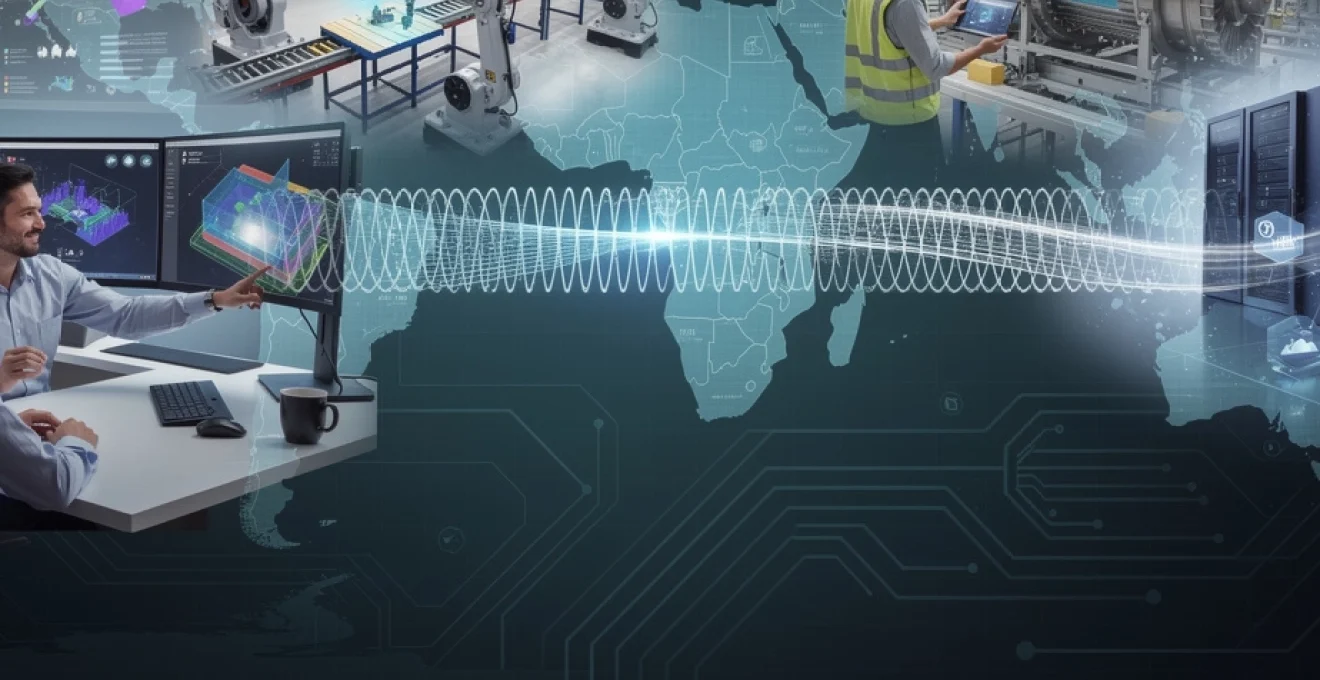
Manufacturing complexity has reached unprecedented levels, with modern products containing thousands of interconnected components requiring seamless coordination across global supply chains. Digital thread technology emerges as the critical solution for managing this complexity, creating an unbroken flow of data that connects every stage of a product’s journey from initial concept through end-of-life disposal. This comprehensive data framework enables manufacturers to maintain visibility, control, and optimisation across increasingly sophisticated product ecosystems.
The implementation of digital thread technology represents more than just technological advancement; it fundamentally transforms how organisations approach product development, manufacturing, and service delivery. By establishing continuous data connectivity, companies can eliminate the traditional silos that have long plagued industrial operations, creating instead an integrated environment where information flows seamlessly between departments, suppliers, and customers.
Digital thread architecture and core infrastructure components
The foundation of any successful digital thread implementation rests upon a robust architecture that can accommodate diverse data sources, processing requirements, and stakeholder needs. Modern digital thread architectures leverage cloud-native technologies, edge computing capabilities, and advanced data orchestration platforms to create scalable, resilient infrastructures capable of handling massive volumes of product lifecycle data.
Central to this architecture is the concept of data sovereignty, where organisations maintain control over their critical product information while enabling secure collaboration with external partners. This approach requires sophisticated identity management, access control, and data governance frameworks that can operate across complex multi-tenant environments whilst ensuring compliance with industry regulations and intellectual property protection requirements.
PLM system integration with IoT sensors and edge computing devices
Product Lifecycle Management systems serve as the primary data repositories within digital thread architectures, but their effectiveness depends heavily on real-time integration with IoT sensors and edge computing devices deployed throughout manufacturing and service operations. These integrations enable continuous monitoring of product performance, environmental conditions, and operational parameters that feed back into design and manufacturing processes.
Edge computing devices play a particularly crucial role in this ecosystem by processing sensor data locally, reducing latency, and filtering information before transmission to central PLM systems. This approach not only improves system responsiveness but also reduces bandwidth requirements and enhances data quality by performing initial validation and cleansing at the source.
Data standardisation through STEP AP242 and industry 4.0 protocols
Achieving seamless data flow across diverse systems requires rigorous adherence to established data standards and protocols. STEP AP242 emerges as the critical standard for product data exchange, providing a comprehensive framework for representing complex product information including geometry, manufacturing specifications, and lifecycle metadata in a vendor-neutral format.
Industry 4.0 protocols complement STEP AP242 by addressing real-time communication requirements between manufacturing systems, IoT devices, and enterprise applications. These protocols enable the creation of truly interoperable environments where data can flow freely between systems from different vendors whilst maintaining semantic integrity and contextual relationships.
Cloud-based digital twin platforms: azure digital twins and AWS IoT TwinMaker
Leading cloud platforms have developed sophisticated digital twin services that provide the computational infrastructure necessary to support comprehensive digital thread implementations. Microsoft Azure Digital Twins offers a platform-as-a-service solution that enables organisations to create detailed virtual representations of their products, processes, and facilities whilst maintaining the scalability needed to support enterprise-wide deployments.
Amazon Web Services’ IoT TwinMaker provides complementary capabilities focused specifically on industrial IoT integration and real-time data processing. These platforms enable organisations to leverage advanced analytics, machine learning, and simulation capabilities without the need to develop and maintain complex infrastructure internally.
Blockchain implementation for supply chain traceability and data integrity
Blockchain technology addresses one of the most challenging aspects of digital thread implementation: ensuring data integrity and traceability across complex, multi-partner supply chains. By creating immutable records of product information, manufacturing processes, and supply chain transactions, blockchain enables unprecedented levels of transparency and trust in product lifecycle data.
The implementation of blockchain within digital thread architectures requires careful consideration of performance, scalability, and energy consumption requirements. Modern enterprise blockchain solutions utilise consensus mechanisms optimised for industrial applications whilst providing the necessary throughput to support high-volume manufacturing operations.
Product design and development phase digital thread implementation
The design and development phase represents the foundation of the digital thread, where initial product concepts are translated into
fully defined digital models, simulation artefacts, and manufacturing constraints. When these early design decisions are digitally linked to downstream processes, engineering teams can evaluate trade-offs in terms of cost, manufacturability, maintainability, and sustainability much earlier. A robust digital thread in the design and development phase ensures that every geometry change, requirement update, or simulation result remains traceable back to its origin and impact.
In practice, this means connecting CAD, CAE, and requirements management tools into the central Product Lifecycle Management environment. Instead of manually exporting files or emailing drawings, data flows automatically between systems with full version history and context. You gain a single digital narrative of the product definition, reducing rework, miscommunication, and the risk of building on outdated information.
CAD data management through siemens teamcenter and PTC windchill systems
Siemens Teamcenter and PTC Windchill act as the backbone of CAD data management within a mature digital thread. They provide controlled environments where 3D models, assemblies, drawings, and related documents are stored with full revision history and configuration logic. By integrating these PLM platforms with authoring tools such as NX, Creo, or SolidWorks, design changes are captured automatically, ensuring that the digital product definition stays synchronised across teams and locations.
Within this framework, engineers can manage complex product structures, options, and variants while maintaining a single source of truth for geometry and metadata. For example, a heavy-equipment manufacturer can use Teamcenter to manage thousands of parts, linking each CAD component to its bill of materials position, manufacturing routing, and service documentation. PTC Windchill offers similar capabilities, enabling companies to enforce check-in/check-out workflows, design review processes, and access control policies that protect intellectual property while still enabling collaboration with suppliers.
From a digital thread perspective, the key is not just storing CAD data but connecting it contextually to downstream manufacturing and service information. When CAD models in Teamcenter or Windchill are linked to process plans, tooling definitions, and service manuals, you create a continuous digital trail from the original geometry through to the as-built and as-maintained configurations. This traceability is essential for industries with strict regulatory requirements, where you must prove how each design decision flowed into production and fielded assets.
Simulation-driven design integration with ANSYS workbench and COMSOL multiphysics
Simulation-driven design is a critical pillar of digital thread technology, enabling organisations to validate performance, durability, and safety before committing to physical prototypes. ANSYS Workbench and COMSOL Multiphysics are widely used platforms that allow engineers to perform structural, thermal, fluid, and multiphysics analyses directly on CAD models. When integrated into the digital thread, these tools turn isolated simulations into reusable, traceable assets that feed continuous improvement.
Instead of treating simulation files as stand-alone artefacts on local drives, results and models are stored in PLM and linked back to specific CAD revisions and requirements. This means that when a geometry update occurs, the digital thread can automatically flag which simulations are impacted and need to be rerun. Think of it as having a living laboratory where every design change triggers a predictable cascade of virtual tests, rather than relying on manual tracking and tribal knowledge.
For example, an aerospace company might use ANSYS Workbench to simulate wing loads and vibration characteristics, while COMSOL Multiphysics models thermal behaviour of avionics. By embedding both tools within the digital thread, the organisation can compare scenarios, document decision rationales, and align simulation assumptions with real-world test data captured later in the lifecycle. Over time, this feedback loop tightens, improving model accuracy and enabling more aggressive optimisation of weight, cost, and reliability.
Requirements traceability using IBM DOORS and polarion ALM tools
Requirements management is often where digital continuity starts—or breaks. IBM DOORS and Polarion ALM provide the structured environment needed to capture, decompose, and trace requirements across systems engineering, software, and hardware domains. Within a digital thread, these tools become the authoritative source for why a product is being built a certain way, while CAD, CAE, and code repositories describe how those requirements are implemented.
By linking requirements in DOORS or Polarion to design artefacts, test cases, and verification results, you create end-to-end traceability that is invaluable for audits, certification, and risk management. For instance, in medical device development, each regulatory requirement can be mapped to design features, hazard analyses, and validation activities. If a requirement changes, the digital thread shows precisely which components, diagrams, and test procedures are affected, dramatically reducing the effort needed to assess impact.
This traceability also supports better decision-making during trade studies and design reviews. When you can see, in one view, which requirements are fulfilled, partially addressed, or at risk, prioritising engineering resources becomes easier and more data-driven. In complex systems, this kind of clarity can be the difference between catching an issue in design reviews versus discovering it late during field deployment—when changes are exponentially more expensive.
Version control and configuration management via git-based PLM solutions
As software content in products grows, traditional PLM needs to integrate tightly with Git-based repositories to maintain a coherent digital thread. Modern Git-based PLM solutions, or integrations between tools like GitLab/GitHub and enterprise PLM, allow hardware and software artefacts to be managed under a common configuration management umbrella. This is crucial for mechatronic systems, where firmware, control algorithms, and embedded software are tightly coupled with mechanical and electrical designs.
Using Git for version control ensures that every code change is documented, reviewed, and traceable, while PLM systems track the overall product configuration, baselines, and variant logic. The digital thread links these layers together so that a specific product configuration can be tied to the exact software commit and build that shipped with it. If you need to investigate a field issue or security vulnerability, you can rapidly identify which customers and serial numbers are affected.
Configuration management in this context becomes more than a compliance exercise; it is the backbone of agile, continuous delivery for physical products. By combining Git workflows (branches, merge requests, CI/CD pipelines) with PLM-driven change processes, organisations can adopt more frequent release cycles while still maintaining the audit trails and approvals required in regulated industries. The result is a more responsive, software-centric product strategy that remains firmly anchored in a robust digital thread.
Manufacturing and production digital thread connectivity
Once designs are released, the digital thread extends into manufacturing and production, connecting planning, scheduling, execution, and quality processes. The goal is to ensure that the as-designed product definition is faithfully transformed into the as-built and as-shipped reality, with full traceability of materials, processes, and deviations. This connectivity enables manufacturers to optimise throughput, reduce scrap, and respond quickly to disruptions while maintaining complete visibility into what happened, where, and why.
In an Industry 4.0 landscape, this means integrating Manufacturing Execution Systems (MES), shop-floor equipment, and industrial IoT platforms with PLM and ERP. Production data captured in real time flows back upstream, informing engineering about manufacturability issues, process drift, and field performance trends. In effect, the factory becomes a powerful feedback node in the digital thread, rather than a black box between design and service.
MES integration with wonderware and rockwell FactoryTalk manufacturing execution systems
Wonderware (now AVEVA MES) and Rockwell FactoryTalk are central to orchestrating production activities on the shop floor. When integrated into the digital thread, these MES platforms receive work instructions, part lists, and process parameters directly from PLM, ensuring that operators always work to the latest released definition. In return, MES sends back execution data such as lot numbers, machine usage, operator actions, and non-conformance records.
This closed-loop connection eliminates manual data entry and paper-based travellers, which are error-prone and hard to audit. For example, a consumer electronics manufacturer can push updated assembly sequences from PLM into Wonderware, while FactoryTalk records cycle times, station downtimes, and test results at each step. If a defect trend emerges, engineers can quickly correlate it to specific design versions, suppliers, or process changes.
From an operational standpoint, MES integration enables more dynamic scheduling and routing decisions. When the system knows in real time which machines are available, which materials are at which stations, and which orders are at risk, it can re-optimise production plans on the fly. This agility is increasingly vital in volatile markets where demand shifts rapidly and supply chains are under constant pressure.
Real-time production data capture through OPC UA and MQTT protocols
Real-time production data is the lifeblood of a connected manufacturing digital thread. OPC UA and MQTT are two key protocols that enable secure, standardised communication between machines, sensors, edge gateways, and enterprise systems. OPC UA, widely adopted in industrial automation, provides rich, structured data models and built-in security mechanisms, making it ideal for connecting PLCs, CNC machines, and SCADA systems. MQTT, a lightweight publish/subscribe protocol, excels in bandwidth-constrained or cloud-centric scenarios.
By leveraging OPC UA and MQTT, manufacturers can stream high-frequency data from the shop floor to MES, historians, analytics platforms, and digital twin environments. Imagine every critical machine parameter—temperatures, pressures, spindle speeds, vibration signatures—being captured and time-stamped, then linked back to specific work orders and serial numbers. This level of granularity allows you to correlate subtle process variations with quality outcomes, enabling predictive maintenance and process optimisation.
The practical challenge is not just capturing the data but contextualising it. Within a robust digital thread, raw signals from OPC UA or MQTT are mapped to product identifiers, process steps, and equipment hierarchies, turning disparate data streams into coherent production narratives. When you later analyse why a field failure occurred, you can look back through this narrative and reconstruct the exact conditions under which that specific unit was produced.
Quality control automation using statistical process control and six sigma methodologies
Quality control is where the digital thread often delivers the fastest, most visible returns. By automating Statistical Process Control (SPC) and embedding Six Sigma methodologies into connected systems, organisations can detect process deviations early and react before defects propagate. Real-time data feeds from machines, gauges, and inspection systems populate control charts automatically, eliminating manual logging and spreadsheet analysis.
Within this digital framework, quality engineers can set control limits, monitor capability indices (Cp, Cpk), and trigger automated alerts or corrective workflows when trends indicate potential issues. For example, if torque values during assembly start drifting towards a control limit, the system can flag the condition, pause the affected workstation, and notify maintenance and engineering. These interventions are documented and linked to specific lots and serial numbers, strengthening traceability and compliance.
Integrating SPC and Six Sigma into the digital thread also supports continuous improvement. Data from non-conformances, rework, and scrap are aggregated and analysed to identify systemic root causes rather than treating defects as isolated events. Over time, this leads to more stable processes, higher first-pass yield, and lower cost of quality—a direct contribution to ROI from digital thread deployment.
Additive manufacturing workflow integration with EOS EOSCONNECT and 3D systems solutions
Additive manufacturing introduces new degrees of design freedom but also new complexity in process control and certification. EOS EOSCONNECT and 3D Systems’ workflow solutions provide specialised connectivity for 3D printers, powder handling systems, and post-processing equipment. When tied into the broader digital thread, they enable full traceability from CAD design to printed part, including build parameters, layer-wise monitoring data, and material batches.
For instance, an aerospace component printed on an EOS machine can have its build file, orientation, support structure design, and in-situ monitoring data stored in PLM alongside the original CAD and simulation models. EOSCONNECT streams real-time machine data—laser power, scan strategy, chamber conditions—back to analytics and quality systems. 3D Systems’ software can link build outcomes to downstream inspection results such as CT scans or dimensional checks.
This level of integration is essential when you must demonstrate equivalence between additive and conventionally manufactured parts, or when certifying highly critical components. The digital thread ensures that every parameter affecting part quality is recorded and accessible, reducing the risk of undetected process drift and enabling faster root-cause analysis when anomalies occur.
Service lifecycle and maintenance digital thread applications
The digital thread does not end when the product leaves the factory; it extends into service, maintenance, and end-of-life. In many ways, this is where its full value becomes apparent. By connecting field data, service records, and customer feedback back into engineering and manufacturing, organisations can move from reactive fixes to proactive and predictive strategies. This is particularly valuable for complex, long-life assets such as turbines, trains, or industrial machinery.
Connected products equipped with IoT sensors stream operational data—usage patterns, fault codes, environmental conditions—into cloud platforms and service management systems. Each data point is associated with a specific serial number and configuration, ensuring that analytics consider the exact variant and usage context. Service technicians access this rich history through digital work instructions, augmented reality (AR) tools, or mobile apps, enabling faster diagnostics and higher first-time fix rates.
From a lifecycle perspective, this service-centric digital thread supports new business models such as outcome-based contracts, pay-per-use arrangements, or equipment-as-a-service. Because you can continuously monitor performance and predict remaining useful life, you can confidently guarantee uptime or output levels. At the same time, field insights feed directly into the next design iteration, closing the loop between how products are used and how they are conceived.
Digital thread security and compliance framework
As data flows across design, manufacturing, and service domains, security and compliance become foundational to any digital thread technology strategy. The same connectivity that unlocks value also increases the attack surface for cyber threats and the risk of data leakage. A robust security framework must therefore span identity and access management, network segmentation, encryption, and continuous monitoring, all aligned with industry standards such as ISO 27001, IEC 62443, and NIST guidelines.
At the core, role-based access control and strong authentication ensure that only authorised users and systems can interact with sensitive product and operational data. Zero-trust principles—“never trust, always verify”—are increasingly adopted to secure connections between on-premise systems, cloud platforms, and edge devices. Data-in-transit is protected through TLS, while data-at-rest is encrypted and governed by strict key management policies. In regulated sectors such as aerospace, defence, and healthcare, additional controls around export compliance, ITAR, or HIPAA may be required.
Compliance is not just about ticking boxes; it is about demonstrable control over who accessed what data, when, and for what purpose. Audit trails embedded within PLM, MES, and service systems provide the evidence needed for regulatory inspections and customer audits. Integration with security information and event management (SIEM) tools allows suspicious patterns—unusual data exports, failed logins, anomalous device behaviour—to be detected quickly. By building security and compliance into the digital thread from the outset, you avoid costly retrofits and reduce the risk of incidents that could undermine trust.
ROI measurement and KPI optimisation for digital thread deployment
Given the scale and ambition of digital thread initiatives, measuring return on investment (ROI) and optimising key performance indicators (KPIs) is essential. Executives need clear evidence that investments in PLM integration, IoT infrastructure, and data governance are translating into tangible business value. This requires defining a balanced set of KPIs that span the entire product lifecycle, from time-to-market and engineering productivity to manufacturing efficiency, service performance, and customer satisfaction.
Typical metrics include reduction in engineering change cycle time, fewer late-stage design defects, improved first-pass yield, lower scrap and rework, higher overall equipment effectiveness (OEE), and increased mean time between failures (MTBF) in the field. Financially, you may track margin improvements, warranty cost reductions, inventory turns, or revenue from new service-based offerings enabled by digital thread visibility. The key is to establish baselines before deployment and then monitor trends as connectivity and automation mature.
To optimise these KPIs over time, organisations often adopt an iterative, use-case-driven approach. Rather than attempting a “big bang” transformation, they prioritise a handful of high-impact scenarios—such as closing the loop between field failures and design updates, or connecting MES to PLM for automated work instructions—and measure the results. Lessons learned from early pilots inform broader rollouts, while analytics tools highlight where further integration or process change will yield the greatest benefit. In this way, the digital thread evolves from a visionary concept into a practical, quantifiable driver of operational excellence and competitive advantage.