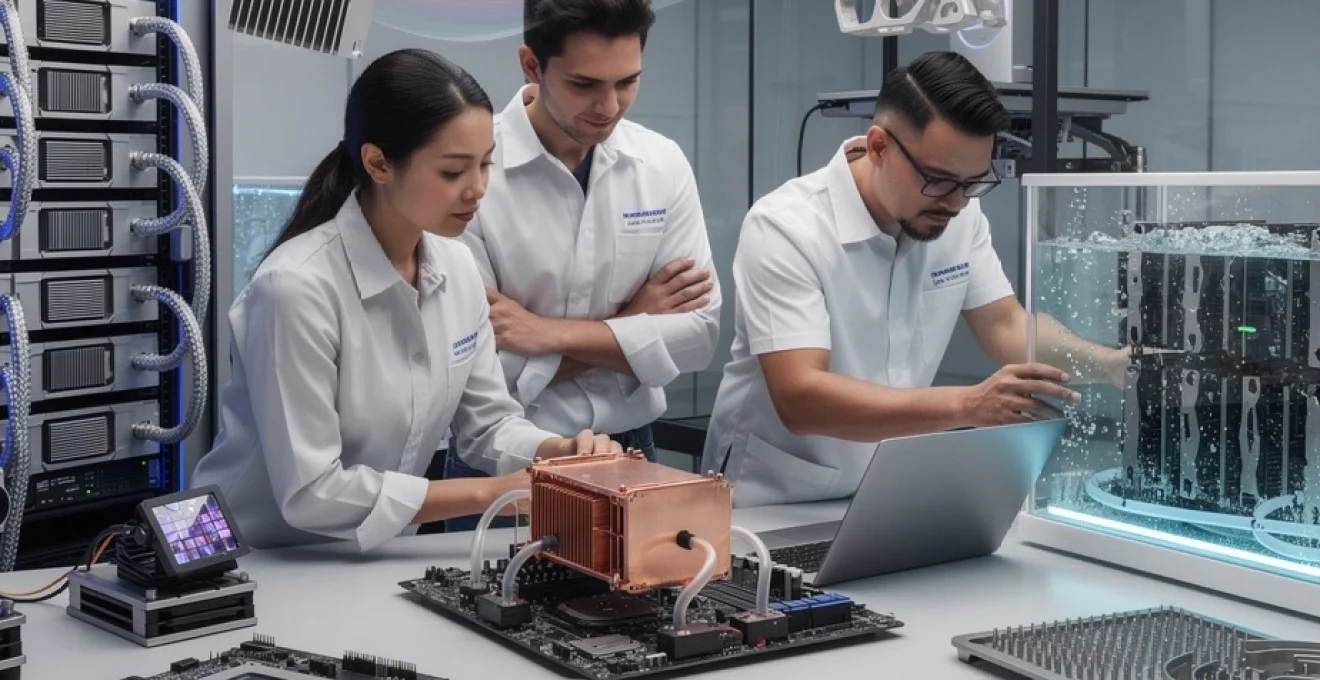
# Innovations in Thermal Management for High-Performance Electronics
The relentless push toward higher computing power, miniaturization, and energy efficiency has placed thermal management at the forefront of electronics engineering. As transistor densities increase and power consumption soars—particularly in artificial intelligence processors, data centre infrastructure, and electric vehicle power electronics—the challenge of dissipating heat effectively has become critical. Modern electronic systems generate thermal loads that traditional air cooling simply cannot handle, driving innovation across materials science, fluid dynamics, and manufacturing techniques. The convergence of advanced computational tools, novel materials like graphene and carbon nanotubes, and precision fabrication methods is reshaping how engineers approach thermal challenges in everything from smartphones to quantum computers.
This transformation extends beyond incremental improvements. Innovations such as vapour chamber integration, direct-to-chip liquid cooling, and additively manufactured heat exchangers represent fundamental shifts in thermal engineering philosophy. The industry is witnessing a transition from passive, one-size-fits-all solutions to active, application-specific thermal architectures that optimize performance, reliability, and energy consumption. Understanding these emerging technologies is essential for anyone designing, manufacturing, or specifying high-performance electronic systems in today’s competitive landscape.
Advanced heat sink architectures for power electronics cooling
Heat sinks remain the cornerstone of thermal management in electronics, but their design has evolved dramatically to meet the demands of modern power densities. Traditional extruded aluminium heat sinks, while cost-effective, often cannot provide the thermal performance required for high-power processors, graphics cards, and power converters. Engineers are now employing sophisticated architectures that maximize surface area, optimize airflow patterns, and incorporate advanced materials to achieve thermal resistances previously unattainable with conventional designs.
The shift toward higher performance heat sinks involves multiple design parameters: fin geometry, base thickness, material selection, and surface treatments. Copper, despite its higher cost and weight compared to aluminium, is increasingly specified for its superior thermal conductivity—approximately 400 W/mK versus aluminium’s 205 W/mK. Hybrid designs combining copper base plates with aluminium fins offer a practical compromise, placing the higher-conductivity material where thermal gradients are steepest while controlling overall system weight and cost.
Vapour chamber technology in GPU thermal solutions
Vapour chambers represent a significant advancement in heat spreading technology, particularly for graphics processing units where heat generation is concentrated in a relatively small die area. Unlike traditional heat pipes that transfer heat along a single axis, vapour chambers spread thermal energy across a two-dimensional plane, creating a more uniform temperature distribution across the heat sink base. This technology utilizes the phase change of a working fluid—typically water or methanol—within a sealed, evacuated chamber containing a wick structure.
When heat is applied to one surface of the vapour chamber, the working fluid evaporates, carrying latent heat to cooler regions where it condenses and releases energy. The capillary action of the internal wick structure returns the condensed liquid to the evaporator region, completing the cycle. Modern GPU coolers from manufacturers like NVIDIA and AMD increasingly incorporate vapour chambers to handle thermal design powers exceeding 300 watts. The result is a reduction in junction-to-case thermal resistance of 20-30% compared to equivalent solid copper base plates, enabling higher clock speeds and improved performance consistency.
Microchannel cold plates for data centre server processors
As data centre processors push beyond 400 watts per socket, traditional air cooling reaches fundamental limits. Microchannel cold plates, featuring passages with hydraulic diameters typically between 100 and 500 micrometres, offer a solution by placing liquid coolant in intimate contact with heat-generating components. These devices exploit the high heat transfer coefficients achievable with forced convection in small channels, where laminar boundary layers remain thin and turbulence enhances mixing.
Manufacturing microchannel cold plates presents considerable challenges. Precision machining, electroforming, and diffusion bonding techniques are employed to create the intricate internal geometries required. The coolant—usually water with corrosion inhibitors or specialized dielectric fluids—flows through these channels at velocities optimized to balance thermal performance against pressure drop and pumping power. Leading data centre operators report thermal resistances below 0.1°C/W with properly designed microchannel systems, enabling significant increases in
rack density and compute capacity without breaching allowable junction temperatures. When combined with manifold-based distribution networks and quick-disconnect fittings, microchannel cold plates enable modular, serviceable liquid cooling architectures that can be scaled across entire data halls. For engineers, key design considerations include channel aspect ratio, header design to ensure uniform flow distribution, and material compatibility to mitigate corrosion over years of operation.
Finned heat sink optimisation using computational fluid dynamics
The complexity of airflow patterns in tightly packed electronics makes intuition-driven heat sink design increasingly unreliable. Computational fluid dynamics (CFD) has become a standard tool for optimising finned heat sink architectures, allowing engineers to explore thousands of design permutations virtually before committing to tooling. By modelling conjugate heat transfer between solid and fluid domains, CFD tools reveal how fin spacing, height, thickness, and orientation affect both convective heat transfer coefficients and pressure drop.
Using CFD, designers can identify phenomena such as flow separation, recirculation zones, and bypassing that degrade thermal performance in real systems. For example, closely spaced fins may appear beneficial from a surface area perspective, yet they can choke airflow and reduce effective heat transfer in forced-convection environments. By iteratively adjusting geometries and boundary conditions, engineers can converge on a fin configuration that maximises heat dissipation per unit volume while meeting acoustic and energy-efficiency targets for fans or blowers. This kind of virtual prototyping significantly shortens development cycles and reduces the risk of over- or under-design.
Graphite-based thermal spreaders in mobile device applications
In smartphones, tablets, and ultra-thin laptops, traditional metal heat spreaders are often too heavy and rigid to meet industrial design goals. Graphite-based thermal spreaders, particularly flexible pyrolytic graphite (PG) films, offer an attractive alternative. With in-plane thermal conductivities exceeding 1000 W/mK, these materials can rapidly redistribute heat from hot spots such as application processors, RF power amplifiers, and fast-charging circuits across a larger area of the device chassis. This reduces peak surface temperatures and mitigates user discomfort without resorting to bulky heat sinks.
Graphite spreaders are typically laminated between structural layers or bonded to shield cans, batteries, or mid-frames, where they act like a thermal “highway” spreading heat laterally. Their anisotropic properties—high in-plane but low through-thickness conductivity—allow designers to control heat flow, for instance by keeping displays and touch surfaces cooler while using the metal frame as a heat sink. As mobile devices increasingly integrate 5G modems, high-refresh-rate displays, and edge AI accelerators, optimised graphite-based thermal spreaders are becoming a cornerstone of compact electronics cooling strategies.
Two-phase liquid cooling systems for high-power density applications
When power densities climb into the tens or hundreds of watts per square centimetre, single-phase air or liquid cooling can struggle to keep up. Two-phase liquid cooling systems exploit the latent heat of vaporisation to move far more energy per unit mass flow, enabling compact thermal solutions for applications as diverse as radar electronics, cryptocurrency mining rigs, and electric vehicle inverters. By allowing the coolant to boil at the heat source and condense at a remote location, these systems act somewhat like miniature refrigeration loops without the complexity of compressors.
The appeal of two-phase cooling lies in its ability to maintain near-isothermal conditions across the evaporator surface, which helps keep junction temperatures tightly controlled even under rapid load changes. However, the design of such systems is non-trivial. Engineers must consider boiling stability, critical heat flux, flow distribution, and the selection of working fluids that balance thermal performance, environmental impact, and compatibility with materials. As we push toward ever-higher power densities, two-phase solutions are likely to move from niche deployments into mainstream power electronics cooling.
Direct-to-chip immersion cooling in cryptocurrency mining rigs
Cryptocurrency mining rigs are a prime example of high-power density electronics operating continuously under full load. To maximise hash rate and minimise downtime, many operators have moved beyond air cooling to direct-to-chip immersion cooling. In these systems, mining boards or ASIC modules are submerged in a dielectric fluid that directly contacts components and removes heat by natural or forced convection, and in some designs, by local boiling at the chip surface.
Direct immersion reduces thermal resistance by eliminating traditional thermal interface layers and air gaps, while also providing electrical insulation and dust protection. Some mining farms deploy single-phase immersion with pumped fluid through external heat exchangers, while others use two-phase immersion, where localized boiling significantly enhances heat transfer. For you as a designer or operator, important considerations include fluid selection (viscosity, thermal conductivity, dielectric strength), materials compatibility with seals and plastics, and the impact of fluid ageing on long-term performance. The result, when done correctly, is markedly lower chip temperatures and improved energy efficiency per terahash.
Thermosyphon loop heat pipes for radar electronics
Airborne and ground-based radar systems often package high-power RF electronics in constrained, vibration-prone environments where traditional pumped liquid cooling is impractical. Thermosyphon loop heat pipes (LHPs) offer a passive two-phase solution that can transfer heat efficiently over distance and against gravity with no moving parts. In an LHP, heat input at the evaporator causes the working fluid to vaporise and flow toward a condenser, where it rejects heat and condenses; capillary action in a porous wick then returns the liquid to the evaporator.
Because the driving potential is the pressure difference between evaporator and condenser, LHPs can transport heat even in microgravity or under varying orientation, making them well suited to defence and aerospace electronics cooling. Their effective thermal conductivity can be orders of magnitude greater than solid copper, allowing engineers to relocate heat from densely packed radar front-ends to more favourable locations for dissipation. Designing reliable loop heat pipes involves careful attention to wick structure, start-up behaviour at low loads, and the avoidance of dry-out or flow instabilities under transient radar duty cycles.
Microchannel evaporator design for electric vehicle inverters
Electric vehicle (EV) inverters operate at high switching frequencies and current levels, resulting in substantial heat generation in power semiconductor modules. To keep these devices within safe junction temperature limits while minimising coolant flow rate and pump power, engineers increasingly employ microchannel evaporators integrated into the inverter baseplate. These structures allow a refrigerant or coolant to undergo phase change directly beneath or adjacent to IGBT or SiC MOSFET dies, removing large amounts of heat with relatively small temperature rises.
Microchannel evaporator design in EVs must balance several constraints: pressure drop across the channels, risk of flow maldistribution among parallel paths, and the need to avoid local dry-out that could trigger thermal runaway. Because automotive environments impose wide ambient temperature swings and vibration, robustness and manufacturability are as critical as pure thermal performance. In many modern EV platforms, the inverter, onboard charger, and electric motor share a common coolant loop; integrating microchannel evaporators into this architecture allows you to maintain compact packaging while still taking advantage of two-phase heat transfer where it delivers the most benefit.
Dielectric fluid selection for immersion-cooled data centres
Immersion-cooled data centres, whether single-phase or two-phase, rely on specialised dielectric fluids that can safely contact live electronics while providing high thermal performance. Selecting the right fluid is akin to choosing the “blood” of your cooling system: it must flow easily, carry heat efficiently, and remain stable over years of operation. Key parameters include thermal conductivity, specific heat, viscosity, boiling point (for two-phase systems), dielectric strength, and chemical compatibility with PCB laminates, elastomers, and metals.
In recent years, there has been a shift away from some legacy fluorocarbon-based fluids due to global warming potential and cost, toward newer synthetic hydrocarbons and engineered fluorinated fluids with improved environmental profiles. Operators must also account for fluid oxidation, contamination from flux residues or dust, and the ease of maintenance such as filtration and degassing. By rigorously evaluating these factors early in the design process, you can avoid expensive retrofits and ensure that immersion-cooled servers deliver the promised gains in energy efficiency and rack density.
Novel thermal interface materials for reducing contact resistance
Even the most advanced heat sink or cold plate will underperform if the thermal interface between it and the device is poorly managed. Microscopic surface roughness and voids trap air, a poor thermal conductor, and can dominate the overall thermal resistance in high-performance electronics. Novel thermal interface materials (TIMs) are addressing this bottleneck by combining high thermal conductivity with low bond-line thickness and mechanical compliance. From phase change materials in laptop CPUs to liquid metal TIMs in game consoles, the industry is experimenting with new chemistries and form factors to squeeze out every degree of thermal margin.
Choosing the right TIM is not just about maximum conductivity on a datasheet. You also need to weigh factors like pump-out resistance under thermal cycling, ease of application in high-volume manufacturing, electrical insulation requirements, and long-term stability. In many designs, optimising the thermal interface can yield lower junction temperatures at far lower cost than a complete redesign of the cooling hardware, making TIM selection one of the most cost-effective levers in electronics thermal management.
Phase change materials in laptop CPU thermal management
Thin-and-light laptops present a challenging combination of high power densities and limited z-height for cooling hardware. Phase change materials (PCMs) used as TIMs between the CPU heat spreader and heat sink or vapour chamber can significantly improve thermal performance in these constrained designs. At temperatures below their phase change point, these materials behave as solid pads, simplifying assembly. As the CPU heats up under load, the PCM softens or partially melts, flowing to fill microscopic gaps and eliminating interfacial air pockets.
This dynamic behaviour results in reduced thermal resistance precisely when the processor is under the greatest thermal stress, helping sustain higher boost clocks for longer durations. From a manufacturing standpoint, PCM TIMs offer advantages over traditional greases by reducing mess, variability in applied thickness, and risk of pump-out during shipping. For OEMs striving to deliver both performance and quiet operation in fan-limited form factors, phase change TIMs are an increasingly attractive option.
Carbon nanotube-enhanced thermal pastes for high-performance computing
High-performance computing (HPC) processors and AI accelerators often operate at or near their thermal limits, making the choice of thermal paste a critical design decision. Carbon nanotube (CNT)-enhanced thermal pastes aim to push beyond the capabilities of conventional silicone or hydrocarbon-based greases filled with ceramic or metallic particles. Thanks to their exceptional intrinsic thermal conductivity and high aspect ratio, CNTs can form conductive networks that bridge micro-scale gaps more effectively, lowering contact resistance between the die, heat spreader, and cooler.
However, formulating reliable CNT-based TIMs is not trivial. Challenges include achieving uniform dispersion without agglomeration, ensuring good wetting of contact surfaces, and maintaining appropriate viscosity for stencil or automated dispensing. In practice, you may see only incremental gains of a few degrees Celsius in junction temperature reduction, but in thermally constrained HPC clusters, this margin can mean the difference between throttling and sustained peak performance. As research advances, we can expect CNT-enhanced materials to become more mainstream in both data centre and enthusiast PC markets.
Liquid metal TIMs in PlayStation 5 and xbox series X cooling
Liquid metal thermal interface materials, typically eutectic alloys based on gallium and indium, have moved from overclocking enthusiasts into mass-market products such as the PlayStation 5 and certain Xbox Series X revisions. These TIMs offer thermal conductivities an order of magnitude higher than conventional greases, enabling console designers to keep powerful system-on-chip (SoC) dies within safe temperatures using relatively compact heat sinks and modest fan speeds. The result is quieter operation and greater headroom for heavy gaming workloads.
Yet liquid metals come with trade-offs. Gallium alloys can aggressively wet and embrittle aluminium, requiring heat sinks and mounting hardware to use compatible materials such as copper or nickel-plated surfaces. They are also electrically conductive, so robust containment and application controls are essential to avoid short circuits. If you are considering liquid metal TIMs in your own designs, you must carefully evaluate assembly processes, long-term stability under thermal cycling, and serviceability, as rework is more complex than with standard pastes.
Graphene-based thermal pads for 5G base station electronics
5G base station radios and massive MIMO antenna arrays pack substantial RF power into outdoor enclosures that must operate reliably across wide temperature ranges. Graphene-based thermal pads are emerging as a compelling TIM solution in this space. By incorporating graphene flakes or films into elastomeric matrices, these pads combine high in-plane thermal conductivity with mechanical compliance, allowing them to conform to component tolerances and absorb vibration without degrading thermal contact.
Compared to traditional silicone pads loaded with ceramic fillers, graphene-enhanced pads can deliver lower thermal resistance at equivalent or lower contact pressures, which is crucial for maintaining reliability in solder joints and fragile components. Their electrically insulating variants are particularly valuable when components and heat spreaders must remain at different potentials. As 5G and upcoming 6G systems push RF front-ends to higher power levels and frequencies, graphene-based thermal pads will likely play an increasing role in keeping base station electronics cool and dependable.
Active thermoelectric cooling solutions for precision electronics
While most electronics cooling solutions are passive, certain precision applications require active temperature control rather than mere heat dissipation. Thermoelectric coolers (TECs) based on the Peltier effect can both heat and cool a device by reversing current direction, enabling tight temperature stabilisation for sensitive components. From laser diodes to infrared sensors and quantum computing qubits, these systems depend on maintaining specific temperature setpoints to achieve optimal performance, wavelength stability, or noise characteristics.
Of course, thermoelectric cooling is not a free lunch. TECs consume electrical power and add heat that must ultimately be rejected by a secondary cooling system, such as a heat sink or liquid loop. Their coefficient of performance (COP) is typically lower than that of compressor-based refrigeration, so they are best suited for low to moderate heat loads where precise control outweighs efficiency concerns. When applied judiciously, however, Peltier modules can provide capabilities that passive solutions simply cannot match.
Peltier module integration in laser diode temperature stabilisation
High-power laser diodes used in telecommunications, lidar, and industrial applications are extremely sensitive to temperature. Small shifts in junction temperature can change their emission wavelength and output power, degrading system performance. To counter this, designers integrate Peltier modules directly beneath the laser package, along with temperature sensors and control electronics that form a closed-loop system. The TEC actively adds or removes heat to maintain the laser at a setpoint, often with stability better than ±0.1°C.
Integrating a TEC into a laser module involves stacking multiple thermal resistances: the laser die to package, package to TEC, TEC to heat sink, and finally heat sink to ambient. Every interface must be optimised, as the TEC can only compensate so much for poor downstream cooling. In compact optical transceivers or lidar units, space and power budgets are tight, so you must carefully size the TEC, select low-resistance TIMs, and ensure that the external heat rejection system can handle the combined load of the laser and TEC power consumption.
Cascaded thermoelectric coolers for infrared sensor arrays
Infrared (IR) sensor arrays, particularly those operating in the mid- or long-wave bands, often require deep cooling to reduce thermal noise and achieve high sensitivity. In some cases, target temperatures can be tens of degrees below ambient, beyond the reach of a single-stage Peltier module. Cascaded thermoelectric coolers address this by stacking multiple TEC stages, each one pumping heat from the previous stage toward ambient, achieving larger overall temperature differentials (ΔT).
Designing cascaded TEC assemblies is akin to building a miniature multi-stage refrigerator: the coldest stage carries the smallest heat load but must be extremely efficient, while the warmest stage handles both the sensor load and the waste heat from inner stages. Mechanical integration must account for differential thermal contraction to avoid stressing the delicate IR array, and control algorithms must coordinate power across stages to avoid oscillations or overshoot. For defence, aerospace, and scientific imaging systems where every photon counts, such sophisticated thermoelectric architectures are often indispensable.
Superlattice thermoelectric materials in quantum computing systems
Quantum computing hardware, particularly systems based on superconducting qubits, operates at cryogenic temperatures reached by dilution refrigerators. Even in room-temperature support electronics, however, precise temperature management is critical to minimising noise and drift. Emerging superlattice thermoelectric materials, engineered with nanoscale layering to enhance the Seebeck coefficient and reduce thermal conductivity, promise higher efficiency TECs that could be integrated into both cryogenic stages and warm electronics racks.
By improving the figure of merit (ZT) of thermoelectric materials, superlattice structures enable more effective heat pumping per unit input power. In quantum computing environments where every watt of heat ultimately adds load to expensive cryogenic infrastructure, even modest gains in TEC efficiency can translate to significant operating cost reductions. Although these advanced materials are still moving from lab to product, they illustrate how materials science innovations are opening new avenues for active thermal control in the most demanding electronics applications.
Additive manufacturing techniques for custom thermal solutions
Additive manufacturing (AM) is transforming how engineers design and produce thermal management hardware. Traditional subtractive methods like milling and extrusion impose constraints on fin geometries, internal channels, and material distribution. With metal 3D printing, you can create conformal heat exchangers, lattice structures, and complex manifolds that were previously impossible or prohibitively expensive to fabricate. The result is cooling solutions that are lighter, more efficient, and better integrated into the surrounding mechanical architecture.
Beyond mere geometric freedom, AM also facilitates rapid iteration. Designers can quickly move from simulation to prototype, test performance, and refine designs without lengthy tooling lead times. This agility is particularly valuable in fast-moving sectors such as aerospace electronics, electric vehicles, and high-performance computing, where thermal requirements evolve rapidly. As machine throughput improves and costs decline, additively manufactured thermal components are likely to become commonplace rather than exceptional.
3d-printed conformal heat exchangers using selective laser melting
Selective laser melting (SLM), also known as laser powder bed fusion, enables the production of dense metal parts with highly intricate internal features. For thermal management, one of the most compelling applications is the creation of conformal heat exchangers that follow the contours of electronic assemblies or enclosures. By printing coolant channels that snake closely around hot components, designers can maximise heat transfer area within a given volume, akin to wrapping a custom-fitted “thermal jacket” around the electronics.
Such conformal heat exchangers are particularly attractive in power-dense modules where every millimetre of space counts, such as inverters, RF amplifiers, or avionics boxes. SLM allows the integration of features like turbulence-inducing ribs, variable channel cross-sections, and integrated mounting points, reducing part count and assembly complexity. However, you must also account for manufacturability constraints, such as minimum wall thickness, powder removal from internal cavities, and post-processing for surface finish where seals or gaskets interface.
Topology optimisation for lightweight aerospace electronics cooling
Weight is a perennial concern in aerospace applications, where every gram saved can translate into fuel or payload advantages. Topology optimisation algorithms, combined with AM, allow engineers to “grow” heat sinks and cold plates that use material only where it contributes most to structural strength and heat transfer. Starting from a design space and boundary conditions, the software iteratively removes low-value material, leaving behind organic-looking structures with branching fins and lattice cores.
These optimised geometries often resemble natural systems such as tree branches or bone structures, where load paths and transport networks are highly efficient—a useful analogy when explaining the concept to non-specialists. By printing these designs in lightweight alloys like aluminium or titanium, aerospace manufacturers can achieve high-performance thermal management with minimal mass. Of course, the success of this approach depends on accurate thermal simulations, robust design rules for printability, and close collaboration between thermal engineers, structural analysts, and manufacturing teams.
Metal binder jetting for complex heat sink geometries
Metal binder jetting is another AM process gaining traction for thermal components, particularly when higher production volumes are required. Unlike SLM, binder jetting builds “green” parts by selectively depositing a binding agent onto a metal powder bed, followed by sintering to densify the structure. This approach can achieve faster build times and lower per-part costs, making it suitable for batch production of complex heat sinks and cold plates.
For electronics cooling, binder jetting shines when producing heat sinks with intricate fin arrays, internal lattice structures, or integrated mounting features that would be difficult to machine. While sintered parts may have slightly lower density and thermal conductivity than wrought metals, clever design—such as increased surface area or optimised air channels—can offset these material limitations. If you are evaluating AM for thermal hardware, binder jetting offers a promising balance between geometric freedom, cost, and scalability.
Thermal simulation and predictive modelling for electronics design
As thermal management challenges grow more complex, relying solely on physical prototyping is both risky and expensive. Thermal simulation and predictive modelling tools are now indispensable in the electronics design workflow, allowing engineers to assess cooling strategies long before hardware exists. From board-level airflow to junction temperature prediction, these tools help you understand how design decisions—from component placement to heat sink selection—affect thermal performance under realistic operating conditions.
The convergence of traditional finite-element and CFD solvers with electronics design automation (EDA) platforms is making it easier to incorporate thermal considerations early in the design process. Moreover, emerging machine learning approaches are augmenting physics-based models, enabling faster what-if analyses and reduced reliance on time-consuming full-fidelity simulations. The result is a more proactive, data-driven approach to keeping high-performance electronics within safe temperature envelopes.
ANSYS icepak for circuit board thermal analysis
ANSYS Icepak is one of the leading tools for simulating electronics cooling at the system and board level. By importing detailed geometry from ECAD and MCAD environments, engineers can model conduction through PCBs and components, convection in air or liquid domains, and radiation effects in sealed enclosures. Icepak’s libraries of electronic components and material properties simplify model setup, while its meshing and solver capabilities handle the complex geometries found in modern electronics assemblies.
Using Icepak, you can evaluate scenarios such as different fan speeds, vent patterns, or heat sink designs without building physical prototypes. The software provides insights into temperature distributions, airflow velocities, and pressure drops, helping identify hot spots and flow blockages. By iterating quickly in the virtual domain, design teams reduce the risk of late-stage thermal surprises that could necessitate costly board respins or enclosure modifications.
Flotherm XT integration in PCB layout design workflows
FloTHERM XT extends thermal simulation deeper into the PCB design workflow by integrating with popular EDA tools. Rather than treating thermal analysis as an afterthought, engineers can run simulations during layout to assess the impact of component placement, copper pour strategies, and via arrays on heat spreading. This is particularly valuable in high-density boards carrying power electronics, FPGAs, or RF front-ends, where localised hot spots can cause reliability issues or derating.
With bidirectional data exchange between FloTHERM XT and layout software, changes made by PCB designers—such as moving a high-power regulator or widening a trace—can be quickly re-evaluated thermally. This tight integration encourages collaboration between electrical and thermal engineers and shortens the feedback loop. Over time, design teams develop an intuition for thermally aware layout practices, reducing the need for drastic fixes late in the development cycle.
Machine learning algorithms for junction temperature prediction
While physics-based simulations remain the gold standard for detailed thermal analysis, they can be computationally intensive and time-consuming, especially for transient scenarios or large assemblies. Machine learning (ML) algorithms are emerging as powerful complements, trained on simulation and test data to predict junction temperatures under varying operating conditions. In effect, these models act like surrogate simulators, providing rapid estimates of thermal behaviour with minimal computational overhead.
For example, you might train an ML model to predict the junction temperature of a power MOSFET based on parameters such as ambient temperature, load current, PWM duty cycle, and cooling configuration. Once validated, this model can be embedded in system-level controllers to enable predictive thermal management—adjusting operating points before critical temperatures are reached. As sensing and telemetry capabilities expand in modern electronics, combining real-time data with ML-based thermal models will allow more intelligent, adaptive cooling strategies that keep high-performance electronics running safely and efficiently.