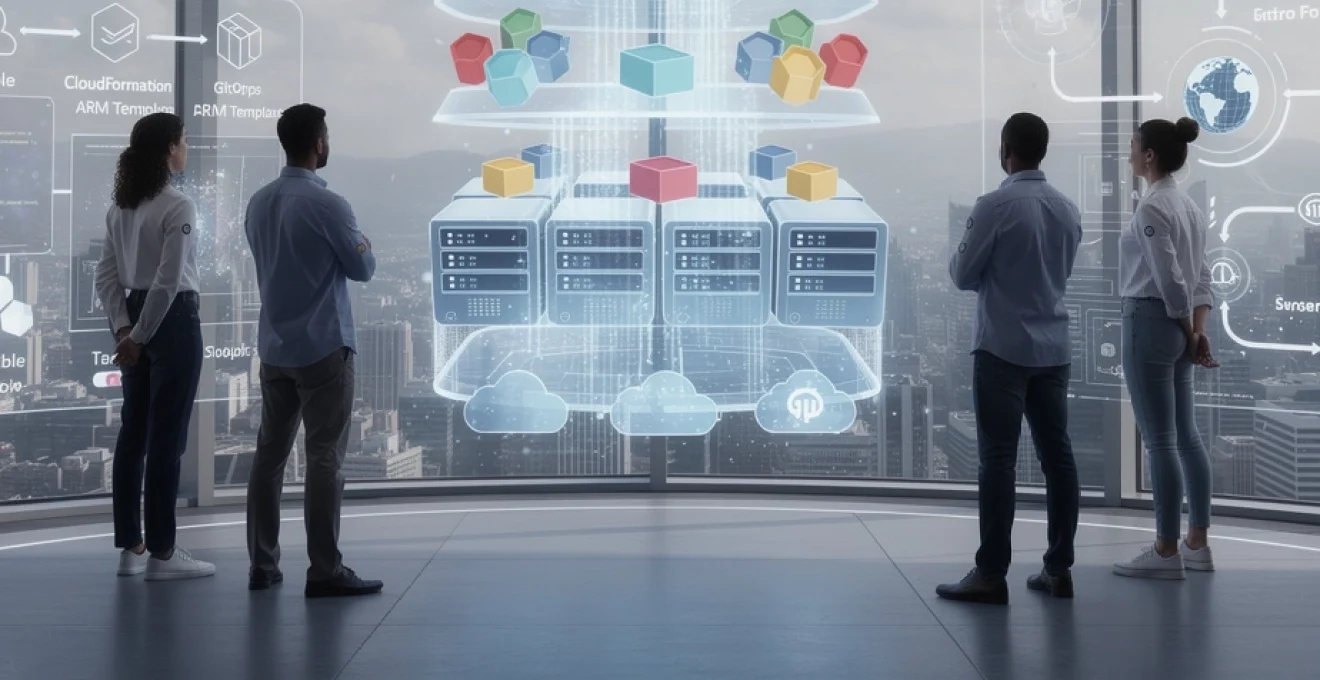
The digital transformation landscape has reached a pivotal moment where manual infrastructure management is becoming increasingly unsustainable. Modern enterprises demand deployment speeds that can match their business agility, security protocols that scale automatically, and operational efficiency that doesn’t require constant human intervention. Zero-touch infrastructure represents a fundamental shift from traditional IT operations, where automated systems handle everything from initial provisioning to ongoing maintenance without requiring manual configuration or oversight.
This paradigm shift isn’t merely about reducing operational overhead—it’s about reimagining how organisations approach technology deployment in an era where downtime costs can exceed £8,000 per minute for large enterprises. Zero-touch deployment methodologies enable businesses to achieve unprecedented scalability whilst maintaining security standards that would be impossible to enforce manually across thousands of distributed resources.
The convergence of cloud-native technologies, artificial intelligence, and sophisticated orchestration platforms has created an environment where infrastructure can truly manage itself. From automatic scaling responses to self-healing capabilities, these systems represent the evolution of DevOps practices into what many industry experts now term “NoOps”—where operational tasks become so automated that traditional operations teams can focus entirely on strategic initiatives rather than maintenance activities.
Zero-touch infrastructure architecture and core components
The foundation of zero-touch infrastructure rests upon several interconnected architectural principles that work together to eliminate manual intervention points. At its core, this architecture treats infrastructure as disposable, version-controlled assets that can be recreated identically at any time. This approach fundamentally changes how organisations think about system reliability, moving from protecting individual components to ensuring the automated recreation of entire environments.
Modern zero-touch architectures integrate declarative configuration management with event-driven automation, creating systems that respond intelligently to changing conditions. These architectures typically incorporate multiple layers of abstraction, from hardware provisioning through application deployment, each layer designed to operate independently whilst maintaining seamless integration with adjacent components.
Infrastructure as code (IaC) implementation with terraform and ansible
Infrastructure as Code represents the foundational layer of zero-touch deployment, transforming infrastructure provisioning from manual processes into executable code. Terraform excels at managing the lifecycle of infrastructure resources across multiple cloud providers, allowing organisations to define their entire infrastructure stack using HashiCorp Configuration Language (HCL). This declarative approach ensures that infrastructure deployments remain consistent and reproducible across different environments.
Ansible complements Terraform by handling configuration management and application deployment tasks that require more procedural logic. Whilst Terraform focuses on resource provisioning, Ansible excels at post-provisioning configuration, software installation, and complex orchestration workflows. The combination of these tools creates a comprehensive automation framework capable of managing infrastructure from bare metal through application deployment.
The integration between these platforms enables sophisticated deployment patterns where Terraform provisions the underlying infrastructure whilst Ansible handles the intricate configuration details. This separation of concerns allows infrastructure teams to maintain clear boundaries between resource management and configuration management, improving both maintainability and debugging capabilities when issues arise.
Container orchestration through kubernetes Auto-Scaling mechanisms
Kubernetes has emerged as the de facto standard for container orchestration, providing sophisticated auto-scaling mechanisms that respond dynamically to application demands. The Horizontal Pod Autoscaler (HPA) automatically adjusts the number of pod replicas based on observed CPU utilisation, memory consumption, or custom metrics, ensuring applications maintain optimal performance without manual intervention.
Vertical Pod Autoscaling (VPA) addresses resource optimisation by automatically adjusting CPU and memory requests for individual containers based on historical usage patterns. This capability is particularly valuable in zero-touch environments where applications must self-optimise resource consumption without human oversight, leading to significant cost savings in cloud deployments.
The Cluster Autoscaler extends these capabilities to the infrastructure layer, automatically adding or removing worker nodes based on pod scheduling requirements. This three-tier auto-scaling approach—horizontal, vertical, and cluster-level—creates truly elastic infrastructure that responds seamlessly to changing application demands whilst maintaining cost efficiency.
Gitops deployment pipelines using ArgoCD and flux controllers
GitOps represents a paradigm shift in deployment methodologies, treating Git repositories as the single source of truth for both application code and infrastructure configurations. ArgoCD and Flux controllers implement this philosophy by continuously monitoring Git repositories and automatically synchronising deployed resources to match the desired state defined
in those repositories. When changes are merged to the main branch, ArgoCD or Flux detects the drift between the declared configuration and the live cluster, then reconciles the difference automatically. This continuous reconciliation loop is what turns a traditional CI/CD workflow into a true zero-touch deployment pipeline.
By using pull-based deployment mechanisms, GitOps significantly reduces the blast radius of configuration errors and improves auditability. Every infrastructure change is captured as a commit, complete with author, timestamp, and review history, which is invaluable for regulated industries and compliance audits. For organisations moving towards zero-touch infrastructure, adopting GitOps tools such as ArgoCD and Flux provides a reliable, observable, and reversible deployment model that aligns perfectly with immutable infrastructure and declarative configuration practices.
Immutable infrastructure patterns with HashiCorp packer and docker
Immutable infrastructure takes the principle of “cattle, not pets” to its logical conclusion by treating servers and containers as short-lived, replaceable artefacts. Rather than patching or manually updating live systems, new versions are built as machine images or container images and then rolled out through automated pipelines. This approach dramatically reduces configuration drift and eliminates the uncertainty that comes from long-lived, manually modified servers.
HashiCorp Packer enables teams to define machine images as code, generating identical artefacts for multiple platforms such as AWS AMIs, Azure images, VMware templates, and more. Docker extends this immutable pattern to the application layer, packaging code and dependencies into portable container images that behave consistently across environments. When combined, Packer and Docker form the backbone of zero-touch infrastructure builds, where every environment—development, staging, and production—can be reproduced on demand.
In practice, organisations integrate Packer and Docker into their CI pipelines so that any change to application code or base images triggers a new image build. These images are then deployed via Kubernetes or traditional orchestrators, with old instances terminated automatically. The result is a robust, repeatable deployment process where recovery often means rolling forward to a new image rather than manually repairing a broken system, aligning perfectly with the self-healing ethos of modern infrastructure.
Automated provisioning technologies in cloud-native environments
As enterprises scale their cloud-native environments, manual provisioning of resources quickly becomes a bottleneck. Zero-touch infrastructure relies on automated provisioning technologies to create, update, and retire resources across multiple clouds without direct human involvement. These tools bring consistency and governance to environments that might otherwise fragment under the pressure of rapid growth and frequent change.
Cloud-native provisioning platforms use declarative templates or code-based definitions to describe everything from virtual networks and compute instances to managed databases and security policies. When executed, these definitions ensure that infrastructure is provisioned exactly as described, every time. For you as an architect or platform engineer, this means less time firefighting configuration issues and more time designing systems that can evolve with business requirements.
AWS CloudFormation and azure resource manager template automation
AWS CloudFormation and Azure Resource Manager (ARM) templates are cornerstone technologies for zero-touch infrastructure in their respective ecosystems. Both allow you to define entire application stacks—networking, compute, storage, and managed services—as version-controlled templates. Once defined, stacks can be launched, updated, or deleted through automated pipelines, eliminating the need for console-based configuration.
CloudFormation supports features such as change sets, drift detection, and nested stacks, which make complex environments easier to manage at scale. ARM templates offer similar capabilities with tight integration across Azure services, role-based access control, and policy enforcement. When integrated with CI/CD systems, these templates form the basis of a zero-touch provisioning strategy where environments can be spun up or torn down in minutes for testing, blue-green deployments, or regional failover.
From a governance perspective, CloudFormation and ARM templates enforce consistency by design. You can lock down cloud consoles and require that all changes flow through approved templates and pipelines. This not only improves security and compliance, but also reduces the risk of misconfigurations—still a leading cause of cloud incidents according to multiple industry studies.
Google cloud deployment manager for multi-region infrastructure
For organisations standardising on Google Cloud Platform, Deployment Manager offers a declarative way to manage complex, multi-region infrastructure deployments. Templates written in YAML, Jinja2, or Python define the desired state, including networking, IAM policies, Kubernetes clusters, and higher-level services. Once applied, Deployment Manager orchestrates the provisioning and update of these resources with minimal manual input.
Multi-region architectures are a critical component of resilient, zero-touch infrastructure, and Deployment Manager helps automate their creation. You can encode patterns for active-active or active-passive deployments across regions, including load balancers, health checks, and failover policies. When a new region needs to be onboarded, you simply reapply the existing templates with region-specific parameters, ensuring a consistent and repeatable rollout.
This capability is particularly valuable for organisations expanding into new markets or complying with data residency requirements. Instead of treating each region as a bespoke deployment project, Deployment Manager allows you to treat regional expansion as a parameterised template execution—shrinking lead times from months to days and significantly reducing the risk of configuration drift between regions.
Pulumi cross-cloud infrastructure programming models
Whilst template-based systems work well, they can become unwieldy in complex, multi-cloud environments. Pulumi addresses this challenge by enabling you to define infrastructure using familiar programming languages such as TypeScript, Python, Go, or C#. This “infrastructure as software” approach gives developers and platform teams access to loops, conditionals, modules, and rich type systems when building zero-touch infrastructure definitions.
Pulumi’s cross-cloud abstraction layer lets you define resources that span AWS, Azure, GCP, Kubernetes, and even SaaS platforms, all in one coherent codebase. For enterprises pursuing a multi-cloud or hybrid strategy, this model simplifies the creation of portable, reusable infrastructure components that can be deployed in different environments with minimal changes. It also integrates well with existing software development practices such as unit testing, code reviews, and static analysis.
By treating infrastructure as a first-class software artifact, Pulumi encourages better engineering hygiene in provisioning workflows. You can encapsulate best practices into libraries and share them across teams, reducing duplication and the risk of subtle errors. For organisations aiming for zero-touch infrastructure at scale, this programmatic model offers a powerful way to standardise deployments whilst giving developers the flexibility they need.
Vmware vrealize automation for hybrid cloud deployments
Many enterprises still operate significant on-premises estates alongside public cloud platforms, creating a complex hybrid environment. VMware vRealize Automation (vRA) plays a key role in bringing zero-touch provisioning capabilities to these mixed infrastructures. It provides a self-service catalogue, policy-driven governance, and workflow automation that span private data centres and public clouds.
vRA allows you to define blueprints that capture complete application stacks, including virtual machines, networks, storage, and integrations with configuration tools like Ansible or Puppet. Users can request these blueprints through a portal, triggering automated workflows that handle approval, provisioning, and lifecycle management without direct administrator involvement. This reduces ticket-based provisioning delays, often measured in weeks, to minutes.
For organisations transitioning from traditional ITIL-driven models to agile, cloud-native practices, vRA offers a pragmatic bridge. It supports existing VMware investments whilst enabling policy-based automation, tagging, chargeback, and compliance controls. In essence, it helps you bring the benefits of zero-touch cloud provisioning—speed, consistency, and observability—into your on-premises and hybrid environments.
Self-healing systems and intelligent monitoring frameworks
Provisioning infrastructure automatically is only half of the zero-touch story; keeping it healthy without constant human oversight is equally important. Self-healing systems use observability data, automation rules, and sometimes machine learning to detect anomalies and initiate corrective actions. Rather than waiting for a pager to go off at 3 a.m., your infrastructure can often resolve issues before users even notice.
Intelligent monitoring frameworks underpin this capability by providing real-time insights into system behaviour. Metrics, logs, and traces are aggregated, correlated, and visualised so that both humans and automation systems can understand what is happening. As environments grow more distributed—from microservices to edge nodes—this level of observability becomes a non-negotiable foundation of sustainable zero-touch operations.
Prometheus and grafana observability stack integration
Prometheus and Grafana have become a de facto standard observability stack for cloud-native systems. Prometheus collects time-series metrics from applications, infrastructure, and Kubernetes components, storing them in a high-performance database optimised for real-time querying. Grafana then visualises this data through dashboards that can be customised for different teams and roles.
In zero-touch infrastructure, Prometheus does more than just monitoring; it often acts as a decision engine. Alerting rules can trigger automated responses via webhooks or integration with orchestration systems, such as scaling up services when latency thresholds are breached or restarting pods when error rates spike. Grafana’s dashboards provide the situational awareness needed to validate that these automated responses are working as intended.
By standardising on Prometheus and Grafana for metrics and visualisation, organisations gain a consistent, vendor-neutral observability foundation. This makes it easier to onboard new services, adopt additional automation tools, and maintain a holistic view of system health—even as architectures evolve across multiple clusters, regions, and clouds.
Chaos engineering with netflix chaos monkey and gremlin
Zero-touch infrastructure assumes that failures are inevitable and designs for graceful degradation and rapid recovery. Chaos engineering tools like Netflix Chaos Monkey and Gremlin help validate these assumptions by deliberately introducing controlled failures into production-like environments. It may sound counterintuitive, but breaking things on purpose is one of the most effective ways to ensure systems can heal themselves.
Chaos Monkey famously terminates random instances in production to test whether services can withstand the loss of nodes without human intervention. Gremlin extends this concept with a broader range of failure modes, including latency injection, packet loss, and resource exhaustion. By running planned experiments, teams can uncover hidden dependencies, misconfigured auto-scaling policies, or brittle recovery procedures long before real incidents occur.
In the context of zero-touch infrastructure, chaos engineering acts as a continuous validation mechanism. If an experiment causes customer impact or requires manual remediation, it highlights a gap in your self-healing capabilities. Over time, iterating on these experiments leads to more resilient architectures, more reliable automation runbooks, and greater confidence that your systems can operate autonomously under stress.
Machine learning-driven anomaly detection in DataDog and new relic
As systems grow in complexity, traditional threshold-based alerting becomes noisy and hard to maintain. Machine learning-driven anomaly detection, as implemented in platforms like DataDog and New Relic, offers a more adaptive approach. These tools analyse historical patterns, seasonal trends, and multivariate relationships to determine when a metric or combination of signals is behaving abnormally.
Instead of configuring hundreds of static alerts, you can rely on ML models to surface unusual spikes in latency, error rates, or resource usage that might indicate emerging issues. For example, DataDog’s Watchdog and New Relic’s applied intelligence features automatically highlight anomalies, correlate them with recent deployments or configuration changes, and suggest likely root causes. This greatly reduces the time to detect and diagnose issues.
In a zero-touch setting, ML-based anomaly detection becomes a key trigger for automated remediation workflows. When combined with runbooks, feature flags, or rollback mechanisms, these insights can initiate corrective actions without waiting for human approval. The result is a monitoring fabric that not only tells you when something is wrong, but also helps your systems decide what to do about it.
Automated incident response through PagerDuty and opsgenie
Even in highly automated environments, some incidents still require human judgment. Tools like PagerDuty and Opsgenie orchestrate the human side of incident response, ensuring the right people are notified with the right context at the right time. They integrate with monitoring platforms, logging systems, and ticketing tools to create an end-to-end response workflow.
For zero-touch infrastructure, these platforms also play a crucial role in automated incident response. You can configure them to trigger runbooks, scripts, or workflows before escalating to on-call engineers. For example, if a service experiences elevated error rates, an automated playbook might first attempt to roll back a recent deployment, clear a cache, or restart a subset of pods. Only if these automated steps fail does the incident escalate to a human.
This layered approach to incident response reduces alert fatigue and ensures humans focus on the most complex, high-impact issues. Over time, teams can codify their learnings into new automation steps, gradually shrinking the number of incidents that require manual intervention. In this way, PagerDuty and Opsgenie serve as both the safety net and the feedback loop for evolving towards truly self-managing infrastructure.
Security automation and compliance in zero-touch deployments
No discussion of zero-touch infrastructure would be complete without addressing security and compliance. Automating deployments and operations without automating security would simply accelerate the rate at which vulnerabilities are introduced. Instead, security needs to be embedded into every stage of the pipeline—often referred to as “shift-left” security—so that controls are applied consistently and automatically.
Security automation encompasses identity and access management, secrets handling, vulnerability scanning, and policy enforcement. Tools such as HashiCorp Vault, Open Policy Agent (OPA), and cloud-native security services enable centralised governance that still supports decentralised development. For example, OPA can enforce rules about which container images can be deployed, which ports may be exposed, or how data must be encrypted, all without manual gatekeeping.
Compliance frameworks like ISO 27001, SOC 2, and PCI DSS increasingly expect demonstrable evidence of control enforcement. Zero-touch infrastructure makes this easier by turning policies into code and recording every change in version control. Automated auditing, configuration baselines, and continuous compliance scanning mean you can prove, at any point in time, that your systems conform to required standards—rather than scrambling to assemble evidence before an audit.
By unifying infrastructure as code, security as code, and policy as code, organisations create a secure-by-default deployment model. Instead of relying on human memory or checklists, compliance becomes a property of the platform itself. This not only reduces risk, but also accelerates innovation, because teams can move quickly knowing that guardrails are enforced automatically.
Edge computing and serverless architecture integration
The rise of edge computing and serverless architectures is reshaping what zero-touch infrastructure looks like in practice. Workloads no longer run exclusively in centralised data centres or cloud regions; they are increasingly distributed across edge locations, content delivery networks, and even individual devices. At the same time, serverless platforms abstract away server management entirely, offering a natural fit for zero-touch deployment models.
At the edge, platforms such as AWS IoT Greengrass, Azure IoT Edge, and Cloudflare Workers enable code and configuration updates to be pushed to thousands of nodes with minimal human involvement. Zero-touch provisioning of these edge devices ensures that they register with central control planes, receive signed configuration bundles, and apply security policies automatically. This is crucial for industries such as manufacturing, retail, and smart cities, where manual updates would be logistically impossible.
Serverless architectures—built on services like AWS Lambda, Azure Functions, and Google Cloud Functions—take the “infrastructure as invisible” concept even further. You define functions and event triggers, and the platform handles scaling, patching, and fault tolerance. From a zero-touch perspective, serverless reduces the operational surface area you must manage, but still benefits from the same practices: IaC for surrounding resources, GitOps for configuration, and automated observability and security.
When combined, edge and serverless architectures enable highly responsive, distributed systems that can adapt in real time. For example, you can run inference models at the edge, trigger serverless workflows in the cloud, and coordinate everything through event buses and streaming platforms. Zero-touch mechanisms ensure that code, configuration, and policies propagate reliably across this landscape, giving you the agility to deploy new capabilities without a corresponding spike in operational overhead.
Enterprise migration strategies from legacy infrastructure models
Most organisations cannot jump to zero-touch infrastructure overnight. They carry a legacy estate of monolithic applications, manual processes, and tightly coupled systems that were never designed for automated lifecycle management. The challenge is to migrate gradually, reducing risk whilst building new capabilities and skills across teams.
A pragmatic migration strategy often starts with identifying “low-risk, high-benefit” candidates for automation—perhaps non-critical services, development environments, or greenfield projects. Introducing infrastructure as code, immutable images, and basic observability in these areas allows teams to experiment, learn, and refine patterns before extending them to more sensitive systems. Over time, successful patterns can be codified into platform services that other teams can consume.
Another effective approach is to adopt a “strangler fig” pattern, where new, cloud-native components are built around existing systems and gradually take over functionality. For example, you might place an API gateway in front of a legacy application, then route an increasing share of traffic to new microservices managed by Kubernetes and GitOps pipelines. This allows you to apply zero-touch principles to the new components while limiting disruption to the old.
Organisational change is as important as technical change. Moving to zero-touch infrastructure often requires shifting responsibilities, redefining roles, and investing in training. Operations teams transition from ticket-driven work to platform engineering, building reusable automation and self-service capabilities. Development teams take on more responsibility for observability and performance, supported by clear guardrails and shared tooling.
Ultimately, the journey from legacy infrastructure to zero-touch deployments is iterative. Each successful automation initiative builds confidence and frees up capacity for the next. By aligning technical practices—such as IaC, GitOps, and self-healing systems—with organisational evolution, enterprises can modernise at a sustainable pace, positioning themselves for a future where infrastructure truly runs itself.