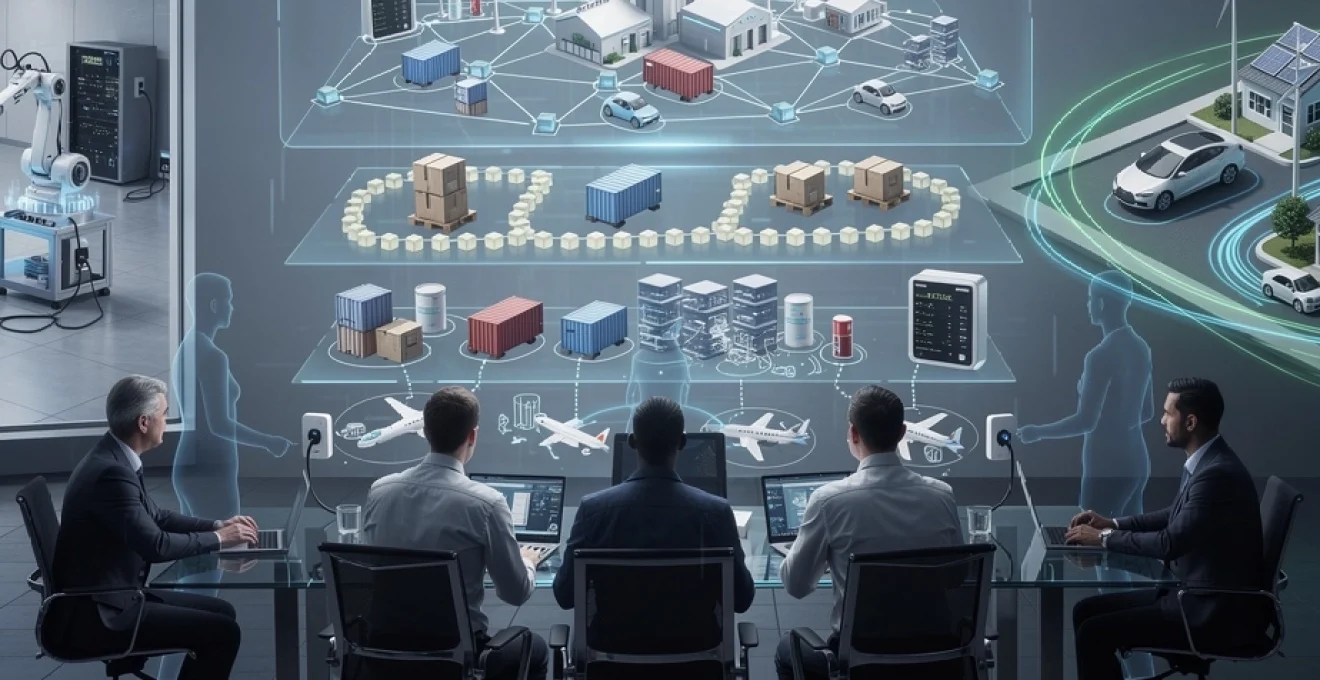
Industrial ecosystems are undergoing a profound transformation as decentralized computing architectures challenge traditional centralized models. Manufacturing facilities, energy grids, and supply chains once dependent on monolithic data centres now embrace distributed systems that process information closer to its source. This paradigm shift addresses critical limitations: latency bottlenecks that hinder real-time decision-making, single points of failure that jeopardize operational continuity, and scalability constraints that stifle innovation. Decentralized computing distributes processing power, data storage, and decision-making authority across networks of autonomous nodes, creating resilient systems capable of adapting to the demands of Industry 4.0 and the emerging Fifth Industrial Revolution. The convergence of edge computing, blockchain technology, federated learning, and distributed identity management is redefining how industrial organizations orchestrate production, manage assets, and collaborate across value chains.
Edge computing architecture transforming manufacturing and supply chain operations
Edge computing represents a fundamental departure from the cloud-centric model that has dominated enterprise IT infrastructure for the past decade. Rather than transmitting raw sensor data to distant data centres for processing, edge architectures deploy computational resources at or near the physical locations where data originates. In manufacturing environments, this means installing processing nodes on factory floors, within production equipment, and at distribution centres. The benefits are substantial: reduced network latency enables real-time process adjustments, bandwidth optimization lowers operational costs, and enhanced data privacy keeps sensitive production information within organizational boundaries. According to IDC research, global spending on edge computing infrastructure reached $317 billion in 2023, with industrial applications accounting for nearly 40% of this investment. Manufacturers implementing edge solutions report response time improvements of 80-95% compared to cloud-based alternatives, a critical advantage when milliseconds determine product quality or worker safety.
Siemens MindSphere and GE predix: industrial IoT platforms driving distributed processing
Industrial Internet of Things platforms from established manufacturers have accelerated edge computing adoption by providing integrated hardware and software ecosystems. Siemens MindSphere operates as a cloud-based yet edge-enabled platform that connects devices, applications, and analytics tools through a standardized framework. The architecture supports distributed edge gateways that pre-process data from programmable logic controllers, sensors, and actuators before transmitting aggregated insights to centralized analytics engines. GE Predix similarly employs edge computing nodes within industrial equipment to run containerized applications that monitor asset health, predict maintenance requirements, and optimize operational parameters. These platforms demonstrate how legacy industrial equipment manufacturers are evolving into software-defined infrastructure providers, offering customers the ability to deploy custom analytics at the edge while maintaining centralized visibility and control. The hybrid model balances local autonomy with enterprise-wide coordination, addressing the reality that industrial environments require both immediate responsiveness and strategic oversight.
Real-time data processing at factory floor level through fog computing nodes
Fog computing extends edge computing concepts by creating hierarchical processing layers between IoT devices and cloud infrastructure. On factory floors, fog nodes aggregate data from dozens or hundreds of sensors, execute preliminary analytics, and route results based on predefined rules. A typical automotive assembly line might generate 2-3 terabytes of data per shift from vision systems, torque sensors, and quality control stations. Processing this volume centrally would create network congestion and introduce unacceptable delays. Fog architecture instead performs anomaly detection and quality assurance checks locally, flagging defects in milliseconds while transmitting only summary statistics and exception reports to enterprise systems. This tiered approach reduces bandwidth consumption by 85-90% while enabling split-second adjustments that prevent defects from propagating through production sequences. Cisco estimates that fog computing implementations in manufacturing settings deliver return on investment within 18-24 months through reduced scrap rates, improved equipment utilization, and lower network infrastructure costs.
Kubernetes and docker container orchestration in production environments
Container orchestration technologies originally developed for cloud data centres have proven equally valuable in edge computing deployments. Kubernetes provides a standardized framework for deploying, scaling, and managing containerized applications across distributed infrastructure. In industrial contexts, this means engineers can package analytics algorithms, control logic, and monitoring tools as Docker containers that run consistently on edge gateways, fog nodes
and central cloud environments. Operations teams can roll out updates to machine learning models or control applications across hundreds of sites with the same declarative configuration files they use in the data centre. This reduces the risk of configuration drift between plants and simplifies compliance audits, since software versions and runtime parameters are consistently managed. As GitOps practices spread into operations technology (OT), many manufacturers now treat factory-floor infrastructure as code, enabling rapid experimentation with new analytics services without lengthy commissioning cycles. The result is a more agile industrial ecosystem where decentralized computing resources can be reallocated dynamically in response to changing production demands.
Reduced latency requirements for autonomous robotics and quality control systems
Autonomous mobile robots, collaborative robots (cobots), and AI-enabled vision systems place stringent requirements on latency and determinism that centralized architectures struggle to meet. A robotic arm performing precision assembly may need to respond to force feedback or visual cues in under 10 milliseconds to avoid damaging components or endangering workers. Routing these control loops through distant data centres would introduce unpredictable delays and jitter. By deploying real-time controllers and inference engines directly at the edge, manufacturers ensure that critical decision-making occurs within a tightly controlled local network, with the cloud reserved for fleet-level optimization and historical analysis.
Quality control systems illustrate this dynamic particularly well. High-speed cameras capturing hundreds of frames per second inspect weld seams, surface finishes, or printed codes as products move along conveyors. Edge accelerators such as GPUs or specialized AI chips attached to inspection stations run convolutional neural networks on-device, classifying defects in microseconds. When anomalies are detected, local logic can halt the line, divert products, or adjust upstream parameters without waiting for round-trip communication to a remote server. In this way, decentralized computing becomes less a nice-to-have and more a prerequisite for maintaining yield, safety, and compliance in highly automated environments.
Blockchain-based distributed ledger systems for industrial traceability
While edge and fog computing address real-time control, distributed ledger technologies tackle another chronic challenge in industrial ecosystems: end-to-end traceability and trust among multiple parties. Traditional supply chain management systems rely on siloed databases owned by individual companies, making it difficult to reconcile records, verify provenance, or audit compliance without manual reconciliation. Blockchain-based distributed ledgers provide a shared, tamper-evident record of events spanning raw material extraction through manufacturing, logistics, and after-sales service. For industries where product authenticity, safety, and regulatory reporting are non-negotiable, decentralized computing in the form of blockchain offers a powerful foundation for collaborative data sharing.
Hyperledger fabric and ethereum enterprise alliance in supply chain management
Enterprise-focused blockchain frameworks such as Hyperledger Fabric and consortiums associated with the Enterprise Ethereum Alliance have become the de facto building blocks for industrial traceability projects. Hyperledger Fabric’s modular design allows organizations to define permissioned networks where only vetted participants can validate transactions, a key requirement for sectors that must comply with strict confidentiality obligations. Its channel mechanism lets sub-groups share sensitive data privately while still anchoring proofs of activity to a common ledger, balancing transparency with business secrecy. Fabric-based networks have been deployed in food safety, automotive parts, and commodity trading to synchronize records across manufacturers, logistics providers, and regulators.
Enterprise Ethereum variants, by contrast, bring smart contract flexibility and interoperability with the broader Ethereum ecosystem while adding permissioning layers suitable for corporate use. Members of the Enterprise Ethereum Alliance experiment with private chains that can anchor hashes or checkpoints to public Ethereum for additional security guarantees. In practice, many industrial consortia adopt a hybrid approach: a permissioned base for high-throughput transaction processing and selective anchoring to public networks for auditability. Regardless of the specific stack, the common pattern is clear: distributed ledgers act as the single source of truth across complex industrial ecosystems without forcing any one company to cede control to a central platform provider.
Smart contracts automating quality assurance and compliance verification
Smart contracts extend distributed ledgers beyond passive record-keeping into active process automation. In supply chain quality assurance, smart contracts encode business rules such as acceptable temperature ranges for refrigerated goods, inspection intervals for safety-critical components, or required certifications for suppliers. As IoT devices, inspection systems, and enterprise resource planning (ERP) platforms submit data to the ledger, smart contracts automatically evaluate compliance against these predefined thresholds. Non-compliant events can trigger alerts, block further processing, or even initiate warranty claims without human intervention.
Consider a pharmaceutical cold chain application where temperature sensors within shipping containers stream data to a blockchain network. If a shipment exceeds the allowable temperature excursion for a specified duration, the smart contract can mark affected batches as quarantined, notify both shipper and receiver, and generate an immutable incident report for regulators. This reduces disputes over liability by providing a shared, time-stamped record and ensures that non-conforming products do not enter downstream production or retail channels. By embedding such rules directly into decentralized computing infrastructure, organizations reduce manual paperwork and increase confidence that quality and compliance obligations are consistently enforced.
Provenance tracking for pharmaceutical and aerospace component manufacturing
In high-stakes sectors like pharmaceuticals and aerospace, provenance tracking is more than a supply chain optimization; it is a regulatory and safety imperative. Counterfeit drugs are estimated by the World Health Organization to represent up to 10% of medicines in low- and middle-income countries, while undocumented modifications to aerospace components can have catastrophic consequences. Blockchain-based provenance systems record each transformation step, from active ingredient synthesis to final packaging, or from raw alloy casting to finished turbine blade installation. Each event—such as batch mixing, quality testing, or maintenance inspection—is logged with cryptographic signatures that tie actions to responsible parties.
When combined with serialized identifiers and IoT-enabled packaging, these ledgers allow stakeholders to verify the authenticity and history of any given unit within seconds. For example, a maintenance engineer scanning a part’s QR code at an airline hangar can retrieve a complete lifecycle record: manufacturing plant, lot number, process parameters, inspection outcomes, and prior installation history. If a defect is discovered in a specific batch, the ledger makes targeted recalls far more precise, reducing waste and customer disruption. Here again, decentralized computing acts as a neutral coordination layer across competing organizations that nonetheless share a common interest in safety and compliance.
Consensus mechanisms: proof of authority versus byzantine fault tolerance
Industrial blockchain networks must reconcile two competing priorities: strong consistency and high throughput on the one hand, and resilience to faulty or malicious nodes on the other. Public cryptocurrencies rely on open, permissionless consensus mechanisms like Proof of Work, which are ill-suited to enterprise environments due to their energy consumption and probabilistic finality. Instead, many industrial consortia adopt Proof of Authority (PoA) schemes, where a limited set of known validators—often large manufacturers, logistics firms, or auditors—propose and validate blocks. PoA offers low-latency confirmation and predictable performance, but requires governance structures to determine who can join the validator set and how misbehaving participants are sanctioned.
Other deployments opt for Byzantine Fault Tolerant (BFT) consensus algorithms such as Tendermint or Practical Byzantine Fault Tolerance (PBFT). These protocols guarantee agreement as long as fewer than one-third of validators act maliciously or fail, providing strong guarantees for mission-critical use cases. The trade-off is scalability: BFT algorithms typically support dozens of validators rather than hundreds or thousands. Selecting a consensus mechanism thus becomes a strategic design decision, reflecting the trust model of the ecosystem and the acceptable balance between decentralization, performance, and governance complexity.
Peer-to-peer energy trading networks in smart grid infrastructure
Energy systems are undergoing a decentralization wave analogous to that seen in manufacturing IT. The rise of rooftop solar, battery storage, electric vehicles, and microgrids transforms formerly passive consumers into active “prosumers” capable of generating, storing, and trading electricity. Traditional grid architectures, optimized for one-way power flows from centralized plants to end users, struggle to manage this bidirectional complexity. Peer-to-peer energy trading platforms built on decentralized computing allow households, businesses, and communities to transact energy locally, price flexibility services, and relieve stress on central infrastructure. In doing so, they complement utility-scale operations with more granular, market-driven coordination at the grid edge.
LO3 energy brooklyn microgrid and power ledger marketplace implementations
Early demonstrations such as LO3 Energy’s Brooklyn Microgrid showcased how blockchain-based marketplaces can enable neighbours to trade excess solar energy within a localized network. Smart meters and solar inverters feed generation and consumption data into a distributed ledger, where a matching engine clears buy and sell orders based on pre-agreed tariffs or dynamic pricing schemes. Participants can specify preferences—for instance, prioritizing locally produced renewable energy over grid power—and have those preferences enforced automatically via smart contracts. Although regulatory constraints have limited full commercialization in some regions, the technical feasibility of such peer-to-peer energy trading has been convincingly established.
Australian-based Power Ledger has taken a similar approach, piloting decentralized energy marketplaces in multiple countries. Its platform supports not only peer-to-peer trading, but also services such as virtual power plants, carbon credit tracking, and electric vehicle charging optimization. By abstracting grid constraints and regulatory rules into software, these systems allow a wide range of actors to participate in energy markets without needing to interface directly with complex utility back-ends. The common denominator in these initiatives is the use of distributed ledgers to create transparent, auditable settlement layers that multiple stakeholders can trust.
Distributed energy resources management through decentralised control systems
Beyond trading, decentralized computing is reshaping how distributed energy resources (DERs)—solar arrays, batteries, smart inverters, and controllable loads—are coordinated at scale. Traditional centralized control systems face scalability and resilience challenges when orchestrating thousands of devices across diverse locations. In contrast, decentralized DER management architectures push intelligence to the edge, allowing local controllers to respond autonomously to voltage fluctuations, frequency deviations, or price signals. Higher-level aggregators then coordinate fleets of resources to provide grid services such as frequency regulation or peak shaving.
This multi-layered control structure resembles the fog computing patterns seen in manufacturing: local autonomy for fast reaction, with supervisory optimization running at regional or national levels. Agents embedded in home energy management systems or industrial microgrids can negotiate setpoints and schedules using distributed protocols, balancing user comfort, asset longevity, and market revenue. For utilities and grid operators, this paradigm offers a more scalable way to integrate high penetrations of renewables while maintaining stability and reliability.
Vehicle-to-grid integration using distributed computing protocols
Electric vehicles (EVs) add another layer of complexity and opportunity to decentralized energy ecosystems. As mobile batteries, EVs can either strain the grid when charging coincidentally or support it by discharging during peak demand. Coordinating these behaviours requires fine-grained, near-real-time communication between vehicles, charging infrastructure, and grid management systems. Distributed computing protocols enable EVs to act as autonomous agents that respond to local constraints and market incentives without constant central oversight.
Vehicle-to-grid (V2G) pilots demonstrate how EVs can participate in ancillary services markets, providing frequency response or reserve capacity. Each vehicle’s onboard controller can assess battery state-of-charge, driver preferences, and grid conditions to decide whether to charge, idle, or discharge. Secure, decentralized identity and payment mechanisms ensure that energy delivered back to the grid is accurately metered and compensated. As EV adoption accelerates, the ability to treat millions of vehicles as a coordinated but decentralized resource could become a cornerstone of smart grid resilience.
Federated learning and distributed AI training across industrial datasets
Data has become a strategic asset in industrial ecosystems, underpinning predictive maintenance, process optimization, and quality analytics. Yet aggregating data from multiple organizations into a single warehouse often proves impractical or undesirable due to privacy regulations, intellectual property concerns, and bandwidth constraints. Federated learning offers a decentralized alternative: rather than moving data to a central model, the model is sent to where the data resides. Each participant trains locally, and only model updates—not raw data—are shared for aggregation. This approach aligns well with the collaborative yet competitive nature of many industrial consortia.
Privacy-preserving machine learning for collaborative predictive maintenance
Predictive maintenance provides a compelling use case for federated learning in manufacturing and process industries. Equipment vendors, operators, and service providers all hold partial, complementary datasets: sensor readings from installed assets, maintenance logs, failure reports, and environmental conditions. Sharing these raw datasets wholesale could expose sensitive operational details or customer identities. With federated learning, a joint model for failure prediction can be trained across many sites without any party relinquishing control over its underlying data.
For example, wind turbine operators across different regions could collaboratively improve a model that predicts gearbox failures under various load and weather conditions. Each operator trains the model on its local fleet data and sends encrypted gradients or parameter updates to a central aggregator or decentralized coordination service. The aggregated model is then redistributed to all participants, improving prediction accuracy for everyone. This allows industrial ecosystems to unlock network effects from collective data without undermining competitive differentiation or regulatory compliance.
Tensorflow federated and PySyft frameworks in cross-organisational analytics
Open-source frameworks such as TensorFlow Federated and PySyft have lowered the barrier for implementing federated learning in real-world industrial contexts. TensorFlow Federated extends the familiar TensorFlow API with constructs for defining federated computations, simulating large-scale deployments, and integrating with secure aggregation protocols. PySyft, by contrast, emphasizes privacy-preserving techniques such as secure multi-party computation and homomorphic encryption, enabling more advanced threat models where even model updates must remain confidential.
Industrial analytics teams can use these tools to prototype cross-organizational models in sandboxes before deploying them to production environments, often in conjunction with container orchestration platforms at the edge. Because many industrial firms already use Python-based data science stacks, adopting these federated learning frameworks typically aligns well with existing skill sets. As standards mature, we can expect to see more plug-and-play integrations between industrial IoT platforms, MES/SCADA systems, and federated learning pipelines.
Model aggregation techniques without centralised data repository access
At the heart of federated learning lies the model aggregation process, which must combine updates from many participants into a coherent global model. Simple approaches such as Federated Averaging (FedAvg) compute a weighted average of local parameters based on data volume or other factors. While effective in many scenarios, industrial datasets often exhibit non-identically distributed (non-IID) characteristics, with different plants or fleets experiencing distinct operating regimes. More advanced aggregation strategies account for these heterogeneities by clustering participants, personalizing subsets of the model, or adaptively re-weighting contributions.
In decentralized industrial settings, aggregation may itself be distributed rather than centralized. Peer-to-peer protocols can propagate model updates across a network of participants, gradually converging towards a consensus model without any single coordinating server. Blockchain-based coordination layers have also been proposed, where model updates are treated as transactions and aggregation logic is encoded in smart contracts. These patterns further blur the line between traditional centralized AI training and fully decentralized computing architectures.
Differential privacy implementation in distributed neural network training
Even when raw data never leaves a site, model updates can inadvertently leak information about underlying datasets. Differential privacy techniques mitigate this risk by adding carefully calibrated noise to gradients or parameters, ensuring that the presence or absence of any single data point does not significantly influence the final model. For industrial ecosystems sharing models across competitors or sensitive critical infrastructure operators, such guarantees are essential.
Implementing differential privacy in federated learning involves trade-offs between privacy budgets and model accuracy. Too much noise degrades performance, while too little undermines confidentiality. Frameworks like TensorFlow Privacy provide building blocks for differential privacy-aware optimizers, enabling data scientists to tune these trade-offs explicitly. When combined with secure aggregation—where individual updates are encrypted and only their aggregate is revealed—industrial consortia can collaborate on AI models with strong technical assurances that proprietary data remains protected.
Decentralised identity management for industrial internet of things devices
As industrial ecosystems proliferate connected devices—from sensors and actuators to robots and autonomous vehicles—managing their identities securely becomes a foundational challenge. Traditional approaches rely on centralized public key infrastructures and device registries, which can become bottlenecks or single points of failure. Decentralized identity management applies principles from self-sovereign identity and blockchain to give devices, organizations, and even software agents verifiable, portable identities. This shift reduces dependence on any one vendor or platform operator and facilitates secure, cross-domain interoperability.
Self-sovereign identity protocols using W3C decentralised identifiers
The W3C Decentralized Identifiers (DIDs) standard provides a foundational building block for self-sovereign identity in industrial IoT. A DID is a globally unique identifier that resolves to a DID Document containing public keys, service endpoints, and metadata, all under the control of the entity it represents. For devices, this means identity can be established and rotated without relying on centralized certificate authorities. DID methods backed by distributed ledgers, distributed hash tables, or other decentralized infrastructures ensure that identifiers remain resolvable even if individual organizations change or exit the ecosystem.
In practice, a manufacturer might provision each new machine with a DID at the time of production. As the asset moves through distributors, integrators, and end customers, its DID-based identity and associated credentials can persist, simplifying onboarding into new environments. Because the DID framework is technology-agnostic, it can bridge proprietary device management platforms, enabling heterogeneous fleets to authenticate and interact securely across organizational boundaries.
Zero-knowledge proof authentication for machine-to-machine communication
Authentication is critical for machine-to-machine communication, but traditional schemes often require revealing extensive identity details or relying on shared secrets that are difficult to manage at scale. Zero-knowledge proofs (ZKPs) offer an alternative: they allow one party to prove possession of certain attributes or credentials to another without disclosing the underlying data. In industrial settings, a robot could prove it is certified to operate in a hazardous zone, or a sensor could prove it was calibrated by an accredited lab, without exposing sensitive configuration details.
Integrating ZKP-based authentication into decentralized identity frameworks enhances privacy and reduces attack surfaces. For example, devices can participate in access control decisions based on attributes such as manufacturer, firmware version, or security posture, proven via ZKPs and verified against decentralized registries. This is particularly valuable in multi-vendor plants or collaborative logistics networks, where you may not want to share full device inventories with partners but still need to enforce strict security policies.
Verifiable credentials in asset lifecycle management systems
Verifiable Credentials (VCs), another W3C standard, build on DIDs to represent attestations such as conformity assessments, maintenance records, or operator certifications. Issuers—like OEMs, inspection bodies, or regulators—digitally sign credentials that subjects (devices, assets, or people) can present to verifiers. Because VCs are cryptographically verifiable and tamper-evident, they provide a trustworthy substrate for asset lifecycle management in decentralized ecosystems.
Imagine an industrial pump whose entire history is expressed as a chain of VCs: factory acceptance tests, installation reports, vibration analyses, seal replacements, and decommissioning. Each event is issued by a distinct actor but bound to the pump’s DID. When the asset is resold or audited, stakeholders can validate its history without phoning prior owners or sifting through paper records. Coupled with decentralized storage and access control, this model reduces administrative overhead and improves confidence in asset data integrity across the value chain.
Resilience and fault tolerance through distributed system architectures
Industrial ecosystems operate in environments where downtime carries substantial financial, safety, and environmental costs. Decentralized computing architectures inherently promote resilience by avoiding single points of failure and distributing workloads across multiple nodes and regions. Yet designing these systems requires a clear understanding of trade-offs between consistency, availability, and partition tolerance, as well as robust mechanisms for handling faulty or malicious components. As industrial operations digitize and interconnect, resilience considerations move from the domain of IT specialists into the core of operational strategy.
Byzantine fault tolerant consensus for critical infrastructure control
Critical infrastructure such as power grids, pipelines, and transportation networks must continue operating correctly even when some components behave unpredictably due to software bugs, hardware faults, or cyberattacks. Byzantine Fault Tolerant (BFT) consensus protocols provide formal guarantees that a distributed system can agree on actions or state updates as long as the proportion of faulty nodes remains below a defined threshold. In control systems, BFT algorithms can coordinate redundant controllers or substations, ensuring that rogue or compromised nodes cannot unilaterally trigger unsafe actions.
Although BFT protocols were once dismissed as too resource-intensive for real-time control, advances in hardware and algorithm design have made them increasingly practical. Hybrid approaches combine BFT consensus for critical decision points—such as switching configurations or protection settings—with lighter-weight coordination for routine telemetry. By embedding these consensus mechanisms into industrial control platforms, operators gain higher assurance that no single compromised component can jeopardize the entire system.
CAP theorem trade-offs in industrial process control networks
The CAP theorem, originally formulated for distributed databases, has practical implications for industrial process control networks as well. It states that in the presence of network partitions, a distributed system must choose between strict consistency and availability. For safety-critical loops, local availability often takes precedence: equipment must continue operating safely even if connectivity to central systems is lost. This drives architectures where local controllers maintain authoritative state for immediate control decisions, while higher-level systems reconcile and optimize when communication is restored.
Designers of decentralized industrial systems therefore segment functions according to their tolerance for temporary inconsistency. Production reporting and KPI dashboards can accept eventual consistency, while emergency shutdown logic cannot. Edge computing, local historians, and peer-to-peer coordination within a cell or line all contribute to maintaining acceptable performance when central resources are unreachable. Understanding these CAP trade-offs helps architects avoid unrealistic expectations and design failure modes that are graceful rather than catastrophic.
Multi-region data replication strategies using apache cassandra and CockroachDB
For higher-level industrial applications—such as manufacturing execution systems, asset performance management platforms, or supply chain visibility dashboards—geo-distributed databases play a key role in achieving resilience and low-latency access. Systems like Apache Cassandra and CockroachDB are designed for multi-region replication, allowing data to be stored redundantly across data centres and edge sites. Cassandra’s masterless architecture and tunable consistency let operators choose read and write quorum settings that balance latency against consistency guarantees, a useful capability when supporting plants in different time zones or connectivity conditions.
CockroachDB, inspired by Google Spanner, offers strongly consistent, SQL-compatible storage with automatic sharding and replication across clusters. For industrial ecosystems, this means applications can continue serving local users even if a region experiences outages, with automatic failover and recovery once connectivity returns. Combined with container orchestration and edge gateways, these databases form the backbone of decentralized information systems that remain operational in the face of hardware failures, network disruptions, or even natural disasters. In a world where industrial operations increasingly depend on digital infrastructure, such distributed architectures are becoming indispensable.