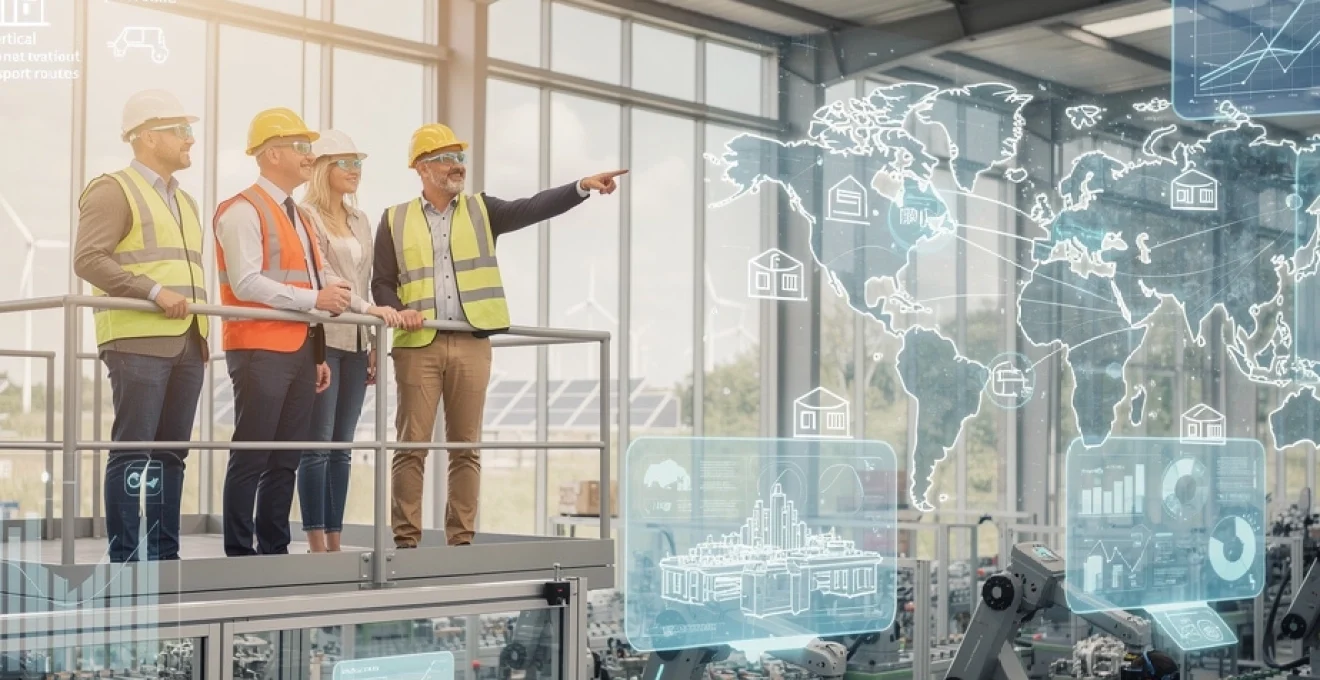
Industrial companies today face an unprecedented convergence of challenges that test their operational foundations and strategic vision. From supply chain disruptions and geopolitical tensions to rapid technological shifts and climate-related risks, the manufacturing landscape has become a complex web of interconnected vulnerabilities. The companies that not only survive but thrive in these turbulent conditions share certain fundamental characteristics that extend far beyond traditional risk management approaches.
True resilience in industrial settings emerges from a comprehensive approach that weaves together strategic diversification, operational flexibility, technological innovation, and human capital development. These organisations understand that resilience isn’t merely about weathering storms—it’s about building adaptive capacity that transforms challenges into competitive advantages. The most successful industrial companies have learned to view uncertainty not as a threat to be minimised, but as a constant that requires systematic preparation and strategic response capabilities.
Modern industrial resilience demands a fundamental shift from reactive crisis management to proactive capability building. This transformation requires companies to reimagine their operational models, investment priorities, and organisational structures in ways that enhance both stability and agility simultaneously.
Strategic diversification models for manufacturing portfolio resilience
Strategic diversification represents one of the most powerful tools for building industrial resilience, but it requires sophisticated planning to avoid the trap of unfocused expansion. Companies that successfully implement diversification strategies understand that spreading risk across multiple dimensions—markets, products, geographies, and customer segments—creates a robust foundation that can withstand sector-specific downturns while capitalising on growth opportunities in different areas.
Horizontal integration strategies across adjacent market segments
Horizontal integration allows industrial companies to leverage existing capabilities whilst expanding into related market segments that share similar manufacturing processes, customer bases, or distribution channels. This approach reduces the risk associated with single-market exposure whilst maximising the utilisation of existing assets and expertise. Companies pursuing this strategy often find that their manufacturing processes, quality systems, and supplier relationships can be adapted to serve multiple adjacent markets with relatively modest additional investment.
The key to successful horizontal integration lies in identifying market segments that complement rather than compete with existing operations. For instance, a company manufacturing automotive components might expand into aerospace or industrial machinery components, leveraging similar precision manufacturing capabilities whilst accessing different customer cycles and demand patterns. This diversification provides natural hedging against industry-specific downturns whilst creating opportunities for cross-pollination of technologies and best practices.
Vertical supply chain integration through backward and forward linkages
Vertical integration strategies enable industrial companies to gain greater control over their value chains whilst reducing dependency on external suppliers and distributors. Backward integration involves acquiring or developing capabilities in upstream activities such as raw material processing or component manufacturing, whilst forward integration extends control into downstream activities like distribution, assembly, or end-user services.
Vertical integration creates strategic flexibility by allowing companies to adjust internal transfer prices, prioritise internal capacity allocation, and maintain better quality control throughout the value chain.
The decision to pursue vertical integration must be balanced against the capital requirements and management complexity it introduces. Companies that successfully implement vertical integration strategies typically focus on activities that are either critical to their competitive advantage or represent significant cost centres where internal control can generate substantial savings. This approach also provides valuable market intelligence and customer insights that can inform product development and strategic planning decisions.
Geographic market diversification risk mitigation frameworks
Geographic diversification spreads operational and market risks across multiple regions, currencies, and regulatory environments, creating natural hedges against localised economic downturns, political instability, or natural disasters. Companies implementing geographic diversification must carefully evaluate market entry strategies, regulatory requirements, and operational complexities associated with different regions whilst building the management capabilities necessary to coordinate dispersed operations effectively.
Successful geographic diversification requires a nuanced understanding of local market conditions, customer preferences, and business practices in target regions. Companies must also consider the implications of operating across multiple time zones, currencies, and regulatory frameworks, which can significantly increase operational complexity. However, the benefits of geographic diversification extend beyond risk mitigation to include access to new growth markets, proximity to key customers, and opportunities to tap into regional talent pools and innovation ecosystems.
Product line extension methodologies for cyclical demand buffering
Product line extension strategies enable industrial companies to smooth revenue fluctuations by offering complementary products that experience different demand cycles
Product line extension strategies enable industrial companies to smooth revenue fluctuations by offering complementary products that experience different demand cycles. Rather than relying on a narrow range of SKUs tied to a single economic indicator, resilient manufacturers design portfolios where products peak at different times, across maintenance, upgrade, and new-build cycles. This might include adding aftermarket services, modular upgrade kits, or lower-spec variants that appeal to cost-conscious buyers in downturns. By intentionally mapping products against customer maturity, capex budgets, and replacement cycles, companies can construct a portfolio that behaves more like a balanced investment fund than a single volatile stock.
Implementing effective product line extensions starts with robust customer and market analysis. Which pain points remain unresolved across the lifecycle of your equipment? Where are customers forced to buy from competitors or improvise in-house solutions? Answering these questions helps you identify adjacent offerings that leverage existing engineering and production capabilities while opening up recurring revenue streams. In practice, this often means expanding into services, digital add-ons, or standardised options rather than completely new product families, keeping complexity manageable while still boosting resilience.
Supply chain redundancy engineering and risk mitigation protocols
Supply chain fragility has become one of the defining constraints on industrial resilience. Disruptions linked to pandemics, geopolitical tensions, extreme weather, and transport bottlenecks have shown how quickly single-source or single-region dependencies can bring production to a standstill. Resilient industrial companies treat supply chain design as an engineering discipline in its own right, applying structured redundancy, scenario planning, and continuous monitoring to reduce both the frequency and impact of disruptions. The goal is not to eliminate risk entirely but to ensure that when disruptions occur, operations can adapt rather than collapse.
Designing a resilient industrial supply chain requires balancing efficiency with robustness. Lean, just-in-time models that ignore risk exposure may look cost-effective on paper but can prove fragile when confronted with real-world shocks. By contrast, a well-engineered redundancy strategy integrates multi-sourcing, geographic diversification, smart inventory buffers, and logistics flexibility into a cohesive risk mitigation framework. As we have seen since 2020, companies that invested early in such capabilities were able to protect customer commitments and even gain market share while competitors struggled to deliver.
Multi-sourcing supplier network architecture design
Multi-sourcing is one of the most straightforward yet underused levers for industrial resilience. Instead of relying on a single supplier for critical inputs, resilient manufacturers build structured supplier networks with at least two qualified sources for strategically important materials and components. This approach mitigates the risk of operational disruption, supplier insolvency, or geo-political shock impacting a single region. Well-designed networks also create healthy competitive tension, helping to stabilise pricing and service levels over time.
However, simply adding more suppliers does not automatically translate into resilience. Industrial companies need clear criteria for categorising components by criticality and setting appropriate redundancy levels. For high-impact, hard-to-substitute items, dual or triple sourcing with pre-approved technical equivalence and interchangeable tooling may be warranted. For lower-impact items, a primary and backup supplier with pre-negotiated emergency capacity can be sufficient. The most resilient manufacturers document these architectures in their ERP and sourcing systems, enabling procurement teams to switch volumes quickly when early warning indicators trigger.
Near-shoring and reshoring strategic implementation models
Near-shoring and reshoring are becoming central to industrial resilience strategies as companies reassess the true cost of extended global supply chains. Rising freight rates, tariff volatility, and geopolitical tensions have eroded many of the labour-cost advantages associated with distant low-cost regions. By bringing production closer to end markets or consolidating critical steps within stable trade blocs, manufacturers can reduce lead times, lower transport risk, and improve responsiveness to demand fluctuations. This geographic rebalancing does not mean abandoning globalisation but rather configuring it more intelligently.
Implementing near-shoring or reshoring requires more than relocating a factory on paper. Companies must evaluate total landed cost, including logistics, inventory holding, quality, and risk factors—not just unit labour costs. They also need to consider workforce availability, infrastructure quality, energy costs, and regulatory frameworks in candidate locations. Many resilient industrial firms adopt hybrid models, maintaining some global sourcing for cost-sensitive, non-critical parts while near-shoring or reshoring high-value, time-critical components. Pilot plants, phased transitions, and co-investment with strategic suppliers can help de-risk these moves while building organisational learning.
Critical component inventory buffer optimisation techniques
Inventory has traditionally been treated as a cost to be minimised, but in uncertain times, well-calibrated buffers become strategic assets. The challenge is to design inventory policies that provide protection against supply and demand variability without tying up excessive working capital. For industrial companies with long lead times and complex bills of materials, this often means distinguishing clearly between generic items and truly critical components whose absence would halt production or jeopardise key customer contracts. These critical components warrant more sophisticated buffering strategies.
Leading manufacturers are using advanced analytics and probabilistic modelling to optimise inventory buffers. Instead of simple days-of-supply rules, they model variation in supplier performance, transport reliability, and demand volatility at the SKU and plant level. Techniques such as safety stock optimisation, decoupling inventory at strategic nodes, and using postponement strategies (delaying final configuration to later in the process) can significantly increase resilience without proportionally increasing stock levels. When paired with improved demand sensing and supplier collaboration, these methods allow you to hold inventory where it creates the most resilience for the least cost.
Supplier financial health monitoring and early warning systems
Financial fragility among suppliers is an often-overlooked threat to industrial resilience. A technically capable supplier with excellent quality can still fail if its balance sheet cannot absorb shocks such as energy price spikes, currency swings, or demand downturns. Resilient companies therefore implement systematic supplier financial health monitoring, combining public data, credit ratings, and behavioural indicators such as delayed deliveries or unusual price requests. The aim is to detect early signs of stress before they escalate into supply failures.
Practical early warning systems typically involve a combination of automated dashboards and regular human review. Category managers and procurement leaders track metrics like days payable outstanding, changes in ownership, and audit findings, while also maintaining close relational contact with key suppliers. In some cases, manufacturers may respond to emerging risks by increasing buffer stocks temporarily, shifting volume to alternative suppliers, or even providing targeted support such as advance payments or joint investments. This proactive stance transforms supplier management from a transactional function into a core risk management capability.
Alternative transportation route mapping for logistics continuity
Even with strong supplier networks and inventory strategies, logistics disruptions can derail production. Port closures, rail strikes, extreme weather, and regulatory changes can all limit access to key markets or components. Resilient industrial companies therefore treat logistics routes as critical infrastructure that must be mapped, assessed, and backed up. Rather than relying on a default port or a single carrier, they identify and validate alternative routes and modes (sea, air, rail, road) that can be activated quickly when primary pathways are compromised.
This kind of logistics continuity planning benefits from close collaboration with freight forwarders and logistics partners. Scenario planning exercises—what happens if our main port is closed for 30 days?—help identify weak points and prioritise investments. Some companies negotiate framework agreements with multiple carriers, including pre-agreed surge capacity, while others diversify their distribution centres to reduce dependence on any single hub. By treating logistics like an electrical grid, with built-in redundancy and failover options, industrial manufacturers can maintain customer service levels even when external conditions become highly unstable.
Digital transformation infrastructure for operational agility
Digital transformation has moved from strategic option to operational necessity for industrial companies seeking resilience in uncertain times. When markets, supply chains, and regulations are shifting rapidly, analogue processes and delayed reporting leave leaders flying blind. By contrast, a robust digital infrastructure provides real-time visibility into production, quality, inventory, and demand, enabling faster, better-informed decisions. The most resilient manufacturers are not simply installing isolated technologies—they are building integrated digital ecosystems that support end-to-end agility.
This transformation is not about technology for its own sake. It is about equipping industrial organisations with the tools and data needed to sense disruptions early, simulate responses, and execute changes with minimal friction. Integrated industrial IoT, predictive analytics, ERP, and digital twin platforms allow companies to move from reactive firefighting to proactive optimisation. As a result, they can adapt production schedules, re-route orders, and reconfigure lines in days or even hours rather than weeks, turning operational flexibility into a sustained competitive advantage.
Industrial IoT sensor networks for real-time production monitoring
Industrial IoT (IIoT) sensor networks form the nervous system of a modern resilient factory. By instrumenting machines, lines, utilities, and environmental conditions with connected sensors, manufacturers gain continuous insight into status, performance, and anomalies. This real-time data allows them to detect issues such as equipment drift, quality deviations, or bottlenecks before they escalate into downtime or scrap. In an uncertain environment, where supply and demand can shift overnight, such visibility is essential for dynamic decision-making.
Effective IIoT implementation goes beyond simply installing sensors. Companies must define clear data architectures, standardise communication protocols, and integrate sensor data with MES, SCADA, and ERP systems. Edge computing can process critical signals close to the source, reducing latency and bandwidth requirements, while cloud platforms support broader analytics and cross-site benchmarking. When executed well, an IIoT-enabled plant can answer questions like, “Which line can absorb this urgent order without jeopardising current commitments?” or “Where are we at highest risk of quality escapes today?”, empowering both operators and managers.
Predictive maintenance algorithms using machine learning analytics
Predictive maintenance represents one of the most tangible ways digital transformation enhances industrial resilience. Instead of reacting to breakdowns or relying on rigid time-based maintenance that may under- or over-service equipment, predictive models use machine learning to forecast when components are likely to fail. By analysing patterns in vibration, temperature, energy consumption, and other signals, these algorithms can identify early warning signs that are invisible to the naked eye. The result is reduced unplanned downtime, lower maintenance costs, and greater confidence in meeting delivery commitments.
Implementing predictive maintenance requires a structured approach to data collection, labelling, and model deployment. Companies need historical failure and maintenance records, sensor data streams, and domain expertise to interpret patterns correctly. Many start with a pilot on a critical asset class—such as compressors, CNC machines, or furnaces—before scaling successful models across sites. When integrated with work order systems and spare parts management, predictive maintenance allows planners to schedule interventions during natural lulls, align them with material availability, and avoid costly last-minute disruptions.
ERP system integration with advanced planning and scheduling modules
Enterprise Resource Planning (ERP) systems sit at the heart of most industrial organisations, but traditional deployments often struggle to support real-time agility. Resilient manufacturers are closing this gap by integrating ERP with advanced planning and scheduling (APS) modules that use optimisation algorithms to balance capacity, materials, and demand. When production plans can be recalculated in minutes rather than days, companies are better equipped to respond to rush orders, supply delays, or sudden demand drops without resorting to blanket overtime or costly rescheduling.
APS systems consider multiple constraints simultaneously—machine availability, changeover times, labour skills, and material arrival dates—to generate feasible, optimised schedules. When linked tightly with shop-floor data from MES and IIoT, these tools can continuously adjust to reality rather than operating on outdated assumptions. From a resilience perspective, this capability functions like a “financial sensing instrument” for operations, turning every planning cycle into a test of current assumptions about throughput, bottlenecks, and customer priorities. Companies that master this integration gain both higher on-time delivery and greater flexibility in reallocating capacity when conditions change.
Digital twin technology implementation for process optimisation
Digital twins—virtual replicas of physical assets, lines, or even entire plants—offer a powerful way to improve industrial resilience. By simulating how a process will behave under different conditions, digital twins allow companies to test changes, diagnose problems, and explore “what-if” scenarios without disrupting actual production. This is particularly valuable in uncertain times, when leaders must evaluate options such as new product introductions, alternative materials, or revised shift patterns under tight time pressure.
Developing an effective digital twin requires accurate engineering models, high-quality data, and clear use cases. Some manufacturers start with asset-level twins to optimise energy consumption or cycle times, while others build line-level or plant-level twins to support layout changes and throughput improvements. Over time, these models become living systems that evolve with the factory, continually updated by sensor data and operator feedback. When combined with scenario planning—what happens to our throughput if a key machine is offline for a week?—digital twins provide a safe laboratory for resilience decision-making.
Financial risk management and capital structure optimisation
Operational resilience must be underpinned by financial resilience. Industrial companies with fragile balance sheets, high leverage, or concentrated customer exposures have limited room to manoeuvre when conditions deteriorate. By contrast, those with robust capital structures and disciplined financial risk management can absorb shocks, invest during downturns, and acquire distressed competitors. Studies of past crises have shown that “resilient” companies often emerge stronger not because they avoided difficulty, but because their financial foundations allowed them to keep learning and investing while others were forced into defensive retrenchment.
Optimising capital structure in an uncertain environment involves more than hitting conventional leverage ratios. It requires aligning debt maturities with asset lifecycles, diversifying funding sources, and maintaining sufficient liquidity buffers to weather prolonged disruptions in revenue or working capital. Tools such as scenario-based cash flow modelling, stress tests on covenant compliance, and sensitivity analyses on interest rates and foreign exchange can help CFOs understand where vulnerabilities lie. In parallel, active management of customer credit risk, hedging strategies for key commodities and currencies, and disciplined capital allocation frameworks ensure that scarce capital is deployed where it most enhances long-term resilience.
Workforce adaptability and skills development programmes
No industrial resilience strategy is complete without a focus on people. Technologies, plants, and supply chains can only adapt as quickly as the workforce that operates and manages them. In an era of rapid automation, new materials, and evolving safety and compliance requirements, industrial employees must continuously develop new skills. At the same time, uncertainty places psychological and emotional strain on teams, making cultural resilience as important as technical capability. Companies that invest in workforce adaptability not only reduce operational risk but also improve engagement, retention, and innovation.
Practical workforce resilience begins with cross-skilling and flexible work design. Instead of narrow job roles tied to a single machine or task, resilient manufacturers build teams with overlapping competencies who can cover for one another during absences, demand spikes, or reconfigurations. Formal training programmes, on-the-job learning, and digital learning platforms all play a role, but so do leadership behaviours. Line managers equipped with strong communication and coaching skills can help employees navigate change, understand the rationale behind new processes, and contribute ideas for improvement. As with technical systems, the goal is to move from brittle structures that break under stress to adaptive systems that bend and recover.
Sustainable manufacturing practices as competitive differentiation
Sustainability has shifted from a compliance exercise to a central pillar of industrial competitiveness and resilience. Climate-related risks, resource constraints, and evolving regulations are reshaping operating conditions, while customers and investors increasingly favour manufacturers with credible decarbonisation and circularity strategies. Companies that proactively redesign processes to reduce energy use, emissions, and waste are not only reducing environmental impact—they are also lowering operating costs, securing future access to markets, and insulating themselves from regulatory and reputational shocks.
Resilient industrial companies integrate sustainable manufacturing practices into core decision-making. This includes energy-efficient equipment investments, heat recovery systems, and renewable energy sourcing, as well as material substitution, recycling, and closed-loop logistics. Life-cycle assessments and carbon accounting tools help quantify trade-offs and identify “hot spots” where targeted interventions deliver outsized benefits. In some cases, sustainability initiatives open entirely new revenue streams, such as offering remanufactured products, take-back programmes, or low-carbon product lines that command premium pricing. In a world where uncertainty increasingly stems from environmental and social pressures, sustainability is not just about doing the right thing—it is a strategic lever for building a more resilient, future-ready industrial enterprise.