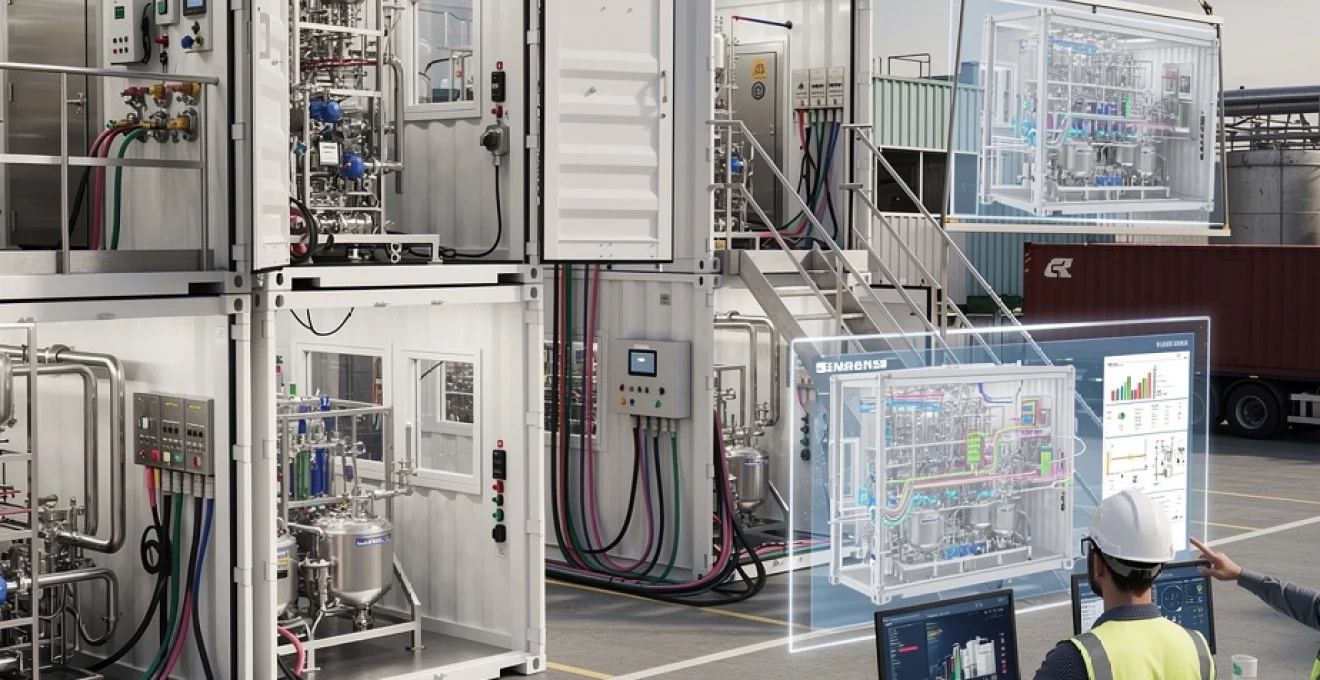
The manufacturing landscape is undergoing a fundamental transformation, driven by market volatility and the imperative for operational agility. Traditional construction methods for industrial facilities—requiring months or even years of on-site fabrication—no longer align with the pace of contemporary business demands. Modular production units have emerged as a strategic response to this challenge, offering manufacturers the ability to scale operations with unprecedented speed whilst maintaining rigorous quality standards. These containerised, pre-fabricated systems represent more than mere convenience; they embody a paradigm shift in how industrial capacity is conceptualised, deployed, and reconfigured. From pharmaceutical manufacturing to chemical processing, organisations are discovering that modular approaches can compress timelines by 40-60% compared to traditional construction, fundamentally altering the economics of expansion and competitive positioning in dynamic markets.
Containerised Skid-Mounted systems: engineering foundations for scalable manufacturing
The technical architecture of modular production units rests upon sophisticated engineering principles that balance portability with industrial-grade performance. At their core, these systems utilise standardised ISO container frameworks as structural foundations, transforming what were once simple transport vessels into fully functional processing environments. This approach leverages decades of refinement in intermodal logistics, ensuring that production capabilities can be mobilised globally with the same efficiency as conventional freight. The fundamental advantage extends beyond mere transportability—standardisation creates reproducibility, allowing manufacturers to deploy proven configurations across multiple sites with confidence in consistent performance outcomes.
Prefabricated process equipment integration in ISO container frameworks
Within the confines of standard 20-foot or 40-foot containers, engineers have achieved remarkable density of functionality. Process equipment—including reactors, separation units, heat exchangers, and control systems—undergoes careful spatial optimisation during the design phase. This prefabrication occurs in controlled factory environments where precision assembly techniques and quality oversight exceed what’s typically achievable on construction sites. The integration process involves sophisticated 3D modelling to ensure equipment accessibility for maintenance whilst maximising productive capacity. Many manufacturers report that containerised units can house 70-80% of the processing capability of traditional built structures occupying three times the footprint, demonstrating the efficiency gains possible through thoughtful engineering.
Plug-and-play utility connections: electrical, pneumatic and hydraulic interfaces
One of the most transformative aspects of modular production units lies in their standardised utility interfaces. Rather than requiring bespoke connection strategies for each installation, these systems employ predetermined connection points for electrical power, compressed air, process water, and other essential services. The electrical interfaces typically conform to international standards, accommodating various voltage configurations from 230V single-phase through to 690V three-phase industrial supplies. Pneumatic connections utilise quick-disconnect couplings that maintain system integrity whilst allowing rapid installation. Hydraulic interfaces, where applicable, incorporate shut-off valves and pressure relief systems that ensure safety during connection and disconnection procedures. This plug-and-play philosophy reduces on-site commissioning time from weeks to mere days, a timeline compression that directly translates to earlier revenue generation for expanding operations.
Structural load distribution analysis for Multi-Level modular configurations
As manufacturing requirements grow more complex, many facilities employ stacked or multi-level modular configurations to maximise spatial efficiency. Such arrangements demand rigorous structural analysis to ensure safety and longevity. Engineers conduct finite element analysis (FEA) to model load distribution across connection points, accounting for static equipment weight, dynamic operational forces, wind loading, and seismic considerations where applicable. The ISO container framework, originally designed to withstand the rigours of maritime transport and container ship stacking, provides inherent structural advantages. However, modifications for process equipment installation—including penetrations for piping and electrical conduits—require careful evaluation to maintain structural integrity. Modern modular designs incorporate reinforcement strategies that preserve the container’s load-bearing capacity whilst accommodating the necessary process connections, enabling configurations of three or even four stacked units in appropriate applications.
Transportation logistics: standard container dimensions and intermodal compatibility
The genius of containerised modular production lies partly in its seamless integration with existing global logistics infrastructure. Standard 20-foot containers (6.1m × 2.4m × 2.6m) and 40-
foot containers (12.2m × 2.4m × 2.9m for high-cube variants) align with road, rail, and sea freight standards, dramatically simplifying global deployment strategies. Because modular production units adhere to these established envelopes, they can move through existing intermodal routes without special permits in most jurisdictions, reducing both lead times and administrative overhead. For manufacturers pursuing rapid industrial expansion across regions, this compatibility means a skid-mounted system can be fabricated on one continent and be fully operational on another within weeks. In practice, the constraint shifts from “how do we build a new plant?” to “how quickly can we secure transport slots?”, allowing operations and commercial teams to plan capacity increases with far greater certainty.
Off-site fabrication and factory acceptance testing protocols
While containerised structures provide the physical framework, the real acceleration in deployment comes from off-site fabrication and rigorous Factory Acceptance Testing (FAT). By shifting construction activities from the field to controlled manufacturing environments, modular production units avoid many of the delays associated with weather, labour shortages, and fragmented subcontracting. The result is a production-ready asset that arrives on site with mechanical, electrical, and control systems already integrated and verified. For organisations seeking to compress project schedules, this off-site-first philosophy can turn traditional 24–36 month build programmes into 9–18 month modular rollouts.
Concurrent engineering workflows reducing on-site construction timelines
In conventional projects, civil works, equipment installation, and automation programming often proceed in a rigid sequence, creating bottlenecks whenever one discipline is delayed. Modular projects instead embrace concurrent engineering workflows where process design, skid fabrication, and control system development occur in parallel. Because most activities take place in a fabrication facility rather than on a congested job site, coordination is easier and dependencies are clearer. For you as an operator, this means on-site work is largely limited to foundations, tie-ins, and utility connections, reducing exposure to schedule risk and safety incidents.
Think of it like assembling a high-performance vehicle: instead of building it piece by piece in your driveway, you receive a fully assembled car that only needs to be fueled and connected to a charging point. The on-site phase transforms from construction to installation, often cutting field labour requirements by 30–50%. This not only accelerates time-to-production but also simplifies contractor management and improves cost predictability, critical factors when justifying capital expenditure for rapid industrial expansion.
Quality assurance through controlled manufacturing environments
Off-site fabrication gives quality assurance teams a level of control that is nearly impossible to replicate in the field. Skid-mounted systems are built in facilities with stable environmental conditions, calibrated tools, and repeatable assembly procedures. Welds, electrical terminations, and instrumentation installations are performed by specialist teams who work to standard operating procedures and audited checklists. As a result, defect rates typically drop, and rework is easier to address before the unit ever leaves the factory.
This controlled environment mirrors the difference between handcrafted, one-off builds and standardised products coming off a modern production line. When your modular units are assembled under these conditions, you gain more consistent performance, easier troubleshooting, and reliable documentation. For heavily regulated sectors like pharmaceuticals or specialty chemicals, that consistency is not just a quality benefit—it is a compliance enabler that simplifies audits and client qualification.
FAT documentation standards: IQ/OQ/PQ validation before deployment
Robust Factory Acceptance Testing sits at the heart of successful modularisation, particularly where validation and regulatory compliance are critical. During FAT, modular production units undergo mechanical, electrical, and functional testing against agreed specifications, often including preliminary elements of Installation Qualification (IQ), Operational Qualification (OQ), and, in some cases, pre-PQ simulations. Test protocols are defined in advance, with clear acceptance criteria, ensuring that both supplier and owner share a common baseline for performance.
By performing much of this validation work before shipping, you dramatically reduce the time needed for on-site commissioning and regulatory sign-off. In a pharmaceutical context, for example, pre-validated cleanroom modules and process skids can move from delivery to GMP-compliant production in weeks rather than months. Detailed FAT documentation—including test records, calibration certificates, and software version logs—provides a traceable history that supports future inspections and change-control processes across the entire lifecycle of the modular production unit.
Supply chain risk mitigation via parallel production streams
Global supply chains are increasingly volatile, with component shortages and logistics disruptions now common topics in boardroom discussions. Modularisation offers a pragmatic way to buffer against these uncertainties by enabling parallel production streams across multiple fabrication partners. Instead of depending on a single large construction site, you can allocate different skids, modules, or process trains to different vendors or even different regions. This diversification reduces the impact of localised disruptions and provides schedule flexibility.
For example, one supplier might fabricate solvent recovery modules while another builds bioreactor units, each working to harmonised interface standards. If one stream experiences delays, others can still progress, and completed modules can be stored until the site is ready. From a risk management perspective, modular production units act like a diversified investment portfolio: not every asset is exposed to the same risks at the same time, making your overall industrial expansion plan more resilient.
Rapid deployment case studies: pharmaceutical and chemical processing
Abstract descriptions of modular production units are useful, but the real proof lies in how they perform in demanding, real-world environments. Pharmaceutical and chemical processing facilities, where speed to market and stringent regulations intersect, have become key proving grounds. Over the past decade, leading organisations have used containerised, skid-mounted systems to launch new products, scale vaccine production, and expand API capacity at unprecedented speeds. What can we learn from these deployments, and how might similar strategies apply to your own industrial expansion?
Modular bioreactor units in vaccine production scale-up: lonza and cytiva examples
During recent global health emergencies, companies like Lonza and technology providers such as Cytiva demonstrated how modular bioreactor units can transform vaccine production timelines. Prefabricated bioreactor skids—housing single-use reactors, media preparation systems, and integrated control platforms—were assembled in parallel and installed into modular cleanroom environments. In some instances, entire production suites were brought online in under 12 months, compared to the 24–36 months typical of traditional plant builds.
These modular bioreactor units leveraged single-use technology to minimise cleaning validation and changeover times, enabling flexible multi-product operations. Because utilities, automation, and critical process parameters were standardised across units, scale-up became less about redesigning the process and more about “numbering up” additional modules. This approach is particularly powerful when demand is uncertain: you can start with a limited number of modular production units and rapidly expand capacity as orders materialise, without committing to a massive, fixed facility from day one.
Continuous flow chemistry platforms for API manufacturing expansion
In the active pharmaceutical ingredient (API) sector, continuous flow chemistry platforms have emerged as a natural fit for modularisation. These systems, often built as compact skids with reactors, heat exchangers, and inline analytics, can be housed in containerised units and replicated as demand grows. Instead of scaling a single large batch reactor, manufacturers deploy multiple identical flow modules, each with predictable performance characteristics. This “Lego block” strategy reduces development time and simplifies regulatory filings, as each new module follows an already qualified design.
From an engineering standpoint, continuous flow modules benefit from precise temperature control, enhanced safety profiles, and improved yield. For you as a capacity planner, they offer a clear path to incremental expansion: when a new contract is signed or a new market opens, additional skids can be ordered and brought online without rethinking the entire plant layout. This modularity also facilitates geographic diversification, allowing companies to distribute API production across several smaller, strategically located sites rather than relying solely on mega-factories.
Solvent recovery systems: turnkey distillation modules for chemical plants
Solvent-intensive chemical plants have also embraced modular production units in the form of turnkey distillation and solvent recovery modules. These skids integrate distillation columns, condensers, reboilers, and control systems into compact packages that can be dropped into existing utility networks. By standardising designs for common solvent systems—such as ethanol, methanol, and acetone—suppliers can deliver proven configurations with predictable performance and energy consumption profiles.
For operators, modular solvent recovery units provide a fast route to both capacity expansion and sustainability improvements. Instead of building new, custom-designed distillation towers on site, you can deploy pre-engineered skids that reclaim solvents more efficiently, reducing raw material consumption and emissions. In many cases, the payback period for these units is shortened not only by operating savings but also by the compressed installation schedules that minimise downtime and lost production.
Brownfield site integration and capacity augmentation strategies
Many manufacturers looking to expand capacity are not starting from a blank sheet of paper; they are working within the constraints of existing plants, often with limited space and complex legacy systems. Brownfield integration is where modular production units can yield some of their most compelling benefits. By designing skids and containerised systems to interface cleanly with current utilities, control systems, and process flows, you can add new capacity with minimal disruption. The challenge is to integrate these modern modules into older infrastructures without compromising safety, reliability, or regulatory compliance.
Minimal downtime installation: hot-tie-in procedures for existing infrastructure
One of the key advantages of modular units in brownfield settings is the ability to execute hot-tie-ins—connecting new modules to live systems with minimal or no shutdown. Carefully planned interventions, often scheduled during off-peak hours or short maintenance windows, allow teams to integrate additional production trains, filtration steps, or utility capacities while the main plant continues operating. Pre-fabricated manifolds, isolation valves, and quick-connect fittings are used to streamline these activities and reduce on-site fabrication.
Executing hot-tie-ins requires detailed risk assessment and method statements, but when done correctly, the payoff is substantial. Instead of weeks of lost production associated with major turnarounds, you might face only a few hours of limited throughput. For businesses operating with tight margins or high opportunity costs, this ability to “expand on the fly” is a decisive factor in choosing modular production units over conventional construction methods.
Footprint optimisation in space-constrained industrial facilities
Space constraints are a common barrier to traditional plant expansion, particularly in urban or long-established industrial zones. Modular units, with their compact, vertical-friendly designs, offer creative ways to unlock latent capacity. Stacked containers, rooftop installations, and tight infill placements between existing buildings become viable options because structural loads and access requirements are engineered upfront. What might have been dismissed as “dead space” can be transformed into valuable production area.
Here, the analogy of urban infill housing is instructive: just as architects use compact, modular apartments to make the most of limited city plots, process engineers can deploy containerised skids to squeeze additional value from constrained sites. Detailed 3D scans of existing facilities, combined with digital models of the modular units, help identify optimal locations and routing paths. The result is a more efficient use of land and infrastructure, reducing the need for expensive greenfield developments.
Retrofitting legacy systems with modern modular process units
Legacy plants often operate with outdated equipment, fragmented automation systems, and inefficient layouts. Rather than embarking on full-scale rebuilds, many operators are now retrofitting these facilities with modular process units that overlay modern capabilities onto existing backbones. Examples include modular filtration skids added to improve product purity, packaged boiler or chiller plants to stabilise utilities, and containerised control rooms that centralise operations previously scattered across multiple panels.
This retrofit strategy allows you to phase upgrades over several budget cycles while steadily lifting overall plant performance. Because modular units are self-contained, they can be installed and validated in parallel with ongoing operations, then switched into service when ready. Over time, the plant transitions from a patchwork of legacy systems to a more coherent, modular architecture without the shock of a single, disruptive mega-project.
Digital twin technology and remote commissioning capabilities
Digital technologies are amplifying the advantages of modular production units by enabling more precise design, faster commissioning, and smarter operation. Central to this evolution is the use of digital twins—high-fidelity virtual replicas of physical assets that mirror their behaviour in real time. When coupled with remote commissioning capabilities, digital twins allow teams to anticipate issues, optimise configurations, and support sites worldwide without always being physically present. For companies scaling rapidly across multiple regions, this digital layer becomes as important as the steel and pipework themselves.
Virtual pre-commissioning using siemens NX and COMOS platforms
Virtual pre-commissioning leverages tools such as Siemens NX for 3D mechanical design and COMOS for integrated plant engineering and lifecycle management. Engineers build a complete digital model of the modular unit, including piping, instrumentation, and control logic, then simulate start-up, normal operation, and shutdown scenarios. Collision checks, maintenance access reviews, and ergonomics assessments can all be completed before a single piece of steel is cut. You effectively “commission” the module in the virtual world, identifying and resolving issues that would otherwise appear during on-site start-up.
This upfront effort pays dividends when the physical unit arrives on site. Because most mechanical and control interactions have already been tested in the digital environment, commissioning teams can focus on verification rather than troubleshooting. Virtual operator training can also be conducted on the digital twin, allowing local teams to rehearse procedures and emergency responses before the equipment goes live. This approach shortens learning curves and enhances safety during the critical early days of operation.
Remote PLC programming and SCADA system configuration
Modular production units are typically delivered with pre-programmed PLCs and pre-configured SCADA or DCS interfaces, but fine-tuning is almost always required to reflect site-specific conditions. Remote connectivity—secured through VPNs, firewalls, and role-based access control—allows automation engineers to adjust logic, modify alarm thresholds, and optimise control loops from anywhere in the world. Instead of flying specialists to distant plants for every change, you can resolve many issues in hours through secure remote sessions.
This remote commissioning capability proved especially valuable during travel-restricted periods, where on-site presence was limited. Even under normal circumstances, the ability to tap into a global pool of automation expertise without logistical delays improves plant uptime and responsiveness. It also supports standardisation: the same core control philosophy can be deployed across multiple modular units in different locations, with remote teams ensuring consistency and best-practice alignment.
Predictive maintenance integration through IoT-enabled modular assets
The self-contained nature of modular units makes them ideal candidates for IoT-enabled monitoring and predictive maintenance. Sensors embedded throughout the skid—measuring vibration, temperature, pressure, and flow—feed data to edge devices and cloud platforms where analytics algorithms detect anomalies and forecast failures. Because each module is a repeatable, standardised asset, machine learning models trained on one unit’s performance can often be applied to others with minimal adjustment.
From an operational standpoint, this means you can move from reactive or calendar-based maintenance to a condition-based strategy aligned with actual equipment health. Imagine knowing weeks in advance that a pump seal is likely to fail or that a heat exchanger is gradually fouling; you can plan spare parts, schedule short interventions, and coordinate production campaigns accordingly. Over a fleet of modular production units, these incremental gains add up to significant improvements in availability and lifecycle cost.
Regulatory compliance and permitting acceleration through modularisation
Regulatory compliance is often perceived as a brake on industrial expansion, but modularisation can turn it into an accelerator. Because modular production units are standardised and repeatable, they can be pre-engineered to meet specific regulatory frameworks, then deployed multiple times with minimal rework. Pre-certified hazardous area modules, modular cleanrooms built to GMP standards, and containerised utility plants with documented environmental performance all streamline permitting and inspection processes. Instead of reinventing compliance for each project, you reuse proven solutions and documentation sets.
ATEX and IECEx certification for pre-certified hazardous area modules
In industries dealing with flammable gases, vapours, or dusts, hazardous area compliance under ATEX or IECEx is non-negotiable. Modularisation allows you to package equipment destined for Zone 1, Zone 2, or similar classifications within pre-certified enclosures. Cable glands, lighting, junction boxes, and instrumentation are all selected to meet the relevant standards, and the assembly as a whole undergoes assessment by notified bodies. Once certified, that module can be replicated and deployed in multiple plants without repeating the full certification process each time.
This approach not only accelerates project approvals but also reduces the risk of non-compliance due to ad-hoc field modifications. For you, it simplifies the engineering challenge: rather than worrying about every individual component, you specify a certified hazardous area module with defined performance and interface characteristics. Documentation packages, including Ex certificates, area classification drawings, and maintenance guidelines, accompany the module, making life easier for HSE teams and inspectors alike.
Environmental impact assessment simplification for temporary installations
Environmental permitting can be especially complex when building permanent, large-scale facilities. Modular production units, particularly when designed as temporary or relocatable assets, often benefit from more streamlined assessment pathways. Because they have a smaller physical footprint, defined utility consumption, and predictable emissions profiles, regulators can more readily evaluate their impact. In some jurisdictions, containerised plants may qualify under simplified or fast-track permitting schemes for pilot plants or temporary capacity expansions.
Furthermore, modular units can be removed or relocated at the end of a project, reducing long-term land-use commitments and remediation obligations. This reversibility is attractive when you are entering new markets, testing new products, or responding to short- to medium-term demand spikes. It effectively lowers the regulatory and environmental “entry ticket” for industrial expansion, giving organisations a more agile way to align capacity with evolving market conditions.
FDA and EMA compliance: modular cleanroom standards for sterile processing
For sterile manufacturing under FDA or EMA oversight, cleanroom facilities are often the critical path in project schedules. Modular cleanroom systems—complete with HVAC, HEPA filtration, environmental monitoring, and integrated utilities—are now engineered to meet ISO 14644 and EU GMP Annex 1 requirements out of the box. These units undergo extensive qualification at the factory, including airflow visualisation, particle counting, and recovery time testing, with results captured in comprehensive IQ/OQ documentation.
When installed on site, the remaining steps typically focus on site integration, final environmental qualification, and process-specific Performance Qualification (PQ). Because the underlying design and materials are already known to regulatory authorities from previous deployments, inspections tend to focus on how you operate and maintain the system rather than on its fundamental suitability. For companies racing to bring new biologics, vaccines, or sterile injectables to market, this modular cleanroom approach can shave months off the path from investment decision to commercial production, turning regulatory compliance into a competitive advantage rather than a bottleneck.