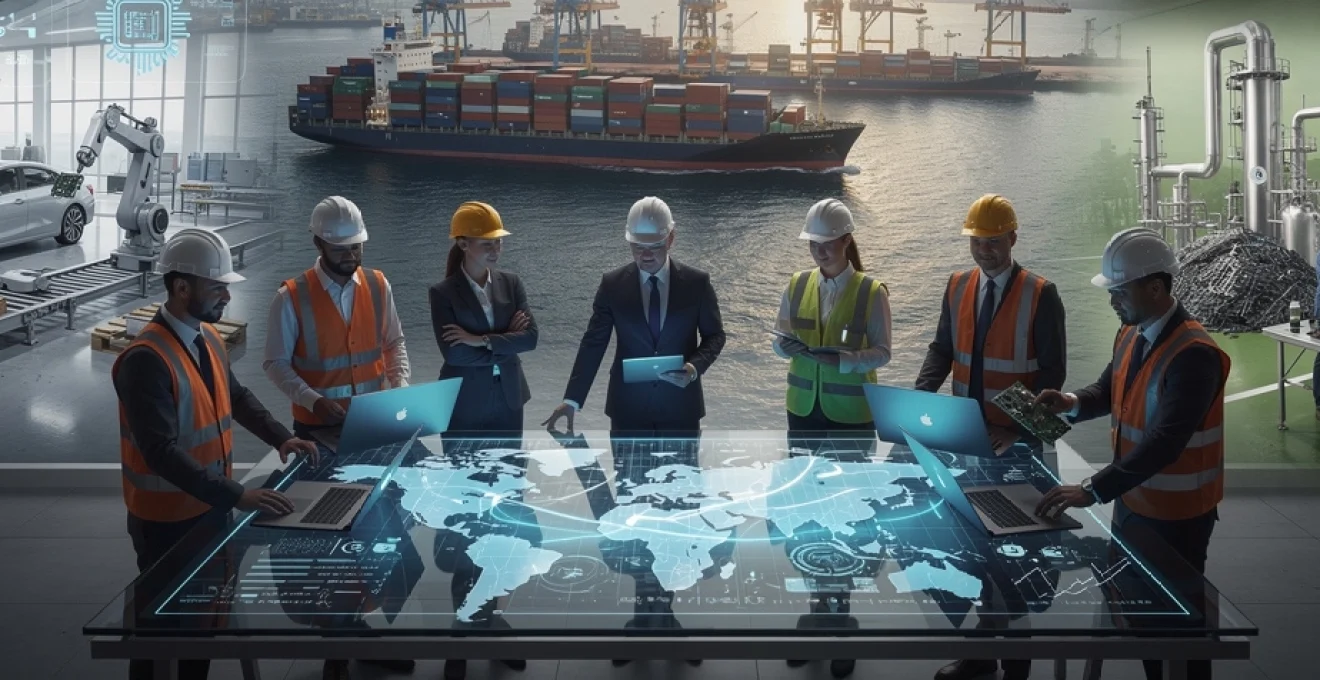
The industrial landscape has undergone unprecedented transformation over the past five years, driven by cascading disruptions that have fundamentally altered how companies approach manufacturing, supply chain management, and operational resilience. From the COVID-19 pandemic’s systemic shock to ongoing geopolitical tensions, semiconductor shortages, and climate-related disruptions, these challenges have exposed critical vulnerabilities in traditional industrial models whilst simultaneously accelerating innovation and strategic thinking across sectors.
What emerged from this period of upheaval is a new paradigm where companies must balance cost efficiency with operational resilience, creating what industry experts term the “cost of resilience” mindset. This shift represents more than tactical adjustments; it signifies a fundamental reimagining of industrial strategies where agility and adaptability take precedence over pure cost optimisation. Companies that previously operated on the assumption that minimising cost was synonymous with competitiveness have discovered that this logic no longer holds in an era of persistent uncertainty.
The implications extend far beyond operational considerations, touching on corporate strategy, national economic security, and the fundamental architecture of global trade. As businesses navigate this new reality, they must develop capabilities to anticipate and manage evolving risks whilst maintaining competitive positioning in increasingly complex markets.
Supply chain vulnerabilities exposed by COVID-19 and geopolitical tensions
The pandemic served as a stress test for global supply chains, revealing systemic weaknesses that had been masked by decades of relative stability. McKinsey’s comprehensive analysis of supply chain leaders demonstrates that 97% of companies have implemented some combination of inventory increases, dual sourcing, and regionalisation to boost resilience. However, this near-universal adoption masks significant variations in the depth and sophistication of these measures, with many companies making surface-level adjustments that may not withstand future disruptions.
The most alarming discovery from recent research is the persistent visibility gap that leaves companies blind to deeper supply chain vulnerabilities. Most organisations understand their supply chain risks only up to tier-one suppliers, creating dangerous blind spots in multi-tier networks where many devastating disruptions originate. This visibility crisis has real consequences, as semiconductor shortages that crippled automotive production globally originated several tiers deep in supply chains, far beyond the direct oversight of primary manufacturers.
Just-in-time manufacturing collapse during semiconductor shortages
The semiconductor crisis of 2020-2021 exemplified how just-in-time manufacturing principles, optimised for efficiency, became catastrophic liabilities during disruption. Automotive manufacturers, having reduced chip orders during initial lockdowns, found themselves unable to restart production when demand surged. With little spare capacity in the semiconductor industry and long lead times for capacity expansion, chip production couldn’t keep pace with the sharp increase in orders from multiple sectors simultaneously.
This crisis highlighted the bullwhip effect, where demand variability amplifies as it moves up the supply chain. Companies began building inventory buffers not just for end products but for critical components, fundamentally altering decades of lean manufacturing philosophy. The automotive sector, in particular, has invested heavily in direct relationships with chip manufacturers and strategic inventory management for critical components.
Single-source dependency risks in critical component manufacturing
The concentration of critical component manufacturing in specific geographic regions or with single suppliers has proven to be a significant vulnerability. Many companies discovered they had unwittingly created single points of failure through their optimisation strategies. For instance, certain rare earth elements essential for electronics manufacturing are predominantly sourced from a handful of locations, creating systemic risks when those sources face disruption.
Companies are now prioritising supplier diversification strategies, with dual sourcing becoming the minimum viable standard across industries. This shift extends beyond simple redundancy to include sophisticated supplier relationship management that considers geopolitical stability, climate risks, and operational capabilities of potential partners across different regions.
Port congestion impact on automotive and electronics industries
Global shipping disruptions revealed the fragility of interconnected logistics networks. Container misplacement and port congestion, driven by rapid economic recovery and rotation of consumption from services to goods, created unprecedented bottlenecks. Shipping costs from major Asian ports to the United States and Europe skyrocketed, with some routes seeing increases of over 300% compared to pre-pandemic levels.
The automotive and electronics industries, heavily dependent on complex, multi
layered shipping routes were especially vulnerable. Vehicles and consumer electronics often rely on components that cross borders multiple times before final assembly, meaning a delay at one port cascaded through production schedules worldwide. Lead times stretched from weeks to months, forcing manufacturers to idle plants, prioritise high-margin models, and reconfigure product mixes on the fly.
These logistics bottlenecks also changed how companies think about network design. Instead of defaulting to the cheapest global routes, many organisations are now factoring in port resilience, alternative inland transport options, and regional warehousing capacity when planning their supply chains. In practice, this means diversifying away from a small number of mega-hubs, developing contingency routes, and investing in more local-for-local distribution models to reduce exposure to chokepoints.
Raw material scarcity effects on steel and aluminium production
Disruptions were not limited to finished goods and components; raw materials such as iron ore, coking coal, and bauxite also faced significant volatility. Lockdowns, mine closures, and energy shortages in key producing regions constrained supply just as construction, infrastructure, and automotive demand rebounded. Steel and aluminium producers grappled with erratic input availability, forcing them to adjust output, delay projects, and renegotiate contracts.
Price spikes were the visible symptom of deeper structural issues. For example, benchmark hot-rolled coil steel prices in some markets more than doubled compared to pre-pandemic levels, while aluminium prices hit multi-year highs amid energy rationing in major smelting hubs. These dynamics exposed how dependent many industrial strategies were on a narrow set of low-cost, high-volume suppliers, with limited consideration for climate risk, political instability, or energy policy shifts.
In response, manufacturers are reassessing their raw material strategies, exploring long-term offtake agreements, regional sourcing options, and even upstream integration where economically viable. Some are also investing in scrap-based production and recycling technologies to reduce reliance on primary materials. By broadening their resource base and embedding risk metrics into procurement decisions, companies aim to make their industrial strategies less vulnerable to raw material shocks.
Digital transformation acceleration through industry 4.0 technologies
As disruptions multiplied, digital transformation ceased to be a buzzword and became a survival imperative. Companies that had already invested in Industry 4.0 technologies—such as IoT sensors, advanced analytics, automation, and digital twins—demonstrated a clear resilience advantage. They could monitor conditions in real time, reroute production, and test scenarios virtually instead of relying on slow, manual processes and static spreadsheets.
At the same time, industry surveys show a paradox: while digital adoption surged between 2020 and 2023, investment growth began to plateau in 2024. Many organisations have implemented pilot projects but struggle to scale them across factories and regions. The challenge now is not just adding more digital tools, but integrating them into coherent, end-to-end systems that directly support resilient industrial strategies.
Iot integration for real-time manufacturing visibility
The Internet of Things (IoT) sits at the heart of this new resilience toolkit. By embedding connected sensors in machines, production lines, and logistics assets, manufacturers gain real-time visibility into performance, quality, and utilisation across their networks. Instead of waiting for monthly reports, operations teams can see deviations as they occur and intervene before minor issues become major disruptions.
For example, vibration and temperature sensors on critical equipment can detect early signs of wear, enabling maintenance teams to schedule repairs during planned downtime rather than reacting to unexpected failures. Similarly, connected pallets and containers can provide location and condition data in transit, helping you anticipate delays at ports or border crossings. When you aggregate this data across sites, patterns emerge that can inform everything from capacity planning to supplier selection.
However, IoT integration is not just about installing sensors; it requires robust data architectures, cybersecurity measures, and change management. Companies that succeed tend to standardise device types and communication protocols, invest in secure connectivity, and train frontline staff to use dashboards and alerts in their daily decision-making. The result is a more transparent, responsive manufacturing environment where surprises are fewer and recovery is faster.
Predictive analytics implementation using machine learning algorithms
Once data is flowing, the next step is to turn it into foresight. Predictive analytics, powered by machine learning, allows manufacturers to move from reactive problem-solving to proactive risk management. Instead of asking, “What went wrong?” after a disruption, you can ask, “What is likely to go wrong next, and what can we do about it now?”
Machine learning models can analyse historical production data, maintenance records, quality metrics, and external signals—such as weather forecasts or commodity prices—to identify leading indicators of disruption. In practical terms, this might mean predicting which machines are most likely to fail in the next 30 days, which suppliers are at rising risk of delivery delays, or which products are most vulnerable to demand swings. These insights can then feed into scheduling, procurement, and inventory policies.
One useful analogy is shifting from driving by looking only in the rear-view mirror to using a combination of rear-view, headlights, and GPS. You still need historical data, but you also need forward-looking models and scenario planning. The main challenge is organisational rather than purely technical: predictive analytics only adds value when it is embedded into processes and governance, with clear ownership for acting on the signals it generates.
Edge computing deployment in distributed manufacturing networks
As factories, warehouses, and logistics hubs become more connected, the volume of data they generate increases exponentially. Sending all of that data to the cloud for processing is not always practical or fast enough, especially when milliseconds matter for safety, quality control, or machine coordination. This is where edge computing—processing data closer to where it is generated—becomes critical.
In a distributed manufacturing network, edge devices can run analytics models locally, filter noise, and trigger immediate responses without relying on distant data centres. For instance, an edge gateway on a production line can detect an anomaly in a weld seam and stop the line instantly, while only sending summarised data to the cloud for long-term analysis. The same principle applies to automated guided vehicles (AGVs) or collaborative robots that must react in real time to their environment.
Strategically, edge computing supports resilience by reducing latency, improving reliability in low-connectivity environments, and enabling factories to operate even if central systems are temporarily unavailable. Think of it as having local “brains” distributed across your network rather than a single, central nervous system. To capture these benefits, companies are redesigning their architectures to balance cloud and edge processing, define clear data governance rules, and ensure cybersecurity at every node.
Blockchain technology adoption for supply chain transparency
While IoT and analytics improve internal visibility, blockchain technology is emerging as a tool for enhancing trust and transparency across multi-party supply chains. By recording transactions—such as material transfers, quality inspections, or certifications—on a tamper-evident, distributed ledger, companies can verify provenance and compliance in ways that traditional documentation cannot match.
This matters especially for industries facing stringent regulatory requirements or reputational risks, such as pharmaceuticals, aerospace, and food and beverage. For example, a blockchain-based system can provide an immutable record of temperature conditions throughout a cold chain, or prove that critical minerals used in batteries come from approved, conflict-free sources. When disruptions occur, this level of traceability can help you quickly identify affected lots, suppliers, or routes and respond precisely rather than issuing broad, costly recalls.
Adoption, however, is not without hurdles. Integrating blockchain into existing systems, aligning data standards across partners, and convincing smaller suppliers to participate can be challenging. Many companies are starting with targeted use cases—like high-value components or regulated materials—before expanding. Over time, as interoperability improves, blockchain can become one of the foundational technologies that underpin resilient, transparent industrial ecosystems.
Reshoring and nearshoring strategies in manufacturing sectors
Amid rising tariffs, geopolitical tensions, and climate-related risks, many manufacturers are rethinking where they make and source their products. Reshoring—bringing production back to a company’s home country—and nearshoring—moving it closer to key markets—have shifted from niche strategies to mainstream considerations. Recent surveys suggest that more than 40% of global manufacturers plan to increase their footprint in North America or Europe over the next three years, often at the expense of highly concentrated, long-distance supply chains.
This does not signal the end of globalisation, but rather a reconfiguration of it. Instead of a single, global supply chain serving all markets, companies are building regionalised networks with local-for-local capabilities. For example, automotive and electronics OEMs are adding capacity in Mexico, Eastern Europe, and Southeast Asia to serve nearby customers, while maintaining innovation hubs in their traditional centres. The goal is to reduce exposure to cross-border friction, shorten lead times, and improve resilience—even if unit labour costs are higher.
Of course, reshoring and nearshoring introduce their own challenges. Higher operating costs, limited local supplier bases, and talent shortages can erode the financial benefits if not carefully managed. This is where the “cost of resilience” mindset becomes essential. Leading companies are offsetting higher labour costs through automation and robotics, partnering with contract manufacturers or joint ventures to share capacity, and working with governments on incentives and workforce development. When you take a total cost of ownership perspective—factoring in disruption risk, tariffs, logistics volatility, and reputational considerations—the case for regionalisation often becomes far more compelling.
Circular economy models driving sustainable industrial practices
Disruptions have not only prompted companies to rethink where and how they manufacture, but also what they manufacture and how they use resources. The circular economy—designing products and processes to minimise waste, maximise reuse, and keep materials in circulation—is moving from sustainability reports into core industrial strategies. In many sectors, circular approaches are becoming a practical response to raw material volatility, regulatory pressure, and customer demand for low-carbon products.
Instead of the traditional “take-make-dispose” model, circular industrial strategies focus on closed material loops, extended product life cycles, and new business models such as product-as-a-service. This shift is particularly pronounced in chemicals, electronics, and heavy industry, where resource intensity and environmental impact are highest. Crucially, circularity also supports resilience: by reducing dependence on virgin inputs and global waste streams, companies gain more control over their material flows.
Closed-loop manufacturing systems in chemical processing
In chemical processing, closed-loop systems aim to recover and reuse solvents, catalysts, and by-products rather than treating them as waste. Advanced separation technologies, membrane systems, and process intensification techniques enable plants to capture valuable substances that previously ended up in effluent streams or landfills. This not only reduces environmental impact but also lowers exposure to volatile feedstock prices and regulatory compliance costs.
For instance, some petrochemical producers are investing in depolymerisation technologies that break down plastic waste into monomers, which can then be reintroduced into production as high-quality feedstock. Others are implementing solvent recovery loops that reduce virgin solvent consumption by 70–90%. From a strategic standpoint, these initiatives turn what was once a liability—waste—into an asset and secondary raw material source.
Implementing closed-loop manufacturing requires careful process redesign, capital investment, and collaboration with downstream customers and waste management partners. Yet, as carbon pricing, extended producer responsibility schemes, and ESG expectations tighten, companies that build closed-loop capabilities today will be better positioned to maintain both cost competitiveness and regulatory compliance in the years ahead.
Industrial symbiosis networks for waste-to-resource conversion
Industrial symbiosis takes the circular economy beyond individual plants, creating networks where the waste or by-product of one facility becomes the input for another. Classic examples include using waste heat from a power plant to warm nearby buildings or industrial greenhouses, or supplying slag from steelmaking to cement producers as a clinker substitute. In practice, these networks resemble industrial ecosystems, where material and energy flows are optimised across multiple players.
Why does this matter for resilient industrial strategies? Because industrial symbiosis reduces dependence on virgin resources and diversified sourcing at the system level. When a cluster of companies can exchange by-products locally, they are less exposed to global logistics disruptions or commodity price shocks. In some regions, industrial parks are being intentionally designed with symbiosis in mind, mapping potential synergies between tenants before construction even begins.
Creating effective symbiosis networks requires data sharing, trust, and often facilitation from public agencies or industry associations. Digital platforms can help match waste streams with potential users, much like a marketplace. Over time, these networks can become a competitive advantage for regions, attracting investors and manufacturers seeking both sustainability and resilience benefits.
Design for disassembly methodologies in electronics manufacturing
Electronics manufacturing illustrates how design decisions made at the drawing board can have far-reaching effects on resilience and sustainability. Design for disassembly (DfD) focuses on creating products that can be easily taken apart at end-of-life so that components and materials can be recovered, refurbished, or reused. This contrasts with traditional designs that prioritise compactness or low assembly cost, often at the expense of repairability and recycling.
From a strategic perspective, DfD allows manufacturers to treat end-of-life products as urban mines—sources of critical materials like rare earths, cobalt, and high-grade plastics. In a world where access to these inputs can be constrained by geopolitics or environmental regulations, having an internal loop of recovered materials becomes a powerful hedge. It also opens up revenue streams in remanufacturing, spare parts, and certified refurbished products, which can appeal to cost-conscious and sustainability-minded customers alike.
Implementing DfD methodologies does require trade-offs. Engineers must balance durability, aesthetics, and cost with modularity and ease of disassembly. Product managers may need to rethink business models to capture value over multiple life cycles rather than a single sale. Yet as right-to-repair legislation spreads and customers become more aware of product lifecycles, DfD is increasingly seen not as a niche practice but as a cornerstone of future-proof electronics strategies.
Risk management frameworks for industrial resilience planning
Underlying all these shifts—from reshoring and digitalisation to circular economy models—is the need for robust risk management frameworks. Many organisations discovered during recent crises that their traditional risk registers and annual reviews were no match for compound shocks: a port closure overlapping with a pandemic wave, or a tariff change coinciding with an extreme weather event. To thrive in this environment, industrial leaders are moving from static, compliance-driven risk management to dynamic, integrated resilience planning.
Modern frameworks start with end-to-end visibility: mapping critical product lines, key suppliers, logistics routes, and dependencies down to sub-tier levels. They then layer on scenario analysis and stress testing, asking questions such as, “What happens if this supplier’s region experiences a prolonged blackout?” or “How would a 20% tariff swing in a major market affect our footprint choices?” Digital twins and simulation tools are increasingly used to explore these scenarios in a virtual environment, allowing companies to test mitigation strategies before real-world disruptions occur.
Governance is just as important as tools. Leading firms establish cross-functional resilience councils that bring together operations, procurement, finance, risk, and sustainability teams. They define clear thresholds for action—such as when to switch suppliers, reroute logistics, or activate inventory buffers—and embed these into playbooks and KPIs. Instead of viewing resilience as a one-off project, they treat it as an ongoing capability, regularly updating assumptions as the geopolitical, technological, and climate landscape evolves.
Ultimately, effective industrial resilience planning is about balance. Over-engineering for every conceivable disruption is neither feasible nor financially sustainable. The most competitive companies recognise that some volatility is inevitable, but they invest in the agility, optionality, and insight needed to respond faster and recover stronger than their peers. In a world where global disruptions are the norm rather than the exception, that ability can be the defining factor between leaders and laggards in industrial sectors.