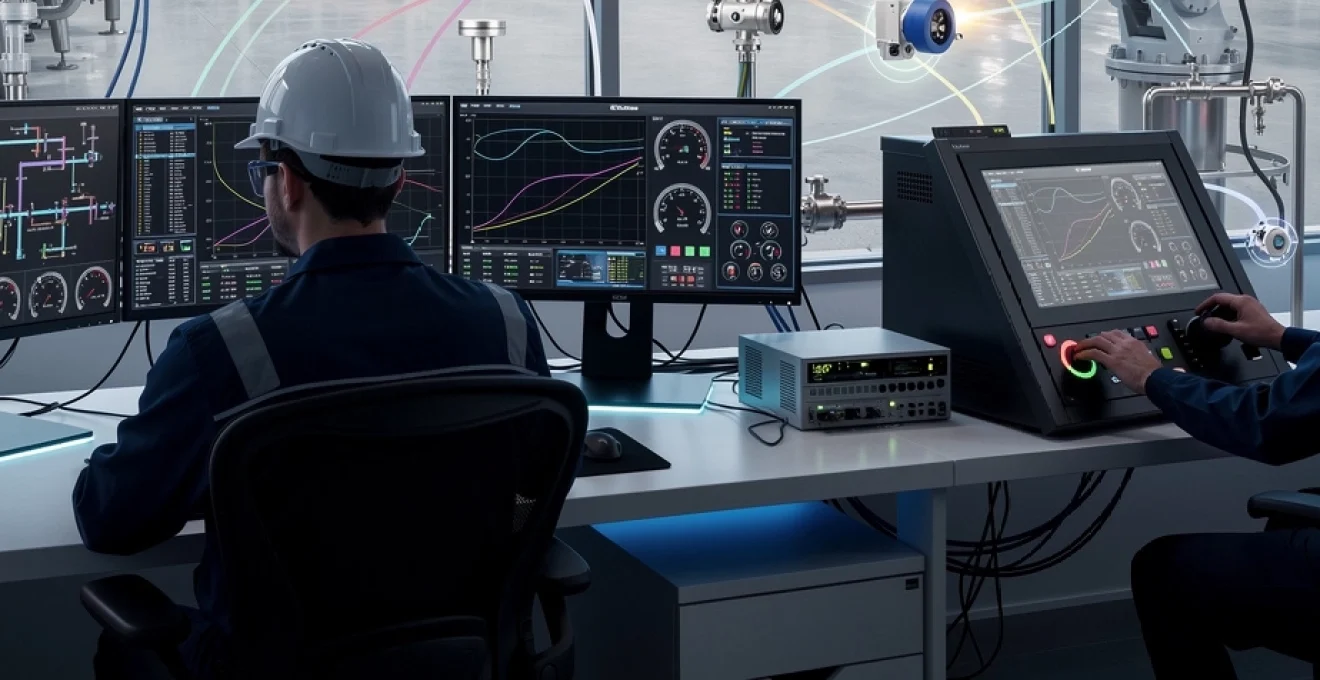
Industrial automation has reached a pivotal moment where the convergence of advanced sensor technologies and sophisticated instrumentation systems determines operational success. Modern manufacturing facilities and processing plants depend entirely on their ability to monitor, measure, and respond to changing conditions within microseconds. This technological evolution transforms how industries approach efficiency, safety, and quality control across diverse sectors from pharmaceuticals to energy management.
The fundamental shift towards real-time industrial control represents more than technological advancement—it embodies a strategic necessity for maintaining competitive advantage. As global markets demand higher precision, reduced waste, and enhanced sustainability, the role of sensors and instrumentation becomes increasingly critical. These systems provide the foundation for intelligent decision-making, enabling automated responses that human operators simply cannot match in speed or consistency.
Today’s industrial landscape requires instrumentation solutions that seamlessly integrate with existing infrastructure while offering the flexibility to adapt to future technological developments. The sophisticated interplay between sensors, controllers, and communication networks creates an ecosystem where real-time data acquisition drives immediate process optimisation, ensuring operational excellence across all production parameters.
Fundamentals of Real-Time industrial control systems architecture
Real-time industrial control systems architecture represents a complex ecosystem where multiple interconnected components work harmoniously to achieve instantaneous process control. The architecture typically comprises several hierarchical levels, starting from field devices and sensors at the lowest level, progressing through local control units, supervisory systems, and ultimately connecting to enterprise-level management systems. This layered approach ensures robust data flow while maintaining system reliability and operational security.
The foundation of any effective real-time control architecture lies in its ability to process information with deterministic timing characteristics. Deterministic behaviour ensures that system responses occur within predictable time frames, typically measured in milliseconds or microseconds. This predictability becomes crucial when controlling high-speed manufacturing processes, chemical reactions, or safety-critical applications where delayed responses could result in significant operational disruptions or safety hazards.
SCADA systems integration with distributed control networks
Supervisory Control and Data Acquisition (SCADA) systems serve as the central nervous system for distributed industrial operations, providing comprehensive visibility and control across geographically dispersed facilities. Modern SCADA implementations leverage advanced communication protocols and redundant network architectures to ensure continuous connectivity with remote terminal units and intelligent electronic devices. The integration capabilities extend beyond traditional monitoring functions to include sophisticated data analytics, historical trending, and predictive maintenance algorithms.
Contemporary SCADA systems incorporate cloud-based technologies and edge computing capabilities, enabling real-time data processing closer to the source while maintaining centralised oversight. This distributed intelligence approach reduces network latency and enhances system responsiveness, particularly crucial for applications requiring sub-second response times. The scalability of modern SCADA platforms allows organisations to expand their monitoring and control capabilities incrementally, adapting to evolving operational requirements without major system overhauls.
Programmable logic controllers (PLCs) and human machine interface (HMI) synchronisation
The synchronisation between PLCs and HMI systems represents a critical aspect of effective real-time control implementation. Modern PLCs operate on scan cycles measured in milliseconds, continuously reading inputs, executing control logic, and updating outputs with remarkable precision. The challenge lies in ensuring that HMI systems can display this rapidly changing information in a meaningful way for human operators while maintaining system responsiveness for critical control functions.
Advanced synchronisation techniques employ dedicated communication channels and prioritised data exchange protocols to balance the demands of real-time control with operator interface requirements. Multi-threading capabilities in modern control systems allow simultaneous execution of time-critical control loops and less urgent data visualisation tasks. This approach ensures that operator interfaces remain responsive and informative without compromising the deterministic behaviour required for effective process control.
Industrial ethernet protocols: modbus TCP, EtherNet/IP, and PROFINET performance
Industrial Ethernet protocols have revolutionised real-time communication in manufacturing environments, offering the bandwidth and reliability necessary for demanding control applications. Modbus TCP provides a simple yet robust communication framework suitable for basic monitoring and control tasks, while EtherNet/IP delivers more sophisticated features including explicit messaging and implicit I/O capabilities. PROFINET represents the pinnacle of industrial Ethernet evolution, offering real-time communication with guaranteed delivery times and advanced diagnostic capabilities.
The performance characteristics of these protocols vary
The performance characteristics of these protocols vary significantly depending on network design, device capabilities, and real-time industrial control requirements. Modbus TCP, while widely adopted and simple to implement, is typically better suited to slower supervisory tasks rather than tight motion control. EtherNet/IP and PROFINET, by contrast, support cyclic I/O updates with determinism tailored for high-speed automation, especially when deployed on switched networks with quality-of-service (QoS) and VLAN configuration. In many plants, we see a hybrid architecture where Modbus TCP handles instrumentation and diagnostics, while PROFINET or EtherNet/IP manages the most time-critical control loops.
When evaluating industrial Ethernet performance, you need to look beyond raw bandwidth figures and consider jitter, update times, and network congestion. A 1 Gbps network that is poorly segmented can deliver worse real-time behaviour than a well-designed 100 Mbps network with deterministic scheduling. Industrial protocols address this through mechanisms such as prioritised frames, time-aware shapers, and isochronous real-time channels. For modern automation systems, designing the network with real-time performance in mind from day one is as important as selecting the right PLC or sensor.
Deterministic communication requirements for sub-millisecond response times
As processes become faster and more integrated, many real-time industrial control applications demand sub-millisecond response times from sensor to actuator. Achieving this level of performance requires more than quick processors; it depends on deterministic communication where latency and jitter are both tightly controlled. In practical terms, determinism means that every control cycle completes within a fixed time window, regardless of network load or background traffic. For high-speed packaging machines or coordinated multi-axis motion, any deviation from this window can translate into product defects or mechanical stress.
To meet these deterministic communication requirements, engineers often deploy real-time extensions such as Time-Sensitive Networking (TSN), PROFINET IRT, or EtherCAT. These technologies use precise time synchronisation, scheduled transmission slots, and hardware-assisted switching to guarantee that critical messages arrive when needed. Think of it like reserving a dedicated lane on a motorway for emergency services—no matter how busy the traffic gets, that lane remains clear. In practice, this might mean separating safety and motion-control traffic from non-critical diagnostics, or pushing non-urgent data to higher-level networks where latency is less important.
Sub-millisecond response times also require tight coordination between sensors, instrumentation, and controllers. Sampling rates, scan times, and network cycles must be harmonised so that fresh data is always available when control algorithms execute. If a pressure transmitter updates every 10 ms, but your PLC runs a 1 ms control loop, nine out of ten iterations will be working with stale data. For this reason, selecting instrumentation with appropriate update rates and communication capabilities is central to reliable real-time control, especially when you scale up to large distributed systems.
Critical sensor technologies enabling process automation
At the heart of every real-time industrial control strategy lies an array of sensors that convert physical phenomena into actionable digital information. These critical sensor technologies provide the eyes and ears of the plant, allowing controllers to make precise adjustments in fractions of a second. Without accurate, reliable sensing, even the most advanced PLC or SCADA architecture will struggle to maintain stability and product quality. You can think of instrumentation as the nervous system of an industrial process, continuously feeding status updates to a central brain that never sleeps.
Modern process automation relies on a diverse mix of temperature, pressure, level, flow, and vibration sensors, each optimised for specific conditions and response times. Over the last decade, sensor intelligence has increased dramatically, with many devices now integrating microprocessors, self-diagnostics, and digital communication interfaces. This shift from purely analogue transducers to smart instrumentation has enabled more granular control, better fault detection, and simplified commissioning. As we explore each sensor category, you will see how their capabilities directly influence the performance of real-time industrial control loops.
Temperature sensors: RTDs, thermocouples, and infrared pyrometry applications
Temperature is one of the most commonly measured variables in industrial environments, and its control is central to processes such as chemical reactions, food sterilisation, and heat treatment. Resistance Temperature Detectors (RTDs) are often the first choice when accuracy and stability are paramount. Constructed from materials like platinum, RTDs provide excellent linearity and repeatability, making them ideal for precision process control in pharmaceuticals or semiconductor manufacturing. Their typical response times are well-suited to slower thermal processes where changes occur over seconds rather than microseconds.
Thermocouples, on the other hand, excel in high-temperature and harsh environments, such as furnaces, kilns, and gas turbines. They can withstand extreme conditions and provide rapid response, albeit with lower absolute accuracy than RTDs. For applications where knowing that a surface has exceeded a threshold is more important than a ±0.1 °C accuracy, thermocouples offer an attractive trade-off. We often see mixed installations where RTDs handle tight control regions, while thermocouples provide broader temperature monitoring and safety interlocks.
Infrared pyrometers take temperature sensing a step further by enabling non-contact measurements. These devices are indispensable where direct contact is impossible or unsafe, such as moving webs, molten metals, or high-voltage components. In fast-moving production lines, infrared pyrometry allows real-time temperature monitoring without introducing mechanical wear or process contamination. For example, in continuous steel casting, IR sensors measure surface temperature to adjust cooling rates in real time, preventing defects and improving yield. As with any optical measurement, proper installation, emissivity compensation, and lens cleaning are critical to long-term reliability.
Pressure transducers and differential pressure transmitters in flow control
Pressure transducers and differential pressure transmitters play a central role in controlling fluid systems, from compressed air networks to complex chemical reactors. Absolute and gauge pressure sensors are used to maintain safe operating ranges, prevent equipment damage, and optimise energy use in pumps and compressors. In many cases, the pressure signal is also a proxy for flow or level, making it a versatile input for real-time industrial control strategies. The faster and more accurately pressure can be measured, the better you can stabilise the process and reduce cycling.
Differential pressure transmitters are particularly important in flow control applications using orifice plates, Venturi tubes, or filters. By measuring the pressure drop across a restriction, these instruments allow controllers to calculate flow rates and respond quickly to changes in demand or blockage. For example, in a filtration system, a rising differential pressure indicates fouling, prompting predictive maintenance before throughput is compromised. High-performance transmitters with digital communication, built-in linearisation, and temperature compensation provide stable measurements even under fluctuating process conditions.
In modern plants, we often integrate pressure instrumentation directly into safety and shutdown systems. Overpressure conditions can lead to catastrophic failures, so real-time monitoring with redundant pressure transmitters is standard practice in many industries. Selecting the right sensor technology, pressure range, and process connection is only half the battle; equally important is ensuring that signal conditioning and communication paths preserve the fidelity of the measurement. When pressure data is used for both control and safety, the accuracy and response time of the instrumentation become non-negotiable.
Level detection systems: radar, ultrasonic, and capacitive sensing technologies
Reliable level measurement underpins safe and efficient storage of liquids, slurries, and bulk solids. Radar level transmitters have become a go-to solution in demanding applications due to their immunity to temperature, pressure, and vapour changes. Guided wave radar (GWR) versions send pulses down a probe, while non-contact radar units emit microwaves into the tank and measure the return time. These technologies are particularly useful for viscous or corrosive media where mechanical floats or differential pressure methods would struggle. In real-time control, radar provides stable level signals even in turbulent vessels or high-foaming environments.
Ultrasonic level sensors work on a similar time-of-flight principle but use sound waves instead of microwaves. They offer a cost-effective solution for many water, wastewater, and bulk solids applications where high precision is not critical. However, ultrasonic sensors can be affected by temperature gradients, heavy vapours, or dust, which must be considered during specification and installation. When deployed correctly, they provide reliable level data that can drive pump control, overflow protection, and inventory management, helping you maintain optimal tank utilisation.
Capacitive level sensors come into their own where contact measurement is acceptable and you need to detect interfaces or point levels. These devices sense changes in dielectric constant as the medium covers or uncovers the probe, making them suitable for a wide range of liquids and some solids. They are frequently used for high and low level alarms in silos, hoppers, and mixing vessels. For real-time industrial control, capacitive sensors often act as limit switches ensuring that processes start and stop at the right time, preventing dry running of pumps or overfilling of vessels. The choice between radar, ultrasonic, and capacitive sensing ultimately depends on process conditions, accuracy requirements, and budget.
Vibration analysis sensors for predictive maintenance in rotating equipment
Rotating equipment such as motors, pumps, fans, and gearboxes is the backbone of most industrial plants, and unexpected failures can be extremely costly. Vibration analysis sensors, including accelerometers and velocity transducers, provide early warning of mechanical issues long before they cause downtime. By continuously monitoring vibration signatures, real-time industrial control systems can detect imbalance, misalignment, bearing wear, or resonance conditions. This enables maintenance teams to intervene at the most cost-effective moment, shifting from reactive to predictive maintenance strategies.
In many facilities, vibration sensors are integrated into condition monitoring systems that run advanced analytics either in the control room or at the edge. These systems compare live data against baseline signatures and alarm thresholds, sometimes using machine learning models to identify subtle trends. Would you rather shut down a critical pump for planned maintenance or risk a catastrophic failure during peak production? With reliable vibration instrumentation, that decision becomes data-driven instead of guesswork. Moreover, connecting vibration data to production metrics helps you quantify the impact of maintenance decisions on overall equipment effectiveness (OEE).
For the best results, vibration sensors must be installed at appropriate locations and axes, with proper mounting to ensure signal integrity. Cabling, grounding, and environmental protection also affect long-term reliability, especially in harsh or hazardous areas. As sensor prices fall and wireless options mature, more assets can be instrumented without the cost of extensive wiring. This expansion of vibration monitoring across critical and semi-critical equipment brings predictive maintenance capabilities to parts of the plant that were previously ignored, improving resilience and reducing lifecycle costs.
Industrial instrumentation signal processing and data acquisition
Once physical variables are captured by sensors, they must be converted, conditioned, and digitised before a controller can act on them. Industrial instrumentation signal processing and data acquisition form the bridge between the analogue world of the process and the digital world of real-time control. This stage is where noise is filtered out, measurement ranges are scaled, and safety isolations are applied. If you imagine an orchestra performance, the signal conditioning hardware is the sound engineer ensuring every instrument is heard clearly and at the right level.
Signal conditioning equipment typically includes amplification, isolation, filtering, and linearisation functions. For example, a thermocouple’s millivolt signal must be amplified and cold-junction compensated before it becomes a meaningful temperature reading. Similarly, strain gauge sensors require excitation and bridge completion to output a stable, low-noise signal. Poorly designed conditioning can introduce delays, offset errors, or non-linearity, all of which degrade the performance of closed-loop control. Investing in high-quality, properly specified conditioning modules therefore pays dividends in process stability and product consistency.
Data acquisition systems (DAQ) aggregate these conditioned signals and convert them into digital data, usually via high-resolution analogue-to-digital converters (ADCs). Key considerations for real-time industrial control include sampling rate, resolution, and synchronisation across multiple channels. If different sensors in a fast process are sampled at different times, your controller will be working with a distorted snapshot of reality. Synchronous sampling and time-stamping help ensure that all variables reflect the same instant in the process, which is vital for high-speed motion control or power quality analysis. Modern DAQ modules often integrate directly into PLC and PAC platforms via industrial Ethernet, simplifying installation and configuration.
Noise suppression is another critical aspect of industrial signal processing. Electromagnetic interference from motors, variable-speed drives, and switching power supplies can corrupt sensitive measurements if not properly mitigated. Techniques such as shielded cabling, twisted pairs, proper grounding, and differential measurement help maintain signal integrity. Digital filtering, averaging, and outlier rejection can further clean up the data, but they must be configured carefully to avoid introducing excessive latency. The goal is always the same: provide the control system with accurate, timely data that truly represents the state of the process.
Closed-loop control algorithms and feedback mechanisms
Closed-loop control is where real-time industrial control systems turn raw measurement data into precise, repeatable action. In its simplest form, a closed loop compares a measured value (process variable) to a desired target (setpoint) and adjusts an output to minimise the error. This fundamental feedback mechanism is used everywhere, from maintaining the temperature of an oven to regulating the speed of a conveyor belt. Without reliable sensors and instrumentation, however, even the most sophisticated control algorithm is flying blind.
The most widely used algorithm in industry is the Proportional-Integral-Derivative (PID) controller. PID combines three terms to respond to current error, accumulated past error, and predicted future error based on the rate of change. When tuned correctly, PID control can deliver stable, fast, and accurate performance for a wide range of processes. Yet tuning remains as much an art as a science, with engineers balancing responsiveness against overshoot and oscillation. Tools such as auto-tuning routines, step-response tests, and simulation models can help you achieve optimal settings faster and with less trial and error.
More advanced applications increasingly adopt model-based control strategies such as Model Predictive Control (MPC). MPC allows the controller to anticipate future behaviour using a mathematical model of the process, taking into account constraints like maximum valve positions or heating rates. This can be especially powerful in multi-variable systems where several inputs and outputs interact, such as in distillation columns or large HVAC plants. However, the effectiveness of MPC hinges on accurate sensor data and time-synchronised measurements. A poor-quality level or flow signal will quickly undermine the benefits of even the most sophisticated control model.
Feedback mechanisms also extend into cascade, feedforward, and ratio control architectures. In cascade control, a primary loop (such as temperature) sets the setpoint for a secondary loop (such as flow), improving disturbance rejection and response time. Feedforward control measures disturbances directly—like incoming feed temperature—and compensates for them before they affect the main process variable. Ratio control ensures that two streams maintain a fixed proportion, which is crucial in blending and mixing operations. In every case, the effectiveness of these strategies depends on the speed, resolution, and reliability of the instrumentation feeding the control logic.
Safety instrumented systems (SIS) and functional safety standards
While productivity and efficiency are key drivers for real-time industrial control, safety remains the ultimate priority. Safety Instrumented Systems (SIS) are specialised control layers designed to bring a process to a safe state when hazardous conditions are detected. Unlike basic process control systems, which focus on keeping operations within normal bounds, SIS are engineered to respond when things go wrong. They rely heavily on independent, reliable sensors and actuators capable of operating even under fault conditions.
Functional safety standards such as IEC 61508 and IEC 61511 provide the framework for designing, implementing, and maintaining SIS. These standards define Safety Integrity Levels (SIL) that quantify the required risk reduction for specific hazards. Achieving a given SIL often involves using redundant sensors, diverse measurement technologies, and rigorous diagnostics to detect faults. For example, a high-integrity shutdown system on a high-pressure reactor might use multiple pressure transmitters with 2oo3 (two out of three) voting to guard against spurious trips or hidden failures. The quality and configuration of the instrumentation therefore directly influence the achievable safety performance.
In practice, SIS architectures usually operate independently from basic process control systems, often on separate hardware and networks. This separation reduces the likelihood that a fault in the control logic or communication network will compromise safety functions. However, there is still a strong interplay between standard control loops and safety functions. Well-calibrated sensors and accurate process models help keep operations away from dangerous zones, reducing the frequency with which SIS must intervene. When a safety function is demanded, deterministic response times and unambiguous sensor readings are essential to preventing escalation.
Verification, testing, and maintenance are also critical components of functional safety. Proof testing intervals, diagnostic coverage, and mean time to dangerous failure (MTTFd) all depend on how well sensors and instrumentation perform over time. Automated partial-stroke testing for valves, built-in sensor diagnostics, and continuous signal plausibility checks can improve safety availability without excessive downtime. As plants become more connected and data-rich, many operators are leveraging real-time diagnostics from safety instrumentation to refine their risk models and optimise test intervals, striking a better balance between safety and productivity.
Edge computing integration with industrial IoT sensor networks
The rise of Industrial IoT has dramatically increased the volume and velocity of data produced by sensors and instrumentation. Edge computing has emerged as a practical solution to process this data closer to where it is generated, reducing latency and bandwidth demands on central systems. Instead of sending every raw measurement to the cloud or a control room, edge devices perform pre-processing, analytics, and even local control actions. This shift is particularly valuable for real-time industrial control, where split-second decisions can prevent faults or optimise performance.
Edge gateways and embedded controllers can run algorithms such as anomaly detection, predictive maintenance models, and local optimisation routines. For instance, a vibration sensor on a remote pump skid can feed directly into an edge controller that tracks bearing health and adjusts operating parameters to extend life. Only meaningful events or aggregated statistics are then sent upstream to SCADA or enterprise systems. This approach is analogous to having local reflexes in the human body; not every stimulus needs to be processed by the brain before you react.
Industrial IoT sensor networks increasingly combine wired and wireless technologies, including industrial Wi-Fi, WirelessHART, and 5G, to reach assets that were previously difficult or uneconomical to instrument. With more endpoints online, cybersecurity becomes a critical consideration, especially when edge devices interface directly with real-time control networks. Implementing secure boot, encryption, role-based access, and network segmentation at the edge helps protect both data and operations. You should treat each edge node as both a valuable analytics resource and a potential gateway to your control infrastructure.
Looking ahead, the combination of edge computing, AI, and advanced instrumentation will continue to reshape how plants operate. Distributed intelligence at the sensor and edge level will enable more autonomous subsystems, capable of self-optimisation and self-diagnosis without constant human oversight. For operations teams, this means a shift from manual intervention to strategic supervision, using dashboards and alerts to focus attention where it is most needed. In every scenario, the common thread remains clear: high-quality sensors and instrumentation are the foundation on which effective, real-time industrial control is built.