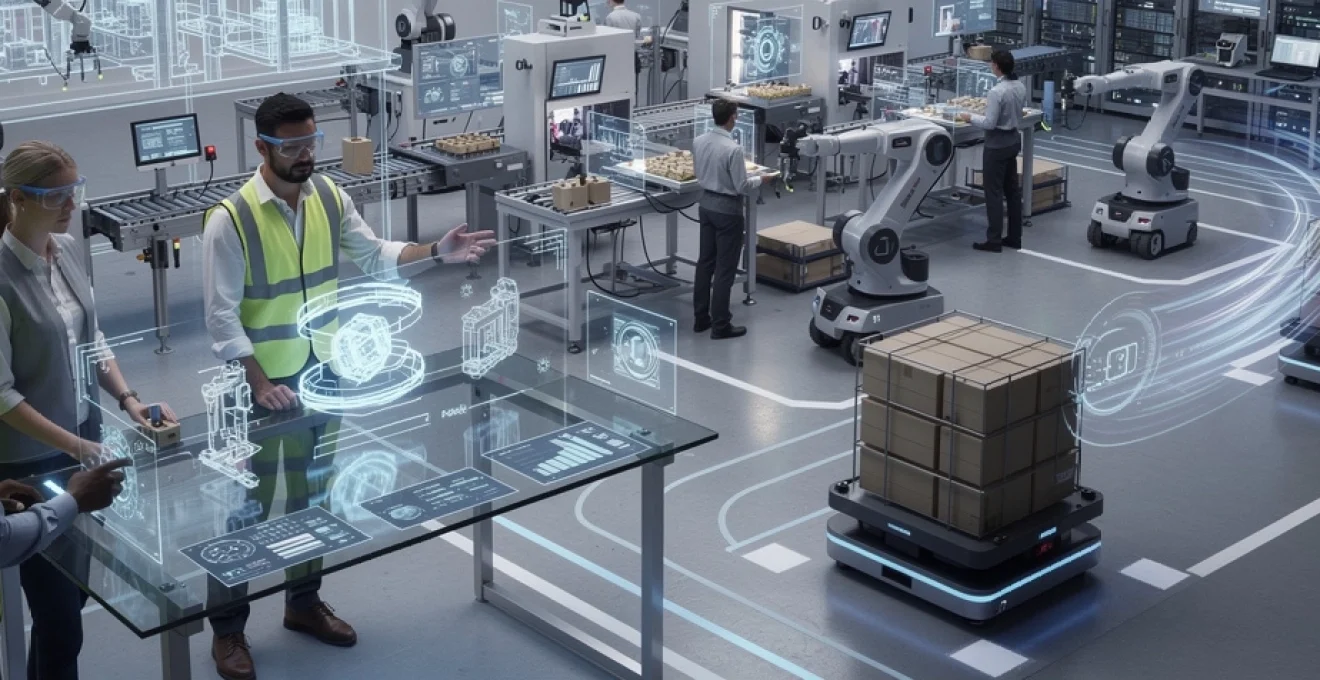
The manufacturing floor hums with an almost orchestral precision as sensors communicate silently, robots collaborate seamlessly with human operators, and artificial intelligence continuously optimises every aspect of production. This isn’t science fiction—it’s the reality of today’s smart factories, where digital transformation has fundamentally altered how we conceive industrial operations. As you step into these facilities, you witness firsthand the convergence of cutting-edge technologies that are reshaping manufacturing from the ground up.
Smart manufacturing represents more than just technological advancement; it embodies a paradigm shift towards data-driven decision-making and autonomous systems that respond dynamically to changing conditions. These facilities demonstrate how the integration of Industrial Internet of Things (IIoT), artificial intelligence, and advanced automation creates unprecedented levels of efficiency, quality, and sustainability. The transformation isn’t merely about replacing old machines with new ones—it’s about creating intelligent ecosystems where every component communicates, learns, and adapts.
Today’s smart factories serve as living laboratories for Industry 4.0 principles, revealing how manufacturers can achieve remarkable improvements in productivity whilst simultaneously reducing their environmental footprint. The evidence is compelling: companies implementing smart manufacturing technologies report efficiency gains of up to 30% and quality improvements exceeding 25%. These facilities are proving that the future of industry isn’t just about automation—it’s about creating intelligent, responsive manufacturing environments that can adapt to market demands whilst maintaining operational excellence.
Industrial internet of things (IIoT) infrastructure in modern manufacturing facilities
The backbone of any smart factory lies in its Industrial Internet of Things infrastructure, where thousands of connected devices create a comprehensive network of real-time data collection and analysis. This interconnected ecosystem transforms traditional manufacturing equipment into intelligent assets capable of self-monitoring, predictive maintenance, and autonomous optimisation. The scale of connectivity in modern facilities is staggering—a typical smart factory might contain over 10,000 sensors monitoring everything from temperature and vibration to energy consumption and product quality metrics.
Edge computing networks and Real-Time data processing capabilities
Edge computing has emerged as the critical enabler for real-time decision-making in smart factories, processing vast amounts of data locally rather than relying solely on cloud-based systems. This distributed computing approach reduces latency to milliseconds, enabling instantaneous responses to production anomalies or quality issues. Manufacturing facilities implementing edge computing report response times that are 90% faster than traditional cloud-only architectures, making the difference between catching a defective product and allowing an entire batch to fail quality standards.
The architecture of edge networks in smart factories typically involves multiple layers of computing power, from simple sensor nodes to powerful edge servers capable of running complex machine learning algorithms. This hierarchical approach ensures that critical decisions happen at the point of production, while less time-sensitive analytics can be processed in centralised systems. Edge computing networks also provide crucial redundancy, maintaining operational continuity even when connectivity to external systems is compromised.
SCADA systems integration with siemens MindSphere and GE predix platforms
Modern SCADA (Supervisory Control and Data Acquisition) systems have evolved far beyond their traditional monitoring roles to become intelligent orchestration platforms that integrate seamlessly with cloud-based industrial IoT platforms. Siemens MindSphere and GE Predix represent the cutting edge of this evolution, offering comprehensive digital twin capabilities and advanced analytics that transform raw operational data into actionable intelligence. These platforms enable manufacturers to visualise their entire production ecosystem in real-time, from individual machine performance to supply chain dynamics.
The integration process involves sophisticated middleware that translates between legacy industrial protocols and modern cloud-native APIs, ensuring that existing investments in automation equipment remain valuable whilst gaining access to advanced analytics capabilities. Companies utilising these integrated platforms report operational efficiency improvements of 15-25% within the first year of implementation, demonstrating the tangible value of connecting traditional SCADA systems with modern IoT platforms.
Wireless sensor networks and 5G connectivity implementation
The deployment of 5G networks in manufacturing environments is revolutionising wireless sensor capabilities, enabling ultra-reliable low-latency communications that support mission-critical applications. Unlike previous wireless technologies, 5G provides the bandwidth and reliability necessary for real-time control applications, making it possible to deploy wireless sensors in
locations that were previously impossible or impractical to connect. For plant managers, this means you can relocate production cells, add new machines, or reconfigure lines without being constrained by fixed cabling. Private 5G networks, often deployed within the factory perimeter, deliver deterministic performance with latencies under 10 milliseconds and support for thousands of concurrent devices per cell.
Wireless sensor networks built on this 5G backbone extend visibility into every corner of the facility, from high-speed bottling lines to remote utility areas. Battery-powered sensors can operate for years while streaming vibration, temperature, and pressure data at high frequency, feeding analytics engines that detect subtle anomalies long before they affect output. In practice, this wireless flexibility accelerates continuous improvement initiatives, as engineers can rapidly instrument new processes, run short, data-rich experiments, and then redeploy hardware as requirements evolve.
Digital twin technology using PTC ThingWorx and ansys twin builder
Digital twin technology is where the smart factory becomes truly predictive rather than merely reactive. Platforms such as PTC ThingWorx and Ansys Twin Builder enable manufacturers to create virtual replicas of machines, production lines, and even entire facilities, synchronised in real time with IIoT data. Think of a digital twin as a constantly updated “Flight Simulator” for your factory, where engineers can test scenarios virtually before implementing any physical change.
In a typical implementation, ThingWorx aggregates live data from PLCs, SCADA systems, and sensors, while Twin Builder provides high-fidelity physics-based models of assets such as motors, furnaces, or compressors. Together, they allow you to simulate performance under different loads, materials, or environmental conditions, and then compare those predictions against actual behaviour. This not only improves accuracy in predictive maintenance and capacity planning, it also reduces commissioning times by up to 50%, as virtual commissioning uncovers integration issues before equipment hits the shop floor.
For operators and maintenance teams, digital twins make complex systems more understandable and transparent. Instead of relying on gut feeling, teams can visualise how parameter changes—like line speed or oven temperature—will ripple through product quality and energy use. As manufacturers move toward more customised, smaller batch production, this ability to experiment digitally becomes a critical competitive advantage, enabling faster product introductions without compromising reliability.
Autonomous manufacturing systems and robotic process automation
Once the data backbone is in place, the next defining feature of a smart factory is its level of autonomous operation. Autonomous manufacturing systems and robotic process automation (RPA) take repetitive, rule-based tasks off human hands and hand them to software robots and physical robots. The result is not a lights-out factory where people disappear, but a rebalanced environment where humans focus on exception handling, innovation, and high-value decision-making.
Across automotive, electronics, and food processing plants, we now see lines where material flow, machine setups, and quality checks are orchestrated by algorithms rather than clipboards. Robots and software agents communicate through standardised protocols, dynamically reallocating work when bottlenecks arise or demand shifts. For manufacturers grappling with skills shortages and rising wage pressures, this blend of physical and digital automation offers a route to stable throughput and consistent quality without overburdening staff.
Collaborative robots (cobots) from universal robots and KUKA integration
Collaborative robots, or cobots, from vendors like Universal Robots and KUKA have transformed how automation is deployed on the factory floor. Unlike traditional industrial robots confined behind safety cages, cobots are designed to work side by side with people, equipped with force-limiting joints, advanced vision systems, and intuitive programming interfaces. They are ideal for tasks that are repetitive but still benefit from human oversight, such as assembly, screwdriving, packaging, and machine tending.
In many smart factories, you’ll see a Universal Robots arm mounted beside an operator on a workbench, handling monotonous pick-and-place motions while the human focuses on fine adjustments or quality decisions. Integration with MES and ERP systems allows these cobots to adapt in real time to new work orders, changing SKUs, or urgent rework. KUKA’s collaborative platforms, often paired with mobile bases, can move between stations as needed, effectively acting as flexible “temp workers” that can be reassigned in hours rather than weeks.
From a workforce perspective, cobots are also powerful tools for upskilling and engagement. Operators can teach a cobot new tasks through hand-guiding or simple graphical interfaces, turning them into “robot supervisors” rather than manual labourers. This helps address the stigma of manufacturing as dirty or dangerous, replacing it with an image of high-tech collaboration where AI and robotics augment human capabilities instead of replacing them.
Automated guided vehicles (AGVs) and warehouse management systems
Material flow is another area where autonomy has become visible and tangible. Automated guided vehicles (AGVs) and their more advanced cousins, autonomous mobile robots (AMRs), now criss-cross factory floors and warehouses, transporting raw materials, work-in-progress, and finished goods. Connected to warehouse management systems (WMS) and manufacturing execution systems (MES), these vehicles operate as part of an orchestrated logistics network rather than isolated assets.
Modern AGVs use lidar, cameras, and SLAM (simultaneous localisation and mapping) to navigate safely around people and obstacles without requiring magnetic tape or fixed paths. The WMS assigns missions based on real-time inventory levels and production priorities, ensuring that the right material is delivered to the right workstation just in time. When demand spikes or a machine goes down, routes are automatically re-optimised, much like ride-sharing algorithms reroute drivers in a busy city.
For manufacturers, this translates into reduced forklift traffic, fewer accidents, and more accurate inventory tracking. It also unlocks new layout possibilities, as lines no longer need to be designed around manual material handling constraints. As one operations director put it, “once the AGVs arrived, the factory felt like it switched from analogue to digital overnight”—a reminder of how visible logistics autonomy can be for both staff and visitors.
Machine learning algorithms for predictive quality control
Quality control is shifting from end-of-line inspection to continuous, in-process prediction, powered by machine learning algorithms. Instead of relying solely on sampling or human visual checks, smart factories feed streams of process data—temperatures, pressures, spindle speeds, torque values—into models that learn the subtle patterns preceding defects. These models can flag at-risk products or processes in real time, allowing operators to intervene before scrap or rework costs escalate.
Supervised learning techniques, such as gradient boosting or deep neural networks, are commonly trained on historical production data labelled with pass/fail outcomes. Once deployed at the edge or within the factory’s private cloud, they score every unit or batch as it moves through the line. If an anomaly score breaches a defined threshold, the system can automatically adjust parameters, trigger additional checks, or route parts to a quarantine area. This is akin to having an experienced quality engineer watching every data point 24/7.
Manufacturers implementing predictive quality control routinely report reductions in defect rates of 20–40%, along with faster root cause analysis when problems emerge. The challenge, of course, lies in data quality and organisational trust. That’s why leading plants combine algorithmic predictions with intuitive dashboards and clear explanations, ensuring that line operators understand not just that a risk has been flagged, but why and what corrective actions are recommended.
Computer vision systems using OpenCV and TensorFlow for defect detection
Computer vision has become one of the most visible applications of AI in smart manufacturing. High-resolution cameras, combined with OpenCV-based image processing and TensorFlow deep learning models, now inspect surfaces, dimensions, labels, and assemblies at speeds that would overwhelm human inspectors. This is particularly valuable for products with reflective or complex surfaces, where traditional rule-based vision systems struggle.
In a typical setup, cameras are mounted above a conveyor or integrated into robotic cells, capturing images of each part as it passes. OpenCV handles pre-processing—such as noise reduction, edge detection, and colour normalisation—while TensorFlow classification or segmentation models identify scratches, dents, missing components, or misalignments. These systems can be retrained as new defect types are discovered, turning every production run into additional training data for continuous improvement.
What makes modern computer vision especially powerful is its integration with the broader factory ecosystem. When a defect is detected, the system doesn’t just reject a part; it can trace back to the machine settings, operator shift, or raw material lot associated with that anomaly. This end-to-end traceability accelerates root cause analysis and supports closed-loop quality control, where process parameters are dynamically tuned based on real-time visual feedback.
Advanced analytics and artificial intelligence applications
Behind the visible robots and vision systems, advanced analytics and artificial intelligence quietly orchestrate much of the smart factory’s performance. These capabilities transform raw data into insights, and insights into automated actions, supporting decisions that range from minute-by-minute machine adjustments to long-term capacity planning. You can think of this as the “brain” of the smart factory, continuously learning from every cycle, shift, and order.
From forecasting demand and optimising inventories to recommending maintenance windows and energy setpoints, AI applications sit at the intersection of operations, supply chain, and sustainability. The most successful manufacturers treat analytics not as a one-off project but as an ongoing capability, embedding data science into daily routines and empowering frontline staff with intuitive tools. The question is no longer whether to use AI, but how quickly you can scale its benefits across multiple plants and product lines.
Predictive maintenance using IBM watson IoT and microsoft azure IoT suite
Predictive maintenance is often the first major AI use case deployed in a smart factory, and platforms such as IBM Watson IoT and Microsoft Azure IoT Suite have become go-to solutions. By continuously monitoring vibration, temperature, acoustics, and other condition indicators, these systems can predict when a critical asset is likely to fail, enabling maintenance teams to intervene just in time. This shifts maintenance from reactive firefighting or overly conservative schedules to data-driven planning.
Using Azure IoT or Watson IoT, manufacturers build models that correlate historical sensor patterns with known failure events. Once trained, these models run either in the cloud or at the edge, generating health scores and remaining useful life estimates for thousands of assets. Maintenance work orders can then be automatically created in the CMMS when certain thresholds are met, ensuring that spare parts, technicians, and production schedules are all aligned.
Organisations that have embraced predictive maintenance often see unplanned downtime reduced by 30–50% and maintenance costs drop by double-digit percentages. Yet the real value goes beyond cost avoidance: stable, predictable equipment performance provides the foundation for more ambitious initiatives, such as lights-out production cells and highly compressed lead times, where every minute of uptime matters.
Supply chain optimisation through SAP integrated business planning
Smart factories do not exist in isolation; their performance is tightly coupled to the wider supply chain. SAP Integrated Business Planning (SAP IBP) brings advanced analytics and machine learning to this broader ecosystem, enabling end-to-end optimisation from suppliers to customers. By combining demand sensing, inventory optimisation, and supply planning within a single platform, SAP IBP helps manufacturers reduce bullwhip effects and respond more quickly to disruptions.
Using real-time signals from sales channels, logistics providers, and production lines, SAP IBP can generate more accurate forecasts and recommend optimal inventory positions at each node in the network. When a key supplier experiences a delay, the system can simulate alternative scenarios—such as expediting shipments, reallocating stock between plants, or adjusting production mixes—and quantify the cost and service-level impact of each option. This is like having a digital control tower that continuously scans for risks and opportunities across the entire value chain.
For manufacturers navigating volatile demand, geopolitical uncertainty, or sustainability pressures, such integrated planning capabilities are becoming non-negotiable. Smart factories that feed real-time capacity and performance data into SAP IBP gain a particular advantage, as planning decisions are grounded in what the plant can actually deliver today, not what was assumed months ago.
Energy management systems and schneider electric EcoStruxure implementation
Energy costs and carbon emissions are now board-level concerns, and smart factories are expected to deliver on both efficiency and sustainability. Energy management systems built on platforms like Schneider Electric EcoStruxure provide granular visibility into electricity, gas, steam, compressed air, and water consumption across the facility. By correlating energy data with production metrics, these systems highlight where energy is being used productively—and where it is simply being wasted.
EcoStruxure connects meters, drives, HVAC systems, and production equipment into a single, cyber-secure architecture. Analytics dashboards display real-time and historical performance, while AI algorithms suggest optimal setpoints, load-shifting strategies, or equipment upgrades. In some cases, factories go a step further by integrating on-site renewables or storage, using EcoStruxure to orchestrate when to draw from the grid, battery, or solar panels based on price signals and demand.
Manufacturers adopting such energy management systems often report reductions in energy consumption of 10–30% within a few years, contributing directly to net-zero roadmaps. Equally important, the transparency provided by these tools supports cross-functional collaboration: production, maintenance, and sustainability teams can finally work from the same data, rather than debating whose numbers are correct.
Production scheduling algorithms and lean manufacturing principles
Even the most advanced equipment and analytics will underperform if production schedules are poorly designed. Smart factories therefore pair sophisticated production scheduling algorithms with time-tested lean manufacturing principles. Advanced planning and scheduling (APS) tools use constraint-based optimisation, heuristics, or even reinforcement learning to generate feasible, efficient schedules that respect machine capacities, changeover times, workforce availability, and due dates.
At the same time, lean concepts such as takt time, pull systems, and value stream mapping guide the configuration of these schedules to minimise waste and variability. The combination allows planners to run “what-if” scenarios—what if a machine goes down, what if a rush order arrives, what if a supplier is late—and quickly select the best compromise between lead time, cost, and resource utilisation. In practice, this can increase on-time delivery performance by 10–20% while reducing overtime and work-in-progress inventory.
For operators on the line, smarter scheduling translates into more predictable workloads and fewer last-minute surprises. Digital work instructions and Andon-style visual management systems keep everyone aligned, while real-time feedback from the shop floor feeds back into the scheduling engine. Over time, this creates a virtuous cycle where both algorithms and people learn from each other, continuously refining how work is organised.
Cybersecurity frameworks and industrial data protection
As connectivity expands, cybersecurity becomes as critical to the smart factory as safety fences and emergency stops. Every sensor, PLC, and cloud connection represents a potential attack vector, and high-profile incidents have shown that ransomware or malware can halt production just as effectively as a broken drive. Protecting industrial data and control systems is therefore a foundational requirement for any serious Industry 4.0 initiative.
Modern smart factories adopt a defence-in-depth strategy aligned with frameworks such as IEC 62443, NIST Cybersecurity Framework, and ISO/IEC 27001. Network segmentation separates operational technology (OT) from IT networks, with carefully controlled demilitarised zones (DMZs) and strict access controls. Role-based access, multi-factor authentication, and secure remote access solutions ensure that only authorised personnel—and approved service providers—can interact with critical systems. Regular patching, vulnerability assessments, and penetration testing further reduce exposure.
Equally important is the establishment of strong data governance and incident response processes. Clear policies define which data can leave the factory, how it is anonymised, and where it is stored, addressing both security and regulatory requirements. Security operations centres (SOCs), sometimes shared across multiple plants, monitor logs and anomalies in real time, ready to isolate affected segments if an attack is detected. By embedding cybersecurity into the design of IIoT and AI projects from day one, manufacturers avoid the costly trap of retrofitting protection after systems are already in production.
Human-machine interface evolution and workforce transformation
Despite all the technology, the most profound changes in a smart factory are often human. Human-machine interfaces (HMIs) are evolving from dense, cryptic panels into intuitive, role-based experiences delivered via tablets, wearables, and augmented reality (AR) headsets. This transformation changes how operators, technicians, and engineers perceive their work, making industrial environments feel more like modern digital workplaces than traditional factories.
New HMIs leverage context-aware design to surface only the most relevant information for each role and situation. An operator might see colour-coded performance indicators and guided workflows, while a maintenance engineer views detailed diagnostics, 3D equipment models, and step-by-step repair instructions. Voice commands and natural language interfaces are starting to appear on the shop floor as well, allowing hands-free interaction with systems—an invaluable capability in noisy or constrained environments.
Alongside interface changes, workforce roles are shifting. We see the rise of digital manufacturing engineers, industrial data scientists, and automation coaches who bridge the gap between operations and IT. Existing staff are being reskilled through blended learning—combining on-the-job training, VR simulations, and microlearning modules—to work confidently with AI tools and cobots. Manufacturers that involve employees early in pilot projects, co-designing solutions with them rather than imposing tools from above, are finding it easier to build trust and avoid resistance.
This people-centric approach also helps attract the next generation of talent. When candidates tour a facility and see AR-guided maintenance, collaborative robots, and clean, digitised workstations, they are far more likely to view manufacturing as a cutting-edge career path. In this sense, smart factories are not only transforming production processes; they are rewriting the narrative of what industrial work can look like.
Sustainability metrics and circular economy integration in smart manufacturing
Sustainability is no longer a peripheral concern; it is a core performance metric for smart manufacturing. Advanced factories track detailed sustainability metrics—from energy intensity per unit produced to scrap reuse rates and end-of-life recovery—using the same IIoT and analytics infrastructure that supports productivity. This data-driven approach allows companies to set science-based targets and demonstrate progress toward net-zero and circular economy goals.
By embedding sensors and RFID tags into products and packaging, manufacturers can trace materials across their entire lifecycle, from raw extraction to recycling or remanufacturing. This visibility enables new circular business models, such as product-as-a-service, take-back schemes, and remanufacturing operations that restore used products to like-new condition. AI-driven forecasting helps predict product returns and plan remanufacturing capacity, ensuring that reverse logistics flows are as efficient as forward ones.
Smart factories also use analytics to minimise waste at the source. Real-time monitoring of yield losses, overconsumption of materials, and off-spec production provides early warning signals, while optimisation algorithms suggest process tweaks that reduce scrap and rework. In energy-intensive sectors, machine learning models can simulate the impact of different process parameters on both output and emissions, helping operators find the sweet spot between productivity and environmental impact.
Ultimately, the integration of circular economy principles into smart manufacturing closes the loop between environmental responsibility and business performance. Companies that harness their data to reduce waste, extend product life, and recover valuable materials are not only meeting regulatory and social expectations; they are unlocking new revenue streams and cost savings. As you walk through a truly smart factory, this holistic vision becomes tangible: every sensor, robot, and algorithm is not just working for efficiency today, but for a more sustainable industry tomorrow.