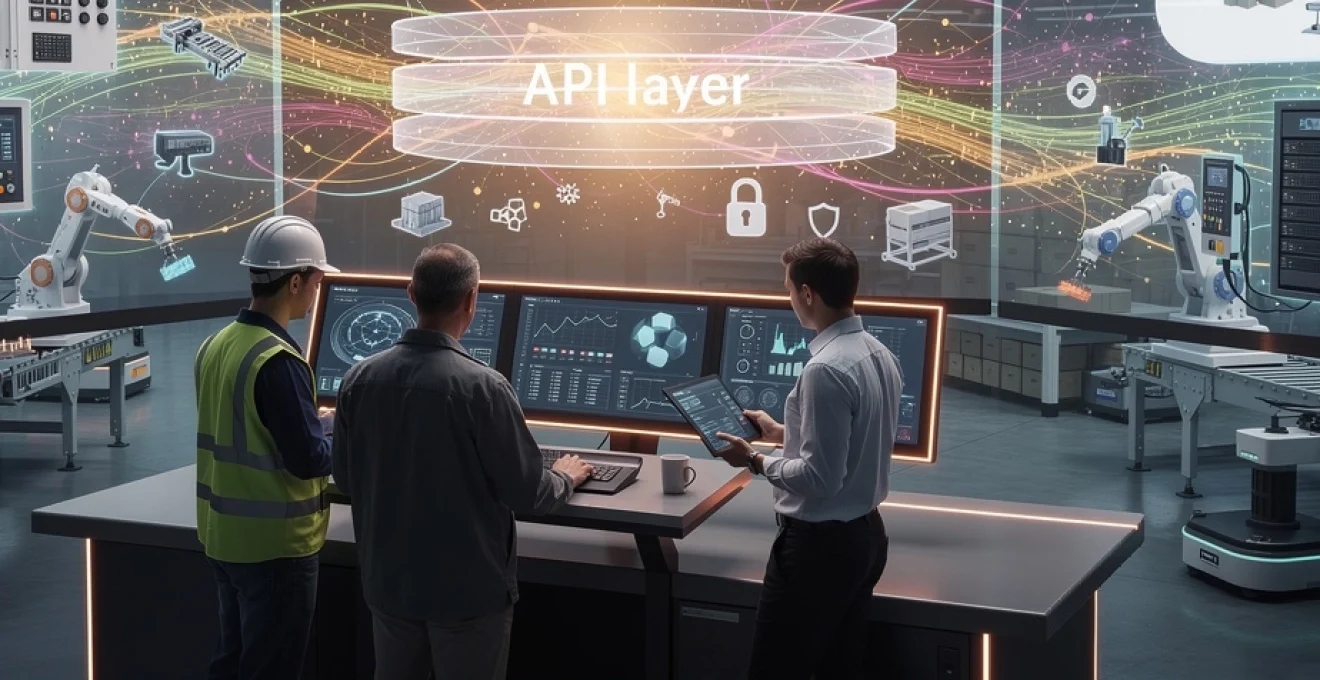
Modern manufacturing environments face an unprecedented challenge: the need to integrate disparate industrial systems that were never designed to work together. As factories evolve from isolated automation islands into interconnected smart manufacturing ecosystems, the complexity of system integration has grown exponentially. Legacy control systems, modern IoT devices, enterprise resource planning platforms, and sophisticated manufacturing execution systems must somehow communicate seamlessly to deliver the operational efficiency that Industry 4.0 promises.
Application Programming Interfaces (APIs) have emerged as the critical technology bridge that enables this transformation. By providing standardised communication protocols between previously incompatible systems, APIs are revolutionising how industrial organisations approach system integration. This technological evolution represents more than just a connectivity solution—it’s fundamentally reshaping how manufacturers think about data flow, operational visibility, and strategic decision-making across their entire value chain.
Industrial system fragmentation challenges in manufacturing environments
The industrial landscape presents a complex web of technological challenges that stem from decades of evolutionary development rather than revolutionary design. Manufacturing facilities today typically operate with a mixture of systems spanning multiple generations of technology, each optimised for specific functions but rarely designed with integration in mind. This fragmentation creates significant operational inefficiencies that can cost manufacturers millions in lost productivity and missed opportunities.
Legacy SCADA systems and modern IoT device communication barriers
Supervisory Control and Data Acquisition (SCADA) systems represent the backbone of industrial automation for many facilities, yet these systems often struggle to communicate with newer IoT devices and edge computing platforms. Traditional SCADA architectures were built around proprietary protocols and closed-loop communication structures that made sense when industrial networks were isolated from external connectivity. However, as manufacturers seek to leverage real-time data analytics and predictive maintenance capabilities, the inability of legacy SCADA systems to interface with modern sensor networks becomes a critical bottleneck.
The communication gap between legacy SCADA infrastructure and contemporary IoT ecosystems manifests in several ways. Protocol mismatches create data translation challenges, whilst different security models can leave networks vulnerable or completely inaccessible. Real-time data streaming becomes nearly impossible when systems operate on different time synchronisation standards or data formats. These barriers force manufacturers to choose between maintaining operational continuity with existing systems or investing in complete infrastructure overhauls.
ERP integration complexities with shopfloor automation platforms
Enterprise Resource Planning systems excel at managing business processes, financial workflows, and supply chain coordination, but they often exist in a parallel universe to shopfloor automation platforms. Manufacturing Execution Systems (MES) and Production Planning Systems operate with different data models, update frequencies, and business logic than their ERP counterparts. This disconnect creates information silos that prevent manufacturers from achieving true operational transparency.
The challenge becomes particularly acute when attempting to synchronise production schedules with inventory management or when trying to correlate quality control data with supplier performance metrics. Data latency between systems can result in production decisions based on outdated information, whilst manual data reconciliation processes introduce errors and delays that undermine operational efficiency. Without proper integration, manufacturers struggle to achieve the agile responsiveness that modern market conditions demand.
Data silos between rockwell automation and siemens control systems
Multi-vendor environments present unique challenges when different automation platforms must coexist within the same facility. Rockwell Automation’s FactoryTalk ecosystem and Siemens’ TIA Portal represent sophisticated automation solutions, but they operate using proprietary communication protocols and data structures that resist interoperability. This vendor-specific fragmentation forces manufacturers to maintain separate operational interfaces and data management systems for different production lines or facility areas.
The impact extends beyond simple communication challenges. Different programming languages, diagnostic tools, and maintenance procedures create operational complexity that requires specialised expertise for each platform. Cross-platform analytics becomes nearly impossible without significant data transformation efforts, limiting the ability to gain holistic insights into manufacturing performance. These silos prevent manufacturers from implementing unified approaches to predictive maintenance, quality management, and production optimisation.
Protocol incompatibilities in OT and IT network convergence
The convergence of Operational Technology (OT) and Information Technology (IT) networks represents one of the most significant architectural challenges in modern manufacturing. OT networks prioritise deterministic communication, real-time responsiveness, and operational safety
requirements, while IT networks focus on scalability, bandwidth efficiency, and enterprise-grade security models. When protocols such as Modbus/TCP, PROFINET, or EtherNet/IP need to coexist with HTTP, MQTT, or AMQP, manufacturers often encounter performance bottlenecks and fragile point-to-point integrations. Without a unifying integration strategy, every new connection between OT and IT risks introducing latency, jitter, or unexpected failure modes that can directly impact production uptime.
These protocol incompatibilities in converged OT/IT networks also increase cybersecurity exposure. Devices designed for air‑gapped environments are suddenly visible to corporate networks or even the public internet, often without appropriate authentication or encryption mechanisms. As a result, organisations find themselves juggling VLANs, firewalls, and custom gateways just to maintain basic segmentation. This is precisely where an API‑centric integration layer can impose structure, security, and observability on what would otherwise be a sprawling mesh of ad‑hoc connections.
Restful API architecture for industrial system integration
To address these integration challenges at scale, many manufacturers are adopting RESTful API architectures as a unifying abstraction layer across fragmented industrial systems. Rather than trying to force every device and application to speak the same low‑level protocol, RESTful APIs provide a common, web‑native interface for exchanging industrial data and commands. This approach allows operational systems to expose capabilities as reusable services, making it far easier to orchestrate workflows that span SCADA, MES, ERP, and industrial IoT platforms.
In practice, this means wrapping legacy protocols and proprietary interfaces behind well‑designed REST endpoints that use standard HTTP methods and JSON payloads. By doing so, we decouple the underlying equipment and control systems from higher‑level business applications, enabling more agile development and integration. Crucially, a RESTful architecture also supports modern DevOps practices, version control, and automated testing, helping manufacturers reduce integration risk while accelerating digital transformation.
OPC UA protocol implementation through modern API gateways
OPC UA has become the de facto standard for secure, platform‑independent communication in industrial environments, yet many enterprise and cloud applications are not natively OPC UA‑aware. Modern API gateways bridge this gap by exposing OPC UA data and methods through RESTful APIs, effectively translating between the industrial protocol and web‑based integration patterns. This allows you to treat OPC UA servers as first‑class data sources within a broader API ecosystem, without rewriting existing control logic.
In a typical implementation, an API gateway connects to OPC UA endpoints on PLCs, DCS systems, or data concentrators and maps key variables, events, and methods to REST resources. Engineers can then query equipment status, subscribe to alarms, or trigger remote procedures using familiar HTTP calls from MES, analytics platforms, or custom applications. By centralising this translation in the gateway, manufacturers maintain a single point of control for rate limiting, schema transformation, and access management, rather than embedding custom connectors in every consuming system.
Middleware solutions using apache kafka for real-time data streaming
RESTful APIs excel at request‑response interactions, but many industrial use cases require continuous, high‑volume data streaming from sensors, controllers, and machines. Apache Kafka has emerged as a powerful middleware layer for real‑time industrial data streaming, acting as a durable, scalable event backbone between OT and IT domains. When combined with APIs, Kafka allows manufacturers to decouple data producers and consumers while preserving low latency and high throughput.
A common pattern is to use lightweight connectors or edge gateways to publish telemetry, alarms, and production events from SCADA or PLCs into Kafka topics. Downstream services—such as quality analytics, predictive maintenance models, or digital twins—consume this data via Kafka clients or through RESTful APIs exposed by a stream processing layer. This event‑driven architecture turns industrial data into a shared resource rather than a series of isolated data feeds, making it far easier to plug in new applications without disruptive changes to the shopfloor.
JSON schema design for industrial equipment telemetry data
As soon as you begin exposing industrial data through APIs, consistent data modelling becomes critical. JSON has become the dominant payload format for RESTful APIs, but poorly defined structures can quickly lead to confusion and incompatibility across teams and systems. Designing robust JSON schemas for equipment telemetry, alarms, and production events gives you a contract that both data producers and consumers can rely on, much like a well‑architected wiring diagram in the physical plant.
Effective JSON schema design for industrial telemetry should capture not only raw values, but also metadata such as units of measure, timestamp accuracy, equipment identifiers, and quality flags. For instance, rather than exposing a bare temperature: 72, a richer schema might include temperature.value, temperature.unit, and temperature.source. This level of structure improves interoperability across MES, ERP, and analytics tools and reduces the likelihood of misinterpretation when new use cases emerge. Over time, standardised schemas form the backbone of scalable industrial data governance.
Authentication and security protocols in manufacturing API ecosystems
As more production‑critical systems become accessible via APIs, security is no longer optional—it is foundational. Manufacturing API ecosystems must implement robust authentication, authorisation, and encryption mechanisms that respect both IT security standards and OT safety constraints. Common approaches include OAuth 2.0 for delegated access, mutual TLS (mTLS) for strong device identity, and fine‑grained role‑based access control (RBAC) to govern who can read or write specific industrial data points.
From a practical standpoint, this means integrating API gateways with identity providers, enforcing least‑privilege access to equipment functions, and monitoring API traffic for anomalies that may indicate misuse or cyberattacks. You might restrict write access to control‑related endpoints to a narrow set of trusted services, while exposing read‑only telemetry more broadly for analytics. By formalising security policies at the API layer, manufacturers can confidently open up their industrial systems to partners, integrators, and cloud platforms without jeopardising operational integrity.
Enterprise resource planning API connectivity solutions
While APIs help connect field devices and control systems, their true business value is realised when industrial data flows seamlessly into Enterprise Resource Planning platforms. ERP systems such as SAP, Oracle NetSuite, Microsoft Dynamics 365, and Epicor are the backbone of planning, finance, and supply chain management, yet they often operate several layers removed from the realities of the shopfloor. API connectivity solutions close this gap by turning production events into business signals that ERPs can act on in near real time.
Rather than relying on nightly batch uploads or manual spreadsheet imports, manufacturers can use ERP APIs to synchronise work orders, inventory levels, quality records, and maintenance events with actual production conditions. This not only improves the accuracy of planning and costing, but also enables more responsive manufacturing strategies such as make‑to‑order, dynamic scheduling, and vendor‑managed inventory. In other words, APIs allow the ERP to stop guessing and start seeing what is really happening in the plant.
SAP manufacturing execution system integration via APIs
SAP environments are increasingly API‑first, with SAP S/4HANA and SAP Manufacturing Execution (SAP ME) providing extensive REST and OData interfaces for integration. For manufacturers running SAP, a common strategy is to use APIs to orchestrate bi‑directional data flow between SAP ME, plant‑level systems, and external industrial IoT platforms. Production orders, routings, and BOMs can be dispatched from SAP to MES via APIs, while actual production counts, scrap rates, and machine states flow back into SAP for real‑time visibility.
Implementing this integration typically involves mapping SAP business objects to shopfloor concepts and designing orchestration workflows that reconcile differences in timing and granularity. For example, multiple machine cycles might roll up into a single confirmed operation in SAP. By encapsulating this logic in well‑documented APIs, manufacturers reduce custom coding inside SAP itself and create a more maintainable integration layer. The result is a tighter loop between planning and execution, enabling rapid response to demand changes or production disruptions.
Oracle NetSuite WMS API connections to warehouse automation
In many plants, warehouse and materials handling operations are a major source of latency and cost, especially when Warehouse Management Systems (WMS) operate in isolation from automated storage and retrieval systems, conveyors, or AMRs. Oracle NetSuite offers REST‑based APIs for its WMS modules, which can be used to integrate with warehouse automation controllers, pick‑to‑light systems, or third‑party logistics platforms. By connecting these systems via APIs, manufacturers can synchronise inventory movements with physical flows on the warehouse floor.
Imagine an automated conveyor that triggers an API call to NetSuite when a pallet passes a barcode scanner, instantly updating inventory locations and availability. Conversely, NetSuite can push pick tasks and replenishment instructions to automation controllers via API, reducing manual data entry and paper‑based processes. This closed‑loop integration not only improves accuracy but also supports advanced strategies such as cross‑docking, wave picking, and real‑time order promising, all of which depend on reliable, API‑driven data exchange.
Microsoft dynamics 365 supply chain API implementation
Microsoft Dynamics 365 Supply Chain Management provides a rich set of REST APIs and Dataverse connectors that make it well suited for integration with industrial systems and IoT platforms. Manufacturers can leverage these APIs to tie production events, equipment condition data, and logistics milestones directly into supply chain processes. For instance, machine utilisation data exposed via APIs can feed into capacity planning models in Dynamics 365, while real‑time quality metrics can trigger automatic supplier returns or rework orders.
A practical implementation often involves using Azure services—such as Azure IoT Hub, Logic Apps, or Azure Functions—to mediate between OT data sources and Dynamics 365 APIs. This cloud‑based integration layer can normalise telemetry formats, apply business rules, and secure connections before updating ERP entities. The result is a more agile, event‑driven supply chain where changes on the shopfloor are reflected quickly in planning and logistics decisions, reducing the bullwhip effect and improving on‑time delivery performance.
Custom API development for epicor ERP manufacturing modules
Epicor ERP is widely used in mid‑market manufacturing, often in environments with a mix of legacy equipment and bespoke applications. While Epicor provides standard REST APIs, many organisations benefit from developing custom APIs that reflect their specific manufacturing modules and workflows. These custom endpoints can encapsulate complex business logic—such as multi‑stage routing, subcontracting, or lot traceability—in a way that is easy for other systems to consume.
For example, a custom Epicor API might expose a simplified interface for creating and updating job travellers based on data from a production scheduling system or IIoT platform. Another API could provide a consolidated view of material availability, combining ERP inventory with vendor lead times and in‑transit shipments. By investing in a coherent API layer around Epicor, manufacturers reduce the need for brittle database‑level integrations and gain a more flexible foundation for future digital initiatives.
Industrial IoT platform API orchestration strategies
As industrial IoT platforms proliferate, the challenge is no longer just connecting devices—it is orchestrating APIs across dozens of services, clouds, and applications. Each IIoT platform may offer its own device management, time‑series storage, analytics, and visualisation APIs, yet value is created when these capabilities are composed into end‑to‑end workflows. API orchestration strategies help manufacturers coordinate this ecosystem so that data, commands, and insights flow where they are needed, when they are needed.
In practice, orchestration often involves using API gateways, workflow engines, or low‑code integration tools to define how events from edge devices trigger actions in MES, ERP, maintenance systems, or digital twins. For example, a vibration anomaly detected by an IIoT edge agent might initiate an API call to a CMMS to create a work order, update a digital twin’s state in the cloud, and notify an operator via a collaboration platform. By defining these interactions declaratively rather than hard‑coding them, you gain the agility to adapt workflows as equipment, vendors, or business priorities change.
Another key element of IIoT API orchestration is lifecycle management. Devices are commissioned, updated, and retired over years, and your APIs must accommodate these changes without breaking dependent applications. Standardising on consistent resource models—for assets, locations, and telemetry streams—across platforms reduces integration complexity. Think of it like standardising electrical connectors in a plant: once everything uses the same plug type, reconfiguring lines and machines becomes far less painful.
Real-world case studies of successful API implementation
The theoretical benefits of APIs in industrial environments become much more tangible when we look at real‑world implementations. Across sectors such as automotive, pharmaceuticals, and heavy industry, manufacturers are already using API‑driven integration to cut downtime, increase throughput, and improve quality. These case studies provide practical patterns you can emulate, while also highlighting common pitfalls to avoid.
Consider a global automotive supplier that needed to harmonise production data across dozens of plants using different PLC vendors and MES solutions. By deploying an API gateway at each site, connected to OPC UA servers and local historians, the company exposed standardised REST endpoints for OEE metrics, machine states, and quality events. A cloud‑based analytics platform consumed these APIs to build global dashboards and predictive models, resulting in a double‑digit reduction in unplanned downtime within the first year.
In the process industries, a chemicals manufacturer used Apache Kafka and RESTful APIs to integrate its legacy DCS with a modern advanced process control and optimisation solution. Telemetry and events were streamed into Kafka topics, while optimisation recommendations were delivered back to operators and, in some cases, to control loops via secure API calls. This architecture allowed the company to trial new algorithms and analytics tools without touching the core control system, much like adding new instrumentation to a process without redesigning the entire plant.
Another example comes from a mid‑sized food and beverage producer that struggled with frequent stockouts and excess inventory due to poor synchronisation between production, warehousing, and sales. By tying its ERP, WMS, and shopfloor systems together via APIs, the company achieved near real‑time visibility of finished goods and raw materials across multiple sites. Automated workflows adjusted production schedules based on actual sales orders and inventory signals, cutting working capital and improving service levels. These stories illustrate that API‑driven integration is not just a theoretical ideal; it is a proven path to measurable business outcomes.
API security and compliance frameworks for industrial networks
As API usage grows across industrial networks, security and compliance move from afterthoughts to central design criteria. Unlike purely digital businesses, manufacturers must protect not only data but also physical processes and human safety. An insecure API that exposes control functions or sensitive telemetry can have consequences far beyond data loss. For this reason, robust API security frameworks tailored to industrial environments are essential.
A comprehensive approach typically combines multiple layers: network segmentation to isolate critical OT assets, secure API gateways to enforce authentication and authorisation, and continuous monitoring to detect anomalous patterns. Standards such as IEC 62443, NIST SP 800‑82, and ISO 27001 provide guidance on securing industrial control systems and information assets, and their principles should extend to any APIs that touch those systems. For example, strong identity and access management ensures that only vetted applications and users can invoke specific API endpoints, while audit logging provides traceability for compliance and incident response.
Data protection and privacy requirements also influence API design, particularly when production data includes information about workers, customers, or regulated products. Encryption in transit and at rest, tokenisation of sensitive fields, and data minimisation practices help manufacturers comply with frameworks such as GDPR or sector‑specific regulations. Additionally, you should consider how third‑party integrators and cloud providers access your industrial APIs, formalising responsibilities and controls in contracts and technical architectures. By treating API security and compliance as integral components of your industrial integration strategy, you can unlock the benefits of connectivity without compromising safety, reliability, or trust.