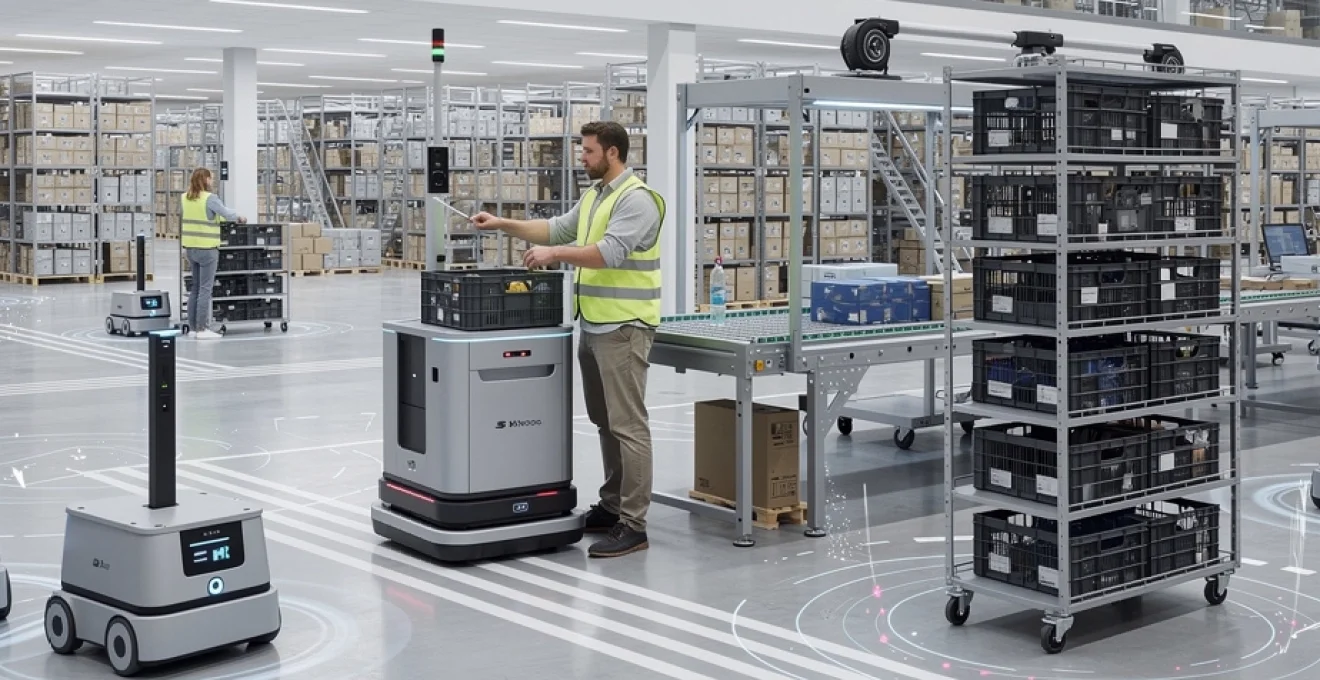
Warehouse operations are experiencing a fundamental transformation driven by autonomous mobile robots (AMRs), technologies that are reshaping how facilities manage material flow, order fulfilment, and labour allocation. Unlike traditional fixed automation systems, these intelligent machines navigate independently through warehouse environments, adapting to changing layouts and operational requirements without extensive infrastructure modifications. The adoption of AMR technology has accelerated dramatically in recent years, with the global market projected to reach £6.8 billion by 2026, representing a compound annual growth rate of approximately 23%. This surge reflects not merely a technological trend but a strategic response to persistent challenges facing warehouse managers: rising labour costs, increasing order complexity, and relentless pressure to improve throughput whilst maintaining safety standards. As e-commerce continues its expansion and customer expectations for rapid delivery intensify, the question for many logistics operations has shifted from whether to implement autonomous mobile robots to how quickly they can be integrated effectively.
Autonomous mobile robot technologies transforming modern warehousing
The technological foundation of modern AMRs represents a convergence of multiple advanced systems working in concert. These sophisticated platforms combine sensor arrays, artificial intelligence algorithms, and robust mechanical designs to create machines capable of independent decision-making within complex warehouse environments. The most effective implementations leverage multiple complementary technologies rather than relying on a single navigation method, creating redundancy and reliability that traditional automation systems often lack.
Collaborative mobile robots (CoMRs) and their integration with human workforce
Collaborative mobile robots represent a particular subset of AMR technology specifically engineered to work safely alongside human operators without requiring physical barriers or extensive safety zones. Unlike their industrial robot predecessors that operated in caged environments, CoMRs feature advanced safety sensors that continuously monitor their surroundings, adjusting speed and trajectory in real-time when human workers approach. This capability fundamentally changes warehouse workflows by allowing robots to share the same operational space as employees, creating a truly integrated work environment where each party contributes according to their strengths.
The integration of CoMRs with human teams typically follows a task-sharing model where robots handle repetitive transport duties whilst workers focus on activities requiring judgement, dexterity, or problem-solving capabilities. Research from warehouse operations implementing collaborative systems indicates that this division of labour can increase overall productivity by 30-40% compared to purely manual operations. The psychological impact on workers is equally significant; many warehouse employees report reduced physical fatigue and increased job satisfaction when robots assume the burden of monotonous material movement tasks.
Goods-to-person systems using AMRs from locus robotics and GreyOrange
Goods-to-person systems represent one of the most transformative applications of AMR technology in warehouse operations. Rather than requiring pickers to walk extensive distances searching for products, these systems dispatch autonomous robots to retrieve storage units and transport them directly to ergonomic picking stations. Companies such as Locus Robotics have pioneered collaborative picking robots that guide workers through optimised pick sequences, displaying item information and quantity requirements through integrated screens whilst simultaneously managing the transport of picked items.
GreyOrange has developed particularly sophisticated goods-to-person systems through their Butler platform, which combines mobile robots with intelligent software orchestration to manage inventory dynamically. Their approach treats warehouse storage as a flexible resource rather than fixed locations, continuously reorganising products based on demand patterns and operational requirements. This dynamic slotting capability can reduce pick times by 50-70% compared to traditional zone-picking methods, whilst simultaneously improving inventory accuracy through automated tracking of every movement.
The economic advantages of goods-to-person systems become increasingly compelling in high-throughput environments. Facilities processing thousands of orders daily often achieve return on investment within 18-24 months, driven primarily by labour productivity improvements and reduced training requirements. The system effectively transforms novice workers into productive contributors within hours rather than weeks, as the robots guide them through optimised workflows requiring minimal warehouse layout knowledge.
Lidar, SLAM navigation, and computer vision in AMR path planning
The navigation capabilities distinguishing autonomous mobile robots from their predecessive automated guided vehicles (AGVs) rely primarily on three interconnected technologies: LiDAR sensing, Simultaneous Localisation and Mapping (SLAM) algorithms, and computer vision systems. LiDAR sensors create detailed three-dimensional maps of warehouse environments by measuring the time required for laser pulses
to bounce off surrounding objects and return to the sensor. These measurements allow the robot to generate a precise, continuously updated model of its environment, even in large, cluttered warehouses. SLAM algorithms then use this data to determine the robot’s exact position within that map while simultaneously refining the map itself, enabling navigation without magnetic tape, QR codes, or fixed beacons. The result is a level of flexibility that traditional AGVs cannot match, as AMRs can be redeployed to new areas with minimal configuration and no construction work.
Computer vision adds an additional layer of intelligence to AMR path planning by interpreting visual cues such as rack labels, pallets, and even human gestures. Cameras mounted on the robots feed image data into machine learning models that can recognise obstacles, detect changes in the environment, and interpret signage that might indicate restricted zones or priority lanes. Combining LiDAR, SLAM, and vision allows autonomous mobile robots to make context-aware decisions, such as slowing down in congested aisles or rerouting around a temporarily blocked picking zone. For warehouse managers, this means path planning that is not only efficient in theory but robust in the messy reality of live operations.
Fleet management software and multi-robot coordination algorithms
As soon as warehouses deploy more than a handful of autonomous mobile robots, the challenge shifts from individual navigation to coordinated fleet management. Fleet management software acts as the “air traffic control” system for AMRs, assigning tasks, balancing workloads, and preventing congestion in busy zones such as packing areas or cross-dock staging lanes. Advanced systems use optimisation algorithms to determine which robot should handle each job based on proximity, current battery level, and task priority, thereby reducing empty travel and improving utilisation across the fleet. This orchestration is essential when dozens or even hundreds of robots share the same workspace with people and material handling equipment.
Multi-robot coordination algorithms go further by enabling AMRs to negotiate shared resources such as intersections, charging stations, and narrow aisles. Techniques such as graph-based path planning, priority queues, and dynamic traffic rules help robots avoid deadlocks and minimise waiting times, particularly during peak season when order volumes surge. Many modern fleet managers incorporate simulation capabilities, allowing operations teams to test new workflows or layout changes in virtual environments before deploying them on the warehouse floor. For organisations considering large-scale AMR deployment, evaluating the maturity of the fleet management layer is just as important as assessing the capabilities of the robots themselves.
AMR market leaders and their warehouse automation solutions
The autonomous mobile robot landscape is now populated by a mix of established industrial players and fast-moving robotics start-ups. Each vendor brings its own design philosophy, software ecosystem, and target use cases, ranging from small e-commerce fulfilment centres to sprawling, multi-site distribution networks. Understanding the strengths of key AMR market leaders helps warehouse operators match technology to operational goals, whether that means accelerating piece picking, automating pallet moves, or integrating with high-density automated storage systems. Below we examine several prominent providers whose solutions are reshaping warehouse automation strategies worldwide.
Mir autonomous mobile robots for internal transport applications
Mobile Industrial Robots (MiR) has built a strong reputation around flexible, easy-to-deploy AMRs for internal transport tasks such as moving pallets, carts, and totes between production areas and storage zones. MiR platforms typically feature a flat top surface that can be fitted with custom modules, conveyors, or cart hooks, allowing them to adapt to a wide range of workflows without bespoke hardware. Their navigation relies on laser scanners and cameras rather than physical guidance infrastructure, meaning sites can reconfigure routes as operations evolve. For manufacturers and warehouses seeking to automate non-value-adding transport, MiR autonomous mobile robots provide a compelling entry point.
One of MiR’s differentiators is its focus on user-friendly configuration tools that allow internal teams to map facilities, define missions, and adjust traffic rules without deep programming expertise. This lowers the barrier to adoption for organisations that may not have dedicated robotics engineers on staff. MiR’s fleet management software supports multi-robot coordination, prioritising urgent tasks such as rush orders or line-feeding operations to keep production running smoothly. For sites looking to scale internal transport automation gradually, starting with a few MiR robots and expanding over time is often a practical and cost-effective approach.
Amazon robotics proteus and drive unit evolution
Amazon Robotics has long been a benchmark for goods-to-person automation, initially through its Kiva-derived drive units that move shelving “pods” to stationary pickers. The introduction of Proteus, Amazon’s first fully autonomous mobile robot designed to move safely in the same space as people, marks a significant evolution in the company’s approach to warehouse robotics. Proteus uses advanced safety, perception, and navigation technologies to operate in open environments rather than being confined to restricted robot-only areas. This aligns with a broader industry trend towards collaborative mobile robots that blend seamlessly into human workflows.
The evolution from early drive units to Proteus highlights how AMR technology is shifting from rigid automation zones to more fluid and adaptable layouts. While legacy drive units thrive in high-density storage grids with controlled access, Proteus and similar platforms can navigate mixed environments, dynamically routing around associates, pallets, and temporary obstacles. For operators outside Amazon’s ecosystem, this trajectory underscores the importance of planning for both current and future warehouse layouts when selecting an AMR solution. As more vendors adopt similar design principles, we can expect a growing focus on modular systems that can evolve alongside changing inventory profiles and fulfilment strategies.
Geek+ and AutoStore integration for high-density storage retrieval
Geek+ has emerged as a leading provider of goods-to-person and tote-handling AMRs, particularly in e-commerce and retail distribution centres that demand high throughput. Its robots move shelving racks or totes to ergonomic workstations, reducing walking time and improving pick efficiency. One of the most interesting developments in this space is the integration of AMR solutions with high-density storage systems such as AutoStore, creating hybrid environments that blend shuttle-based storage with flexible robotic transport. In these configurations, AutoStore handles ultra-compact cube storage while AMRs like those from Geek+ shuttle totes to packing or value-added service areas.
For warehouse operators, combining Geek+ robots with AutoStore can unlock both space utilisation optimisation and workflow flexibility. AutoStore’s grid maximises vertical and horizontal density, while the AMRs provide dynamic routing and capacity on demand, especially during seasonal peaks. This integration is particularly attractive for urban fulfilment centres where floor space is at a premium but order profiles are highly variable. By orchestrating storage and retrieval across both systems, operations teams can smooth bottlenecks, balance workloads, and maintain high service levels even under fluctuating demand.
Fetch robotics cloud-based workflow automation platform
Fetch Robotics, now part of Zebra Technologies, takes a software-centric approach to warehouse automation through its cloud-based workflow platform. Instead of treating AMRs as isolated machines, Fetch emphasises end-to-end workflow automation, connecting robots, handheld devices, and existing warehouse systems into a unified ecosystem. Its robots are designed for tasks such as case picking support, cart transport, and point-to-point delivery, but the real value often lies in the orchestration layer that coordinates missions across the facility. Because the platform is delivered via the cloud, updates and new features can be rolled out without major on-premises upgrades.
This cloud-first strategy is particularly compelling for organisations seeking rapid deployment and remote management capabilities across multiple sites. Operations leaders can monitor AMR fleets, analyse utilisation metrics, and adjust workflows from a central dashboard, standardising best practices globally. For warehouses already invested in Zebra handhelds and data capture devices, Fetch Robotics’ integration can create a smooth bridge between manual processes and automated flows. In many cases, this approach allows companies to digitise and optimise their workflows before adding more sophisticated levels of robotic automation.
ROI analysis and operational efficiency metrics for AMR deployment
Investing in autonomous mobile robots inevitably raises questions about payback period, total cost of ownership, and measurable performance improvements. While headline figures such as “30% productivity gains” are common, effective ROI analysis for AMR deployment requires a more granular look at order fulfilment metrics, labour costs, space utilisation, and error rates. By establishing clear baseline data before implementation, warehouse managers can track how AMRs influence key performance indicators over time. This disciplined approach also helps build internal business cases and secure stakeholder buy-in for future phases of automation.
Order fulfilment speed enhancement and pick rate improvements
One of the most visible benefits of autonomous mobile robots is the acceleration of order fulfilment speed. By reducing walking time and streamlining material transport, AMRs can dramatically increase lines picked per hour and shorten cycle times from order release to shipment. In goods-to-person environments, it is not uncommon to see pick rate improvements of 2–3 times compared to traditional manual carts, particularly when robots are orchestrating optimised pick paths and batching multiple orders. Faster fulfilment directly supports same-day and next-day delivery promises that are now standard in many sectors.
To quantify these gains, warehouses typically track metrics such as average order processing time, picks per labour hour, and on-time shipment percentage before and after AMR deployment. Many operations also measure the impact on order accuracy, as robots help standardise workflows and reduce the chance of items being picked from the wrong location. When autonomous mobile robots handle transport and location management, pickers can focus on verification and quality, which tends to lower error rates. For organisations under pressure to meet service-level agreements, these combined improvements in speed and accuracy form a compelling part of the AMR business case.
Labour cost reduction through warehouse task automation
Labour represents a significant proportion of warehouse operating expenses, often exceeding 50% of total costs in labour-intensive fulfilment centres. Autonomous mobile robots do not eliminate the need for people, but they can substantially reduce time spent on low-value tasks such as walking, searching for items, or moving empty containers. By reassigning staff from manual transport to higher-value activities like exception handling, inventory analysis, or process improvement, warehouses can achieve more output with the same headcount. In tight labour markets where hiring and retention are ongoing challenges, AMRs also help reduce reliance on temporary workers during peak periods.
From a financial perspective, labour savings manifest in several ways: fewer overtime hours, lower recruitment and training costs, and reduced absenteeism due to physical fatigue or repetitive strain. Some operations choose to freeze headcount and let natural attrition deliver cost savings as AMRs take on more routine work. Others redirect staff to support business growth without a proportional increase in labour spend. When building ROI models, it is important to factor in not only hourly wage reductions but also indirect savings such as lower supervisory overhead and decreased injury-related costs.
Space utilisation optimisation with dynamic storage systems
Space utilisation is another critical lever in AMR-driven warehouse optimisation, especially as industrial real estate costs continue to rise. Dynamic storage systems, including goods-to-person robots and high-density grids, allow facilities to compress inventory into smaller footprints while maintaining or even improving accessibility. Autonomous mobile robots can navigate tighter aisles than forklifts, enabling higher rack density and more creative layouts that would be impractical with manual equipment. For example, narrow-aisle configurations serviced by AMRs can increase storage capacity by 20–40% without expanding the building.
Beyond simple density, AMRs support intelligent slotting strategies that adapt to changing demand. Frequently picked items can be positioned closer to pick stations, while slow movers migrate to less accessible zones, with robots handling the additional travel. This dynamic approach contrasts with static layouts where product locations are rarely updated due to the labour involved. When combined with data from the warehouse management system, autonomous mobile robots become key enablers of continuous space optimisation, helping operators defer or avoid costly facility expansions.
Integration challenges with warehouse management systems and legacy infrastructure
Despite their benefits, autonomous mobile robots must coexist with existing warehouse management systems (WMS) and physical infrastructure, which can introduce integration challenges. Many facilities run mature, heavily customised WMS platforms that were not originally designed with robotics in mind. Bridging this gap requires careful planning around data exchange, task orchestration, and exception handling. Similarly, legacy buildings may feature narrow docks, irregular floor surfaces, or limited network coverage, all of which can affect AMR performance if not addressed early in the project.
API connectivity between AMRs and SAP extended warehouse management
SAP Extended Warehouse Management (EWM) is widely used in complex distribution environments, making API connectivity between AMRs and SAP EWM a priority for many large enterprises. Effective integration ensures that robots receive tasks in alignment with existing wave planning, slotting rules, and inventory strategies, rather than operating as a disconnected subsystem. Typically, the WMS remains the system of record for stock information and order allocation, while the AMR fleet manager handles real-time execution details such as route optimisation and robot assignment. This division of responsibilities helps maintain data consistency while exploiting the agility of autonomous mobile robots.
To achieve seamless connectivity, many vendors provide pre-built connectors or certified integrations for SAP EWM and similar platforms. These interfaces handle message formats, status updates, and error codes, reducing the need for custom development. Nevertheless, integration projects still require careful mapping of business processes: How should the system respond if a robot cannot complete a task? Which exceptions should trigger human intervention versus automatic retries? By resolving these questions upfront, operations teams can avoid disruptive edge cases once AMRs are live on the warehouse floor.
Retrofitting existing facilities with AMR-compatible infrastructure
Few warehouses are built from scratch around autonomous mobile robots, so retrofitting existing facilities is often part of the automation journey. AMRs are more forgiving than fixed systems, but they still rely on certain infrastructure elements to perform reliably: consistent Wi-Fi coverage, sufficient charging areas, clearly marked pathways, and safe crossing points at busy intersections. In older buildings, addressing these fundamentals may involve adding wireless access points, levelling uneven floors, or redesigning certain traffic flows to separate pedestrian and forklift traffic. Though these upgrades carry a cost, they also contribute to broader safety and productivity improvements.
When planning retrofits, involving cross-functional teams from IT, operations, and safety ensures that changes support both robot performance and human workflows. For instance, relocating staging areas or re-striping aisles can eliminate bottlenecks and clarify right-of-way rules for all traffic, not just AMRs. Some organisations run pilot zones to test infrastructure changes before rolling them out across the warehouse. This iterative approach allows you to validate assumptions, fine-tune layouts, and build internal confidence in autonomous mobile robot technology without committing to a full-scale redesign from day one.
Real-time inventory synchronisation and data exchange protocols
Autonomous mobile robots introduce new data streams into the warehouse technology stack, from task status updates to sensor-based location information. To prevent discrepancies, real-time inventory synchronisation between AMR systems and the WMS is essential. If the robot reports a tote has been delivered to a packing station, for example, the WMS must immediately reflect that change so subsequent processes can proceed without confusion. This requires robust data exchange protocols, often using RESTful APIs, message queues, or event-driven architectures to minimise latency and ensure reliability.
In practice, designing these integrations is as much about process clarity as it is about technology. Which system creates the initial move task? At what point is inventory ownership transferred between zones? How are partial picks, damaged items, or exceptions communicated back to the WMS? By defining these rules clearly and implementing consistent messaging patterns, warehouses can leverage AMR-generated data for richer analytics and continuous improvement. In many cases, the journey towards autonomous mobile robots becomes a catalyst for broader digital transformation, prompting organisations to modernise legacy interfaces and standardise data models across their supply chain systems.
Scalability and peak season demand management with AMR fleets
One of the most compelling advantages of autonomous mobile robots is their inherent scalability. Unlike fixed conveyor systems that require significant capital expenditure and construction to expand, AMR fleets can often be scaled simply by adding more robots and adjusting software configurations. This flexibility is particularly valuable in industries with pronounced peak seasons, such as retail, fashion, and consumer electronics. Instead of overbuilding permanent capacity that sits idle for much of the year, warehouses can size their core infrastructure for average demand and supplement it with additional robots during busy periods.
From an operational perspective, fleet scalability hinges on the maturity of the orchestration software and the robustness of supporting infrastructure. Can the network handle increased robot traffic? Are charging strategies optimised so that additional units do not create bottlenecks at power stations? Well-designed systems use predictive analytics to anticipate peak loads and pre-stage robots in strategic zones, much like airlines position aircraft ahead of holiday travel surges. By planning for elasticity in both technology and processes, warehouses can respond quickly to demand spikes without compromising safety or service levels.
Scalability also has a strategic dimension: as order profiles change or new channels are added, AMR fleets can be re-tasked to support emerging workflows. For example, robots originally deployed for replenishment can be reassigned to support click-and-collect operations or reverse logistics processing. This ability to reconfigure capabilities over time reduces the risk of technology obsolescence. For organisations operating multiple sites, standardising on a common AMR platform further simplifies scaling, as robots and best practices can be replicated across the network with minimal re-engineering.
Future developments in AMR artificial intelligence and machine learning capabilities
The next wave of innovation in autonomous mobile robots will be driven by advances in artificial intelligence and machine learning. While today’s AMRs already use AI for navigation and obstacle avoidance, future systems will increasingly learn from historical data to optimise routes, predict maintenance needs, and adapt to subtle changes in demand patterns. Imagine robots that can anticipate congestion before it occurs, rerouting themselves proactively like a GPS system that automatically avoids traffic jams. As more warehouses capture detailed operational data, machine learning models will become better at recommending layout changes, slotting strategies, and staffing levels that complement robotic capabilities.
Another promising area is the development of more intuitive human–robot interaction, where associates can communicate with AMRs through natural language, simple gestures, or wearable devices. This could make it easier to introduce robots into environments with high staff turnover or seasonal labour, as the learning curve for working alongside autonomous mobile robots becomes even shorter. At the same time, AI-driven perception systems will continue to improve, enabling robots to handle increasingly complex tasks such as mixed-SKU pallet handling or dynamic hazard recognition. As with any emerging technology, successful adoption will depend on thoughtful change management and a clear focus on how AMRs enhance, rather than replace, human expertise on the warehouse floor.