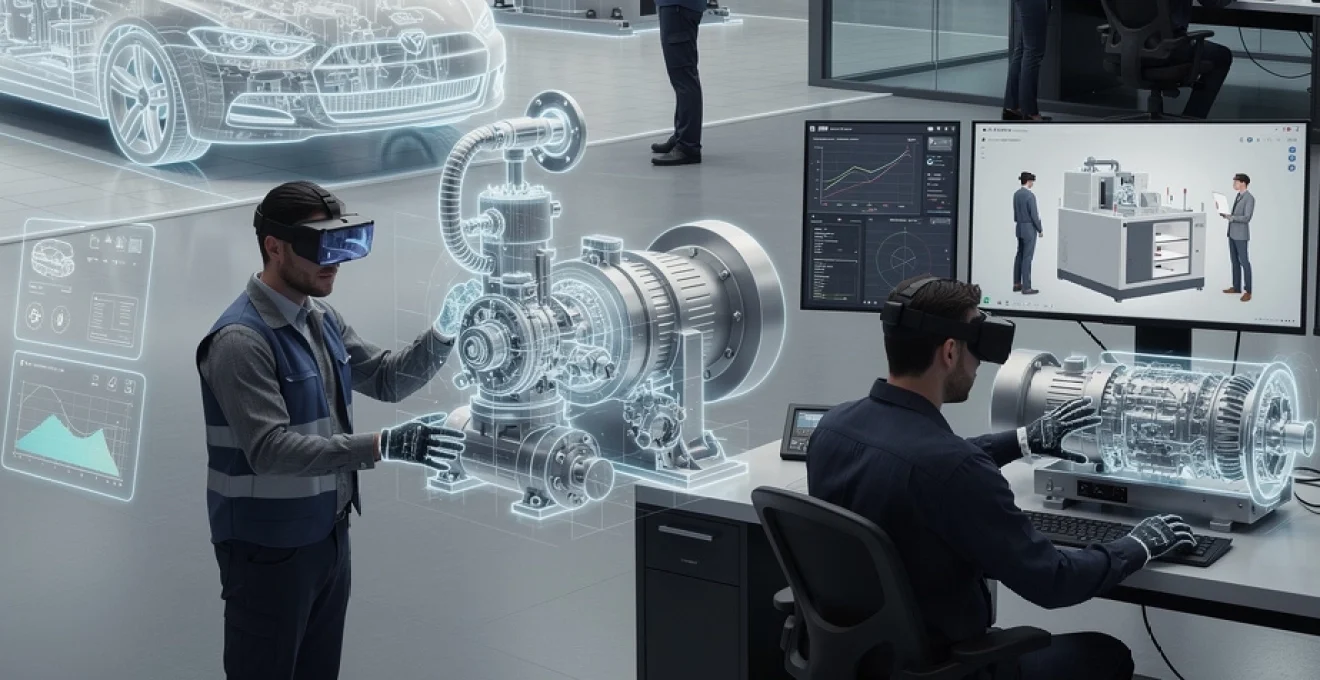
The industrial landscape is experiencing a profound transformation as virtual reality technology moves beyond entertainment applications into mission-critical training and design operations. Manufacturing facilities, aerospace companies, and energy corporations are discovering that VR provides unprecedented opportunities to simulate complex scenarios, reduce training costs, and accelerate product development cycles. What once required expensive physical prototypes and high-risk training environments can now be accomplished safely and cost-effectively through immersive digital experiences.
This technological shift represents more than just a trend; it’s becoming an essential competitive advantage for organisations seeking to modernise their training programmes and design review processes. The ability to create photorealistic simulations of industrial environments, combined with sophisticated haptic feedback systems, is revolutionising how employees learn complex procedures and how design teams collaborate across global projects. As hardware costs decrease and software capabilities expand, the adoption rate of VR in industrial applications is accelerating rapidly.
Virtual reality hardware solutions for industrial training applications
The foundation of any successful industrial VR implementation lies in selecting appropriate hardware that balances performance requirements with practical considerations. Modern VR systems must deliver high-resolution visuals, responsive tracking, and comfortable extended-use capabilities whilst maintaining compatibility with existing industrial software platforms. The evolution of standalone and tethered VR solutions has created diverse options for different training scenarios and budget constraints.
Oculus quest 2 and HTC vive pro implementation in manufacturing environments
The Oculus Quest 2 has emerged as a popular choice for industrial training due to its wireless functionality and user-friendly setup requirements. Manufacturing environments benefit from the device’s inside-out tracking system, which eliminates the need for external sensors whilst providing reliable spatial awareness. The headset’s 1832 x 1920 per eye resolution delivers sufficient detail for most training applications, including assembly procedures and safety protocol demonstrations.
Conversely, the HTC Vive Pro offers superior tracking precision through its lighthouse system, making it ideal for applications requiring millimetre-accurate hand positioning. The headset’s modular design allows for custom industrial mounting solutions, whilst its higher resolution displays (1440 x 1600 per eye) provide enhanced clarity for detailed technical drawings and component identification tasks. Manufacturing facilities often deploy multiple Vive Pro units for concurrent training sessions, leveraging the system’s robust tracking capabilities for group learning scenarios.
Microsoft HoloLens 2 mixed reality integration for maintenance procedures
Microsoft’s HoloLens 2 represents a unique approach to industrial training through mixed reality capabilities that overlay digital information onto physical equipment. Maintenance technicians can access step-by-step instructions, component identification guides, and safety warnings directly within their field of view whilst working on actual machinery. The device’s hand tracking technology enables intuitive manipulation of holographic interfaces without requiring handheld controllers.
The HoloLens 2’s enterprise-focused design includes features specifically valuable for industrial applications, such as extended battery life, comfortable weight distribution, and compatibility with safety equipment. Field of view limitations at 52 degrees may restrict some applications, but the device excels in scenarios where real-world interaction remains essential. Remote assistance capabilities allow expert technicians to guide field personnel through complex procedures using shared holographic annotations.
Varjo aero High-Resolution displays for precision assembly training
Varjo Aero headsets address the critical need for ultra-high resolution displays in precision manufacturing training. With 2880 x 2720 resolution per eye and human-eye resolution clarity in the central viewing area, these devices enable trainees to work with small components and read fine text that would be illegible on standard VR displays. The technology proves particularly valuable for electronics assembly, medical device manufacturing, and aerospace component installation training.
The headset’s advanced optics reduce the screen-door effect that can interfere with precision tasks, whilst maintaining a 115-degree field of view for immersive experiences. Integration with high-end workstations enables real-time rendering of complex CAD models and detailed material textures. However, the premium pricing positions Varjo Aero as a solution for specialised training applications where visual fidelity directly impacts learning outcomes.
Haptic feedback systems using HaptX gloves for technical skill development
Haptic feedback technology transforms
Haptic feedback technology transforms virtual reality from a purely visual experience into a tactile training environment where learners can feel tools, surfaces, and resistance. HaptX gloves, for example, use microfluidic actuators to simulate touch sensations, enabling trainees to grasp virtual components with realistic force feedback. This makes them particularly effective for technical skill development in areas such as valve operation, torque application, and delicate component handling. By reproducing the sensation of resistance when turning a wrench or pressing a button, VR training more closely mirrors real-world conditions and helps reinforce muscle memory.
For industrial organisations, integrating HaptX gloves into VR training programmes can significantly enhance the effectiveness of technical instruction whilst reducing wear and tear on physical equipment. Trainees can repeat complex procedures, such as disassembling and reassembling a pump, without risking damage to costly components. The main implementation challenge lies in calibrating virtual tools and objects so that haptic feedback aligns accurately with visual cues, preventing confusion and discomfort. As haptic systems become more affordable and easier to deploy, we can expect broader adoption in fields where fine motor skills and tactile sensitivity are critical to performance.
Immersive training programme development using unity 3D and unreal engine
Once the appropriate VR hardware has been selected, the next step is to design and develop immersive training content that reflects real industrial workflows. Game engines such as Unity 3D and Unreal Engine have become the de facto platforms for building interactive simulations because they offer robust physics systems, rich visual capabilities, and large ecosystems of plugins. Industrial organisations often collaborate with specialist VR development studios or build in-house teams to create training modules tailored to their specific equipment and safety procedures. The key is to strike the right balance between graphical fidelity, interactivity, and performance on the chosen headsets.
By adopting a modular development approach, companies can create a library of reusable training scenarios that cover everything from basic orientation to advanced fault-finding exercises. For example, the same virtual factory model can support onboarding tours, safety drills, and equipment-specific maintenance training by simply swapping out interactive elements and instructional overlays. This reusability significantly reduces long-term content development costs and allows training programmes to evolve alongside changes in production lines and regulations. In many ways, a well-structured VR training ecosystem becomes a living digital playbook for industrial operations.
Photogrammetry and CAD model integration for realistic industrial environments
To achieve maximum realism, industrial VR training increasingly relies on combining photogrammetry and CAD model integration. Photogrammetry uses hundreds or thousands of photographs of a facility or component to generate highly detailed 3D meshes and textures, effectively creating a digital twin of the real environment. When this is paired with CAD models of machines, tools, and safety equipment, the result is a training space that looks and feels remarkably close to the actual workshop or plant floor. This realism is especially important for tasks where spatial awareness and familiarity with equipment layout directly impact safety.
From a technical standpoint, the challenge lies in optimising these high-fidelity assets so that they run smoothly on devices such as Oculus Quest 2 or HoloLens 2 without causing motion sickness or frame-rate drops. Developers must simplify meshes, bake lighting, and compress textures while preserving critical visual details like labels, warning signs, and control interfaces. An effective strategy is to keep background elements lighter in detail while reserving high-resolution assets for interactive components and areas where learners must make precise visual judgments. When done well, you get the best of both worlds: immersive realism and reliable performance.
Physics-based simulation programming for heavy machinery operation training
Heavy machinery operation training is one of the most compelling use cases for physics-based simulation in virtual reality. Instead of learning to operate cranes, excavators, or hydraulic presses directly on expensive and potentially dangerous equipment, operators can first practise in a controlled VR environment. Unity 3D and Unreal Engine both offer advanced physics engines that simulate gravity, inertia, friction, and material resistance. By fine-tuning these parameters, developers can approximate how a load swings on a crane hook or how a forklift responds to sudden steering inputs under heavy weight.
Why does this matter for industrial training? Because realistic physics help trainees develop intuitive understanding of machine behaviour, similar to how a flight simulator prepares pilots for real-world turbulence. In VR, operators can experience hazardous scenarios—such as load shifts, near-collisions, or hydraulic failures—without any real-world consequences. This allows you to train for events that would be too risky or too rare to simulate physically. Over time, organisations often see reduced incident rates and lower equipment damage costs as operators bring their VR-acquired instincts to the real world.
Multi-user collaborative VR sessions through photon network architecture
Industrial training is rarely a solo activity; teams must coordinate actions, communicate effectively, and respond together to emergencies. Multi-user collaborative VR sessions, enabled by networking solutions such as Photon, make this possible in a virtual environment. With Photon network architecture, multiple trainees and instructors can occupy the same simulated plant, see each other’s avatars, and interact with shared tools and equipment in real time. This transforms VR from a single-user experience into a collaborative learning arena where teamwork skills can be practised and evaluated.
From an implementation perspective, synchronising object states, voice communication, and user interactions across several devices requires careful network design and optimisation. Developers must minimise latency to avoid disorienting delays, particularly when multiple users manipulate the same virtual component. When configured correctly, however, multi-user VR can support complex scenarios such as coordinated lockout-tagout procedures or emergency response drills involving operators, supervisors, and control room staff. It also makes remote participation viable, allowing geographically dispersed teams to train together as if they were on the same factory floor.
Performance analytics and learning assessment integration via xAPI standards
To justify investment in VR training and continuously improve programme quality, organisations need robust performance analytics and learning assessment tools. This is where the Experience API (xAPI) standard becomes essential. By instrumenting VR scenarios with xAPI statements, every meaningful learner action—such as inspecting a gauge, selecting the correct PPE, or completing a lockout sequence—can be recorded and transmitted to a Learning Record Store (LRS). These granular data points provide far more insight than traditional pass/fail tests or attendance records.
In practice, this means you can track how long it takes a trainee to identify a simulated leak, how many mistakes they make when assembling a component, or how consistently they follow prescribed safety steps. Trainers can then use dashboards and analytics tools to identify common pain points, adapt content, and personalise coaching. Over time, correlations between VR performance metrics and real-world incident data can help validate and refine the training strategy. The result is an evidence-based approach to industrial education where every simulation session contributes to a richer understanding of workforce competence.
Industrial design review workflows through virtual reality platforms
Beyond training, virtual reality plays a growing role in industrial design reviews, where engineers, designers, and stakeholders evaluate products and production systems before committing to physical prototypes. Traditional design reviews often rely on 2D drawings or on-screen 3D models, which can make it hard to grasp scale, ergonomics, and spatial relationships. VR platforms change this by placing reviewers inside the design, enabling life-size inspection, intuitive navigation, and rapid iteration. This immersive approach helps uncover design flaws and usability issues earlier in the development process, when they are less costly to fix.
As organisations adopt VR for design collaboration, workflows are evolving to integrate virtual reviews at multiple stages—from concept validation to pre-production checks. For example, a team might first explore rough volumetric concepts in VR, then later perform detailed ergonomics assessments using high-fidelity CAD data. The goal is not to replace traditional CAD tools but to augment them with spatial understanding and real-time collaboration. In many industries, this shift is shortening design cycles and reducing the number of physical prototypes needed before sign-off.
Autodesk VRED and KeyShot VR rendering for product visualisation
High-end visualisation tools such as Autodesk VRED and KeyShot VR are central to immersive product visualisation workflows, especially in automotive and consumer electronics sectors. These platforms specialise in accurate material rendering, lighting, and reflections, which are critical when evaluating surface quality, colour choices, and perceived build quality. By exporting scenes to VR or using built-in VR modes, teams can step around a full-scale digital prototype, examine details under different lighting conditions, and assess how materials look from various viewing angles.
For industrial design teams, this kind of photorealistic virtual reality product visualisation helps bridge the gap between engineering intent and marketing expectations. Stakeholders can experience multiple trim levels, colour palettes, or accessory options without commissioning separate physical mock-ups for each variant. This is particularly useful when making decisions about high-cost tooling or surface finishes that are expensive to change later. In effect, VR becomes a high-fidelity “virtual showroom” where design trade-offs can be evaluated quickly and collaboratively.
Real-time CAD collaboration using gravity sketch and immersed platforms
While traditional CAD tools are optimised for precision modelling on 2D screens, platforms such as Gravity Sketch and Immersed bring real-time CAD collaboration into virtual reality. In these environments, designers can sketch, block out forms, and manipulate 3D geometry using natural hand movements, much like sculpting clay in a studio. Multiple participants can join the same virtual workspace, annotate designs, and iterate on concepts in real time. This spatial co-creation process often leads to more intuitive forms and faster consensus on key design directions.
Imagine standing next to a full-scale model of a machine housing or vehicle interior and reshaping surfaces collaboratively with colleagues in different countries. Instead of sending static screenshots back and forth, you all see changes instantly, discuss ergonomics, and test different configurations on the fly. These immersive CAD collaboration sessions can significantly compress review cycles and reduce misunderstandings between industrial designers, engineers, and manufacturing planners. For teams under pressure to deliver products faster, the ability to align decisions in a single VR session can be a major competitive advantage.
Digital twin integration with siemens NX and SolidWorks visualize
As digital twin strategies gain traction in industry, integrating VR with tools like Siemens NX and SolidWorks Visualize is becoming a natural next step. A digital twin is more than just a static 3D model; it combines geometry with real-time data about performance, usage, and environmental conditions. When brought into VR, these digital twins allow engineers and operators to explore complex assemblies, visualise sensor data, and simulate system behaviour under different scenarios. This can be particularly powerful for troubleshooting recurring issues or planning upgrades to existing equipment.
For example, maintenance engineers could walk through a virtual model of a production line generated from Siemens NX, overlay live performance data, and identify bottlenecks or components prone to failure. SolidWorks Visualize can provide high-quality renderings of these systems, which are then adapted for VR review without losing critical details. By unifying design, simulation, and operational data in an immersive environment, organisations gain a holistic perspective that is difficult to achieve on traditional monitors. It is like having an X-ray and time-lapse view of your factory, all accessible from a VR headset.
Stakeholder review sessions using spatial computing and remote presence
One of the most transformative aspects of VR-based design reviews is the ability to conduct stakeholder sessions using spatial computing and remote presence. Instead of flying executives, suppliers, or clients to a central location, organisations can invite them into a shared virtual environment where they experience the design at full scale. Avatars represent participants, and spatial audio makes conversations feel natural as people move around the virtual prototype. This approach not only reduces travel costs and carbon footprint but also makes it easier to involve decision-makers early and often.
Remote presence in VR can be especially useful when aligning cross-functional teams on complex projects, such as new production lines or large industrial installations. You might, for instance, conduct a safety walkthrough of a proposed refinery layout with process engineers, HSE specialists, and local regulators all present in the same virtual model. Questions can be addressed immediately, and proposed changes can be visualised on the spot. Compared to reviewing 2D plans in a conference room, this spatially immersive method often leads to fewer surprises during construction and commissioning.
Sector-specific VR adoption: automotive, aerospace, and energy industries
While the core technologies are similar, the way virtual reality is adopted for industrial training and design reviews varies significantly across sectors. In the automotive industry, VR is heavily used for assembly training, ergonomic assessments, and full-vehicle design reviews, often starting early in the concept phase. Major manufacturers use VR caves and head-mounted displays to evaluate line-of-sight, reachability, and operator comfort, helping to design workstations that minimise fatigue and injury risks. At the same time, dealerships and marketing teams leverage VR for virtual test drives and showroom experiences.
In aerospace, VR adoption focuses on complex assembly procedures, maintenance training, and systems integration checks. Aircraft and spacecraft involve dense, tightly packed systems where access routes and serviceability are critical. VR allows engineers and technicians to rehearse installation sequences, identify clashes between components, and plan maintenance tasks before physical hardware is available. Similarly, the energy sector—spanning oil and gas, renewables, and power generation—relies on VR for safety training, plant familiarisation, and emergency response simulations in hazardous environments such as offshore platforms and substations.
What unites these industries is the need to manage high risk, strict regulation, and costly equipment. VR enables them to shift much of the learning curve from the real world into a safe, repeatable digital environment. However, sector-specific requirements shape content and hardware choices: automotive often emphasises visual quality and ergonomics, aerospace demands precision and configuration management, while energy focuses on safety compliance and remote operations. Understanding these nuances helps organisations benchmark their own VR strategies against leaders in comparable fields.
Implementation challenges: hardware compatibility and software integration
Despite the clear benefits, implementing virtual reality for industrial training and design reviews is not without challenges. Hardware compatibility is a recurring issue, particularly when organisations operate a mix of devices across sites or legacy systems. Ensuring that content runs reliably on Oculus Quest 2, HTC Vive Pro, Varjo Aero, and HoloLens 2 can require device-specific optimisation and rigorous testing. Peripheral integration—such as haptic gloves, motion platforms, or specialised controllers—adds further complexity, especially when industrial environments impose constraints around safety certifications and durability.
On the software side, integration with existing enterprise systems can be a significant hurdle. Companies often expect VR training platforms to connect seamlessly with Learning Management Systems (LMS), product lifecycle management tools, and CAD repositories. Without proper planning, data silos can emerge, making it difficult to version-control assets, track learner progress, or keep training content aligned with the latest engineering changes. Adopting open standards like xAPI and using middleware or APIs to bridge systems is essential, but this demands IT resources and clear governance.
Another implementation challenge is change management: how do you help instructors, technicians, and designers embrace new ways of working in virtual environments? Some stakeholders may worry that VR could erode traditional craftsmanship or tactile skills, echoing concerns seen in industrial design education research. Addressing these fears requires transparent communication, pilot projects that demonstrate tangible benefits, and structured upskilling for trainers and subject-matter experts. In many cases, the most successful deployments treat VR as a complement to—not a replacement for—hands-on training and physical prototypes.
ROI measurement and training effectiveness metrics in VR-based industrial education
To sustain investment in VR-based industrial education, organisations must be able to demonstrate a clear return on investment (ROI) and measurable improvements in training effectiveness. This starts with defining baseline metrics, such as incident rates, rework levels, time-to-competency, and equipment damage costs, before VR is introduced. After deployment, these metrics are tracked over time to quantify impact. For example, many companies report reductions in safety incidents and faster onboarding when trainees complete VR safety simulations before entering live work environments.
Beyond high-level business metrics, detailed training effectiveness can be assessed using data captured through xAPI and related analytics tools. You might measure the number of errors made during a simulated assembly, the time required to complete a maintenance procedure, or the frequency with which trainees consult virtual instructions. By comparing these metrics across cohorts and over time, trainers can identify which modules deliver the greatest performance gains and which need refinement. This data-driven approach helps ensure that VR programmes evolve in response to real-world outcomes rather than assumptions.
Calculating ROI for virtual reality in industrial settings also involves considering cost avoidance and risk reduction. How many physical prototypes were avoided due to effective VR design reviews? How much travel was eliminated by conducting remote stakeholder sessions in virtual environments? What is the estimated cost of a major safety incident that might have been prevented through better VR-based emergency training? When these factors are included alongside direct productivity gains, the business case for VR often becomes compelling. Ultimately, organisations that rigorously measure and optimise their VR initiatives are best positioned to turn immersive technology into lasting competitive advantage.