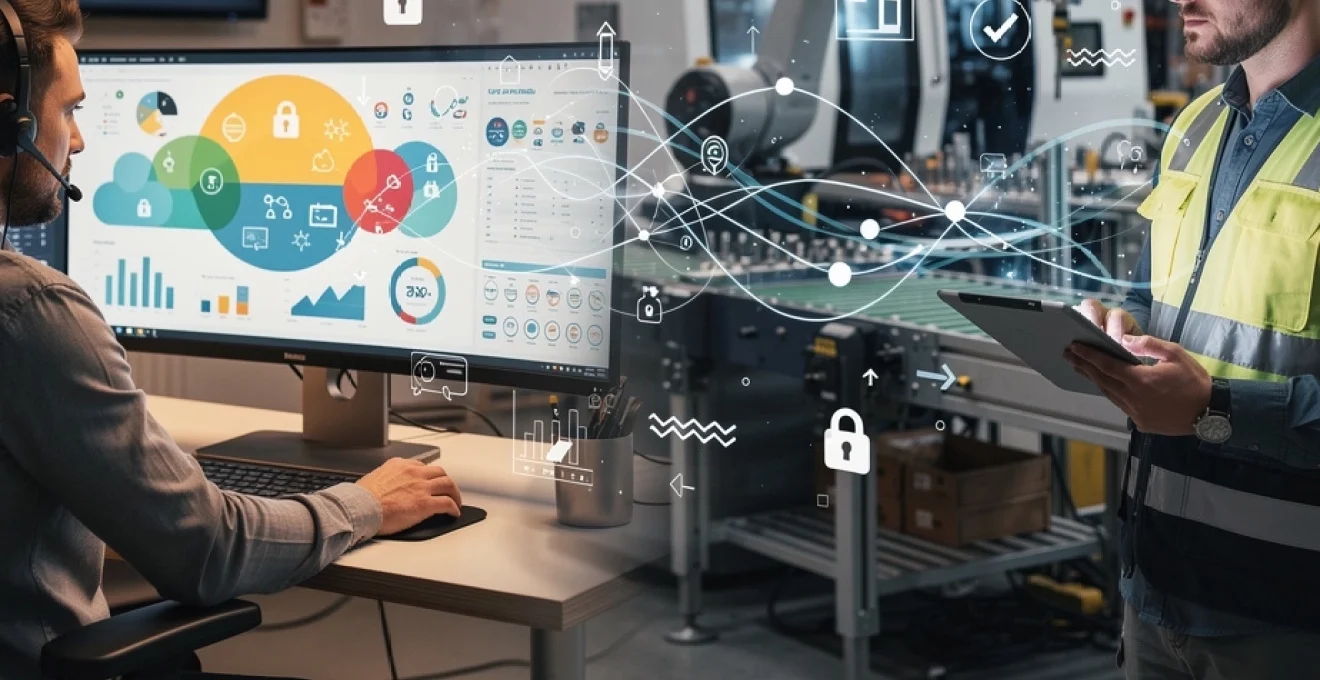
The industrial sector is experiencing an unprecedented transformation as remote work capabilities reshape traditional manufacturing and production management approaches. What was once considered impossible in heavy industry—managing complex manufacturing processes from a distance—has become not only feasible but essential for competitive advantage. This shift represents far more than a temporary adaptation; it signals a fundamental evolution in how industrial operations can be orchestrated, monitored, and optimised across distributed teams and geographical boundaries.
Modern industrial management now leverages sophisticated digital technologies to bridge the gap between physical production environments and remote oversight capabilities. The convergence of Internet of Things (IoT) sensors, cloud computing, and advanced analytics has created new possibilities for maintaining operational excellence whilst accommodating flexible work arrangements. Manufacturing leaders who successfully integrate these technologies are discovering enhanced efficiency, reduced operational costs, and improved workforce satisfaction without compromising production quality or safety standards.
Digital transformation of production planning systems in distributed manufacturing environments
The backbone of modern remote industrial management lies in sophisticated digital infrastructure that enables seamless coordination between on-site production teams and distributed management personnel. Traditional production planning systems, once confined to physical control rooms and local networks, have evolved into comprehensive digital ecosystems accessible from virtually any location with secure internet connectivity.
This transformation requires more than simply moving existing systems to the cloud. It demands a complete reimagining of how production data flows through an organisation, how decisions are communicated and implemented, and how quality standards are maintained across distributed teams. The most successful implementations involve careful integration of multiple technological layers, each designed to address specific aspects of remote industrial management whilst maintaining the reliability and security standards essential for manufacturing operations.
Cloud-based ERP integration across geographically dispersed teams
Enterprise Resource Planning (ERP) systems have undergone dramatic evolution to support distributed manufacturing teams effectively. Modern cloud-based ERP platforms provide real-time visibility into production schedules, inventory levels, and resource allocation across multiple facilities simultaneously. These systems enable production managers to coordinate complex multi-site operations remotely whilst maintaining precise control over material flows and production timing.
The integration challenges extend beyond technical considerations to encompass workflow redesign and staff training. Manufacturing organisations must establish new protocols for data entry, approval processes, and exception handling that account for potential communication delays inherent in remote work environments. Successful implementations often involve phased rollouts that allow teams to adapt gradually whilst maintaining operational continuity.
Real-time manufacturing execution system (MES) implementation for remote oversight
Manufacturing Execution Systems have become critical enablers of remote industrial management, providing granular visibility into production line performance and quality metrics. Modern MES platforms incorporate advanced dashboards and alert systems that enable production managers to monitor dozens of key performance indicators simultaneously from remote locations. These systems can automatically flag anomalies, trigger corrective actions, and maintain detailed audit trails for regulatory compliance purposes.
The implementation of remote-capable MES requires careful consideration of data latency, system reliability, and user interface design optimised for various device types. Production managers working remotely need access to the same depth of information available in traditional control rooms, often through mobile-optimised interfaces that maintain functionality across different screen sizes and connection speeds.
Advanced planning and scheduling (APS) software adaptation for hybrid workforces
Advanced Planning and Scheduling software has evolved to accommodate the complexities of managing hybrid workforces where some team members work on-site whilst others contribute remotely. These systems now incorporate sophisticated algorithms that account for communication delays, schedule coordination challenges, and the different working patterns typical of distributed teams.
Modern APS implementations include collaborative features that enable remote planners to work together on complex scheduling challenges, share scenario analyses, and implement schedule changes with appropriate approval workflows. The software must balance automation capabilities with human oversight, ensuring that critical scheduling decisions receive appropriate review regardless of where team members are located.
Industrial IoT sensor networks enabling remote production monitoring
Industrial Internet of Things (IIoT) sensor networks form the sensory nervous system of remote industrial management, providing continuous streams of data about equipment performance, environmental conditions, and product quality. These networks enable unprecedented visibility into manufacturing processes, allowing remote managers to detect potential issues before they impact production schedules or product quality.
The data generated by IIoT sensors requires sophisticated analytics platforms capable of processing large volumes of information in real-time. Machine learning algorithms can identify
patterns in vibration data, temperature fluctuations, or throughput variations that might indicate emerging faults or process deviations. In many cases, these analytics platforms are accessible via secure web interfaces, allowing engineers, reliability specialists, and operations managers to collaborate remotely on root-cause analysis and predictive maintenance strategies. When combined with automated alerts and visual dashboards, industrial IoT networks give remote teams an almost real-time “window” into the factory floor, similar to a pilot’s cockpit instruments providing a complete view of an aircraft’s status.
Remote quality assurance protocols and compliance management frameworks
As remote work becomes embedded in industrial management, quality assurance and compliance frameworks must also adapt to support distributed teams. Traditional quality systems assumed that engineers, inspectors, and auditors were physically present on-site to review records, inspect products, and verify processes. Today, many of these activities are coordinated remotely, with digital tools replacing paper-based records and in-person meetings. The challenge for manufacturers is to maintain—or even enhance—quality levels whilst shifting to remote-friendly processes and documentation practices.
Remote quality management requires a robust digital backbone that connects production data, documentation, and collaboration tools within a single integrated environment. Instead of relying on ad hoc file sharing or email chains, organisations are increasingly moving to cloud-based quality management systems that provide controlled access, version history, and automated workflows. This evolution allows quality leaders to uphold rigorous standards even when teams are spread across multiple locations and time zones.
Six sigma methodology implementation through virtual collaboration platforms
Six Sigma and other continuous improvement methodologies are highly dependent on structured collaboration, data sharing, and disciplined problem-solving cycles. In a remote or hybrid work model, these requirements are met through virtual collaboration platforms that support digital whiteboards, shared data repositories, and real-time communication. Black Belts and Green Belts can facilitate DMAIC (Define, Measure, Analyze, Improve, Control) projects with cross-functional teams using video conferencing and shared analytics dashboards instead of conference-room workshops.
To maintain rigour in remote Six Sigma projects, organisations often standardise templates, data collection formats, and reporting structures within their digital tools. For instance, project charters, SIPOC diagrams, and cause-and-effect matrices can be stored in centralised workspaces, ensuring that all stakeholders work from a single source of truth. This approach not only preserves methodological discipline but can also accelerate project timelines, as data and insights are accessible to authorised team members at any time.
ISO 9001:2015 documentation management in cloud-based quality systems
ISO 9001:2015 certification remains a cornerstone of quality assurance in manufacturing, and remote work has prompted many organisations to rethink how they manage the documentation requirements associated with this standard. Instead of maintaining physical binders or local file servers, manufacturers are increasingly adopting cloud-based document management systems tailored to ISO frameworks. These platforms support controlled document creation, review, approval, and distribution workflows, reducing the risk of outdated procedures being applied on the shop floor.
From a remote management perspective, cloud-based quality systems enable auditors, quality managers, and process owners to access procedures, work instructions, and records securely from any location. Automated version control and role-based permissions ensure that only approved documents are visible in production environments, whilst historical records remain available for audit and continuous improvement purposes. This digital approach simplifies both internal and external audits, as evidence can be retrieved quickly without physically searching archives.
Statistical process control (SPC) charts analysis via remote desktop solutions
Statistical process control has long been a core tool for monitoring process stability and capability in manufacturing operations. In a remote work context, engineers and quality specialists increasingly review SPC charts through remote desktop solutions or browser-based analytics tools connected to plant data historians. This allows them to track control limits, detect special-cause variation, and initiate corrective actions without being physically present on the production line.
To make this remote SPC analysis effective, organisations must ensure consistent data collection and automated chart generation at the source. Machine controllers, sensors, and MES platforms should feed process measurements directly into SPC software, reducing manual entry errors and delays. When alerts are triggered by trends or rule violations, notifications can be routed to remote experts who can collaborate with on-site staff to investigate issues, similar to a doctor consulting on a patient’s vital signs from another location.
Supplier quality management integration with remote audit capabilities
Supplier quality management has also been transformed by remote work and digital collaboration. Where supplier audits once required travel and on-site inspections, many organisations now conduct remote audits leveraging video tours, digital document reviews, and shared data platforms. Whilst some critical audits still demand physical presence, remote auditing capabilities allow procurement and quality teams to maintain oversight of a broader supplier base more frequently and at lower cost.
Effective remote supplier quality management depends on clear expectations around data transparency, documentation availability, and communication responsiveness. Manufacturers increasingly require suppliers to maintain digital quality records, process documentation, and non-conformance reports in accessible formats. Structured remote audit protocols—covering pre-audit data submissions, live virtual walkthroughs, and follow-up actions—help ensure that remote assessments are as thorough and credible as traditional audits, even when the auditor is thousands of kilometres away.
Lean manufacturing principles adaptation for distributed operational teams
Lean manufacturing, with its emphasis on waste reduction and continuous improvement, has traditionally relied on physical observation of processes—think of Gemba walks, Kanban boards, and visual management on the shop floor. With the rise of remote work in industrial management, these principles must be translated into digital equivalents that still deliver transparency, engagement, and disciplined problem-solving. The core question becomes: how do we “go to the Gemba” when the Gemba is instrumented with sensors and displayed on a screen?
Many organisations are answering this by deploying digital visual management boards that aggregate key metrics, Andon alerts, and improvement actions in real time. These boards can be accessed simultaneously by on-site supervisors and remote managers, allowing everyone to see the same performance picture. Virtual Gemba walks—where leaders review live process data, video feeds, and operator feedback through scheduled online sessions—are becoming more common, turning remote work into an enabler of more frequent, rather than less frequent, engagement with frontline operations.
In addition, Lean problem-solving tools such as A3 reports, 5 Whys, and value stream maps are being digitised and stored in collaborative platforms. This ensures that improvement history, countermeasures, and standard work updates are visible and traceable across distributed teams. When teams in different plants or regions can access each other’s Lean artefacts, the organisation accelerates learning transfer, reducing duplicated effort and making remote work an engine for cross-site standardisation.
Cybersecurity infrastructure requirements for remote industrial management access
As industrial management functions move beyond the physical perimeter of plants, cybersecurity becomes a central concern. Remote access to supervisory control and data acquisition (SCADA) systems, MES platforms, and IIoT dashboards dramatically expands the potential attack surface for malicious actors. Ransomware incidents in manufacturing have grown sharply in recent years, and regulators and insurers alike now scrutinise cybersecurity posture as closely as safety performance.
To support secure remote work in industrial environments, organisations must implement layered cybersecurity architectures that treat every connection and device as potentially untrusted. This involves not only technical controls—such as segmentation, encryption, and strong authentication—but also clear policies and training to ensure that managers and engineers follow secure practices from home offices and on mobile devices. In many ways, cybersecurity has become the invisible infrastructure that makes remote industrial management feasible without compromising plant integrity.
Zero trust network architecture implementation in manufacturing systems
Zero Trust Network Architecture (ZTNA) has emerged as a leading framework for securing distributed industrial environments. Instead of assuming that devices inside the plant network are trustworthy, Zero Trust operates on the principle of “never trust, always verify.” Every access request to MES, SCADA, or historian systems is evaluated based on user identity, device posture, location, and the sensitivity of requested resources. This model is particularly well-suited to remote work, where connections originate from diverse networks and devices.
In practice, implementing Zero Trust in manufacturing requires close coordination between IT and OT (operational technology) teams. Network segmentation, micro-perimeters around critical assets, and continuous monitoring must be planned to avoid disrupting real-time control systems. When done correctly, however, Zero Trust can significantly reduce the risk of lateral movement within networks if a single endpoint is compromised, providing a more resilient foundation for remote management and monitoring.
VPN tunnelling protocols for secure SCADA system remote access
Virtual Private Networks (VPNs) remain a core mechanism for providing secure remote access to SCADA and other industrial systems. By creating encrypted tunnels between remote devices and plant networks, VPNs help prevent eavesdropping and tampering with sensitive control traffic. Modern VPN solutions also support split tunnelling, bandwidth optimisation, and integration with identity providers, making them more flexible for remote industrial users who may need access to both corporate and plant resources.
However, simply deploying a VPN is not enough. Organisations must define strict access control policies that limit which systems and functions are reachable through remote connections. For example, a remote engineer may be granted read-only access to process trends and alarms but restricted from issuing direct control commands without additional verification. Regular reviews of VPN access logs and user entitlements are essential to ensure that privileges remain aligned with role requirements and security best practices.
Multi-factor authentication integration with industrial control systems
Multi-factor authentication (MFA) has become a baseline security requirement for remote access to industrial control systems. By requiring users to present two or more verification factors—such as a password plus a hardware token or biometric confirmation—MFA greatly reduces the risk that stolen credentials alone could be used to compromise critical systems. This is particularly important when engineers and managers access industrial dashboards from personal devices or home networks.
Integrating MFA into legacy control environments can be challenging, as many older SCADA and HMI applications were not designed with modern authentication methods in mind. To address this, organisations often deploy identity and access management (IAM) layers or secure gateways that sit in front of control systems and handle MFA before granting session access. When combined with role-based access control and detailed session logging, MFA forms a key part of a comprehensive defence-in-depth strategy for remote industrial management.
Performance metrics and KPI tracking systems for remote industrial operations
Effective remote industrial management depends on clear, reliable performance metrics. Without the ability to walk the floor and observe operations firsthand, managers must rely on well-designed KPI dashboards that translate raw data into meaningful insights. Metrics such as Overall Equipment Effectiveness (OEE), first-pass yield, energy consumption, and maintenance backlog must be available in near real time and contextualised so that remote leaders can quickly distinguish normal variation from emerging issues.
Modern KPI tracking systems consolidate data from ERP, MES, SCADA, and IIoT platforms into unified performance cockpits accessible via web or mobile interfaces. These dashboards often support drill-down capabilities, enabling managers to move from high-level plant performance views to machine-level details with a few clicks. When configured correctly, they provide a shared language for on-site and remote teams to discuss performance, prioritise actions, and align on improvement goals. This shared visibility is crucial for maintaining accountability and engagement in hybrid work models.
In addition, many organisations are experimenting with predictive and prescriptive analytics to move beyond retrospective KPI reporting. Machine learning models can forecast potential bottlenecks, quality risks, or maintenance needs based on historical patterns, giving remote leaders more time to intervene proactively. As these tools mature, remote work will increasingly shift from reactive monitoring to strategic optimisation, with data-driven recommendations guiding daily management decisions.
Change management strategies for traditional manufacturing leadership transitioning to hybrid models
The technical foundations of remote industrial management are only part of the story; the human and cultural dimensions are equally important. Many manufacturing leaders have built their careers on hands-on, in-person management styles, and the transition to hybrid models can feel like a fundamental change in identity. How do you lead effectively when you are no longer physically present on the shop floor every day? How do you build trust and maintain safety, quality, and productivity when much of your interaction happens through screens?
Successful change management in this context starts with acknowledging these concerns and providing leaders with practical tools and training for remote leadership. This includes guidance on setting clear expectations, running effective virtual meetings, and using digital dashboards to support coaching and decision-making. Organisations that invest in leadership development for hybrid models generally report smoother transitions, higher morale, and fewer conflicts between on-site and remote staff. In many cases, the move to remote-friendly practices becomes an opportunity to modernise management culture more broadly.
Communication plays a central role in this transition. Leaders must articulate why hybrid work is being adopted, how it aligns with business strategy, and what support is available to employees navigating new ways of working. Regular check-ins, transparent sharing of performance data, and deliberate recognition of both on-site and remote contributions help maintain a sense of unity. By treating remote work not as a temporary workaround but as a strategic capability, industrial organisations can build management practices that are more resilient, inclusive, and adaptable to whatever disruptions the future may bring.