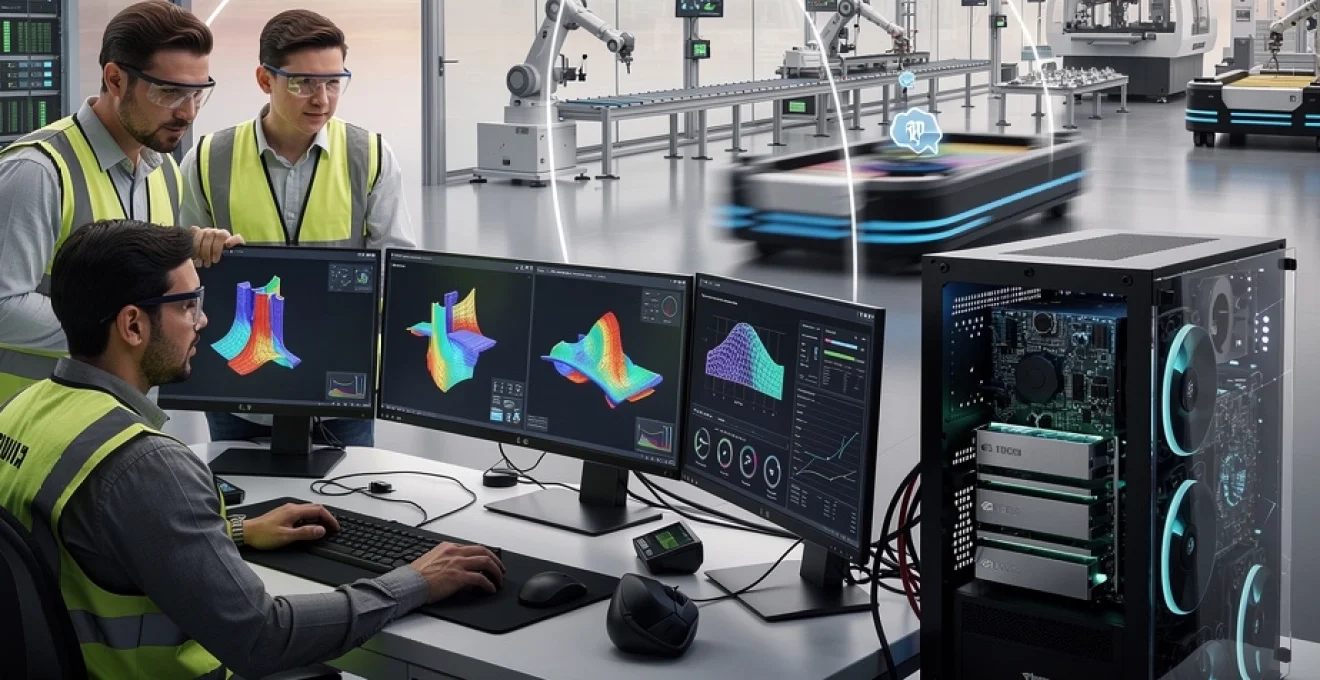
Manufacturing and industrial engineering have entered an era where computational bottlenecks represent the primary obstacle to innovation velocity. The ability to access powerful computing resources on demand has transformed from a competitive advantage into an operational necessity. Modern industrial organisations face increasingly complex challenges—from computational fluid dynamics simulations that previously required weeks of processing time to real-time quality control systems that must analyse thousands of data points per second. The infrastructure supporting these computational demands has evolved dramatically, with cloud platforms, high-performance computing clusters, and edge computing architectures converging to create unprecedented opportunities for accelerated execution. Companies that master rapid resource provisioning can compress development cycles from months to days, respond to market changes with agility previously thought impossible, and maintain operational efficiency that directly translates to bottom-line performance. Understanding how different computing paradigms support industrial workflows has become essential knowledge for engineering leaders, IT strategists, and operations managers seeking to maintain relevance in increasingly competitive global markets.
Cloud computing infrastructure: elastic resource provisioning for industrial workloads
Cloud computing platforms have fundamentally altered the economics and accessibility of computational resources for industrial applications. Rather than investing millions in on-premises infrastructure that sits idle during off-peak periods, organisations can now provision precisely the computing capacity required for specific workloads, scaling resources dynamically as demand fluctuates. This elasticity proves particularly valuable for manufacturing operations with variable computational requirements—during peak design phases, engineering teams can access hundreds of virtual machines simultaneously, then scale back during production phases when computational needs diminish. The financial implications extend beyond capital expenditure reduction; operational expenses become directly aligned with actual resource consumption, eliminating the traditional overhead associated with maintaining surplus capacity.
Auto-scaling mechanisms in AWS EC2 and azure virtual machine scale sets
Amazon Web Services Elastic Compute Cloud (AWS EC2) and Microsoft Azure Virtual Machine Scale Sets implement sophisticated auto-scaling mechanisms that respond to workload demands in real time. These platforms monitor computational metrics—CPU utilisation, memory consumption, network throughput—and automatically provision or decommission virtual machine instances according to predefined policies. For industrial applications, this capability translates to immediate resource availability during critical operations. When a manufacturing execution system experiences sudden data ingestion spikes from factory floor sensors, the underlying infrastructure expands automatically to maintain processing speed. AWS EC2 offers both target tracking scaling, which maintains specific metric thresholds, and predictive scaling, which uses machine learning algorithms to anticipate demand patterns based on historical data. Azure provides similar functionality through its autoscale settings, allowing you to define custom scaling rules based on schedule or metrics. The granularity of control extends to scaling policies that consider multiple metrics simultaneously, ensuring that infrastructure responds appropriately to complex workload characteristics rather than single-dimensional triggers.
Kubernetes orchestration for containerised manufacturing applications
Container orchestration through Kubernetes has revolutionised how industrial software applications are deployed and managed across cloud infrastructure. Kubernetes provides a declarative framework for defining application requirements—compute resources, storage volumes, networking configurations—then automatically schedules containerised workloads across available cluster nodes to optimise resource utilisation. Manufacturing applications benefit substantially from this approach, as complex software systems comprising dozens of interconnected microservices can be deployed consistently across development, testing, and production environments. The platform’s self-healing capabilities ensure that failed containers are automatically restarted, while its load balancing distributes network traffic across healthy instances to maintain application availability. Horizontal pod autoscaling adjusts the number of container replicas based on observed CPU utilisation or custom metrics, enabling manufacturing execution systems to handle variable transaction volumes without manual intervention. For organisations running computer-aided design (CAD) applications, simulation software, or data analytics platforms, Kubernetes abstracts infrastructure complexity, allowing engineering teams to focus on application logic rather than deployment mechanics.
Gpu-accelerated computing with NVIDIA A100 tensor cores for CAD rendering
Graphics processing units (GPUs) have evolved from specialised graphics hardware into general-purpose computational accelerators particularly suited for parallel processing tasks. The NVIDIA A100 Tensor Core GPU represents the current pinnacle of this evolution, delivering unprecedented performance for workloads that can exploit massive parallelism. CAD rendering operations, which traditionally consumed hours or days on CPU-based systems, complete in minutes when executed on A100-powered infrastructure. The architecture’s 6,912 CUDA cores and 432 third-generation Tensor Cores enable simultaneous processing of thousands of computational threads, dramatically accelerating ray tr
acing, shading, and complex geometry calculations. For design teams iterating on high-resolution assemblies, this means rendering multiple variants in parallel, reviewing photorealistic visuals with stakeholders in the same day rather than the same week. When combined with cloud computing infrastructure, A100-powered instances can be spun up only when needed, providing rapid access to computing resources without permanent capital investment. You can also co-locate GPU-accelerated rendering with storage buckets that hold large CAD models, reducing data transfer times that often slow down design workflows. In practice, this level of GPU-accelerated computing enables faster industrial execution by collapsing the feedback loop between design, simulation, and visual validation.
Edge computing nodes: reducing latency in industrial IoT deployments
While cloud platforms offer near-infinite scalability, many industrial processes cannot tolerate the latency of sending all data to a remote data centre. Edge computing nodes address this limitation by placing compute resources directly on the factory floor or in close proximity to industrial assets. These ruggedised devices run containerised analytics, stream processing engines, and lightweight machine learning models locally, so decisions such as anomaly detection or safety interlocks occur in milliseconds rather than seconds. For example, an edge gateway monitoring vibration on CNC machines can shut down equipment when thresholds are exceeded without waiting for a round trip to the cloud.
By processing data at the edge, manufacturers also reduce bandwidth consumption and avoid saturating networks with high-volume sensor streams, video feeds, or PLC data. Only aggregated metrics, alerts, or selected historical data need to be forwarded to the cloud or central data centre for long-term analysis and reporting. This hybrid pattern—fast reaction at the edge, deeper insight in the cloud—supports more resilient industrial execution, as critical systems continue operating even if WAN connectivity is interrupted. When edge computing nodes are managed through platforms such as Kubernetes distributions optimised for the edge, IT and OT teams gain a common control plane to deploy updates, enforce security policies, and maintain configuration consistency across dozens or hundreds of sites.
High-performance computing clusters: parallel processing for engineering simulations
High-performance computing (HPC) clusters remain the backbone for compute-intensive engineering simulations that underpin product performance and safety. Unlike general cloud workloads that can tolerate modest latency, simulations such as computational fluid dynamics (CFD), structural analysis, and multiphysics modelling demand tightly coupled parallel processing. HPC clusters achieve this by combining thousands of CPU or GPU cores, high-speed memory, and low-latency interconnects into a unified environment orchestrated by specialised schedulers. For industrial organisations, this means engineers can explore more design variants, run finer meshes, and simulate longer time horizons within the same project window.
The strategic impact is clear: rather than relying on conservative safety margins or limited prototype testing, companies can validate behaviour under a wide range of operating conditions before cutting metal. This shift from physical to virtual testing shortens development cycles and reduces the cost of late-stage design changes. As cloud providers now offer dedicated HPC instances and bare-metal nodes, even mid-sized manufacturers can access supercomputer-class performance on demand, without building their own data centre. The key is to structure simulation workloads to exploit parallel processing effectively.
ANSYS fluent CFD simulations on multi-node HPC architecture
ANSYS Fluent is a flagship CFD solver used extensively in aerospace, automotive, and process industries to model turbulent flows, heat transfer, and chemical reactions. On a single workstation, complex simulations with tens of millions of cells can take days or even weeks to converge. When deployed on a multi-node HPC architecture, the computational mesh is decomposed into partitions distributed across hundreds or thousands of cores, allowing Fluent to solve the governing equations in parallel. This domain decomposition dramatically reduces wall-clock time, turning overnight runs into a few hours and enabling multiple design iterations per day.
To maximise performance, HPC architects tune Fluent jobs to match the underlying hardware topology—balancing the number of cores per node, memory per core, and interconnect bandwidth. For example, running a 100-million-cell automotive aerodynamics simulation across 256 cores connected via InfiniBand can deliver near-linear speedup compared to a 32-core baseline. For you as an engineering leader, the practical question becomes: how many more configurations can your team evaluate within the same project deadline if each simulation completes four to eight times faster? In competitive sectors, the ability to explore the design space more thoroughly often translates directly into better fuel efficiency, lower noise, or improved thermal management.
Finite element analysis acceleration using OpenMP and MPI protocols
Finite element analysis (FEA) for structural integrity, vibration, and fatigue is another domain where rapid access to computing resources changes what is feasible. Most industrial FEA solvers support both shared-memory parallelism via OpenMP and distributed-memory parallelism via the Message Passing Interface (MPI). OpenMP allows a single node with many cores to parallelise loops and linear algebra operations in a relatively straightforward manner, ideal for medium-sized models that fit in the memory of one server. MPI extends this by enabling the solver to run across multiple nodes, each with its own memory space, coordinating work and exchanging results through explicit messages.
In practice, high-end simulations often combine both approaches in a hybrid model: OpenMP is used within each node to exploit all cores efficiently, while MPI distributes the global problem across nodes. This dual-level parallelism is particularly effective for large assemblies, contact problems, or nonlinear material behaviour that would be impractical on a single machine. Industrial teams that modernise their FEA workflows to exploit OpenMP and MPI often report order-of-magnitude reductions in solve time. The result is not only faster answers but also the freedom to increase model fidelity—finer meshes, more load cases, and longer fatigue life predictions—without slipping schedules.
SLURM workload manager: job scheduling for computational fluid dynamics
As HPC capacity grows, the challenge shifts from raw performance to efficient utilisation. The SLURM workload manager has become a de facto standard in both academic and commercial HPC environments for scheduling jobs, allocating resources, and enforcing fair usage policies. For CFD workloads, SLURM coordinates the placement of Fluent, OpenFOAM, or STAR-CCM+ jobs across the cluster, ensuring that each simulation receives the requested number of nodes, cores, and memory while avoiding fragmentation. Engineers submit jobs using plain-text scripts that define resource requirements, wall-time limits, and any job dependencies.
From an operational standpoint, SLURM provides detailed accounting and reporting, helping organisations understand which projects consume the most compute and identify opportunities for optimisation. Features such as job arrays and advanced reservations allow you to batch parametric sweeps or guarantee capacity for time-critical runs, such as certification tests or customer demonstrations. When integrated with cloud-based HPC clusters, the same SLURM interface can be used to burst into additional capacity during peak demand, giving teams rapid access to computing resources without learning new tools. This continuity of workflow is crucial for industrial execution, where process reliability matters as much as raw speed.
Infiniband networking: low-latency interconnects for distributed calculations
In tightly coupled simulations, communication between compute nodes can become a bottleneck if the network is not fast enough. InfiniBand interconnects address this by providing extremely low latency—often below two microseconds—and high bandwidth, exceeding 200 Gbit/s in modern deployments. This combination allows MPI processes in CFD or FEA solvers to exchange boundary data and synchronisation messages without stalling, preserving the parallel efficiency of large jobs. You can think of InfiniBand as the high-speed motorway that keeps thousands of computational vehicles moving in lockstep, rather than a congested city street that forces frequent stops.
Beyond raw bandwidth, InfiniBand supports advanced features such as Remote Direct Memory Access (RDMA), which lets one node access another’s memory without involving the remote CPU. This reduces overhead and further cuts latency, particularly beneficial for applications that exchange many small messages. For industrial organisations evaluating HPC options, ensuring that critical simulation workloads run on clusters equipped with InfiniBand or equivalent high-performance fabrics is often the difference between modest and transformative speedups. When combined with optimised MPI libraries, these interconnects help maintain scalability as simulations grow from dozens to thousands of cores.
On-demand computing resources: reducing time-to-market in product development
Time-to-market pressure has intensified across automotive, aerospace, electronics, and machinery sectors. Customers expect faster innovation cycles, customisation, and higher quality, while regulatory and testing requirements grow more stringent. On-demand computing resources—delivered via cloud, hosted VDI, or burstable HPC—allow engineering and product teams to align compute capacity with these fluctuating demands. Instead of queuing for shared workstations or waiting for simulation windows, designers and analysts can spin up the resources they need, when they need them.
This flexibility is analogous to moving from a single shared workshop to a campus of modular labs that appear on demand. During early concept phases, lightweight virtual machines and small simulation clusters may suffice. As the design matures and verification loads increase, teams can expand capacity rapidly, then release it once key milestones are passed. Organisations that embrace this on-demand model consistently report shorter design cycles, fewer schedule overruns, and better utilisation of specialist talent, as engineers spend less time waiting and more time iterating.
Siemens NX and CATIA V5 performance on virtual desktop infrastructure
Virtual Desktop Infrastructure (VDI) has become a cornerstone for delivering high-end CAD tools such as Siemens NX and CATIA V5 to distributed design teams. Instead of installing heavy clients on local workstations, users connect to GPU-enabled virtual desktops hosted in data centres or the cloud. These desktops provide the same—or better—performance than traditional workstations, particularly when backed by modern GPUs and fast storage. For organisations with multiple sites or external partners, VDI simplifies license management, improves security, and enables consistent configuration across users.
From a performance perspective, the key enablers are GPU virtualisation technologies and low-latency display protocols that stream pixels rather than geometry. This means large assemblies, complex surface models, and real-time shading operations run on central hardware optimised for these tasks. Designers can access their environment from thin clients, laptops, or even tablets without sacrificing responsiveness. In practical terms, this allows you to onboard new engineers quickly, support remote work without shipping expensive hardware, and scale up or down the number of CAD seats in line with project needs—all contributing to faster industrial execution.
Rapid prototyping through scalable rendering farms for generative design
Generative design and topology optimisation tools generate dozens or hundreds of candidate geometries based on design goals and constraints. Visualising and evaluating these options requires substantial rendering capacity, especially when stakeholders expect photorealistic imagery or animations. Scalable rendering farms—clusters of GPU-equipped nodes dedicated to visual workloads—provide a way to process these jobs in parallel. Designers submit batches of scenes, and the farm distributes frames or camera angles across multiple machines, drastically reducing total render time.
This approach is similar to using a 3D printer farm instead of a single printer: throughput scales with the number of nodes, and deadlines become more predictable. Because rendering farms can be spun up on demand in the cloud, you avoid the trap of over-provisioning hardware that sits idle between projects. In the context of rapid prototyping, this means you can move from algorithmically generated concepts to compelling visuals in hours, supporting faster decision-making in design reviews, customer presentations, and internal gate meetings. When combined with GPU-accelerated CAD operations, the entire loop from generative design to rendered proposal tightens significantly.
CI/CD pipeline acceleration with jenkins and GitLab runners
Software now plays a central role in industrial products and manufacturing systems, from embedded firmware in controllers to analytics platforms and MES extensions. Continuous Integration and Continuous Delivery (CI/CD) pipelines orchestrated by tools like Jenkins and GitLab CI/CD help teams deliver this software reliably and quickly. By running automated builds, unit tests, integration tests, and even hardware-in-the-loop simulations on scalable compute infrastructure, you reduce the risk of defects reaching production while shortening release cycles.
On-demand runners—ephemeral virtual machines or containers that execute pipeline jobs—are key to this acceleration. When a large number of developers push changes simultaneously, the CI/CD system can scale out runners to handle the backlog, then scale back when activity subsides. For industrial organisations, integrating CI/CD with edge deployments and OT systems introduces new considerations such as staged rollouts, canary releases on non-critical lines, and strict approval workflows. Yet the benefits are substantial: you can patch security issues faster, roll out new analytics or optimisation algorithms more frequently, and maintain a consistent software baseline across plants. Ultimately, this software delivery speed feeds directly into faster industrial execution on the shop floor.
Database performance optimisation: real-time data access for manufacturing execution systems
Manufacturing Execution Systems (MES), SCADA platforms, and quality management tools all rely on timely access to production data. As factories become more instrumented—with thousands of sensors, PLC tags, and machine events—traditional relational databases can struggle to cope with the write rates and query complexity. Database performance optimisation, therefore, becomes a strategic enabler for real-time decision-making. By selecting appropriate data stores, tuning indexes, and introducing caching layers, you can ensure that dashboards, scheduling algorithms, and control loops operate on fresh, reliable information.
In practice, this often involves a polyglot architecture where different databases serve different workload profiles: in-memory systems for transactional ERP integration, time-series databases for sensor streams, and key–value stores for ultra-fast lookups. The goal is not just raw speed but predictable performance under varying loads. When factory throughput spikes or a new data-intensive application is introduced, you want your database layer to scale gracefully rather than becoming the weakest link in the chain.
In-memory databases: SAP HANA for enterprise resource planning integration
In-memory databases such as SAP HANA store data primarily in RAM rather than on disk, enabling sub-second response times for complex analytical queries and transactional workloads. For industrial organisations running SAP ERP or S/4HANA, this architecture allows near real-time integration between enterprise planning and shop-floor execution. Production orders, inventory levels, and material requirements can be updated and analysed continuously, reducing the latency between a change in demand and a change in manufacturing behaviour.
From a practical standpoint, leveraging SAP HANA for industrial workloads means designing data models and interfaces that minimise data duplication and batch processing. Instead of nightly ETL jobs, you can use real-time replication and event-driven updates to keep MES, quality systems, and planning tools aligned. This shift supports scenarios such as dynamic rescheduling based on actual machine states or supplier delays, which would be difficult with traditional disk-based databases. While in-memory systems require careful sizing and governance, the payoff is a much tighter coupling between business decisions and operational execution.
Timescaledb and InfluxDB for industrial sensor data aggregation
Time-series databases like TimescaleDB and InfluxDB are purpose-built for handling high-volume, append-only data such as sensor readings, PLC tags, and machine logs. They optimise storage, compression, and query execution around time-based patterns, making operations like downsampling, windowed aggregation, and retention policy enforcement efficient. In an industrial IoT context, this means you can ingest millions of data points per second from distributed assets while still querying recent history in real time for dashboards or anomaly detection algorithms.
Choosing between TimescaleDB, which extends PostgreSQL, and InfluxDB often comes down to ecosystem preference and integration needs. TimescaleDB benefits from the rich SQL and tooling support of PostgreSQL, easing adoption for teams already familiar with relational databases. InfluxDB provides a specialised query language and ecosystem tailored to metrics and observability. Either way, placing a time-series database at the heart of your sensor data pipeline gives you a robust foundation for predictive maintenance, energy optimisation, and OEE (Overall Equipment Effectiveness) analytics. The key is to design retention and aggregation strategies that keep storage growth under control while preserving the resolution needed for critical analyses.
Redis caching layers: sub-millisecond query response in SCADA systems
Even with optimised databases, some industrial use cases demand ultra-low latency access to specific data elements—think of HMI screens that must update dozens of tags in real time, or control applications that query configuration parameters on every cycle. Redis, an in-memory key–value store, excels as a caching layer in these scenarios. By storing frequently accessed values, precomputed aggregates, or session state directly in memory, Redis can deliver sub-millisecond responses consistently, offloading pressure from back-end databases.
In SCADA architectures, Redis is often introduced as a sidecar cache that front-end applications consult before falling back to slower data stores. This pattern not only improves responsiveness but also provides a buffer during database maintenance or transient network issues. For you, the implementation considerations include cache invalidation strategies, high-availability configurations, and security controls to ensure that cached data remains accurate and protected. When executed well, Redis caching contributes to smoother operator experiences, more responsive dashboards, and ultimately quicker reactions to changing plant conditions.
Serverless computing architectures: event-driven processing for industrial automation
Serverless computing extends the idea of on-demand resources to an even finer granularity: individual functions that execute in response to events, without you managing servers or runtime environments. Platforms such as AWS Lambda, Azure Functions, and Google Cloud Functions allow developers to deploy small pieces of logic that trigger on sensor alarms, file arrivals, API calls, or schedule-based timers. In an industrial automation context, this event-driven model is particularly powerful for glue logic—connecting systems, enriching data, or triggering workflows—without the overhead of maintaining dedicated application servers.
Consider a quality inspection station that uploads images to a storage bucket whenever a part passes under a camera. A serverless function can automatically launch an AI inference pipeline, log the results to a time-series database, and raise an alert if defect probabilities exceed a threshold. Because functions scale horizontally with the volume of events, the architecture naturally adapts to fluctuating production rates. Costs align closely with actual usage, as you pay only for execution time and resource consumption, not idle capacity. The trade-offs include cold-start latency for infrequently used functions and constraints on execution duration, which means serverless is best suited to short-lived tasks rather than long-running simulations.
Bare-metal servers vs virtualisation: performance trade-offs in compute-intensive industrial applications
When every millisecond of latency and every percentage point of utilisation matters, the choice between bare-metal servers and virtualised environments becomes critical. Bare-metal servers provide direct access to hardware resources without a hypervisor layer, eliminating virtualisation overhead and enabling more predictable performance. This is particularly important for tightly coupled HPC simulations, real-time control systems, or GPU-intensive workloads such as large-scale rendering and deep learning training. With bare metal, you can fine-tune BIOS settings, NUMA layouts, and network stacks to squeeze out maximum throughput.
Virtualisation, on the other hand, offers significant advantages in flexibility, isolation, and consolidation. Hypervisors like VMware ESXi, KVM, or Hyper-V allow multiple virtual machines to share the same physical host, improving overall utilisation and simplifying lifecycle management. For many industrial applications—MES servers, databases, application gateways—the performance overhead of virtualisation is minimal compared to the benefits of rapid provisioning, snapshotting, and migration. The decision is rarely binary; many organisations adopt a mixed model, reserving bare-metal for the most demanding HPC or real-time workloads while running the rest of their stack on virtualised or containerised infrastructure.
As you assess performance trade-offs, it is helpful to run representative benchmarks and pilot projects rather than relying solely on vendor specifications. Modern virtualisation technologies have narrowed the gap significantly, especially when combined with features like SR-IOV for near-native network performance or GPU pass-through for direct access to accelerators. Ultimately, the optimal architecture is the one that aligns computing resources with workload characteristics, ensuring that rapid access to compute—whether bare-metal or virtualised—translates into faster, more reliable industrial execution.