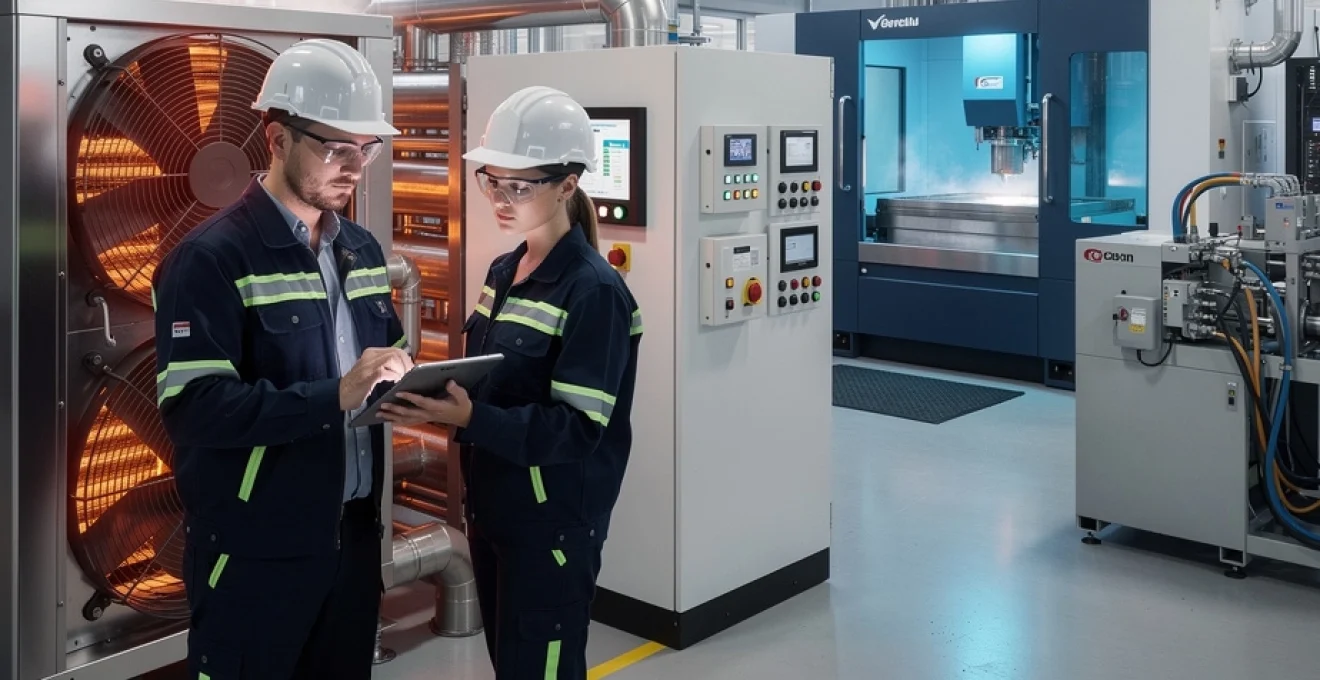
Industrial cooling systems serve as the unsung heroes of modern manufacturing, silently maintaining optimal operating temperatures that prevent catastrophic equipment failures and ensure consistent production quality. These sophisticated thermal management networks represent the difference between profitable operations and costly downtime, directly influencing both immediate performance metrics and long-term equipment durability. As industrial processes become increasingly complex and energy-intensive, the role of effective cooling systems has evolved from a basic necessity to a strategic competitive advantage that can determine the success or failure of entire manufacturing operations.
Thermodynamic principles governing industrial cooling system efficiency
The fundamental physics governing industrial cooling systems revolve around the strategic manipulation of heat transfer mechanisms to achieve maximum thermal efficiency whilst minimising energy consumption. Understanding these principles enables engineers to design and optimise cooling systems that deliver superior performance across diverse industrial applications. The efficiency of any industrial cooling system depends on its ability to facilitate rapid heat removal through conduction, convection, and radiation processes, each playing a crucial role in maintaining optimal equipment temperatures.
Heat transfer mechanisms in chiller systems and cooling towers
Chiller systems operate on the principle of phase change refrigeration, utilising the latent heat of vaporisation to absorb substantial quantities of thermal energy from process equipment. The evaporator component extracts heat from the process fluid, causing the refrigerant to transition from liquid to vapour state, whilst the condenser rejects this heat to the ambient environment. This continuous cycle creates a highly efficient thermal management system capable of maintaining precise temperature control even under varying load conditions.
Cooling towers complement chiller systems by providing an economical method for rejecting waste heat through evaporative cooling processes. The interaction between hot water and ambient air creates a natural convection effect, where approximately 1% of the circulating water evaporates to remove the heat load. This evaporative process can achieve temperature differences of 5-7°C below the ambient wet-bulb temperature, making cooling towers particularly effective in moderate climate conditions where free cooling opportunities exist.
Coefficient of performance (COP) optimisation in centrifugal compressors
Centrifugal compressors represent the heart of large-scale industrial cooling systems, with their efficiency directly impacting overall system performance and operational costs. The COP metric quantifies the ratio of cooling output to energy input, with modern centrifugal chillers achieving COP values between 5.5 and 7.0 under optimal conditions. Optimisation strategies focus on maintaining ideal refrigerant flow rates, minimising pressure losses, and operating within the compressor’s sweet spot for maximum efficiency.
Variable speed drive technology allows centrifugal compressors to modulate their capacity based on real-time cooling demands, preventing the energy waste associated with constant-speed operation. This dynamic adjustment capability can improve seasonal energy efficiency ratios by 30-40% compared to traditional fixed-speed systems. Advanced control algorithms continuously monitor suction and discharge pressures, adjusting compressor speed to maintain optimal efficiency whilst meeting fluctuating process cooling requirements.
Evaporator and condenser design parameters for maximum heat exchange
Evaporator design directly influences heat transfer effectiveness through surface area optimisation, fluid flow patterns, and heat transfer coefficient enhancement techniques. Shell-and-tube evaporators utilise enhanced surface geometries, such as micro-fin tubing and turbulence promoters, to increase the heat transfer coefficient by 200-300% compared to plain tube designs. The arrangement of tube bundles and baffle configurations creates optimal fluid velocity profiles that maximise heat exchange whilst minimising pressure drop penalties.
Condenser performance depends on effective heat rejection to the ambient environment, whether through air-cooled or water-cooled configurations. Air-cooled condensers require careful fan selection and coil geometry to achieve adequate heat transfer rates, particularly during peak ambient temperature conditions. Water-cooled condensers typically achieve superior heat transfer rates due to water’s higher thermal conductivity, but require additional infrastructure for water circulation and treatment systems.
Refrigerant flow dynamics in Multi-Stage compression cycles
Multi-stage compression systems enable industrial cooling applications to achieve extremely low temperatures whilst maintaining reasonable energy efficiency levels. The staging process involves intermediate cooling between compression stages, reducing the overall compression work required and
improves volumetric efficiency. Careful management of refrigerant flow through expansion valves, intercoolers, and flash tanks prevents liquid slugging and ensures stable superheat at each stage. In well-engineered industrial cooling systems, multi-stage compression can reduce specific power consumption by 10–20% compared to single-stage designs operating over the same temperature lift.
Flow dynamics within these multi-stage cycles are governed by refrigerant properties, piping layout, and control valve response times. Sudden load changes or poor refrigerant distribution can cause pressure fluctuations that reduce chiller reliability and increase wear on compressors and bearings. By combining electronic expansion valves with real-time mass flow measurement, modern industrial cooling systems can finely tune refrigerant circulation, maintaining high efficiency across part-load and full-load conditions. Computational fluid dynamics (CFD) models are increasingly used to optimise suction and discharge line geometries, reducing pressure drops and preventing oil trapping that would otherwise compromise long-term equipment performance.
Critical temperature control technologies for process equipment protection
Precise temperature control is fundamental to protecting high-value industrial equipment from thermal stress, distortion, and premature failure. Industrial cooling systems now integrate advanced control technologies that continuously adapt to changing process demands, rather than relying on fixed-speed pumps and simple thermostatic controls. By coordinating pumps, valves, and heat exchangers through intelligent automation, facilities can maintain tight temperature tolerances that directly translate into better product quality and extended equipment lifespan.
Variable frequency drive (VFD) integration in cooling pump systems
Variable frequency drives transform traditional cooling pump systems from blunt instruments into finely tunable assets. Instead of running pumps at constant speed and throttling flow with valves, VFDs modulate motor speed to match real-time flow and head requirements. This approach follows the affinity laws, where a 20% reduction in pump speed can reduce power consumption by nearly 50%, significantly improving the overall efficiency of industrial cooling systems.
From an equipment protection standpoint, VFD-driven pumps minimise hydraulic shock and pressure spikes in cooling circuits. Soft start and ramp-down functions reduce mechanical stress on seals, bearings, and pipework, lowering the risk of leaks and unplanned outages. You also gain more stable flow through heat exchangers, which helps maintain consistent process temperatures and avoids the rapid thermal cycling that can crack welds, warp machine frames, or degrade sensitive electronics. In many retrofits, integrating VFDs into existing cooling loops delivers payback periods of less than three years due to combined energy savings and reduced maintenance costs.
Programmable logic controller (PLC) temperature monitoring protocols
Programmable logic controllers act as the central nervous system of modern industrial cooling systems, aggregating temperature data from dozens or even hundreds of sensors. Robust PLC temperature monitoring protocols define how frequently points are sampled, what tolerances trigger alarms, and which interlocks protect equipment from runaway conditions. Rather than relying on a single sensor at the outlet of a chiller, advanced plants monitor supply and return temperatures at critical machines, coolant headers, and even individual heat exchangers.
By implementing multi-level alarm thresholds and trend analysis within the PLC, you can detect gradual drifts in cooling performance long before they cause damage. For example, a slow rise in temperature differential across a heat exchanger may indicate fouling, while increased variance at a CNC spindle could signal partial blockage or pump degradation. Integrating PLC logic with SCADA or MES platforms offers operators real-time visibility, historical reporting, and automated shutdown sequences that protect equipment if temperatures exceed safe operating limits. This data-rich approach turns temperature control from a reactive to a predictive discipline.
Thermal management in CNC machining centres and laser cutting equipment
CNC machining centres and laser cutting systems are particularly sensitive to temperature fluctuations, as even minor thermal expansion can compromise dimensional accuracy. Spindle motors, ball screws, and linear guides all generate heat during operation, and without effective thermal management, machine frames can distort by microns that translate into measurable defects in finished parts. Industrial cooling systems for these machines often include dedicated coolant circuits that stabilise both components and cutting fluids within narrow temperature bands.
In high-speed machining, maintaining coolant temperature within ±1°C of the setpoint can be the difference between consistent tolerances and costly scrap. Chilled coolant supplied to spindle jackets and drive components limits thermal growth, while temperature-controlled cutting fluids preserve lubricant viscosity and chip evacuation performance. Laser cutting equipment introduces an additional challenge, as both the laser source and optical components require precise cooling to protect against wavelength drift and lens damage. Here, industrial cooling systems often employ deionised water loops with corrosion-resistant materials and continuous conductivity monitoring, ensuring long-term reliability of high-value optical assemblies.
Precision cooling for injection moulding and extrusion machinery
Injection moulding and extrusion processes rely on tightly controlled mould and barrel temperatures to achieve consistent product quality and cycle times. Uneven cooling across a mould can lead to warping, sink marks, or internal stresses, while uncontrolled extrusion temperatures may cause dimensional variations and surface defects. Industrial cooling systems for these applications typically incorporate dedicated mould temperature control units (TCUs), multi-zone cooling manifolds, and high-precision chillers.
By designing cooling circuits that balance flow through complex mould geometries, engineers can maintain uniform heat extraction and avoid hot spots. This level of precision cooling also has a direct impact on equipment lifespan: stable thermal conditions reduce fatigue on mould steels, seals, and heaters, extending maintenance intervals and reducing unplanned downtime. In extrusion lines, barrel and die cooling helps maintain a stable melt temperature profile, protecting gearboxes, screws, and motors from overload conditions. The net result is a more predictable process where both equipment and product benefit from disciplined thermal management.
Predictive maintenance strategies for industrial cooling infrastructure
Industrial cooling systems are often distributed across large sites, with multiple chillers, cooling towers, pumps, and heat exchangers working in concert. Waiting for a component to fail before intervening is a recipe for costly downtime and collateral damage. Predictive maintenance strategies use real-time monitoring, analytics, and machine learning to anticipate failures based on subtle changes in performance indicators. Instead of changing parts on a fixed schedule, you replace them when condition data suggests their remaining useful life is nearing its end.
Key parameters for predictive maintenance include vibration levels on pump and fan bearings, temperature trends across heat exchangers, differential pressures on strainers and filters, and power consumption patterns of compressors and motors. For example, a gradual increase in chiller energy use per unit of cooling output may indicate fouling in the condenser or evaporator long before alarms are triggered. By combining sensor data with digital twins of the cooling system, facilities can run “what-if” simulations and identify the most cost-effective time to schedule maintenance. This approach not only extends the operational lifespan of cooling equipment but also stabilises process temperatures by reducing unexpected interruptions.
Remote monitoring platforms further enhance predictive maintenance by aggregating data from multiple sites and comparing performance across similar assets. If one cooling tower fan exhibits rising vibration levels compared to its peers, maintenance teams can prioritise inspection before the issue escalates into blade damage or motor failure. When you view industrial cooling systems as strategic assets rather than background utilities, predictive maintenance becomes a powerful lever for increasing equipment reliability and safeguarding production throughput.
Energy consumption analysis across cooling system configurations
Energy use in industrial cooling systems represents a significant portion of total facility power consumption, often ranging from 20% to 40% in energy-intensive sectors. As energy prices rise and decarbonisation targets tighten, understanding how different cooling configurations affect power use is essential. System-level analysis looks beyond individual components to evaluate how chillers, cooling towers, pumps, and control strategies interact. The objective is to minimise kilowatt-hours per unit of useful cooling delivered, without compromising process stability or equipment protection.
Power usage effectiveness (PUE) metrics in data centre cooling applications
Data centres provide a clear example of how cooling performance and energy metrics intersect. Power Usage Effectiveness (PUE) measures the ratio of total facility power to IT equipment power, with modern facilities targeting PUE values close to 1.2 or lower. Cooling systems are one of the largest contributors to overhead energy use, so optimising industrial cooling system efficiency can substantially improve PUE. As AI workloads and high-density racks become more common, traditional air cooling strategies are reaching their limits.
Liquid cooling technologies such as cold plates, rear-door heat exchangers, and coolant distribution modules dramatically increase heat removal capacity while reducing fan energy. Moving heat via liquid instead of air is analogous to switching from a handcart to a freight train: you transport far more thermal energy with less effort. When combined with advanced controls that modulate pumps, valves, and compressors in response to IT load, these systems can significantly cut cooling energy per kilowatt of IT power. For operators, this means that investing in efficient industrial cooling not only prevents overheating but also directly improves PUE and reduces operating costs.
Comparative analysis of air-cooled vs water-cooled chiller performance
Choosing between air-cooled and water-cooled chillers is one of the most important design decisions in any industrial cooling project. Air-cooled chillers offer simpler installation and lower water management requirements, but they typically operate at higher condensing temperatures, reducing efficiency. In contrast, water-cooled chillers paired with cooling towers can reject heat at temperatures closer to the ambient wet-bulb, yielding higher coefficients of performance and lower energy use, particularly for large, continuous loads.
From an equipment lifespan perspective, water-cooled systems often experience more stable operating conditions and lower compressor discharge pressures, which reduces mechanical stress. However, they demand diligent water treatment and regular maintenance to control scaling, corrosion, and biofouling. Air-cooled systems avoid many water-related issues but may face more severe thermal cycling and fan wear in harsh climates. For many facilities, a hybrid approach—using water-cooled chillers for baseload cooling and air-cooled units or dry coolers for peak loads—delivers the best balance of efficiency, resilience, and maintenance overhead. Analysing life-cycle cost rather than just upfront price helps ensure the selected configuration supports both performance and long-term reliability.
Free cooling implementation in european climate conditions
Many European regions enjoy extended periods of low ambient temperatures, making them ideal candidates for free cooling strategies. Free cooling uses cool outside air or water to partially or fully meet cooling loads, reducing or even eliminating the need for mechanical refrigeration during certain hours. In industrial cooling systems, this might involve plate heat exchangers that bypass chillers when the outdoor temperature is sufficiently low, or dry coolers that take over from traditional condensers.
Implementing free cooling requires careful control logic to switch between operating modes without causing temperature shocks to sensitive equipment. For example, data centres or pharmaceutical plants may use indirect economisers that protect process fluids from direct contact with outdoor air while still benefiting from reduced compressor hours. Over a typical year in Northern Europe, well-designed free cooling systems can cover 30–60% of total cooling hours, dramatically lowering energy consumption and extending chiller lifespan by reducing run-time. The result is a cooler that behaves more like a part-time worker, saving energy and enduring less wear and tear.
Heat recovery systems integration with primary cooling circuits
Industrial cooling systems are often viewed purely as heat rejection mechanisms, but the waste heat they remove can be a valuable resource. Heat recovery strategies capture low- to medium-grade heat from condenser water, compressor discharge lines, or process cooling loops and repurpose it for space heating, domestic hot water, or preheating of process streams. This integration turns what would otherwise be a thermal liability into a practical energy asset.
For instance, a manufacturing facility might use recovered heat from its water-cooled chillers to warm incoming fresh air or feed a low-temperature district heating network. Doing so reduces the load on separate boilers and cuts overall fuel consumption and emissions. From an equipment standpoint, stabilising condenser temperatures through heat recovery can enhance chiller efficiency and reduce on/off cycling, supporting longer compressor life. When you approach industrial cooling design with heat recovery in mind, you move towards a more holistic energy ecosystem where cooling, heating, and process demands reinforce rather than compete with each other.
Equipment longevity factors in high-temperature industrial environments
High-temperature industrial environments, such as foundries, glass plants, or chemical reactors, subject equipment to extreme thermal stress. Without robust industrial cooling systems, components can quickly exceed their design temperatures, leading to accelerated wear, deformation, or outright failure. Prolonged operation at elevated temperatures also degrades lubricants, seals, and insulation materials, shortening maintenance intervals and raising the risk of catastrophic breakdowns.
Several factors determine how well equipment survives under these harsh conditions. First, the stability of cooling system performance—consistent flow, pressure, and temperature—directly influences thermal cycling rates in mechanical and electronic components. Second, the quality of heat exchanger design and placement affects how evenly heat is removed, which in turn impacts thermal gradients across critical parts. Third, the choice of materials in contact with hot fluids or environments governs resistance to corrosion, oxidation, and creep. By optimising these aspects, facilities can slow down the “thermal ageing clock,” extending the service life of motors, drives, reactors, and structural elements.
Another key consideration is how quickly cooling systems respond to process upsets. In batch operations or start-up scenarios, sudden heat release can overwhelm undersized or poorly controlled cooling circuits. Designing sufficient buffer capacity—whether in the form of thermal storage tanks, oversised heat exchangers, or fast-acting control valves—helps prevent dangerous temperature spikes. Over the lifetime of an installation, such design choices often prove more valuable than incremental efficiency gains, because they directly reduce the probability of major equipment damage and associated production losses.
Regulatory compliance and environmental impact assessment
Industrial cooling systems operate within a tightening framework of environmental regulations and sustainability expectations. Compliance now extends far beyond simple safety codes to encompass water use, refrigerant selection, noise emissions, and greenhouse gas impact. Operators must balance the need for reliable, high-capacity cooling with obligations under standards such as the F-Gas Regulation in Europe, ASHRAE guidelines, or local discharge permits governing cooling tower blowdown and thermal pollution.
Refrigerant choice is a prime example of how regulatory and environmental factors intersect with equipment performance. High global warming potential (GWP) refrigerants are being phased down in favour of lower-GWP alternatives, often with different thermodynamic properties. This shift affects chiller design, operating pressures, and safety measures, particularly where mildly flammable (A2L) or natural refrigerants like ammonia and CO2 are used. While the transition can be challenging, it also offers opportunities to adopt more efficient cycle architectures and future-proof cooling assets against upcoming regulatory changes.
Water stewardship is another critical dimension of environmental impact assessment. Cooling towers can account for a significant fraction of industrial water consumption, prompting regulators to encourage or mandate measures that reduce evaporation losses and minimise chemical discharge. Technologies such as side-stream filtration, advanced water treatment, and hybrid dry-wet coolers help meet these targets while safeguarding heat transfer performance. Life-cycle assessments that account for embedded energy, operating emissions, and end-of-life disposal are becoming standard practice when evaluating cooling system upgrades or replacements.
Ultimately, aligning industrial cooling systems with regulatory and environmental expectations enhances more than just compliance metrics. Efficient, low-impact cooling improves corporate sustainability performance, reduces operating costs, and strengthens resilience against future policy shifts. By treating environmental impact assessment as an integral design criterion rather than an afterthought, you can build cooling infrastructure that supports both long-term equipment health and broader organisational goals.