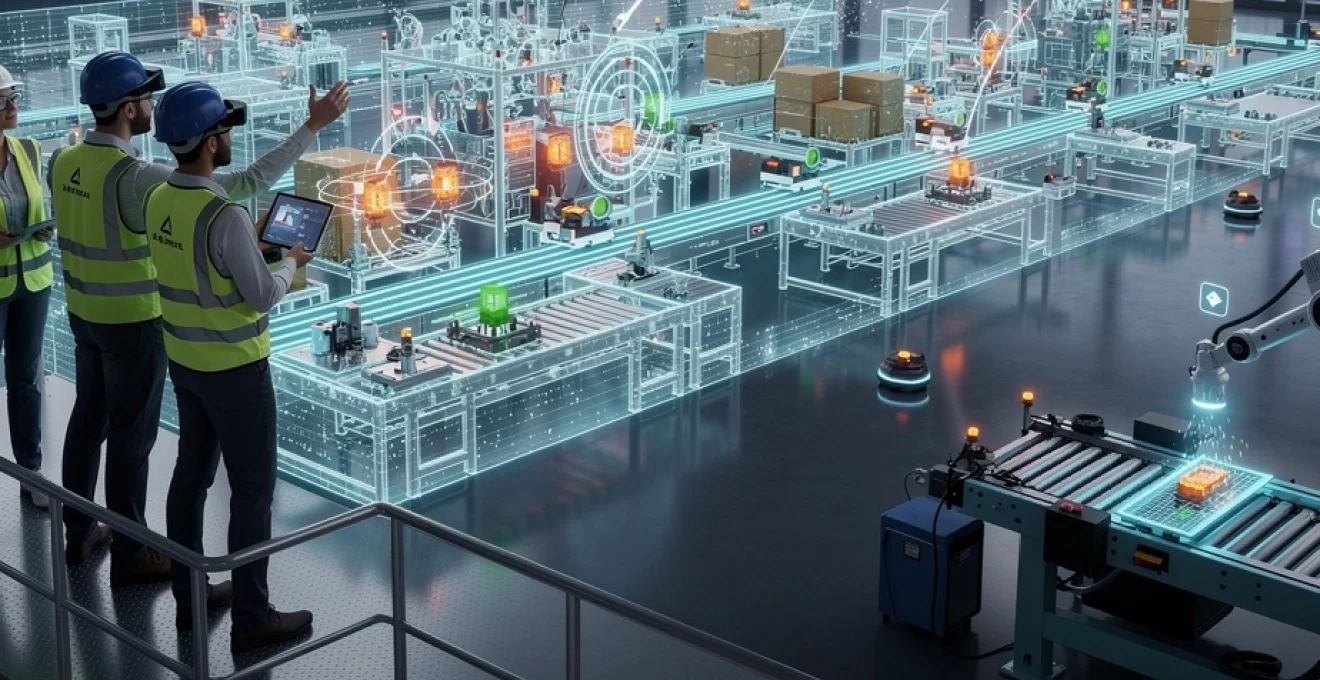
Manufacturing operations today face unprecedented demands for efficiency, cost reduction, and operational transparency. The convergence of Internet of Things (IoT) sensors, artificial intelligence, and cloud computing has created a revolutionary approach to factory management through digital twin technology. These virtual replicas of physical manufacturing systems are transforming how companies monitor, predict, and optimize their production processes in real-time.
Digital twins represent more than advanced visualisation tools—they function as dynamic, data-driven mirrors of entire manufacturing ecosystems. By creating bidirectional data flows between physical assets and their virtual counterparts, manufacturers can now achieve levels of operational visibility that were impossible just a decade ago. This technological transformation enables predictive maintenance strategies, reduces unplanned downtime by up to 50%, and delivers operational cost savings exceeding 30% across various industry sectors.
The integration of digital twin technology fundamentally changes how manufacturing leaders approach decision-making processes. Rather than relying on historical data or periodic inspections, production managers can now access continuous, real-time insights into every aspect of their operations. This shift from reactive to proactive management strategies represents a cornerstone of Industry 4.0 implementation.
Digital twin architecture and core components in manufacturing operations
Modern digital twin architectures in manufacturing environments comprise multiple interconnected layers that work together to create comprehensive operational visibility. The foundation begins with physical asset instrumentation, progresses through data processing layers, and culminates in intelligent decision-support systems. Understanding these architectural components is essential for successful implementation and maximising return on investment.
Iot sensor networks and Real-Time data acquisition systems
Industrial IoT sensor networks form the sensory nervous system of digital twin implementations. These networks deploy thousands of connected devices throughout manufacturing facilities to capture critical operational parameters including temperature, vibration, pressure, flow rates, and energy consumption. Advanced sensor technologies now provide millisecond-level data transmission capabilities, enabling true real-time monitoring of production processes.
Modern sensor deployment strategies utilise wireless mesh networks and edge computing nodes to reduce latency and improve data reliability. Temperature sensors monitor thermal conditions across production lines, whilst vibration sensors detect early indicators of bearing wear or mechanical misalignment. Pressure transducers track hydraulic and pneumatic systems, providing insights into equipment performance and energy efficiency patterns.
The architecture typically incorporates redundant data pathways to ensure continuous operation even during network disruptions. Edge gateway devices aggregate sensor data locally before transmitting to cloud-based digital twin platforms, reducing bandwidth requirements and improving response times. This distributed approach enables manufacturers to maintain operational visibility even during temporary connectivity issues.
Machine learning algorithms for predictive asset performance
Artificial intelligence algorithms transform raw sensor data into actionable insights through sophisticated pattern recognition and predictive analytics capabilities. Machine learning models analyse historical performance data to identify subtle indicators of impending equipment failures, often weeks or months before traditional monitoring systems would detect problems. These algorithms continuously refine their accuracy through supervised learning processes.
Neural networks excel at identifying complex, non-linear relationships between multiple operational variables. For instance, a combination of temperature fluctuations, vibration patterns, and energy consumption changes might indicate developing bearing problems in rotating equipment. Deep learning algorithms can detect these multi-parameter correlations that would be impossible for human operators to identify manually.
Anomaly detection algorithms compare current operational patterns against established baselines to identify deviations that could signal emerging issues. These systems adapt to changing operational conditions, such as seasonal variations or production schedule modifications, ensuring accurate predictions across diverse operating scenarios. The integration of reinforcement learning enables digital twins to optimise operational parameters autonomously, continuously improving performance through trial-and-error learning processes.
Cloud computing infrastructure and edge computing integration
Cloud computing platforms provide the computational power and storage capacity required for processing massive datasets generated by modern manufacturing facilities. Leading cloud providers offer specialised industrial IoT services designed specifically for digital twin applications, including Amazon AWS IoT Core, Microsoft Azure IoT Hub, and Google Cloud IoT Core. These platforms deliver virtually unlimited scalability and advanced analytics capabilities.
Edge computing integration addresses the latency requirements of time-critical manufacturing processes. Local processing nodes execute immediate decision-making algorithms whilst forwarding aggregated data to cloud-based systems for deeper analysis. This hybrid approach enables sub-second response times for safety-critical applications whilst maintaining comprehensive historical data analysis capabilities.
The architecture
The architecture typically incorporates data lakes or time-series databases for long-term storage, alongside stream-processing engines that support real-time analytics. Security is enforced across every layer through encryption, role-based access control, and network segmentation to protect sensitive production data. When designed correctly, this cloud–edge fabric becomes the backbone that keeps your digital twin synchronised with the shop floor, even as production scales or new facilities come online.
3D modelling and simulation engine technologies
At the presentation and decision-support layer, 3D modelling and simulation engines bring the digital twin to life. Rather than static CAD drawings, manufacturers increasingly rely on physics-based and discrete-event simulation tools that replicate how products, machines, and material flows behave under real operating conditions. These engines can incorporate kinematics, collision detection, fluid dynamics, and human ergonomics to reflect the physical constraints of the factory.
By linking 3D models to live data feeds, the digital twin becomes a continuously updated representation of the plant floor. Engineers can walk through a virtual factory, test new line configurations, or evaluate “what-if” scenarios—such as adding a new product family—without disrupting production. This is akin to having a flight simulator for your factory: you can practice, fail, and optimise in a safe virtual environment before committing capital in the real world.
Modern platforms also support integration with augmented reality (AR) and virtual reality (VR) headsets, enabling immersive training and collaborative remote reviews. When operators see real-time sensor data overlaid on the 3D model of a machine, troubleshooting becomes faster and safer. As a result, 3D simulation does not just enhance visibility; it directly accelerates project approvals, changeovers, and continuous improvement initiatives.
Real-time process monitoring through digital twin implementation
Once the architectural foundations are in place, digital twins start to deliver their most visible benefit: real-time process monitoring. Instead of piecing together spreadsheets, SCADA screens, and manual reports, operations teams gain a single, coherent view of how assets, lines, and plants are performing. This unified operational visibility is where many manufacturers first see tangible value from digital twin adoption.
SCADA systems integration with digital twin platforms
Supervisory Control and Data Acquisition (SCADA) systems have long been the central nervous system of manufacturing control. Integrating SCADA with digital twin platforms allows manufacturers to extend that visibility from the control room to the entire enterprise. Real-time tags, alarms, and historical trends from SCADA are mapped into the digital twin, providing context-rich views of what is happening and why.
Rather than replacing SCADA, the digital twin sits on top of it, enriching raw control data with analytics, simulation, and visualisation. For example, when an alarm is raised on a bottling line, the digital twin can immediately highlight the affected assets, display recent operating history, and suggest likely root causes. This shortens mean time to diagnose (MTTD) and allows maintenance teams to arrive at the machine with the right tools and spare parts.
Because SCADA integration often leverages existing communication drivers and data historians, it is a pragmatic entry point for digital twin projects. You can start with one critical line or process, validate the benefits of real-time process monitoring, and then scale integration across additional areas of the plant with minimal disruption.
OPC UA communication protocols for manufacturing equipment
To achieve consistent data acquisition across heterogeneous equipment fleets, most manufacturers rely on OPC UA as the backbone protocol for digital twin communication. OPC UA offers a vendor-neutral, secure way to access data from PLCs, CNC machines, robots, and legacy systems, enabling a unified information model for the digital twin. This standardisation is essential when you operate multi-vendor plants or brownfield sites with mixed generations of equipment.
OPC UA not only transports process values; it also supports complex data structures, semantic information, and event notifications. That means your digital twin can understand that one tag represents a motor speed and another represents a quality status, rather than simply treating them as anonymous numbers. This semantic richness makes it easier to build higher-level analytics and dashboards that speak the language of operations and maintenance.
In practice, OPC UA servers embedded in machines or provided by edge gateways expose the data, while the digital twin platform subscribes to relevant variables and events. With this pattern, you avoid custom point-to-point integrations and gain a scalable way to onboard new assets. As your factory evolves, you simply extend the OPC UA data model, and the digital twin inherits that expanded visibility.
Condition-based monitoring and anomaly detection algorithms
Real-time visibility becomes even more powerful when combined with condition-based monitoring and anomaly detection. Instead of relying on fixed time-based maintenance intervals, digital twins continuously evaluate asset health using live operating data. Algorithms compare current sensor patterns against historical baselines or engineered thresholds to detect early warning signs of failure.
For example, a subtle increase in vibration amplitude combined with a slight rise in motor temperature may indicate bearing degradation long before an operator can feel or hear it. Anomaly detection models—often powered by unsupervised machine learning—flag these deviations automatically, even when no explicit failure pattern has been defined. The outcome is fewer surprise breakdowns and a smoother shift from reactive to predictive maintenance strategies.
From a practical standpoint, you do not need to model every asset from day one. Many manufacturers begin with their most critical machines, such as furnaces, compressors, or bottleneck stations, and progressively expand coverage. Each additional piece of equipment monitored through the digital twin adds to the organisation’s collective intelligence about failure modes and process behaviour.
Production line visualisation and operational dashboards
To make all this data actionable, digital twin platforms provide production line visualisation and operational dashboards tailored to different roles. Plant managers need high-level KPIs like Overall Equipment Effectiveness (OEE), throughput, and scrap rates, while line supervisors may focus on cycle times, changeover durations, and current alarm states. A well-designed dashboard hierarchy aligns with these needs without overwhelming users.
Visualisations often combine 2D schematic views and 3D line layouts with colour-coded status indicators. You might see machines changing colour based on utilisation, buffers displaying live work-in-progress levels, and conveyors reflecting material flow direction. When something goes wrong, you can zoom from an executive KPI down to the specific workstation or sensor reading in a few clicks.
Because these dashboards draw from the same digital twin data model, they provide a “single source of truth” across departments. This reduces the time wasted reconciling conflicting reports and allows everyone—from production planners to quality engineers—to make decisions based on consistent, real-time information.
Predictive maintenance capabilities using digital twin analytics
Predictive maintenance is often the flagship use case that justifies investment in digital twin technology. By combining sensor data, historical maintenance records, and machine learning algorithms, digital twins can estimate remaining useful life (RUL) for critical components and recommend optimal intervention windows. This approach minimises unplanned downtime while avoiding premature part replacements.
In a typical predictive maintenance workflow, the digital twin ingests time-series data such as vibration spectra, temperature trends, and lubrication condition. Models then correlate these signals with past failure events to build prognostic curves. When the system detects convergence towards a known failure pattern, it generates a risk score and maintenance recommendation—often weeks in advance. You can then coordinate spare parts procurement, technician availability, and production plans around this forecast.
McKinsey estimates that predictive maintenance can reduce machine downtime by 30–50% and extend asset life by 20–40%. For manufacturers running capital-intensive equipment, these gains translate directly into higher asset utilisation and lower total cost of ownership. However, achieving such benefits requires disciplined data governance, cross-functional collaboration between maintenance and IT teams, and a willingness to adjust long-standing maintenance practices.
Digital twins also support scenario analysis for maintenance strategies. For instance, you can simulate the impact of deferring a planned intervention by one week, increasing inspection frequency, or changing spare parts suppliers. This ability to rehearse maintenance decisions in the virtual world helps you balance risk, cost, and uptime in a more scientific way, rather than relying solely on tribal knowledge.
Supply chain transparency and inventory management enhancement
Operational visibility does not end at the factory walls. Leading manufacturers are extending digital twin concepts across their supply chains to create end-to-end transparency. By modelling suppliers, warehouses, transport routes, and distribution centres, a supply chain digital twin provides a real-time picture of material flows and inventory positions from raw material to finished goods.
This holistic view enables more accurate demand forecasting and production planning. When your digital twin can see supplier lead times, in-transit shipments, and current stock levels in one place, you can better align production schedules with actual material availability. The result is fewer line stoppages due to missing parts and lower safety stock levels without increasing risk.
Inventory management also benefits from digital twin-driven analytics. Advanced models can recommend optimal reorder points and lot sizes for each SKU based on variability in demand and supply. They can simulate the impact of supplier disruptions, transport delays, or sudden demand spikes, helping you design more resilient sourcing strategies. In volatile markets, this ability to run rapid “what-if” analyses becomes a strategic differentiator.
Some manufacturers go further by sharing portions of their digital twin with key suppliers and logistics partners. This controlled data sharing improves collaboration, reduces bullwhip effects, and supports joint decision-making around capacity investments or inventory positioning. As more ecosystem participants connect their systems, the supply chain digital twin evolves from a static model into a living network that reflects the real world with increasing fidelity.
Leading digital twin platforms transforming manufacturing visibility
Although the principles of digital twins are technology-agnostic, the choice of platform has a significant impact on implementation speed, scalability, and integration effort. Several industrial platforms have emerged as front-runners, each with its own strengths, ecosystem partners, and preferred use cases. Understanding these differences helps you select a foundation that aligns with your technology stack and business priorities.
Siemens MindSphere industrial IoT operating system
Siemens MindSphere is an industrial IoT operating system purpose-built for connecting machines, analysing data, and enabling digital twin scenarios. It excels in environments where Siemens automation hardware, drives, and PLCs are already prevalent, offering out-of-the-box connectors and templates. MindSphere aggregates machine data in the cloud and provides analytics, visualisation, and application development tools tailored to manufacturing use cases.
One of MindSphere’s strengths lies in its application ecosystem, which includes pre-configured solutions for OEE monitoring, energy management, and condition-based maintenance. Manufacturers can quickly deploy these applications to gain baseline visibility, then extend them into more advanced digital twin models. Because Siemens also offers engineering and simulation tools such as NX and Tecnomatix, you can create a tightly integrated workflow from design to production.
For organisations pursuing a “vendor-aligned” strategy, MindSphere offers a coherent roadmap that spans sensors, automation, MES, and analytics. However, even in mixed-vendor plants, its support for OPC UA and open APIs allows integration with third-party equipment, making it a viable choice for multi-site deployments seeking consistent operational visibility.
GE digital predix platform for industrial applications
GE Digital’s Predix platform was originally developed to support high-value industrial assets such as gas turbines, jet engines, and power generation equipment. As a result, it has strong capabilities in asset performance management (APM), reliability-centred maintenance, and long-term lifecycle analytics. For manufacturers with complex, capital-intensive machinery, Predix provides a robust backbone for asset-centric digital twins.
Predix emphasises advanced analytics and machine learning models that predict failures and optimise asset utilisation. GE’s own experience operating thousands of industrial assets feeds into pre-trained models and best practices that customers can leverage. In manufacturing environments, this translates to improved uptime for critical equipment and more accurate planning of overhauls and retrofits.
Because Predix was built with security and multi-tenancy in mind, it is also suitable for OEMs that want to offer digital services to their customers. By embedding Predix-powered digital twins into their products, original equipment manufacturers can provide remote monitoring, performance guarantees, and outcome-based service contracts—deepening customer relationships and creating new revenue streams.
PTC ThingWorx industrial innovation platform
PTC ThingWorx is an industrial innovation platform that focuses on rapid application development, integration flexibility, and strong AR capabilities. It is particularly well-suited to manufacturers that need to connect diverse equipment, create custom dashboards, and deliver role-based applications without long development cycles. ThingWorx offers model-driven tools, drag-and-drop interfaces, and reusable building blocks that accelerate digital twin implementation.
One differentiator for ThingWorx is its integration with PTC’s CAD and PLM solutions, such as Creo and Windchill. This makes it easier to extend product digital twins into the production environment, closing the loop between design and operations. Combined with Vuforia, PTC’s AR platform, manufacturers can overlay digital twin data onto physical machines through tablets or smart glasses, enhancing training and guided maintenance workflows.
Because ThingWorx is designed to be vendor-neutral, it fits well in heterogeneous environments where you need to connect legacy systems, multiple PLC brands, and various IT applications. For organisations prioritising flexibility and speed, it offers a practical path to building and scaling digital twin use cases without being locked into a single automation supplier.
Microsoft azure digital twins service implementation
Microsoft Azure Digital Twins is a platform-as-a-service (PaaS) offering that enables you to create comprehensive digital models of environments, from individual assets to entire factories and campuses. It leverages Azure’s broader IoT, analytics, and AI services, making it a strong choice for organisations already invested in the Microsoft cloud ecosystem. With Azure Digital Twins, you define a graph-based model of your physical environment and bind live data streams to that model.
This graph-centric approach is particularly powerful for representing complex relationships between equipment, rooms, lines, and even people. For example, you can model how a compressor feeds multiple lines, how those lines relate to specific orders, and how environmental conditions affect quality outcomes. Queries against this graph then provide rich insights into cause-and-effect relationships that might otherwise be hidden.
Because Azure Digital Twins integrates natively with services like Azure IoT Hub, Time Series Insights, Power BI, and Azure Machine Learning, you can build end-to-end solutions that move seamlessly from data ingestion to analytics and visualisation. For manufacturers pursuing a broader “smart facility” or smart building strategy alongside factory digitalisation, Azure’s horizontal capabilities provide a scalable and future-proof foundation.
Return on investment analysis and implementation challenges
As with any major transformation initiative, successful digital twin adoption requires a clear view of expected returns and potential obstacles. While case studies frequently highlight impressive numbers—such as 20–30% reductions in operational costs or 25% improvements in productivity—the actual ROI will depend on your maturity, asset mix, and change management effectiveness. A structured business case is essential to secure stakeholder buy-in and prioritise projects.
On the benefits side, digital twins typically generate value across four dimensions: reduced unplanned downtime, improved throughput, lower maintenance and energy costs, and better quality and compliance. Quantifying these impacts often involves comparing current baseline KPIs with projected improvements derived from pilot projects or benchmarks. You should also consider softer benefits such as faster ramp-up of new lines, improved collaboration between engineering and operations, and enhanced safety through remote inspections.
However, there are also non-trivial implementation challenges. Data quality and availability remain top concerns—if sensor coverage is patchy or tags are poorly documented, building an accurate digital twin becomes difficult. Integration complexity between OT and IT systems can slow progress, especially in brownfield plants with legacy equipment. Talent shortages in data science, OT cybersecurity, and industrial networking can further constrain execution if not addressed through training or partnerships.
To navigate these challenges, many manufacturers adopt a phased approach. They start with a narrow, high-impact use case—such as predictive maintenance on a critical asset or OEE visibility for a bottleneck line—and use that as a proving ground. Lessons from the pilot inform standards for data modelling, cybersecurity, and governance that can then be reused across subsequent rollouts. By iterating in this way, you reduce risk while steadily expanding the scope of your digital twin and the operational visibility it provides.
Ultimately, the question is not whether digital twins will reshape manufacturing visibility—they already are—but how quickly and effectively your organisation will embrace them. By grounding your strategy in a solid architecture, choosing platforms that fit your environment, and focusing on measurable use cases, you can turn digital twins from a buzzword into a core capability that underpins smarter, more resilient operations.