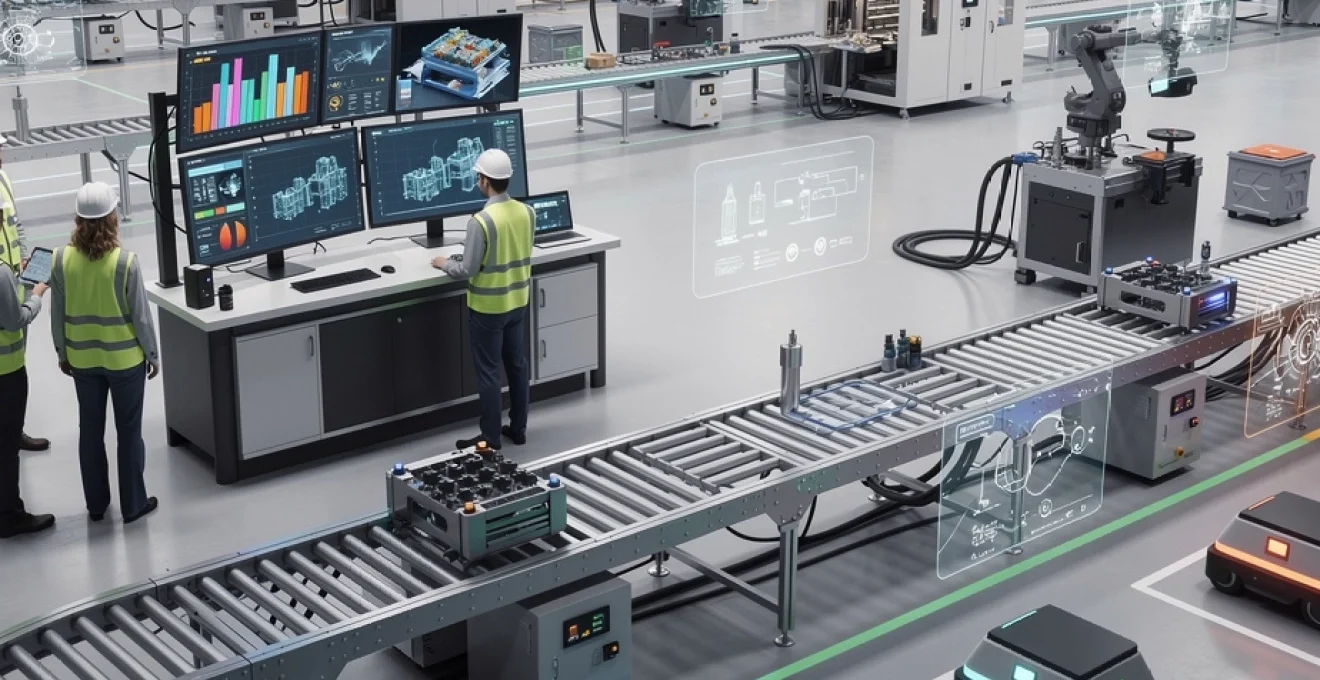
Modern manufacturing environments face unprecedented challenges in adapting to rapidly changing market demands, supply chain disruptions, and evolving customer expectations. Traditional fixed production systems, once the backbone of industrial operations, now struggle to provide the agility and responsiveness required in today’s dynamic landscape. Custom industrial solutions have emerged as the cornerstone of operational flexibility, enabling manufacturers to pivot quickly, scale efficiently, and maintain competitive advantages in an increasingly volatile marketplace.
The shift towards customised manufacturing technologies represents more than just technological advancement—it signifies a fundamental transformation in how industrial operations approach production planning, resource allocation, and system integration. These bespoke solutions allow manufacturers to break free from the constraints of one-size-fits-all approaches, creating production environments that can adapt in real-time to changing requirements whilst maintaining optimal efficiency and quality standards.
Modular manufacturing systems and scalable production architecture
The foundation of operational flexibility lies in the implementation of modular manufacturing systems that can be reconfigured, expanded, or modified based on production requirements. These systems represent a paradigm shift from traditional linear production lines to adaptive manufacturing ecosystems that can respond dynamically to varying demand patterns and product specifications.
Modular production architecture enables manufacturers to achieve unprecedented levels of flexibility by compartmentalising production processes into independent, yet interconnected modules. Each module can operate autonomously or in coordination with others, creating a production environment that scales seamlessly from small-batch custom orders to high-volume mass production. This approach reduces the capital investment required for capacity expansion whilst simultaneously decreasing the time needed to implement changes to production workflows.
Reconfigurable manufacturing systems (RMS) implementation strategies
Reconfigurable Manufacturing Systems represent the evolution of flexible manufacturing, offering customised flexibility that can be adjusted precisely to meet specific production requirements. Unlike traditional flexible systems that provide general-purpose capability, RMS solutions are designed around product families, enabling rapid reconfiguration when product designs change or new variants are introduced.
The implementation of RMS requires careful consideration of machine modularity, where individual production units can be easily relocated, reconnected, or repurposed. This approach allows manufacturers to respond quickly to market changes without the substantial downtime and costs associated with traditional system overhauls. Modern RMS implementations incorporate advanced sensing technologies and intelligent control systems that enable automatic reconfiguration based on production schedules and quality requirements.
SCADA integration with Allen-Bradley ControlLogix platforms
Supervisory Control and Data Acquisition systems integrated with Allen-Bradley ControlLogix platforms provide the intelligent backbone for modular manufacturing operations. These systems enable real-time monitoring and control of distributed production modules, ensuring seamless coordination across the entire manufacturing ecosystem. The integration facilitates predictive maintenance scheduling, quality monitoring, and production optimisation through comprehensive data collection and analysis.
ControlLogix platforms excel in providing deterministic control for time-critical manufacturing processes whilst offering the scalability needed for modular system expansion. The platform’s ability to integrate with various fieldbus protocols and industrial networks makes it an ideal choice for manufacturers implementing mixed-vendor equipment environments, ensuring interoperability whilst maintaining optimal performance levels.
Flexible conveyor systems using bosch rexroth MontTrac technology
Material handling represents a critical component in achieving operational flexibility, and Bosch Rexroth MontTrac technology exemplifies how intelligent conveyor systems can enhance manufacturing adaptability. This monorail system provides individual vehicle control, enabling dynamic routing, buffering, and sequencing of materials throughout the production facility.
MontTrac technology allows manufacturers to implement just-in-time delivery of materials to production stations whilst maintaining the flexibility to reroute materials when production schedules change or equipment requires maintenance. The system’s ability to handle varying product sizes and weights without manual intervention significantly reduces changeover times and labour requirements, contributing directly to improved operational efficiency.
Automated guided vehicle (AGV) fleet optimisation with KIVA systems
Automated Guided Vehicle systems, exemplified by KIVA technology, revolutionise material handling by creating autonomous logistics networks within manufacturing facilities. These systems provide unparalleled flexibility in material movement, enabling manufacturers to adapt warehouse layouts and material flow patterns without significant infrastructure modifications.
By using a grid-based navigation logic and dynamic task allocation, a custom AGV control solution can rebalance workloads in real time as priorities change. For example, if a critical production order is brought forward, AGVs can automatically reprioritise raw material deliveries, return empty pallets, and clear finished goods from bottleneck stations. This level of responsive material handling not only improves operational flexibility, it also reduces the need for fixed conveyors and manual transport, lowering both capital expenditure and ongoing labour costs.
Advanced process control integration through digital twin technology
While modular hardware creates physical flexibility, digital twin technology delivers process flexibility by mirroring production systems in a virtual environment. A digital twin is a dynamic, data-driven model that reflects the current state of machines, lines, and entire plants, allowing you to test scenarios, optimise parameters, and predict failures without disrupting live operations. As more manufacturers invest in industrial IoT, digital twins are becoming the central hub for advanced process control integration across multi-vendor environments.
Custom industrial solutions built around digital twins enable manufacturers to implement advanced process control strategies that would be risky or impractical to trial directly on the shop floor. You can adjust recipe parameters, line speeds, or shift patterns in the virtual model, then roll out only the proven configurations to physical assets. This approach reduces commissioning time, cuts process variability, and supports faster response to shifts in demand, raw material quality, or regulatory requirements.
Siemens digital factory suite for real-time process monitoring
The Siemens Digital Factory Suite, including tools such as SIMATIC PCS 7, NX, and Plant Simulation, provides a comprehensive platform for building and operating digital twins of industrial facilities. When tightly integrated with field devices and PLCs, this ecosystem offers real-time process monitoring, advanced visualisation, and closed-loop optimisation capabilities. Manufacturers gain a unified view of equipment performance, energy use, and product quality across disparate systems.
In a custom deployment, the Siemens Digital Factory Suite can be configured to mirror the exact layout, recipes, and control logic of your plant. What does this mean in practice? Engineers can run “what-if” analyses on new SKUs, verify changeover strategies, or stress-test throughput limits in the virtual model before touching physical hardware. This significantly improves operational flexibility, as you can adapt to market changes faster and with greater confidence in the outcome.
Predictive analytics using GE predix industrial IoT platform
GE Predix, designed as an industrial IoT platform, excels at ingesting high-frequency sensor data and turning it into actionable predictive analytics. By connecting assets such as compressors, pumps, turbines, and packaging lines to Predix, manufacturers can develop custom industrial solutions that predict failures, optimise maintenance windows, and fine-tune process setpoints. According to recent industry benchmarks, predictive maintenance can reduce unplanned downtime by up to 30–50% and extend asset life by 20–40%.
Within a flexible manufacturing environment, these gains translate directly into more reliable capacity and smoother product mix changes. Instead of scheduling maintenance on fixed intervals, you schedule interventions only when the data signals emerging issues. This is like having a “health forecast” for every critical machine, allowing you to reshuffle production schedules, reroute work, or buffer inventory in advance, rather than reacting to unexpected breakdowns.
Machine learning algorithms for demand forecasting in SAP manufacturing
Operational flexibility is not just about how quickly you can change over lines; it also depends on how accurately you can anticipate demand. SAP Manufacturing, when integrated with embedded machine learning algorithms and SAP Integrated Business Planning (IBP), enables advanced demand forecasting tailored to your specific product portfolio and market behaviour. Instead of relying on static forecasts, you can use custom models that consider seasonality, promotions, macroeconomic signals, and even real-time sales data.
By improving forecast accuracy, you align production plans more closely with actual demand, reducing both stockouts and excess inventory. This is especially important in industries with short product life cycles or volatile order patterns, such as electronics or consumer packaged goods. With better visibility into future demand, manufacturers can use their modular lines and reconfigurable cells more intelligently, reserving capacity where it is most valuable and delaying non-urgent runs without risking service levels.
OPC-UA communication protocols for multi-vendor equipment interoperability
Many plants operate a mix of legacy systems, new machines, and third-party automation components. Without a common communication layer, operational flexibility quickly suffers, as each change requires bespoke interfaces and one-off engineering. OPC-UA has emerged as the de facto standard for secure, platform-agnostic data exchange between industrial devices, SCADA systems, and higher-level MES or ERP platforms.
Custom industrial solutions that leverage OPC-UA create a unified “language” for your equipment, allowing data to flow seamlessly between Siemens, Rockwell, ABB, and other vendors’ systems. This interoperability is critical when you introduce new modules, AGVs, or quality inspection stations into an existing plant. Instead of re-architecting the entire control system, you integrate via OPC-UA nodes, preserving your flexibility to scale or swap assets as technology evolves.
Lean manufacturing principles enhanced by custom automation solutions
Lean manufacturing focuses on eliminating waste and maximising value, but in many plants the biggest constraint is the rigidity of existing equipment. Custom automation solutions bridge this gap, embedding lean principles into the very design of machines, cells, and information systems. When automation is tailored to your value streams, you can support single-piece flow, rapid changeovers, and mixed-model production without sacrificing efficiency or quality.
For example, custom vision-guided robotics can replace multiple dedicated fixtures, allowing you to handle different product variants on the same line. Likewise, bespoke MES dashboards can show line operators real-time takt attainment, defect trends, and bottlenecks, empowering them to react immediately rather than waiting for end-of-shift reports. The result is a production environment where continuous improvement is not just a philosophy, but a built-in capability of your automation ecosystem.
Supply chain resilience through adaptive manufacturing networks
Recent global disruptions have highlighted how fragile traditional supply chains can be. Manufacturers that relied on a single plant or region for critical components found themselves unable to respond when logistics networks faltered. Custom industrial solutions support the creation of adaptive manufacturing networks, where production can be shifted across multiple sites, contract manufacturers, or even partners without lengthy revalidation or engineering work.
At the core of these networks are standardised yet configurable process templates, shared digital twins, and interoperable data models. When a disruption occurs—such as a supplier outage or regional lockdown—you can move a product family to another facility, deploy the validated process recipe, and connect local equipment via OPC-UA or similar standards. This flexibility turns manufacturing from a fixed asset into a strategic lever for maintaining service levels, even in highly volatile conditions.
Energy management systems and sustainable production optimisation
Operational flexibility today must go hand in hand with energy efficiency and sustainability. As energy prices fluctuate and regulatory pressure increases, manufacturers are expected to reduce their carbon footprint while preserving responsiveness. Custom energy management systems designed around plant-specific loads, processes, and schedules help you achieve this balance by making energy consumption visible, controllable, and optimisable in real time.
Rather than treating energy as a fixed overhead, leading manufacturers now manage it like any other production input. They synchronise high-energy processes with off-peak tariffs, shift non-critical loads during demand-response events, and reconfigure production plans to avoid simultaneous use of multiple peak-demand assets. When integrated with digital twins and MES, energy data becomes another dimension in your decision-making, enabling trade-offs between throughput, cost, and environmental impact.
Schneider electric EcoStruxure for industrial energy efficiency
Schneider Electric’s EcoStruxure platform delivers a layered architecture for industrial energy efficiency, combining connected products, edge control, and apps, analytics, and services. In a custom deployment, EcoStruxure can monitor everything from main switchgear and motor control centres to HVAC units and process heaters, turning raw consumption data into detailed load profiles and performance KPIs. This granular visibility is the first step toward flexible, optimised energy use.
By integrating EcoStruxure with production planning systems, you can automatically adjust line speeds, batch scheduling, or equipment start-up sequences to minimise peak demand. For instance, if your forecast indicates a surge in orders, EcoStruxure can help identify the most energy-efficient way to meet that demand, perhaps by spreading production across shifts or reallocating work to more efficient lines. This approach not only reduces costs, it also supports corporate sustainability targets and regulatory compliance.
Variable frequency drive (VFD) integration with ABB ACS880 series
Electric motors account for a substantial share of industrial energy consumption, and many operate at constant speed even when full output is not required. Integrating ABB ACS880 series variable frequency drives into your custom industrial solutions allows precise control of motor speed and torque across a wide range of applications—pumps, fans, mixers, conveyors, and more. In many cases, energy savings of 20–50% are achievable simply by matching speed to process demand.
Beyond energy efficiency, VFDs also enhance operational flexibility. You can ramp up or down gently to avoid mechanical stress, adjust speeds for different product formats, or create dynamic control strategies based on process feedback. Think of it as replacing an on/off light switch with a dimmer that automatically sets the perfect brightness; the process gets exactly what it needs, when it needs it, without waste or unnecessary wear on equipment.
Compressed air system optimisation using atlas copco SmartLink technology
Compressed air is often called the “fourth utility” in manufacturing, but it is also one of the least visible and most energy-intensive. Atlas Copco’s SmartLink technology provides remote monitoring and analytics for compressed air systems, allowing you to track pressure, flow, energy use, and machine health across multiple compressors and dryers. With a custom SmartLink implementation, manufacturers can detect leaks, identify inappropriate uses of compressed air, and optimise control strategies such as cascade or variable-speed operation.
From a flexibility standpoint, a well-optimised compressed air network can support the addition of new tools, lines, or automation modules without expensive oversizing. By using predictive insights from SmartLink, you can plan capacity expansions or rebalancing based on actual demand profiles rather than rough rules of thumb. This reduces both energy waste and the risk of pressure drops that could affect product quality or equipment performance.
Quality control automation and statistical process control implementation
In highly flexible manufacturing environments, maintaining consistent quality across frequent product changes is a constant challenge. Manual inspection and paper-based checks are too slow and error-prone to keep up with short runs, rapid changeovers, and complex product variants. Custom quality control automation, combined with robust Statistical Process Control (SPC), provides the framework for real-time quality assurance that scales with your operational flexibility.
Automated vision systems, in-line sensors, and advanced metrology equipment can capture critical quality data at each step in the process, feeding it directly into SPC software. Control charts, capability indices, and trend analyses are updated in real time, giving operators immediate feedback and triggering alerts when processes drift toward specification limits. This is like having a continuous “health monitor” for your product quality, rather than relying on occasional check-ups.
When integrated with MES and digital twin platforms, SPC insights can drive automatic process adjustments, recipe tweaks, or equipment offsets to keep quality within tight tolerances. You can also use the historical data to refine setup parameters for new product introductions, shortening validation cycles and reducing scrap rates from the very first batch. In this way, quality control automation does more than catch defects—it actively supports the agility and responsiveness that modern manufacturing demands.