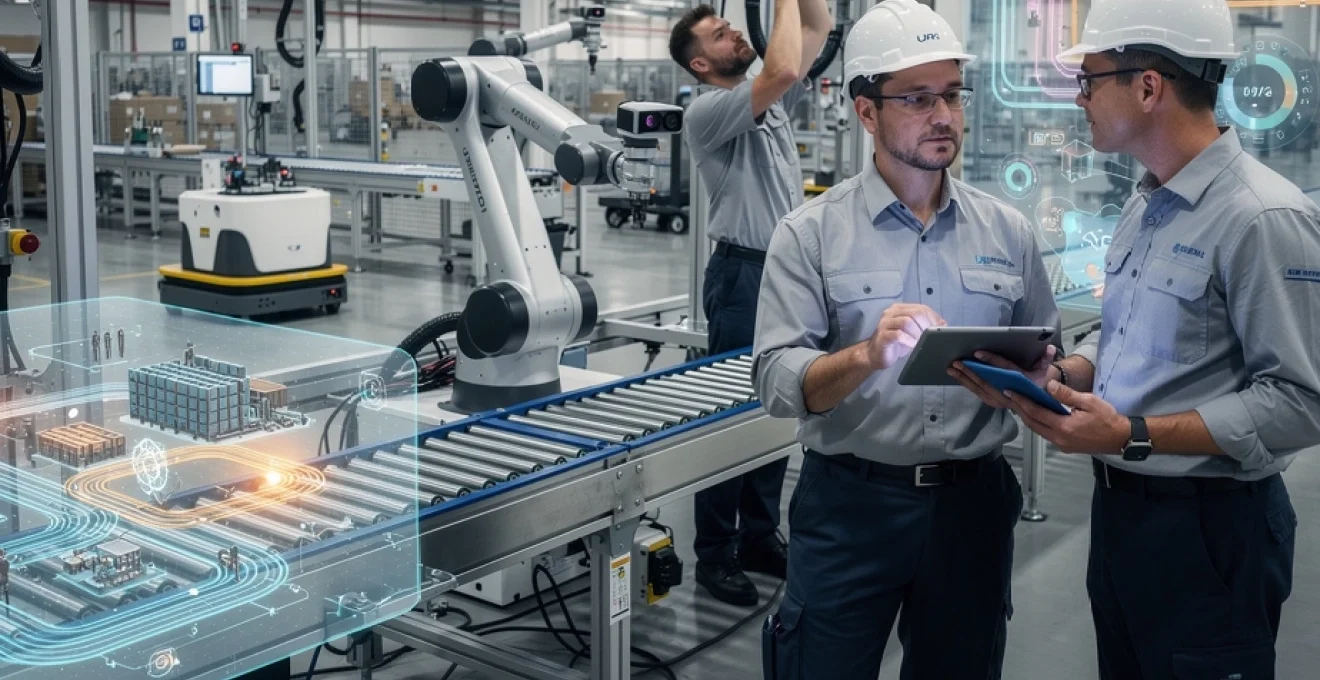
The industrial landscape is undergoing a profound transformation as automation technologies reshape manufacturing operations across the globe. Manufacturing companies are increasingly recognising that automation isn’t simply about replacing human workers—it’s about liberating skilled employees from repetitive, mundane tasks so they can focus on strategic initiatives that drive innovation and competitive advantage. This shift represents a fundamental reimagining of the relationship between technology and human expertise in industrial environments.
Recent studies indicate that 73% of organisations worldwide now utilise automation technologies, a significant increase from 48% in 2019. This rapid adoption reflects not just technological advancement, but a growing understanding that automation can enhance human capability rather than diminish it. When implemented thoughtfully, automated systems create opportunities for workers to engage in higher-value activities such as strategic planning, creative problem-solving, and complex decision-making that requires human insight and expertise.
Robotic process automation implementation in manufacturing operations
Robotic Process Automation (RPA) has emerged as a cornerstone technology for streamlining manufacturing workflows and reducing the administrative burden on skilled technicians. Unlike traditional industrial robots that handle physical tasks, RPA focuses on automating repetitive digital processes that consume valuable employee time. These software-based solutions can manage everything from inventory tracking to compliance reporting, allowing human workers to concentrate on tasks that require critical thinking and technical expertise.
Modern RPA implementations in manufacturing environments typically achieve time savings of up to 25% across various operational processes. This efficiency gain translates directly into increased capacity for value-added activities such as process improvement initiatives, equipment optimisation, and quality enhancement projects. The technology excels particularly in areas where data accuracy is paramount, as automated systems eliminate the human error factor that can occur during repetitive manual data entry tasks.
Siemens MindSphere integration for production line monitoring
Siemens MindSphere represents a sophisticated approach to production line automation that demonstrates how IoT platforms can transform manufacturing operations. This cloud-based operating system collects and analyses data from connected devices throughout the production environment, providing real-time insights that would previously require extensive manual monitoring. The platform enables predictive analytics that can identify potential equipment failures before they occur, shifting maintenance teams from reactive troubleshooting to proactive system optimisation.
The implementation of MindSphere systems typically results in a 15-30% reduction in unplanned downtime, directly correlating to increased productivity and reduced stress on maintenance personnel. Rather than spending hours diagnosing equipment issues, technicians can focus on implementing preventive measures and optimising production parameters. This shift from firefighting to strategic planning represents a significant upgrade in job satisfaction and professional development opportunities for skilled workers.
Collaborative robotics deployment using universal robots UR10e systems
Collaborative robotics, or “cobots,” exemplify the ideal partnership between automation and human expertise. The Universal Robots UR10e system is designed to work alongside human operators, handling physically demanding or repetitive tasks while employees focus on quality control, process oversight, and complex assembly operations. These systems are particularly effective in applications requiring both precision and adaptability—qualities that benefit from the combination of robotic consistency and human judgement.
Deployment of collaborative robotics systems has shown remarkable results in reducing physical strain on workers while improving overall production quality. Companies implementing UR10e systems report that employees experience greater job satisfaction as they transition from monotonous assembly tasks to roles involving problem-solving, quality assurance, and system optimisation. The human-robot collaboration model preserves the invaluable human elements of creativity and adaptability while leveraging robotic precision for repetitive operations.
SAP manufacturing execution system workflow optimisation
SAP Manufacturing Execution Systems (MES) provide comprehensive workflow automation that eliminates many of the administrative bottlenecks that traditionally consume significant employee time. These systems automatically track production orders, manage inventory levels, and coordinate scheduling across multiple production lines. By automating these coordination tasks, SAP MES solutions free up production managers and supervisors to focus on strategic planning, team development, and process improvement initiatives.
The workflow optimisation capabilities of SAP MES extend beyond simple task automation to include intelligent resource allocation and real-time performance monitoring. This comprehensive approach enables manufacturing teams to identify opportunities for continuous improvement and implement changes more rapidly than
ever before. Instead of chasing paper-based work orders or manually consolidating spreadsheets, supervisors can review real-time dashboards, investigate bottlenecks, and collaborate with cross-functional teams to redesign workflows. In practical terms, this means more time spent on root cause analysis, Kaizen events, and continuous improvement projects—activities that directly increase throughput and reduce waste in manufacturing operations.
Predictive maintenance algorithms through IoT sensor networks
Predictive maintenance powered by IoT sensor networks is one of the clearest examples of how automation frees up employee time for higher-value industrial work. By continuously collecting data on vibration, temperature, pressure, and other performance indicators, sensor-equipped machines can feed algorithms that forecast failures before they occur. Instead of following rigid preventive maintenance schedules, maintenance teams can intervene only when needed, based on data-driven insights into asset health.
This automation of condition monitoring eliminates countless hours previously spent on routine inspections that often revealed no issues. Maintenance engineers can redirect their time toward analysing failure patterns, optimising maintenance strategies, and collaborating with production on equipment upgrades. According to multiple industry reports, manufacturers that implement predictive maintenance algorithms typically see maintenance costs drop by 10–20% and unplanned outages reduced by up to 50%. For employees, the shift is tangible: fewer crisis callouts and more opportunities to design robust, reliable systems.
Machine learning applications for quality control and inspection tasks
Quality control and inspection tasks have historically been labour intensive, relying on human inspectors to visually examine products, measure dimensions, and document non-conformities. Machine learning and automation are changing this paradigm, turning quality inspection into a continuous, data-rich process. When organisations deploy automated inspection systems, they not only reduce inspection cycle times, they also enable quality engineers to spend more time on root cause analysis, process improvement, and cross-functional collaboration.
In many factories, quality teams report that automated inspection can increase inspection throughput by 2–3x while maintaining or improving defect detection rates. Instead of inspecting every part manually, employees can oversee machine learning models, validate edge cases, and focus on systemic issues such as supplier variability or process drift. This is where the real value lies: using automated quality control to free experts from repetitive checks so they can design more robust, higher-yield processes.
Computer vision implementation with cognex In-Sight systems
Cognex In-Sight systems are a leading example of how computer vision can automate complex inspection tasks on high-speed production lines. These smart cameras use advanced image processing and machine learning to verify labels, measure features, detect defects, and confirm assembly integrity in real time. Once configured, they perform inspections consistently at speeds that would be impossible for human inspectors, even on the most demanding lines.
The real benefit for employees comes from the shift in responsibility: instead of staring at products all day, quality technicians configure inspection recipes, fine-tune lighting and camera positioning, and analyse inspection data to detect trends. This allows them to move into higher-value industrial work such as designing new inspection strategies for upcoming products or collaborating with design engineering to improve manufacturability. It’s the difference between counting products at the end of a line and designing the entire quality assurance approach.
Statistical process control through real-time data analytics
Statistical Process Control (SPC) has long been a cornerstone of manufacturing quality, but manual data collection and offline analysis limited its effectiveness. With real-time data analytics, SPC charts are now generated automatically from live production data, providing instant feedback on process stability. Operators and engineers receive alerts the moment a process starts to drift, enabling them to intervene before defects accumulate.
Automated SPC eliminates the tedious work of logging measurements by hand, compiling spreadsheets, and plotting control charts after the fact. Instead, quality engineers can devote their time to interpreting the data, running designed experiments, and working with production teams to tighten process capability. This is where real continuous improvement happens. By letting automated SPC handle the number-crunching, you empower your engineers to act as strategic partners who prevent problems rather than simply documenting them.
Automated defect detection using keyence vision technology
Keyence vision systems bring another powerful option for automated defect detection, especially where surface inspection or complex pattern recognition is required. These systems combine high-resolution imaging with sophisticated algorithms to detect scratches, dents, misalignments, and other subtle anomalies that human inspectors might miss during long shifts. Once deployed, they provide consistent, repeatable inspection at any hour of the day.
From a workforce perspective, Keyence-based automation means that line operators and inspectors no longer need to perform intense visual checks for every component. Instead, they monitor inspection dashboards, respond to alarms, and participate in structured problem-solving when defect rates change. This transition moves employees away from monotonous, error-prone tasks and into roles that demand diagnostic skills and cross-functional communication, such as coordinating with maintenance, engineering, and suppliers to tackle underlying causes.
Six sigma integration with digital twin manufacturing models
Digital twin technology allows manufacturers to build virtual replicas of production lines and processes, which can be used to test improvements before implementing them on the shop floor. When combined with Six Sigma methodologies, digital twins become powerful tools for reducing variation and improving quality. Engineers can run virtual Design of Experiments (DoE), model process changes, and simulate “what if” scenarios without disrupting live production.
This integration fundamentally changes how Six Sigma practitioners spend their time. Rather than manually gathering data and running slow, offline trials, Black Belts and Green Belts can use digital twins to validate hypotheses rapidly and refine process settings. It’s similar to using a flight simulator before flying a new route: you can explore edge cases and failures safely, then deploy the best solution with confidence. The result is a higher rate of successful projects, faster cycle times for improvement initiatives, and more time for engineers to tackle strategic issues across multiple production lines.
Enterprise resource planning automation across industrial workflows
Enterprise Resource Planning (ERP) systems sit at the heart of most industrial organisations, coordinating finance, procurement, production, logistics, and HR. Historically, many ERP-related workflows required manual data entry, paper-based approvals, and repetitive reconciliations that absorbed enormous amounts of employee time. Modern ERP automation changes this by orchestrating end-to-end workflows that connect shop-floor data with back-office processes in near real time.
Automating ERP workflows—such as purchase order creation, materials requirements planning, and production order confirmations—dramatically reduces administrative overhead for planners, buyers, and production schedulers. For example, integrating ERP with shop-floor systems can automatically post goods movements based on real-time consumption, eliminating the need for manual backflushing. Supply chain and production teams can then focus on scenario planning, supplier collaboration, and constraint management, rather than keying data into multiple systems. In effect, ERP automation frees skilled employees to act as decision-makers rather than data clerks.
Artificial intelligence-driven supply chain management systems
As supply chains become more complex and volatile, artificial intelligence-driven supply chain management systems are emerging as a crucial differentiator. These platforms use machine learning, advanced analytics, and automation to balance demand and supply across global networks. Instead of relying solely on periodic planning cycles and spreadsheets, planners can leverage AI to generate optimal plans, simulate scenarios, and automate routine decisions.
For industrial companies, the value is twofold. First, AI supply chain automation reduces the time planners spend on repetitive tasks such as adjusting safety stocks or rebalancing inventory across sites. Second, it allows supply chain professionals to focus on strategic work: assessing risk, developing supplier partnerships, and designing resilient networks that can withstand disruptions. In a world of frequent shocks—geopolitical events, raw material shortages, and transport constraints—having planners who are free to think ahead is a competitive advantage.
Oracle supply chain planning cloud implementation strategies
Oracle Supply Chain Planning Cloud offers a comprehensive suite of tools for automating planning across demand, supply, and inventory. Successful implementation starts with clearly defining planning hierarchies, time fences, and decision rights so that automated recommendations can flow smoothly into execution. Companies that invest early in data quality and master data governance typically see faster time-to-value from their Oracle planning automation.
From a workforce standpoint, one of the most important strategies is to position planners as “reviewers and challengers” of system suggestions, rather than as manual schedulers. By configuring Oracle to generate baseline plans automatically, you allow planners to spend their time reviewing exceptions, challenging assumptions, and collaborating with sales and operations to align on the best course of action. This is where human judgment and negotiation skills create real value, while the platform handles the heavy mathematical optimisation in the background.
Demand forecasting through advanced analytics platforms
Advanced analytics platforms, often powered by machine learning, have transformed demand forecasting from a static, backward-looking exercise into a dynamic, forward-looking capability. These systems ingest a wide range of signals—historical sales, promotions, macroeconomic indicators, even weather data—to generate highly granular forecasts. When embedded into planning workflows, they can automatically update forecasts as new data arrives, providing a “living” view of demand.
What does this mean for forecasting teams? Instead of spending days merging spreadsheets and reconciling numbers, demand planners can interpret forecast drivers, manage outliers, and partner with sales and marketing on scenario planning. The automation of routine demand forecasting tasks frees them to focus on questions such as: Which customers or product lines are most volatile? Where should we place strategic buffers? How do we align production and inventory with new product launches? These are higher-value, strategic decisions that require human insight, supported—but not replaced—by AI.
Inventory optimisation using blue yonder WMS solutions
Blue Yonder Warehouse Management System (WMS) and inventory optimisation solutions use algorithms to determine the right stock levels, picking strategies, and replenishment rules across distribution networks. By automating tasks such as slotting, wave planning, and reorder calculations, these systems reduce the manual workload on warehouse supervisors and inventory analysts. They also improve service levels while minimising working capital tied up in excess stock.
With Blue Yonder automation in place, employees can concentrate on designing better warehouse layouts, improving safety, and experimenting with new fulfilment strategies such as micro-fulfilment or cross-docking. It’s akin to moving from manually steering a ship to setting its course and monitoring key instruments: the system handles the day-to-day adjustments, while people focus on navigation and strategy. This shift not only boosts productivity but also enhances job satisfaction for logistics professionals who want to contribute at a more strategic level.
Supplier relationship management via ariba network integration
Supplier Relationship Management (SRM) is another area where automation delivers significant benefits. Integrating ERP systems with platforms like Ariba Network automates procurement workflows such as request for quotation (RFQ) distribution, purchase order transmission, invoice matching, and supplier performance tracking. Routine communications and document exchanges are handled electronically, reducing email overload and manual data entry for both buyers and suppliers.
By automating these transactional tasks, procurement teams gain the capacity to cultivate deeper, more strategic relationships with key suppliers. Instead of chasing down order confirmations or clarifying invoices, buyers can spend their time negotiating better terms, collaborating on innovation, and assessing supplier risk. In an environment where supply continuity is critical, this reallocation of effort—from transaction processing to value-added supplier management—can significantly strengthen an organisation’s competitive position.
Workforce redeployment strategies for value-added manufacturing roles
Implementing automation and AI in industrial environments inevitably raises questions about workforce impact. The most successful organisations treat automation not as a headcount reduction tool but as a catalyst for workforce redeployment. The goal is to move employees from low-value, repetitive tasks into higher-value industrial work such as equipment optimisation, continuous improvement, advanced troubleshooting, and digital system oversight.
Effective redeployment strategies start with a clear skills inventory and a vision for future roles. Where will you need more data-savvy technicians, automation specialists, or cross-functional improvement leaders? Companies often create structured reskilling programmes that blend classroom training with on-the-job coaching, focusing on topics like basic data analytics, root cause analysis, and human–machine interface (HMI) operation. When employees see a clear pathway from their current roles into more advanced, better-paid positions, they are more likely to embrace automation rather than resist it.
Communication is critical. Workers need to understand how automation will change their day-to-day tasks and what support they will receive during the transition. Involving frontline employees in automation projects—inviting them to help document processes, test new systems, and identify improvement opportunities—can turn potential sceptics into champions. This collaborative approach ensures that automation projects reflect real operational realities while also reinforcing a culture in which people and technology evolve together.
ROI measurement frameworks for industrial automation investments
To sustain investment in automation, leaders need robust ROI measurement frameworks that capture both tangible and intangible benefits. Traditional metrics such as labour savings, throughput increases, scrap reduction, and maintenance cost avoidance are still essential. However, they only tell part of the story. Automation also drives improvements in employee satisfaction, safety, and innovation capacity—factors that, while harder to quantify, have significant long-term impact on competitiveness.
A comprehensive ROI framework for industrial automation typically includes three layers. First, operational metrics such as cycle time, Overall Equipment Effectiveness (OEE), defect rates, and downtime. Second, financial metrics including payback period, net present value (NPV), and internal rate of return (IRR) for automation projects. Third, people metrics like employee engagement scores, turnover rates in key roles, and time spent on improvement activities versus manual work. By tracking these indicators before and after automation, organisations can build a clear evidence base for future investments.
It can be helpful to think of automation ROI like a “time dividend.” When you free up 20–25% of employees’ time from low-value tasks, how much of that time is reinvested in innovation, training, and continuous improvement? Organisations that deliberately reinvest this time—rather than simply letting it be absorbed by new administrative work—see compounding benefits over the years. By framing automation as a way to unlock human potential, supported by a rigorous ROI measurement framework, manufacturers can ensure that technology and people advance together toward higher-value industrial work.