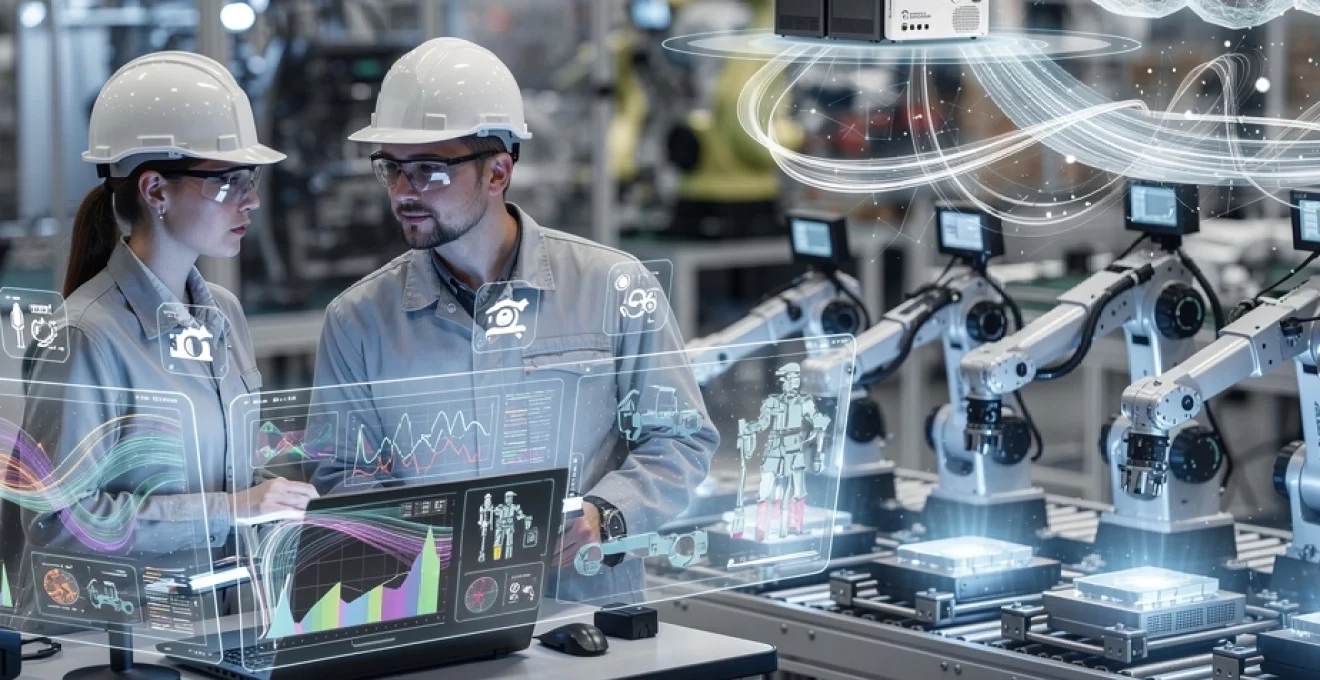
Modern manufacturing landscapes demand unprecedented flexibility and responsiveness to market fluctuations, supply chain disruptions, and evolving customer requirements. Adaptive automation systems have emerged as the cornerstone of this transformation, leveraging sophisticated technologies to monitor, analyse, and respond to production changes instantaneously. These intelligent systems combine sensor networks, machine learning algorithms, and advanced control mechanisms to create manufacturing environments that can pivot seamlessly between different production scenarios without compromising efficiency or quality.
The integration of real-time data acquisition, predictive analytics, and automated response mechanisms represents a fundamental shift from reactive to proactive manufacturing strategies. Companies implementing adaptive automation report productivity improvements of up to 30% whilst simultaneously reducing waste by 25% and enhancing product quality metrics. This technological evolution enables manufacturers to maintain competitive advantages in an increasingly volatile global marketplace where customer expectations continue to rise and production cycles become shorter.
Sensor integration and Real-Time data acquisition in adaptive manufacturing systems
The foundation of any effective adaptive automation system lies in its ability to gather comprehensive, real-time data from across the production environment. Sensor integration creates the nervous system of modern manufacturing facilities, providing continuous streams of information that enable intelligent decision-making processes. These sophisticated data acquisition networks monitor everything from environmental conditions and machine performance to product quality parameters and energy consumption patterns.
Contemporary sensor technologies have evolved beyond simple measurement devices to become intelligent nodes capable of edge processing and predictive analysis. Advanced sensor arrays can detect minute variations in production parameters that human operators might miss, triggering automated responses before issues escalate into costly problems. The seamless integration of multiple sensor types creates a holistic view of manufacturing operations, enabling system-wide optimisation that considers the complex interdependencies between different production elements.
Industrial IoT sensors for temperature, pressure and vibration monitoring
Industrial Internet of Things (IoT) sensors form the primary data collection layer in adaptive manufacturing systems, continuously monitoring critical parameters that influence production quality and equipment reliability. Temperature sensors equipped with wireless communication capabilities provide real-time thermal profiling across production lines, enabling automatic adjustments to heating and cooling systems based on ambient conditions and process requirements. These sensors typically achieve accuracy levels of ±0.1°C, ensuring precise control over temperature-sensitive processes such as polymer curing and metal heat treatment.
Pressure monitoring systems utilise high-precision transducers to track hydraulic and pneumatic system performance, detecting potential failures before they occur. Modern pressure sensors incorporate strain gauge technology with digital signal processing capabilities, providing measurement accuracies better than 0.25% of full scale. Vibration monitoring sensors employ accelerometers and gyroscopes to analyse machine health, identifying bearing wear, misalignment, and other mechanical issues through frequency domain analysis and pattern recognition algorithms.
Machine vision systems using cognex and keyence technologies
Machine vision systems represent a critical component of adaptive automation, providing real-time quality assessment and product tracking capabilities. Cognex In-Sight vision systems integrate advanced image processing algorithms with high-resolution cameras to perform dimensional measurements, surface inspection, and barcode reading with microsecond response times. These systems can process up to 1000 images per minute whilst maintaining measurement accuracies of ±0.001 inches, enabling precise quality control even at high production speeds.
Keyence CV-X series vision systems offer multi-camera coordination capabilities, allowing comprehensive 3D inspection and measurement across complex geometries. The integration of deep learning algorithms enables these systems to adapt to product variations automatically, reducing setup times and improving detection reliability. Advanced illumination techniques including structured light and laser profiling enhance defect detection capabilities, particularly for challenging surfaces such as reflective metals and translucent plastics.
SCADA integration with wonderware and FactoryTalk platforms
Supervisory Control and Data Acquisition (SCADA) systems serve as the central nervous system for adaptive manufacturing operations, integrating data from distributed sensors and control devices into unified monitoring and control interfaces. Wonderware System Platform provides scalable SCADA architecture supporting up to 100,000 I/O points per server, enabling comprehensive monitoring of large-scale manufacturing facilities. The platform’s InTouch HMI software offers intuitive operator interfaces with real-time trending, alarm management, and historical data analysis capabilities.
FactoryT
oryTalk View SE provides similar capabilities with tight integration to Rockwell Automation controllers, offering multi-client visualization, centralised alarm management, and secure remote access. In adaptive automation systems, these SCADA platforms aggregate data from PLCs, drives, and intelligent devices, normalising disparate protocols such as Modbus, EtherNet/IP, and Profinet into a single operational view. This unified layer enables operators to visualise real-time production changes, acknowledge alarms, and trigger workflows that feed higher-level manufacturing execution systems (MES). By combining SCADA with historian databases, manufacturers can analyse long-term trends and support continuous improvement programmes focused on reducing downtime and enhancing overall equipment effectiveness.
Edge computing implementation through siemens MindSphere and GE predix
Edge computing brings data processing closer to the production floor, reducing latency and bandwidth usage in adaptive manufacturing systems. Siemens MindSphere and GE Predix provide industrial IoT platforms that support edge analytics, allowing critical decisions to be executed within milliseconds of data capture. Instead of streaming every sensor reading to the cloud, edge gateways perform initial filtering, aggregation, and anomaly detection, forwarding only meaningful events and KPIs. This architecture is particularly valuable for real-time vibration monitoring, rapid defect detection, and high-speed packaging lines where even minor network delays can impact product quality.
MindSphere-enabled edge devices can host containerised applications that run machine learning models directly at the machine level, adjusting setpoints or triggering alarms when predefined thresholds are exceeded. GE Predix offers similar capabilities with its Edge Manager, enabling remote deployment and lifecycle management of analytics applications across fleets of assets. By combining edge computing with adaptive automation, manufacturers can maintain production continuity even when cloud connectivity is intermittent, while still benefiting from centralised analytics and fleet-level optimisation. In practice, this means your production systems can respond to real-time changes locally, yet continue to learn and improve globally as data is synchronised with cloud platforms.
Machine learning algorithms driving production optimisation decisions
Once sensor networks and edge computing infrastructures are in place, the true power of adaptive automation systems is unlocked through machine learning algorithms. These algorithms analyse vast quantities of production data to uncover patterns, predict outcomes, and recommend or implement optimal responses. Rather than relying solely on fixed rules and static thresholds, adaptive manufacturing environments learn from historical behaviour and continuously refine their decision-making logic. This data-driven approach enables production lines to adjust proactively to variability in materials, equipment conditions, and demand profiles.
From predictive maintenance to intelligent scheduling, machine learning models provide the analytical backbone for real-time production optimisation. They transform raw sensor streams into actionable insights that PLCs, SCADA systems, and MES platforms can use to coordinate automated responses. For manufacturers, the question is no longer whether to adopt AI in production, but how to architect models and workflows so that insights translate into tangible improvements in throughput, quality, and energy efficiency.
Predictive analytics using TensorFlow and PyTorch neural networks
TensorFlow and PyTorch have become the de facto standards for building predictive analytics models in industrial environments. Engineers use these frameworks to train neural networks that forecast equipment failures, quality deviations, and process bottlenecks based on historical data. For example, a convolutional neural network might analyse images from machine vision systems to predict weld defects, while a recurrent neural network processes time-series vibration signals to estimate remaining useful life of rotating equipment. These models can be deployed on-premises, at the edge, or in the cloud, depending on latency and security requirements.
In adaptive automation systems, predictive models are often integrated with MES and CMMS platforms to automatically schedule maintenance and adjust production plans. When a TensorFlow model forecasts an imminent bearing failure with high confidence, the system can slow the affected line, reroute orders to redundant equipment, and create a maintenance work order without human intervention. By anticipating issues hours or even days ahead, manufacturers can avoid unplanned downtime and maintain consistent product quality. As more data is collected, retraining these neural networks improves their accuracy, creating a virtuous cycle of continuous learning on the factory floor.
Reinforcement learning models for dynamic resource allocation
While predictive analytics focuses on forecasting future states, reinforcement learning (RL) excels at determining optimal actions in complex, dynamic environments. In adaptive manufacturing, RL agents can be trained to make real-time decisions about resource allocation, such as assigning jobs to machines, sequencing production orders, or adjusting conveyor speeds. The agent receives feedback in the form of rewards tied to KPIs like throughput, energy consumption, and on-time delivery, gradually discovering strategies that maximise long-term performance.
Imagine your production line as a chessboard where every move—starting a batch, changing a tool, or reconfiguring a robot—has downstream consequences. Reinforcement learning treats this as a sequential decision-making problem, exploring different strategies in simulation before being deployed on the real line. Once validated, RL policies can respond rapidly to real-time production changes, such as a machine going offline or an urgent order arriving mid-shift. By continuously adapting to changing conditions, RL-driven scheduling and routing reduce bottlenecks and help manufacturers meet tight delivery windows without excessive buffer stocks.
Anomaly detection algorithms through statistical process control
Anomaly detection is critical for ensuring that adaptive automation systems recognise when processes drift outside their normal operating envelopes. Statistical process control (SPC) techniques, including control charts and multivariate analysis, remain foundational tools for identifying unusual behaviour in production data. Modern implementations augment classical SPC with unsupervised learning methods such as clustering and autoencoders, enabling systems to detect subtle deviations that traditional thresholds might miss. These hybrid approaches are particularly useful in high-mix, low-volume environments where historical data for each product variant may be limited.
When anomaly detection algorithms identify out-of-control conditions, they can trigger adaptive responses ranging from automated setpoint adjustments to controlled line stoppages. For example, a sudden increase in torque required by a servo motor may signal tool wear, prompting a tool-change routine before defects appear. By combining SPC with adaptive automation, manufacturers shift from reactive firefighting to proactive quality management. You gain the ability to intervene at the earliest signs of trouble, protecting yield and maintaining customer confidence in your product consistency.
Digital twin integration with ANSYS twin builder and azure digital twins
Digital twins bring together physics-based simulation and real-time data to create virtual replicas of machines, lines, or entire factories. ANSYS Twin Builder enables engineers to develop high-fidelity models of equipment that capture thermal, mechanical, and electrical behaviours under varying load conditions. When connected to live sensor data, these models can simulate how the system will respond to different operating scenarios, providing a safe environment for testing control strategies and process changes. This is especially valuable when evaluating responses to rare but critical events, such as extreme demand spikes or simultaneous equipment failures.
Azure Digital Twins extends this concept to whole facilities, allowing manufacturers to model complex relationships between assets, processes, and people. By integrating digital twins with adaptive automation systems, you can run “what-if” analyses in real time, comparing potential responses and selecting the most effective option before acting on the shopfloor. For instance, if a key machine is predicted to fail within 24 hours, the digital twin can evaluate multiple rescheduling and rerouting strategies, estimating impacts on delivery dates and energy use. The chosen plan is then executed automatically through MES and PLCs, ensuring coordinated, data-driven adaptation across the entire production ecosystem.
Control system response mechanisms and feedback loop architecture
Adaptive automation systems rely on robust control architectures that can translate analytical insights into precise, coordinated actions. At the heart of these architectures lie closed-loop feedback mechanisms, where sensors provide continuous measurements, controllers compute corrective actions, and actuators apply those adjustments to the physical process. This real-time feedback loop operates at multiple layers—from millisecond-level PID control in PLCs to higher-level supervisory control implemented in SCADA and MES platforms. The objective is to ensure that production processes remain stable, efficient, and aligned with business objectives, even as conditions change.
In practice, adaptive control architectures often follow a hierarchical structure. Field-level devices handle fast, deterministic control tasks, while line and plant-level systems focus on optimisation, scheduling, and coordination. Model predictive control (MPC) may be used for complex, multivariable processes where interactions between variables make traditional PID control insufficient. As machine learning models and digital twins become more tightly integrated, we see a convergence of classical control theory and AI, resulting in control loops that can not only maintain stability but also learn and improve over time. For manufacturers, this means your automation systems become more like an experienced operator—constantly watching, learning, and fine-tuning performance.
Industry 4.0 applications across manufacturing sectors
The principles of adaptive automation and real-time production response are being applied across a broad spectrum of manufacturing sectors. In automotive plants, flexible body-in-white lines equipped with collaborative robots can switch between multiple vehicle models with minimal changeover time, responding quickly to shifts in consumer demand. Electronics manufacturers use adaptive pick-and-place systems and reconfigurable test stations to cope with short product life cycles and frequent design updates. Pharmaceutical facilities deploy continuous manufacturing lines that automatically adjust mixing speeds, feed rates, and environmental conditions to maintain stringent quality standards across multiple product formulations.
Even traditionally conservative sectors such as food and beverage are embracing Industry 4.0 applications to handle seasonal demand spikes, recipe variations, and packaging changes. Adaptive filling and labelling lines can reconfigure themselves based on real-time order data, reducing waste and enabling smaller batch sizes. In metals and process industries, advanced process control and digital twins optimise energy use in furnaces and reactors while maintaining throughput and emissions targets. Regardless of the sector, the common thread is clear: manufacturers that harness adaptive automation systems are better equipped to handle volatility, customise products, and operate sustainably in an increasingly demanding marketplace.
Performance metrics and KPI monitoring for adaptive automation excellence
To realise the full value of adaptive automation, manufacturers must define and monitor performance metrics that reflect both operational efficiency and responsiveness. Traditional KPIs such as Overall Equipment Effectiveness (OEE), yield, and scrap rate remain essential, but they are complemented by new indicators that capture adaptability. Metrics like changeover time, schedule adherence under disruption, and time-to-recover from unplanned events provide insight into how well your systems respond to real-time production changes. Energy intensity per unit produced and carbon footprint per order help align adaptive manufacturing strategies with sustainability goals.
Modern manufacturing analytics platforms consolidate these KPIs into role-based dashboards, giving operators, engineers, and executives a shared view of performance. Real-time alerts highlight deviations from targets, while historical analyses reveal trends and improvement opportunities. By linking KPI monitoring directly to control strategies and machine learning models, you create a closed-loop performance management system where insights drive automated adjustments and continuous improvement. Ultimately, adaptive automation excellence is not defined solely by how advanced your technology stack is, but by how effectively you measure, learn, and act on the data it generates. When you align metrics, algorithms, and control systems, your factory becomes a living system—constantly sensing, thinking, and adapting to stay ahead of change.