Manufacturing facilities worldwide face a disturbing reality: EPA zones that pass certification audits still experience costly ESD failures. Components tested as compliant one day fail catastrophically the next. Production lines with documented procedures suddenly report damage rates that halt operations entirely.
This certification paradox reveals a fundamental truth about electrostatic discharge protection. The gap between documented compliance and actual safety creates systematic vulnerabilities that standard audits cannot detect. Understanding ESD protected areas requires looking beyond surface-level compliance to examine the hidden failure mechanisms that persist even in certified environments.
The architecture of EPA zone failures follows a predictable pattern. Systemic compliance gaps create the foundation, physical boundary vulnerabilities provide the entry points, equipment degradation opens temporal windows of exposure, human factors systematically override technical controls, and verification blind spots ensure these failures remain undetected. Each layer compounds the risk, transforming minor weaknesses into critical threats.
EPA zone safety failures in key points
- Certified EPA zones can maintain documentation while operating with active ESD vulnerabilities that audits fail to detect
- Transition zones between protected and unprotected areas create the highest-risk exposure points for component damage
- ESD equipment degrades continuously between testing cycles, creating unmonitored windows of inadequate protection
- Operational pressure systematically drives protocol shortcuts that technical controls cannot prevent
- Standard verification methods have structural blind spots that miss intermittent failures and system-level interactions
The Certification Paradox: Why Compliant Zones Still Experience Failures
Audit certificates displayed on facility walls often mask a troubling reality. The very documentation that demonstrates compliance can create dangerous complacency. When facilities focus on passing periodic reviews rather than maintaining continuous protection, they optimize for audit performance instead of actual ESD prevention.
Audit preparation activities frequently produce temporary improvements that evaporate immediately after certification. Equipment receives attention only before scheduled reviews. Procedures get reinforced during audit windows. Personnel demonstrate perfect compliance when evaluators observe them. These cyclical improvements create a rhythm of compliance theater rather than sustained protection.
General Dynamics Mission Systems: From Compliance to Zero Violations
The manufacturing crisis at General Dynamics exposed how documentation can coexist with systematic failures. When ESD manufacturing failure rates have been known to approach 100% for Class 0 devices, it caused virtual production shutdowns despite existing compliance procedures. The root cause wasn’t absence of documentation but the fundamental disconnect between ESD inclusion in the NPI process and actual manufacturing practices.
The documentation-reality gap manifests in subtle but critical ways. Equipment logs show functional status while devices operate outside optimal parameters. Calibration certificates remain current even as performance drifts toward specification limits. Training records document completed courses while workers demonstrate incomplete understanding during actual operations.
Snapshot compliance testing creates a fundamental limitation in protection verification. A facility operates across multiple shifts with varying personnel, different production volumes, and changing environmental conditions. Yet audits capture a single moment in time, typically during optimal conditions when experienced personnel follow heightened protocols.
| Documented Status | Actual Field Condition | Risk Level |
|---|---|---|
| Equipment Certified | Operating outside optimal parameters | High |
| Training Completed | Lack of personnel training | Critical |
| Procedures Documented | Insufficient compliance verification procedures | High |
This disparity between audit performance and daily operations creates vulnerability windows that certified zones fail to recognize. The assumption that certification equals protection becomes the most dangerous mistake facilities make.
The visual contrast between pristine documentation and degraded operational reality captures the essence of the certification paradox. Facilities must recognize that compliance certificates represent minimum thresholds achieved during optimal conditions, not sustained protection maintained across all operational scenarios.
Perhaps most critically, certified zones often receive less vigilance than uncertified areas. The false confidence created by passing audits reduces management attention, decreases resource allocation for ongoing monitoring, and signals to personnel that existing practices adequately address ESD risks. This paradoxical reduction in vigilance following certification creates the conditions for the most preventable failures.
Transition Zone Vulnerabilities: Where EPA Boundaries Become Blind Spots
The physical boundaries of EPA zones represent the most critical vulnerability points in ESD protection systems. These transition interfaces where materials, components, and personnel move between protected and unprotected areas receive minimal attention during standard audits. Yet these boundary zones account for a disproportionate share of actual ESD damage events.
Protection degradation accelerates when components move from EPA to non-EPA areas during testing, rework, or inspection activities. The transition moment itself creates exposure risk. Workers carrying sensitive devices across boundaries may maintain proper grounding within the EPA zone but lose protection the instant they cross into uncontrolled areas. The component remains vulnerable until it receives appropriate shielding for the non-EPA environment.
It informs employees when the shielding of ESD Sensitive Devices is required. If the ESD Sensitive Devices is outside the EPA it pretty much guarantees it is no longer grounded
– Desco Europe Technical Team, Desco Europe Blog on EPA Control
Shipping and receiving docks function as contamination vectors that introduce non-compliant packaging materials directly into EPA zones. Incoming components arrive in packaging that meets supplier standards but may not align with facility requirements. The transition from receiving to storage to production creates multiple handoff points where protection protocols can break down.
The invisible nature of electrostatic fields makes boundary zone risks particularly insidious. Personnel cannot see or feel the protection degradation occurring as they cross thresholds. This invisibility requires deliberate boundary marking, clear signage, and systematic entry/exit protocols that many facilities implement inconsistently.
Personnel transition errors occur during the critical moments when workers enter or exit EPA zones. The proper grounding sequence requires specific steps in correct order: approaching the boundary, testing wrist strap continuity, verifying footwear conductivity, and only then entering with sensitive components. Rushed entries during production pressure skip these verification steps. Exits pose equal risk when workers carry components out without transferring them to appropriate shielding.
Critical control points for EPA boundaries
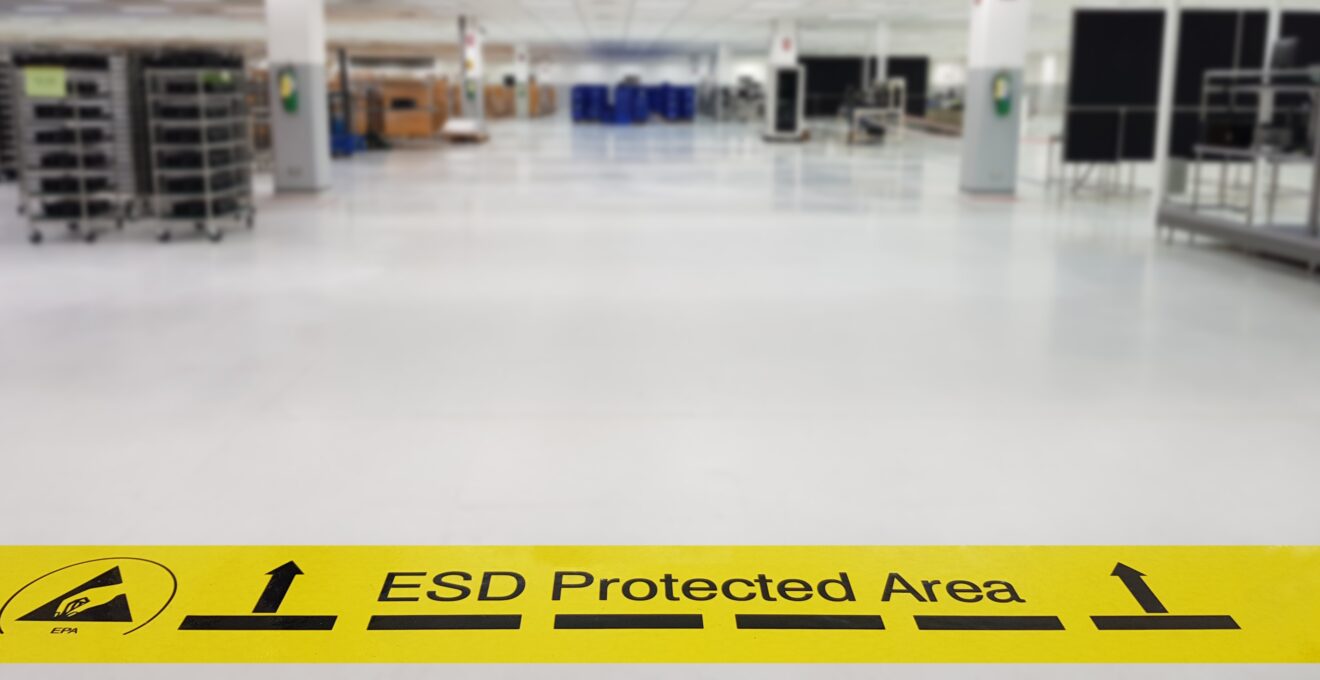
- Use floor marking tape and signs to deliver clear messages alerting operators and visitors when entering an EPA which requires special precautions
- Indicate areas where exposed ESDS items can be handled safely through consistent visual cues
- Maintain non-antistatic floor marking materials outside the EPA to prevent confusion about protection zones
- Apply consistent signage throughout the workplace to avoid operator confusion about boundary locations
Material staging areas exist in regulatory grey zones that create systematic ambiguity. These spaces technically fall outside EPA boundaries but regularly handle sensitive components during work-in-progress storage, quality inspection holds, or rework queuing. The ambiguous status of these areas means they receive neither full EPA controls nor clear exclusion from protection requirements. Components accumulate exposure time in these undefined spaces without deliberate risk management.
Progressive Equipment Degradation: Failures That Testing Cycles Miss
ESD protection equipment fails gradually through mechanisms that discrete testing intervals cannot capture. A wrist strap that tests within specification during monthly verification may experience intermittent connection failures during actual use. An ionizer that passes calibration checks may lose effectiveness between scheduled evaluations. This temporal vulnerability between test points creates unmonitored exposure windows.
Wrist strap resistance drift represents one of the most common progressive failures. The connection point between skin and conductive element experiences microscopic degradation from repeated flexing, perspiration exposure, and contact surface oxidation. These changes occur gradually, allowing straps to pass resistance testing while providing inadequate protection during the intervals between tests.
Establishing comprehensive equipment required for EPA zones must account for this degradation reality. Specifications that define acceptable performance ranges create comfort zones where equipment operates at degraded but technically compliant levels. Multiple devices simultaneously functioning near specification limits produce cumulative protection deficiencies that individual component testing cannot detect.
Surface analysis reveals the microscopic reality of equipment aging that standard testing overlooks. Wear patterns, contamination deposits, and material fatigue accumulate continuously while verification occurs periodically. The disconnect between continuous degradation and discrete testing creates systematic blind spots in protection monitoring.
Ionizer performance decay between calibrations illustrates the temporal vulnerability inherent in periodic verification. These devices lose effectiveness through emitter point erosion, contamination buildup on discharge elements, and high-voltage power supply drift. The ionizer continues producing ions throughout this degradation process, creating the appearance of functionality while actual neutralization capability diminishes.
Flooring conductivity changes from wear patterns, cleaning products, and contamination occur between resistance measurements. High-traffic pathways develop insulating contamination layers. Improper cleaning solutions leave residues that increase surface resistance. Seasonal humidity variations affect conductivity in ways that annual testing cannot capture. The floor remains the same physical material while its electrical properties shift substantially.
The cascading effect when multiple pieces of equipment simultaneously operate at degraded but still passing levels creates system-level vulnerabilities that component-wise testing misses entirely. A wrist strap at the high end of acceptable resistance combined with flooring at the low end of acceptable conductivity and an ionizer operating at reduced efficiency may individually meet specifications while collectively providing inadequate protection. Standard verification approaches test each component in isolation, missing these dangerous interactions.
Cultural Compliance Erosion: When Operational Pressure Overrides Protocols
The human and organizational dimensions of EPA zone failures often overshadow technical factors in determining actual protection levels. Production pressure, efficiency metrics, and workplace culture create systematic protocol violations that engineering controls alone cannot prevent. Understanding this people problem reveals why technically sound EPA zones fail in operational practice.
The productivity-safety tradeoff manifests most acutely during production rushes. When facilities face delivery deadlines, customer escalations, or backlog recovery targets, throughput pressure incentivizes ESD protocol shortcuts. Workers skip wrist strap testing to save seconds per cycle. Supervisors permit extended work in non-EPA areas to avoid production flow interruptions. Management prioritizes shipping schedules over protection verification.
These shortcuts rarely produce immediate visible failures, creating a dangerous feedback loop. When protocol violations succeed in meeting production targets without obvious ESD damage, the behavior receives positive reinforcement. The invisible nature of electrostatic discharge means that component damage may not manifest until field deployment weeks or months later, breaking the causal connection between protocol shortcuts and actual consequences.
Training retention failure explains why workers revert to non-compliant behaviors weeks after certification courses. Initial training produces temporary behavior changes that decay rapidly without continuous reinforcement. Personnel demonstrate perfect technique during training assessment, then gradually adopt time-saving shortcuts during actual production. The gap between trained knowledge and habitual practice widens as time from certification increases.
The normalization of deviance describes how small violations become standard practice through repeated successful outcomes. A worker who occasionally skips the wrist strap continuity test without experiencing problems begins skipping it regularly. Others observe this behavior without consequences and adopt it themselves. Supervisors notice but don’t correct it because production continues without apparent issues. What began as individual deviation becomes team-wide accepted practice.
Implementing effective strategies for defect detection requires addressing these cultural factors alongside technical controls. Detection systems that rely solely on equipment monitoring miss the human behavior patterns that create most real-world failures.
Management blind spots occur when supervisors lack ESD expertise and inadvertently reward unsafe efficiency gains. A supervisor without technical background sees workers who complete tasks faster and produce more units per shift. Without understanding the protection protocols being skipped to achieve these gains, the supervisor praises and promotes efficient workers. This creates organizational incentives that systematically undermine safety protocols.
The cultural dimension also includes resistance to reporting near-miss events and minor failures. When organizational culture emphasizes blame over learning, personnel conceal mistakes that could provide early warning of systematic protection failures. Workers who experience wrist strap failures or notice equipment degradation avoid reporting these issues if they fear negative consequences. This reporting gap prevents facilities from detecting emerging problems before they cause critical failures.
Key Takeaways
- Certification creates false confidence when facilities optimize for audit performance rather than continuous protection maintenance
- Boundary transition zones require deliberate control protocols for material movement, personnel entry sequences, and staging area management
- Equipment degradation occurs continuously between discrete testing intervals, creating unmonitored vulnerability windows
- Production pressure systematically incentivizes protocol shortcuts that normalized deviance transforms into standard practice
- Verification systems using point-in-time testing cannot detect intermittent failures or system-level interaction vulnerabilities
Verification System Gaps: Critical Mistakes Your Testing Won’t Catch
Standard ESD testing protocols contain structural limitations that systematically prevent detection of critical failure categories. Understanding these verification blind spots reveals why facilities that perform all required testing still experience unexpected ESD damage. The problem lies not in testing frequency but in fundamental methodological constraints.
Point-in-time testing cannot detect intermittent failures that occur only under specific operational conditions. A wrist strap that provides perfect continuity during stationary testing may experience connection breaks during the arm movements required for actual assembly work. An ionizer that demonstrates proper ion balance in still air may fail to neutralize charges effectively in the turbulent airflow created by production equipment operation.
The testing-to-the-test problem describes how EPA zones become optimized for audit compliance rather than actual ESD prevention. Facilities learn which specific items auditors check and which testing methods evaluators use. Resources focus on ensuring those specific elements pass those specific tests. Meanwhile, aspects of protection that audits don’t verify receive minimal attention regardless of their operational importance.
This optimization for audit success creates EPA zones that perform excellently during formal evaluation but poorly during normal operation. The distinction between what gets tested and what matters for actual protection grows wider as facilities gain experience with audit patterns. Personnel learn to prepare specifically for known evaluation criteria rather than maintaining comprehensive protection across all dimensions.
Blind spots in standard test equipment represent another fundamental limitation. Current meters and monitors cannot measure triboelectric charging from process activities. The act of moving a component through assembly generates static charges that standard EPA monitoring equipment doesn’t detect. Field effects from nearby equipment create charge imbalances that resistance measurements miss entirely.
Electronic field meters measure static electricity in specific locations at specific moments. They cannot capture the dynamic charge generation that occurs during material handling, equipment operation, and personnel movement. This measurement gap means facilities can achieve perfect readings on all installed monitoring equipment while workers simultaneously generate damaging static charges through their normal activities.
The absence of system-level testing creates perhaps the most critical verification gap. Standard protocols test individual components: wrist strap resistance, ionizer balance, flooring conductivity, packaging shielding effectiveness. Each component may meet specifications in isolation while their interactions create unexpected vulnerabilities.
A grounded workstation may introduce ground loops when connected to grounded flooring and grounded equipment racks simultaneously. Ionizers positioned to neutralize charges on one assembly area may create charge imbalances in adjacent workspaces. Conductive containers placed on dissipative surfaces may charge components through triboelectric contact despite both materials individually meeting ESD requirements.
These system-level interactions escape detection because verification protocols test components individually rather than evaluating the complete protection system under operational conditions. Facilities can demonstrate perfect compliance on every individual test while the integrated system creates multiple failure pathways that standard verification never examines.
Frequently Asked Questions About EPA Safety
What causes EPA zones to fail despite passing compliance audits?
The gap between audit conditions and daily operations creates vulnerabilities that periodic testing cannot detect. Audits capture optimal moments with heightened awareness and prepared equipment, while actual protection depends on consistent performance across all shifts, production volumes, and operating conditions. Equipment that passes point-in-time testing may degrade between verification cycles, and personnel who demonstrate proper technique during evaluation may adopt shortcuts during normal work.
How do transition zones between EPA and non-EPA areas create ESD risks?
Boundary zones represent the highest-risk exposure points because components cross between protected and unprotected environments during these transitions. Personnel may lose grounding when moving from EPA to non-EPA areas while still handling sensitive devices. Incoming materials arrive in packaging that may not meet facility standards. Staging areas exist in regulatory grey zones that receive neither full EPA controls nor clear exclusion from protection requirements.
Why does ESD protection equipment fail between testing cycles?
Equipment degrades continuously through wear, contamination, and environmental exposure while testing occurs at discrete intervals. Wrist straps develop intermittent connection failures from repeated flexing. Ionizers lose effectiveness through emitter erosion and contamination buildup. Flooring conductivity changes from traffic patterns and cleaning products. These gradual changes allow equipment to pass periodic verification while providing inadequate protection during the gaps between tests.
What organizational factors undermine technical ESD controls?
Production pressure creates systematic incentives for protocol shortcuts when efficiency metrics conflict with safety procedures. Workers skip time-consuming verification steps during rush periods. Supervisors without ESD expertise reward fast workers without recognizing the shortcuts being taken. The normalization of deviance occurs when small violations succeed without immediate consequences, transforming individual shortcuts into team-wide standard practice.